This site is supported by our readers. We may earn a commission, at no cost to you, if you purchase through links.

A ball python refused food for three weeks, grew lethargic, and developed a respiratory infection—all because its owner relied on a stick-on thermometer that read 10°F too high. Temperature isn’t just about comfort for snakes; it’s the foundation of their metabolism, immune function, and survival.
Without precise thermal zones, even well-fed snakes can’t digest their meals properly, leaving them malnourished despite regular feeding. You’ll need more than guesswork or a single gauge to verify your snake’s habitat maintains the 75-90°F ambient range with proper basking spots at 85-92°F.
The right equipment, strategic sensor placement, and consistent monitoring create the thermal gradient your snake depends on for thermoregulation.
Table Of Contents
Key Takeaways
- Temperature precision determines whether your snake can digest food properly and maintain immune function, with even a 10°F measurement error causing lethargy, feeding refusal, and respiratory infections.
- You need to create a thermal gradient spanning 75-90°F ambient with basking spots at 85-92°F, using digital thermometers with probes placed at snake eye level in multiple zones rather than relying on single-point measurements or stick-on gauges.
- Species-specific requirements vary significantly—ball pythons need 88-92°F basking spots while corn snakes thrive at 85-90°F—and nighttime temperatures should drop 5-10°F to mirror natural thermal cycling without metabolic stress.
- Behavioral indicators reveal temperature problems before equipment does: prolonged basking signals inadequate heat, constant hiding suggests temperature fluctuations, and open-mouth breathing or feeding refusal indicate heat stress or cold shock respectively.
Why Proper Temperature Matters for Snakes
Your snake’s entire health hinges on temperature—it’s not just about comfort, it’s about survival. Without the right warmth, digestion shuts down, immunity weakens, and your snake can’t function properly.
Temperature isn’t just comfort for your snake—it’s the difference between thriving digestion and immune collapse
Let’s look at exactly why temperature control matters so much for your pet’s well-being.
Effects of Temperature on Digestion and Immunity
Temperature regulation sits at the heart of your snake’s survival—thermoregulation directly shapes both digestive health and immune response. Snake habitat temperature controls enzymatic activity in the gut, determines metabolic rate, and influences leukocyte proliferation for pathogen defense.
Within a proper thermal gradient, your snake achieves:
- Faster prey breakdown through optimized enzyme function
- Enhanced nutrient absorption via efficient gut passage
- Stronger antimicrobial peptide production in tissues
- Reduced temperature stress on immune cell activity
Maintaining the right temperature is vital, and using scientific study methods can help ascertain the ideal environment for your snake.
Risks of Inadequate Heating
Heat deficiency in your snake habitat creates compounding problems: incomplete digestion impedes nutrient absorption, leading to chronic weight loss; immune dysfunction raises susceptibility to bacterial and viral infections. Choosing the right heating options for your snake enclosure prevents these health issues by maintaining consistent temperature zones throughout the day and night.
Cold shock disrupts behavioral patterns, reducing appetite and shedding quality.
Thermal stress triggers persistent physiological responses that compromise growth and reproduction—your snake’s thermoregulation depends entirely on the temperature control and heat management you provide.
Importance of Thermal Gradients
Your snake won’t simply tolerate a uniform temperature—it needs a thermal gradient that mimics nature’s temperature control. This heat distribution creates distinct zones: a warm basking area (usually 85–92°F/29–33°C) and a cooler retreat (75–80°F/24–27°C). Understanding how terrarium size and design impact temperature zones helps you create a setup where your snake can thermoregulate naturally throughout the day.
Gradient design facilitates behavioral thermoregulation, allowing your snake to shift between microclimates for digestion, immunity, and activity—supporting the physiological flexibility that uniform heating can’t provide. Pairing that gradient with proper heating and lighting setup ensures your snake can thermoregulate effectively while you monitor conditions with calibrated, accurate tools.
Recommended Temperature Ranges for Pet Snakes

Getting the temperature right isn’t a guessing game—your snake’s species dictates precise ranges that make the difference between thriving and merely surviving. Most pet snakes need daytime ambient temperatures between 75–90°F (24–32°C), but the specifics vary considerably depending on whether you’re keeping a tropical python or a temperate colubrid. A reliable digital thermometer designed for reptile enclosures eliminates guesswork by giving you accurate readings at both ends of your snake’s habitat.
Let’s break down the general principles, then look at what individual species actually require.
General Guidelines for Snake Habitats
You’ll need to maintain a thermal gradient across your enclosure, creating distinct warm and cool zones rather than uniform heat. Target ambient enclosure temperatures between 75–85°F (24–29°C), with basking spots reaching higher.
Install a reliable thermostat to prevent dangerous overshooting, and place calibrated thermometers at multiple locations—basking area, mid-range, and cool retreat—to verify consistent temperature control and proper thermoregulation opportunities.
Species-Specific Temperature Needs
Precision matters here—species variation drives every habitat design decision you make. Each snake’s physiology dictates unique thermoregulation needs; research temperature targets before you set up any enclosure.
- Corn snakes thrive with basking spots at 85–90°F and cool zones at 75–82°F
- Ball pythons require warmer basking areas (88–92°F) and slightly warmer cool retreats (78–80°F)
- Milk snakes prefer basking temps of 85–90°F with cooler zones at 70–75°F
- Boa constrictors need a thermal gradient spanning 75–90°F
These species-specific needs directly influence snake behavior and long-term health outcomes.
Nighttime Temperature Drops
To mirror natural thermal cycling, you need to drop nighttime temperatures by 5–10°F from daytime peaks—most species tolerate 65–75°F at night without metabolic stress.
Maintain gradient integrity by positioning thermostats to sustain a cooler zone even as nighttime fluctuations occur.
Continuous temperature monitoring over 7–14 nights confirms your cooling systems deliver gradual, stable drops rather than abrupt shifts that compromise temperature regulation.
Tools to Accurately Measure Habitat Warmth
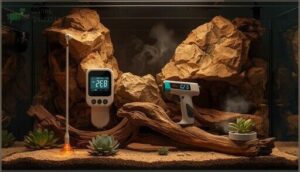
You can’t manage what you can’t measure—and regarding snake habitats, guesswork isn’t good enough. Accurate temperature monitoring requires the right tools placed in the right spots, from digital thermometers that give you precise readings to thermostats that maintain consistent heat without constant adjustments.
Here’s what you need to keep your snake’s environment dialed in.
Digital Thermometers and Probes
You can’t gauge your snake’s thermoregulation needs by touch alone—digital thermometers with accurate probes deliver fast readings in 1–2 seconds, ensuring proper temperature monitoring. Digital probes come in contact and non-contact variants; contact sensors provide higher thermometer accuracy when placed directly on surfaces.
Most devices support dual-channel inputs for simultaneous heat monitoring of warm and cool zones, critical for maintaining species-specific thermal gradients. Calibrate annually for ±0.5°C accuracy.
Thermostats and Temperature Controllers
Thermostats regulate your heat sources by cycling them on and off, maintaining consistent temperature control across basking and ambient zones. Digital thermostats with external probes eliminate the temperature swings that stress your snake’s thermoregulation.
Consider these essentials for ideal thermostat maintenance:
- Choose proportional controllers for gradual adjustments
- Verify sensor accuracy through annual temperature calibration
- Position digital probes at substrate level in each zone
- Set controller settings 2–3°F above target temperatures
- Test heat source options against actual readings weekly
Placement of Temperature Sensors
Your temperature sensors must sit at snake eye level—not on cage tops or buried in substrate—to capture the actual thermal gradient your animal experiences.
Install primary temperature probes at the basking zone and secondary units in the cool end, positioning them away from direct heat source placement to avoid false readings.
Sensor calibration against a validated thermometer every month ensures your gradient monitoring and temperature control systems maintain accuracy within ±0.5°C for reliable thermal mapping.
Step-by-Step: Checking if Your Snake’s Habitat is Warm Enough
You’ve got your thermometers and probes positioned—now it’s time to actually check if your snake’s enclosure is hitting the right numbers.
This process isn’t complicated, but it does require you to take measurements in specific zones and interpret what those readings mean for your snake’s health.
Follow these steps to verify your habitat temperatures are where they need to be.
Measuring Warm and Cool Zones
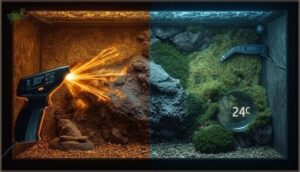
You need accurate zone temperatures to verify your thermal gradient works properly. Place temperature probes at substrate level in both the warm zone—usually 29-32°C (84-90°F)—and the cool zone, which should read 21-26°C (70-78°F).
This contrast facilitates natural thermoregulation. Check multiple locations across each zone; consistent readings confirm gradient stability and proper heat mapping throughout the enclosure.
Monitoring Basking Spot Temperatures
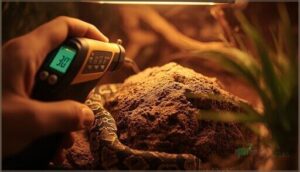
Your snake’s basking spot demands precision. Place a probe or infrared thermometer directly on the basking surface—not nearby—to capture the actual contact temperature.
You’re targeting 28–32°C (82–90°F) for most tropical species, staying within ±2°C of your target. Measure at multiple angles across the spot to confirm consistency, ensuring your snake accesses reliable warmth for ideal thermoregulation whenever it basks.
Verifying Consistency Across The Enclosure

Beyond single-point checks, you need thermal mapping across your entire enclosure to verify gradient consistency. Position sensors at multiple vertical heights—cooler zones at floor level, warmer areas near basking spots—then compare readings over 24-hour cycles to catch temperature fluctuations.
Infrared imaging reveals hidden hotspots your thermostat might miss, confirming your temperature control system maintains stable temperature regulation throughout every zone.
Interpreting Temperature Readings

Once you’ve collected readings from thermometers across the enclosure, compare them against your species’ normative ranges—not just single-point averages. Stable measurements over several hours confirm reliable heat mapping rather than transient spikes.
Watch how your snake responds: prolonged basking signals inadequate gradient control, while constant hiding may indicate temperature fluctuations disrupting thermoregulation. Correlate sensor data with behavior for accurate thermal monitoring and effective temperature regulation through your thermostat system.
Troubleshooting and Adjusting Habitat Temperatures
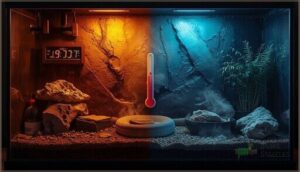
Even with quality equipment, you’ll encounter temperature fluctuations that require immediate attention—heating elements fail, seasonal changes affect room temperature, and thermostats drift out of calibration. Recognizing these problems early prevents digestive issues, respiratory infections, and behavioral stress in your snake.
Here’s how to identify common heating failures, adjust your setup for ideal thermal gradients, and spot the warning signs that your snake is too hot or too cold.
Common Heating Problems and Fixes
Even the best setups falter when equipment ages or placement goes wrong. You’ll encounter four critical failures in thermal regulation:
- Heating element or heat mat loses power—verify wattage matches enclosure size and check connections
- Thermostat calibration drifts—recalibrate monthly using independent probes for temperature control accuracy
- Heat source positioning creates cold zones—relocate to establish proper temperature gradient across the habitat
- Poor insulation materials allow heat escape—add foam board or reflective barriers to minimize temperature fluctuation
Adjusting Heat Sources and Placement
To create a precise thermal gradient, position your heat lamp or heat mat at one end only—this establishes the basking spot without overheating adjacent areas. Temperature probes placed beneath the basking surface and at multiple heights verify your gradient’s accuracy. Heat source calibration becomes essential after changing substrate or furnishings; recalibrate immediately to maintain stable conditions.
| Heat Source Type | Best Placement | Gradient Effect |
|---|---|---|
| Basking lamp | One end, elevated 8-12 inches | Creates defined warm zone 85-95°F |
| Heat mat | Under tank, 1/3 to 1/2 coverage | Gentle belly heat, 80-88°F surface |
| Ceramic emitter | Overhead, one side only | Ambient warmth without light |
| Radiant heat panel | Mounted ceiling, warm end | Even distribution, 82-90°F |
| Heat cable | Buried in substrate | Subsurface thermal ladder |
Use platforms or elevated surfaces to create a thermal ladder—your snake moves vertically between temperature zones for precise thermoregulation. After adjustments, monitor with your thermostat for 48 hours to confirm stability across the enclosure.
Monitoring for Signs of Heat Stress or Cold
Vigilant observation reveals temperature problems before they escalate. Watch your snake’s behavior daily—heat stress manifests through open-mouth breathing, avoidance of basking spots, and sudden lethargy. Cold shock prevention requires checking for reduced activity, prolonged hiding, and feeding refusal.
Your thermal monitoring should include:
- Sunken eyes or wrinkled skin indicating dehydration from excessive heat (above 95°F)
- Incomplete sheds signaling inadequate thermoregulation across your gradient
- Respiratory distress like wheezing, often triggered by temperatures below species-specific minimums
Regular snake health checks catch thermal imbalances early.
Frequently Asked Questions (FAQs)
How often should I replace heating equipment?
Inspect your heating pads, heating mats, and quality thermostats annually for thermal efficiency.
Most heating maintenance schedules recommend replacing equipment every 3–5 years, though thermostat failures or reduced temperature output may warrant earlier replacement.
Can I use multiple heat sources together?
You can combine heat lamp and heating pads or ceramic emitters, but install independent thermostat controls for each.
Multi heater systems prevent hot spots when supplemental heating doesn’t overlap—verify heat distribution patterns maintain proper temperature gradient.
Do snakes need different temperatures when breeding?
Yes, many species benefit from elevated temperatures during breeding season to stimulate mating behaviors and enhance reproductive cycles. However, species-specific needs vary—some snakes don’t require thermal changes, so research your particular species before adjusting habitat temperature.
What humidity levels pair with each temperature range?
Temperature ranges and humidity levels work together: 40–60% relative humidity suits most species at moderate temperatures, while desert species thrive at 20–40% paired with heat gradients to maintain localized microclimates without elevating overall moisture.
How does room temperature affect enclosure heating?
Like a leaky bucket fighting a current, your enclosure battles room climate constantly. Cooler ambient air increases heating demand and destabilizes temperature gradients, forcing thermostats to cycle more frequently—compromising thermal dynamics despite quality heating pads and insulation.
Conclusion
Your snake won’t tap out a telegraph message when its habitat drops below safe levels—it’ll simply stop eating, become lethargic, or develop infections. Learning how to check if snake habitat is warm enough transforms you from reactive owner to proactive guardian.
Digital thermometers at multiple zones, consistent monitoring, and species-specific adjustments guarantee your snake maintains the metabolic efficiency it needs. Temperature precision isn’t perfectionism; it’s the difference between survival and decline.
- https://academichelpexpress.blog/2024/08/please-use-the-bulleted-points-and-the-rubric-below-to-guide-your-work-your-pa/
- https://x.com/godofprompt/status/1990526288063324577
- https://www.sciencedirect.com/science/article/pii/S0749208123000268
- https://pmc.ncbi.nlm.nih.gov/articles/instance/9553038/bin/pone.0275964.s005.docx
- https://arxiv.org/html/2507.17948v2