This site is supported by our readers. We may earn a commission, at no cost to you, if you purchase through links.

Your ball python hasn’t eaten in three weeks, and you’ve noticed she spends most of her time pressed against the glass near the room’s heat vent. Meanwhile, your corn snake has developed a persistent wheeze, and his latest shed came off in fragments instead of one clean piece. These aren’t coincidences—they’re your snakes telling you their enclosure is too cold.
Temperature problems rank among the most common yet overlooked issues in reptile care, and the consequences extend far beyond a sluggish snake. When temperatures drop below species-specific requirements, your snake’s entire physiology struggles to function properly, from digestion to disease resistance.
Recognizing the signs your snake enclosure is too cold can mean the difference between a thriving pet and a veterinary emergency.
Table Of Contents
- Key Takeaways
- Why Proper Enclosure Temperature Matters
- Common Signs Your Snake is Too Cold
- Behavioral Changes Indicating Cold Stress
- Physical Symptoms of Cold Exposure
- Health Risks of a Cold Enclosure
- Checking and Monitoring Enclosure Temperature
- Preventing and Addressing Cold Enclosures
- Frequently Asked Questions (FAQs)
- Conclusion
Key Takeaways
- Your snake depends entirely on external heat to power digestion, immune function, and organ health—when temperatures drop below species-specific requirements, everything from nutrient absorption to disease resistance breaks down.
- Cold stress shows up through specific behaviors like tight coiling, heat-seeking, lethargy, and appetite loss, often before you notice physical symptoms like difficult sheds, regurgitation, or respiratory infections.
- Prolonged cold exposure creates cascading health risks including respiratory infections from weakened immunity, digestive failure from slowed enzyme activity, and potentially fatal hypothermia leading to organ damage.
- Preventing temperature problems requires accurate thermometers at multiple enclosure points, proper heating equipment with thermostat control, and a thermal gradient allowing your snake to self-regulate between warm basking zones (84–90°F) and cooler retreats (70–75°F).
Why Proper Enclosure Temperature Matters
Your snake isn’t just particular about temperature—it depends on it for survival. When the enclosure gets too cold, everything from digestion to immune defense starts breaking down.
Here’s what happens in your snake’s body when the heat drops, and why getting it right matters so much.
Snake Metabolism and Digestion
Your snake’s metabolism runs like a cold-blooded engine—temperature is the throttle. When the enclosure drops below ideal warmth, digestive enzymes slow down, bolus transit time through the gut increases dramatically, and nutrient absorption takes a nosedive. You’ll notice your snake refusing meals or, worse, regurgitating because digestion can’t proceed without adequate heat. If your baby snake does regurgitate, understanding the underlying causes of regurgitation in baby snakes can help you prevent it from happening again.
Your snake’s metabolism depends entirely on heat—without it, digestion grinds to a halt and meals get rejected
Temperature dependence isn’t negotiable for gut health. Ensuring the right temperature is vital for scientific study methodological rigor in understanding animal physiology.
Immune System Function
Beyond digestion, temperature directly governs immune response in your snake. Cold stress suppresses disease resistance by slowing immune cell activity—lymphocyte counts drop, antibody production falters, and respiratory infections take hold far more easily.
When your enclosure runs cool, you’re basically handing pathogens an open invitation. Hypothermia cripples the immune system’s ability to mount effective defenses against illness. If you’re uncertain whether your setup is providing adequate heat, checking your snake’s habitat temperature helps you catch problems before health issues develop.
Organ Health and Longevity
That immune suppression is just the beginning. Cold stress triggers cascading organ damage throughout your snake’s body—enzyme function stalls, metabolic rate plummets, and cellular stress compounds with every hour.
Prolonged hypothermia leads to cardiovascular strain, liver dysfunction, and compromised gut integrity. Without stable warmth, you’re risking respiratory infections, digestive issues, and ultimately organ failure that could shorten your snake’s lifespan dramatically.
Common Signs Your Snake is Too Cold
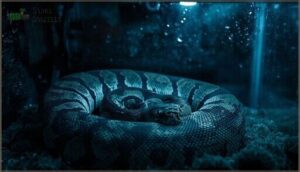
Your snake won’t always tell you something’s wrong, but its body will. When temperatures drop below what your snake needs, you’ll start noticing changes in how it looks and acts.
Here are the most common warning signs that your enclosure is too cold.
Lethargy and Reduced Activity
When your snake moves like it’s wading through molasses, cold stress might be the culprit. Lethargy causes reduced activity levels and minimal exploration, signs that thermal gradients are off. Getting your heating and lighting setup dialed in is the first step to keeping your snake active and healthy.
Cold stress slows metabolism and triggers temperature regulation issues, sometimes progressing to hypothermia. If your snake shows persistent lethargy, check enclosure temps immediately—restored warmth usually revives normal snake behavior and activity within hours. Investing in a reliable thermometer-hygrometer setup helps you monitor temperature gradients accurately and catch thermal problems before your snake’s health suffers.
Loss of Appetite
When feeding issues arise, appetite suppression often signals cold stress. Temperature effects slow digestion to a crawl, making your snake refuse meals it would normally take. If heating adjustments don’t restore feeding within a few weeks, consult experienced reptile veterinarians who specialize in ball pythons for proper diagnosis.
Digestive health relies on adequate warmth—without it, elevated stress hormones further dampen appetite while gut motility drops.
Most snakes regain interest in food within days once you restore proper temps, though recovery timing varies by species and how long hypothermia persisted.
Dry or Pale Scales
Unusual skin changes—especially dullness or paleness across your snake’s body—often flag thermal stress before more severe cold stress symptoms appear. Reduced blood flow to the skin and impaired skin hydration both contribute to these visible shifts in scale coloration.
Watch for these dry scale causes:
- Chalky patches concentrated on the dorsal surfaces where shedding cycles are active
- Diffuse dryness accompanying lethargy and loss of appetite
- Persistent pale scale diagnosis beyond 48 hours despite humidity adjustments
Proper temperature regulation and a stable thermal gradient prevent hypothermia and restore snake health.
Sunken Eyes
Recessed or hollow-looking eyes signal dehydration signs rather than direct cold exposure, though hypothermia worsens fluid balance and complicates snake health. Compare your pet’s current eye appearance with baseline photos, and check skin elasticity alongside mucous membrane moisture.
Veterinary diagnostics can rule out respiratory infections or other cold stress complications.
Restore proper thermal gradient conditions, increase humidity gradually, and guarantee consistent access to fresh water for snake hydration and eye care.
Behavioral Changes Indicating Cold Stress
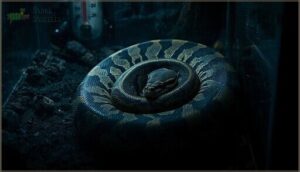
When your snake isn’t warm enough, it won’t just sit there and suffer silently. Instead, you’ll notice specific behaviors that signal something’s wrong with the temperature.
These changes are your snake’s way of telling you it needs more heat, and recognizing them early can prevent serious health problems.
Curling Up Tightly
When your snake tightens into a compact ball, it’s launching a desperate heat conservation strategy. This coiling behavior minimizes exposed surface area, reducing heat loss through convection—but it comes at a cost.
- Thermal posture: Tight coiling signals cold adaptation attempts in suboptimal snake enclosures
- Breathing trade-off: Compact resting slightly restricts respiratory depth during temperature regulation
- Detection issues: Dense coils may obscure peripheral thermal gradient cues
- Warning sign: Persistent coiling alongside lethargy indicates genuine cold stress or hypothermia risk
Seeking Heat Sources
When your snake suddenly camps out near the enclosure lamp or presses against one wall, it’s signaling temperature trouble. This isn’t random wandering—it’s active thermoregulation in crisis mode.
Install thermostats on all heat sources to prevent cold stress while maintaining your thermal gradient. Position equipment to create distinct temperature zones—your snake will navigate to its comfort range naturally.
| Heat Source | Ideal Use | Key Safety Feature |
|---|---|---|
| Heat Lamps | Establish reliable basking spots | Adjustable wattage control |
| Ceramic Emitters | Maintain ambient warmth 24/7 | No light emission |
| Heat Mats | Create stable substrate gradient | Thermostat-controlled output |
| Guarded Fixtures | Prevent direct contact burns | Protective cage barrier |
| Emergency Sources | Power outage backup | Independent supply system |
Reluctance to Move
If your snake barely budges even when you approach, cold-induced lethargy has likely taken hold. Temperature regulation drives movement patterns—when ambient conditions drop, thermal seeking becomes their sole focus while general activity plummets.
Watch for these cold stress behavior indicators:
- Extended periods of complete immobility, even during typical exploration hours
- Refusal to leave heat sources despite environmental stimuli
- Slowed responses to handling or feeding attempts
- Dormancy-like states lasting multiple days
- Progressively worsening weakness affecting basic functions
Cold stress compromises snake health quickly, pushing metabolic rates dangerously low. Hypothermia develops when your thermal gradient fails, turning normal inactivity into life-threatening immobility factors.
Physical Symptoms of Cold Exposure
When your snake’s environment stays too cold for too long, the effects show up on their body in ways you can see and touch. These physical symptoms often appear after behavioral changes, signaling that the cold stress has progressed beyond discomfort.
Recognizing these signs early gives you the chance to correct the temperature before serious health complications develop.
Difficulty Shedding
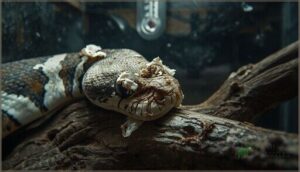
Incomplete or irregular shedding cycles often signal that your enclosure’s temperature isn’t supporting proper skin turnover. When cold stress disrupts temperature regulation, you’ll notice dry, patchy skin or retained eye caps clinging stubbornly after a shed. These shedding issues aren’t just cosmetic—they point to deeper problems with your snake’s thermal gradient and overall health.
Temperature fluctuations combined with humidity imbalances create the perfect storm for skin problems. If your snake consistently struggles through sheds, check whether chronic underheating is compromising its ability to complete this essential process. Addressing cold stress now prevents hypothermia and protects long-term snake health.
| Cold-Related Shedding Problem | What You’ll Observe |
|---|---|
| Incomplete sheds | Patchy skin, stuck pieces along body |
| Retained eye caps | Cloudy scales covering eyes post-shed |
| Prolonged shedding cycles | Irregular timing, dull appearance between sheds |
Regurgitation or Vomiting
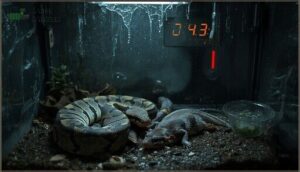
When your snake brings up a recently eaten meal, it’s often signaling cold stress symptoms and digestive issues. Inadequate temperature regulation slows digestion to a crawl, forcing the stomach to reject food it can’t process.
If vomiting recurs after meals, check your thermal gradient immediately—prolonged cold stress can escalate into hypothermia and serious complications.
Adjust feeding strategies by ensuring proper warmth before offering prey, which aids regurgitation prevention and healthy digestion.
Weakness and Slow Movements

Cold temperatures put muscle function on hold, triggering sluggish reflexes and uncoordinated strikes. When cold stress disrupts neuromuscular response, you’ll notice dramatic changes in movement patterns—your coldblooded companion may barely lift its head or respond to handling. These thermal effects signal impaired temperature regulation and control, warning that cold shock syndrome or hypothermia could follow without intervention.
- Decreased muscle contractility reduces strike accuracy
- Impaired neuromuscular signaling slows escape responses
- Reduced peripheral blood flow limits oxygen to muscles
- Energy metabolism shifts cause rapid exhaustion
Health Risks of a Cold Enclosure
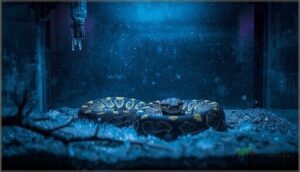
When your snake’s enclosure drops below the right temperature, you’re not just dealing with a sluggish pet—you’re risking serious medical conditions that can escalate quickly.
Cold stress doesn’t just make your snake uncomfortable; it actively compromises essential body systems and opens the door to infections and organ damage.
Here are the three most critical health risks you need to watch for.
Respiratory Infections
When your enclosure runs too cold, your snake’s respiratory defenses weaken dramatically. Bacterial diseases from Aeromonas and Pseudomonas thrive, while respiratory pathogens like Mycoplasma take hold. You’ll notice wheezing, open-mouth breathing, or nasal discharge—clear signs infection control has failed.
Cold stress and hypothermia compromise immunity, making respiratory infections in snakes a serious threat. Prompt temperature regulation and veterinary care are essential to prevent cold shock syndrome from turning critical.
Digestive Issues
Insufficient warmth wreaks havoc on your snake’s digestive system, triggering gastric slowdown and compromised digestive enzyme production. You’ll see cold-induced regurgitation, disrupted intestinal motility, and poor nutrient absorption—all hallmarks of digestive issues in snakes.
Without proper thermoregulation and snake enclosure management, hypothermia sets in, potentially escalating to cold shock syndrome in snakes if you don’t intervene quickly.
Hypothermia and Organ Failure
When hypothermia takes hold, your snake’s organs begin shutting down—a cascade of cellular stress that starts with impaired liver and kidney function, leading to dangerous toxin buildup. Cold shock syndrome disrupts cardiac output and tissue oxygen delivery, risking irreversible organ damage.
Swift hypothermia treatment and proper thermoregulation through temperature control are your only defenses against organ failure.
Checking and Monitoring Enclosure Temperature

You can’t fix what you don’t measure, and temperature is no exception. Without reliable monitoring tools and a proper setup, you’re basically guessing whether your snake’s environment is safe.
Here’s what you need to track and maintain the right conditions in your enclosure.
Using Accurate Thermometers
You can’t manage what you don’t measure accurately. Digital or infrared thermometers should be calibrated against a known standard before use—accuracy standards matter here.
Place thermometers at multiple points to capture temperature variance across your thermal gradient, since a single reading won’t show the full picture. Digital readings within ±0.5°C help guarantee proper thermoregulation and prevent dangerous heat fluctuations.
Creating a Thermal Gradient
Think of a thermal gradient like a temperature highway—your snake needs the freedom to travel between zones. Set up a basking spot at 29–32°C (84–90°F) on one end, with a cooler retreat around 21–24°C (70–75°F) on the other.
This gradient design facilitates natural thermoregulation, allowing your snake to self-regulate through thermal mapping rather than being stuck in uniform heat.
Regular Temperature Checks
Temperature logging isn’t a one-and-done task—it’s your frontline defense against cold stress prevention. Check your enclosure twice daily using calibrated thermometers placed at both ends of your thermal gradient.
Record readings in a temperature log for at least two weeks to spot drift before hypothermia becomes a threat. Accurate thermal monitoring transforms guesswork into proactive heat source management and enclosure calibration.
Preventing and Addressing Cold Enclosures

Once you’ve identified a temperature problem, you need to act quickly to protect your snake’s health. The right heating equipment makes all the difference between a stable environment and a constant guessing game.
Let’s look at the most reliable ways to keep your enclosure warm year-round.
Choosing Proper Heating Sources
Selecting the right heating elements is like building a safety net—you need reliability and precision. Electric heat mats deliver consistent surface warmth, while ceramic heat emitters provide radiant heat without disturbing your snake’s day-night cycle.
- Install a thermostat with a probe to prevent dangerous overheating
- Position heat sources to create a clear thermal gradient across the enclosure
- Use guards around heating elements to eliminate direct contact burns
Always verify compatibility with your enclosure materials before installation.
Emergency Heat Solutions
When power fails, you’re racing against cold shock syndrome. Keep battery-powered heat packs and a generator-assisted backup power system ready. Set up alarm systems that alert you when temperatures drop below safe thresholds.
Your emergency protocols should include spare heating solutions and clear temperature control steps—because during a crisis, a well-rehearsed plan protects your snake’s thermal gradient better than improvisation ever could.
Adjusting for Seasonal Changes
Beyond emergency preparedness, your snake’s needs shift with the seasons. Even stable indoor environments experience thermal fluctuations that demand adjustments:
- Research your species’ seasonal temperature requirements—some need cooler winters
- Modify heat sources and basking spots to maintain consistent thermal gradients
- Adjust humidity control during shedding cycles
- Adapt feeding schedules as metabolic rates change
- Increase monitoring frequency during seasonal transitions to prevent cold shock syndrome
Frequently Asked Questions (FAQs)
What temperature range is ideal for my snake species?
You can’t wing it—every snake species demands precision. Most tropical snakes thrive between 82–90°F on the hot side, while temperate species need cooler zones around 75–82°F, supported by proper thermal gradients.
Can a cold enclosure cause permanent health damage?
Yes, prolonged cold exposure can cause permanent damage. Chronic respiratory infections may scar lung tissue, while repeated hypothermia can impair organ function and weaken your snake’s immune system irreversibly.
How quickly does hypothermia develop in snakes?
Hypothermia onset varies by species and temperature drop. Cold shock can trigger metabolic decline within hours, while full hypothermia develops over 24 hours without proper thermal gradients.
Swift temperature control ensures hypothermia recovery and snake health.
Do baby snakes need different temperatures than adults?
Baby snakes have higher metabolic demands than adults, so you’ll need to provide a warmer basking spot—usually 88–92°F for hatchlings. Their smaller size makes them more vulnerable to temperature drops.
Should I use multiple thermometers in one enclosure?
Think of it like checking the weather in two different rooms—your enclosure’s hot and cool zones need separate thermometers to confirm your snake can thermoregulate properly across the entire temperature gradient.
Conclusion
Your snake’s survival hinges on temperature—it’s that fundamental. When you recognize the signs your snake enclosure is too cold, you’re not just preventing discomfort; you’re protecting your pet from respiratory infections, digestive failure, and potentially fatal hypothermia.
Don’t wait for dramatic symptoms to appear. Invest in reliable thermometers, maintain proper thermal gradients, and check temperatures daily. Your snake can’t regulate its own body heat—that responsibility falls entirely on you.
- https://trendybeatz.com/download-mp3/31773/iyanya-one-side
- https://pubmed.ncbi.nlm.nih.gov/24235903/
- https://www.weather.gov/safety/coldwater
- https://www.researchgate.net/publication/238025792_Freezing_survival_of_the_garter_snake_Thamnophis_sirtalis
- https://vpi.com/sites/default/files/ComeOutOfCold_BCHS_4.pdf