
This site is supported by our readers. We may earn a commission, at no cost to you, if you purchase through links.

Your bearded dragon spends the afternoon on the cool end of its tank—not because it’s relaxed, but because your basking spot reads 95°F when it’s actually pushing 110°F. A faulty analog gauge or misplaced probe doesn’t just skew numbers; it disrupts thermoregulation, suppresses appetite, and over time can trigger metabolic bone disease or respiratory infection.
The best way to measure reptile tank heat demands more than sticking a thermometer on the glass—you need the right tools positioned in the right zones, calibrated to catch both ambient air temps and surface readings where your reptile actually makes contact. Precision here isn’t perfectionism; it’s the foundation of every healthy shed, every successful digest, and every basking session that keeps your animal thriving.
Table Of Contents
Key Takeaways
- Digital thermometers with probes deliver ±0.1–1.0°C accuracy and should be placed at multiple heights—basking zone, mid-enclosure, and cool end—to map the thermal gradient your reptile relies on for thermoregulation, while analog gauges drift ±2–5°C and fail to provide the precision needed for species-specific temperature control.
- Infrared temperature guns measure surface temperatures on basking platforms and substrate where your reptile makes direct body contact, requiring emissivity settings near 0.95 and perpendicular aim to avoid reflective errors, whereas standard thermometers only capture ambient air temperature and miss the critical contact-heat readings that govern digestion and metabolic health.
- A functional monitoring system demands sensors in both warm and cool zones with 5–30 minute logging intervals to detect equipment drift, thermal fluctuations, and gradient collapse before they trigger appetite suppression, metabolic bone disease, or respiratory infection—single-point measurements conceal the microclimate variations that determine whether your setup succeeds or fails.
- Quarterly calibration against traceable reference standards at temperature extremes prevents sensor drift from compromising your data, while daily logs with timestamp, location, and both surface and ambient readings create the historical record needed to identify malfunction patterns, verify alarm systems, and adjust heating elements before your reptile pays the price for undetected equipment failure.
Choosing The Right Thermometer for Reptile Tanks
You can’t manage what you can’t measure—and in reptile husbandry, choosing the right thermometer determines whether you’re guessing or knowing with certainty. Digital devices, infrared sensors, hygrometers, and multi-function monitors each serve distinct roles in maintaining proper thermal and humidity conditions. Understanding which tool meets which measurement need ensures you’re equipped to create a thriving environment for your reptile.
In reptile husbandry, choosing the right thermometer determines whether you’re guessing or knowing with certainty
Digital Thermometers Vs. Analog Gauges
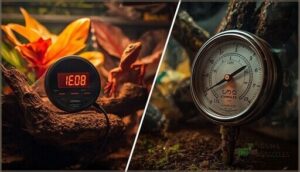
When you’re choosing between digital thermometers and analog gauges for your reptile tank, digital probes deliver enhanced measurement precision—generally within ±0.1 to ±1.0°C—while dial thermometers can drift ±2 to ±5°C over time. Digital calibration features and sensor technology provide consistent temperature readings and faster response times, giving you reliable temperature control that protects your reptile’s health and ensures thermometer accuracy throughout daily monitoring.
To achieve accurate measurements, it’s vital to examine the importance of methodological rigor in scientific studies.
Infrared Temp Guns for Surface Measurement
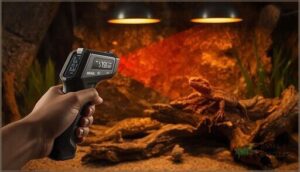
Infrared thermometers let you measure surface temperature across basking platforms and décor without physical contact—your temp gun samples radiant heat from each spot in seconds. For infrared accuracy, set emissivity near 0.95 for typical enclosure materials and aim perpendicular to the target to minimize reflective errors.
Gun maintenance includes regular surface calibration against a probe thermometer, ensuring your temperature gauge readings remain consistent and your temperature control reflects actual substrate and perch temperatures, not just ambient air.
Importance of Hygrometers for Humidity Monitoring
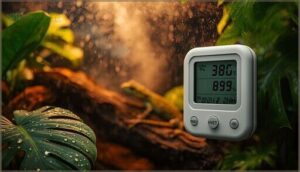
While temp guns map surface heat, your digital hygrometer tracks ambient humidity levels—the invisible factor governing shedding, respiration, and hydration.
Many tropical species require 60–90% RH for reptile health, whereas arid-adapted animals thrive at 30–50% RH.
A thermohygrometer combining temperature and moisture readings gives you complete climate management data, ensuring your enclosure design meets species-specific thresholds and prevents humidity-related illness.
Multi-Function Devices for Comprehensive Readings

Instead of juggling three or four separate gauges, you can simplify microclimate monitoring with a 2in1 electronic thermometer and hygrometer that delivers temperature and humidity readings on a single digital display.
Device integration simplifies sensor calibration and provides data logging for trend analysis, while wireless alerts notify you the instant conditions drift beyond your species’ thermal or moisture range—making thorough reptile thermometer management practically hands-free.
Best Practices for Accurate Temperature Measurement

Owning the right thermometer is only half the battle—you need to use it correctly if you want readings that actually reflect your reptile’s reality. Poor placement, misunderstanding what you’re measuring, and overlooking gradients can all sabotage your setup, even with premium equipment.
Let’s walk through the techniques that separate accurate monitoring from guesswork, so you can trust the numbers you’re seeing.
Proper Placement of Thermometers and Probes
Accurate thermometer placement transforms guesswork into precision when you’re thermal mapping your reptile’s enclosure. Position your digital thermometer probe at the center of the enclosure to capture representative ambient readings, then distribute additional probes vertically—one near the basking zones and another at the cool end—to reveal the temperature gradient your ectothermic animal relies on for thermoregulation.
Measuring Ambient Vs. Surface Temperatures
Understanding the distinction between ambient and surface readings allows you to interpret what your reptile actually experiences. You measure ambient temperature by positioning a digital thermometer probe in mid-air—capturing the warmth or coolness surrounding your animal—while infrared thermometers gauge surface materials like basking rocks and substrate that absorb or radiate heat differently depending on composition, color, and proximity to heat sources.
- Ambient temperature refers to air temperature measured at a distance from enclosure surfaces and heat sources
- Surface temperature captures substrate, décor, and wall readings where your reptile makes direct body contact
- Thermal gradients create distinct temperature zones that enable natural thermoregulation behaviors
- Environmental factors such as humidity and material type influence how surfaces retain or dissipate warmth
- Multiple measurement points across your reptile tank reveal whether temperature zones meet species-specific requirements
Monitoring Temperature Gradients in The Enclosure
Gradient analysis requires sensors at multiple heights and locations to accurately monitor temperature variations within a reptile tank. Since the tank is not a single-temperature environment, position one thermometer near the basking zone and another at the cool end to document the gradient spread. Record readings every 15–30 minutes to capture fluctuations that reveal how substrate, décor, and ventilation influence microclimate monitoring and heat distribution.
| Zone | Target Temperature Range |
|---|---|
| Basking surface | Species-specific (often 95–110°F) |
| Basking ambient | 5–10°F below surface |
| Mid-enclosure | Species-specific gradient midpoint |
| Cool-end surface | Species-specific minimum |
| Cool-end ambient | Lowest acceptable threshold |
Avoiding Common Measurement Mistakes
You’ll stumble into measurement errors if you skip probe calibration against a known standard before placing sensors in your enclosure. Avoid relying on a single thermometer—deploy multiple devices at the warm and cool ends to capture true temperature gradients.
Verify thermometer placement after rearranging décor, and maintain data logging to spot equipment drift before it compromises your reptile’s health.
Top 5 Thermometers and Hygrometers for Reptile Tanks
You need reliable instruments that can withstand high humidity while delivering accurate readings over months of continuous use.
The devices below represent the most dependable options available to reptile keepers—each offering distinct advantages for different monitoring needs and enclosure configurations.
Your choice will depend on whether you prioritize compact design, dual-probe capability, or sophisticated data logging features.
1. Fluker’s Digital Thermometer Hygrometer
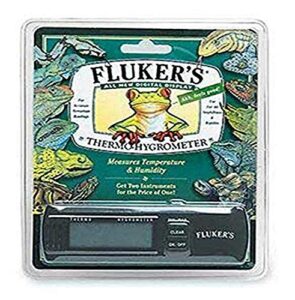
Fluker’s Digital Thermometer Hygrometer combines temperature and humidity monitoring in one compact unit—making it a practical entry-level option for reptile care and management. You’ll get real-time readings on an easy-to-read LCD display, powered by a standard 3V coin cell with reasonable battery life.
The device offers temperature accuracy within ±1.5 to ±2.0°F and humidity readings within ±5% to ±7% RH, which suits routine monitoring in most setups.
Proper sensor placement away from direct heat sources ensures reliable data, though periodic device calibration against known standards helps verify equipment durability and performance over time.
| Best For | Reptile and amphibian owners who want an affordable, all-in-one monitoring solution for basic temperature and humidity tracking in terrariums and enclosures. |
|---|---|
| Display Type | Digital |
| Measures | Temperature & Humidity |
| Material | Plastic |
| Power Source | Battery |
| Mounting | Adhesive |
| Temperature Scale | Fahrenheit |
| Additional Features |
|
- Combines temperature and humidity readings in one compact, easy-to-read display
- Budget-friendly entry point for routine environmental monitoring
- Battery-powered and simple to set up with no complicated installation
- Accuracy can drift over time, with some users reporting inconsistent hygrometer readings
- Adhesive backing may fail, causing the unit to fall or potentially trap pets
- Less precise than dedicated high-accuracy meters and may require periodic verification against calibrated instruments
2. Zoo Med Dual Thermometer Humidity Gauge
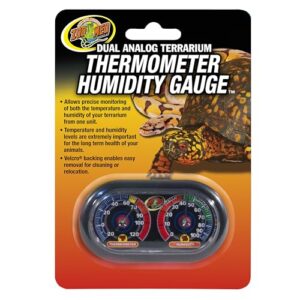
The Zoo Med Dual Analog Gauge mounts easily with Velcro backing, letting you reposition your reptile thermometer and hygrometer wherever you need reliable temperature and humidity control. You’ll see both metrics displayed on a single 6-inch plastic face, though accuracy can vary ±2°F for temperature ranges and ±5–7% for humidity readings.
Proper sensor placement away from basking lamps prevents misleading data, and regular equipment maintenance—including device calibration against known standards—ensures your thermometer hygrometer delivers consistent performance for temperature and humidity control across your enclosure.
| Best For | Reptile owners who need a simple, affordable way to monitor both temperature and humidity in one spot without running cables or dealing with complex digital setups. |
|---|---|
| Display Type | Analog |
| Measures | Temperature & Humidity |
| Material | Plastic |
| Power Source | Battery |
| Mounting | Velcro |
| Temperature Scale | Fahrenheit |
| Additional Features |
|
- Velcro backing makes it super easy to move around and find the best monitoring location in your enclosure
- Displays both temperature and humidity on one unit, so you don’t need separate gauges taking up space
- No batteries or power source required—just stick it on and get instant readings
- Accuracy can drift by ±2°F for temperature and ±5–7% for humidity, so it’s not ideal if you need precise measurements
- Analog display can be harder to read quickly compared to digital screens, especially in dim lighting
- Some users report the readings become less reliable over time without a way to recalibrate
3. Repti Zoo Digital Thermometer Hygrometer
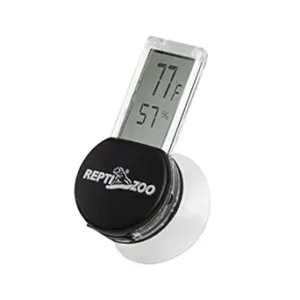
Repti Zoo’s SH125B digital thermometer hygrometer combines an LCD display with a battery-powered probe, giving you simultaneous ambient temperature and humidity readings on a single unit for your reptile tank. You’ll mount it using the included suction cup—though sideways installation requires patience—and the clear display tracks both metrics at a glance, supporting effective reptile monitoring and tank maintenance.
Digital accuracy outperforms analog gauges, yet the unit’s water sensitivity demands careful placement away from misting zones. You should verify temperature calibration against a known standard to confirm your humidity sensors deliver reliable data for reptile thermometer applications.
| Best For | Reptile owners who need an affordable, dual-function device to track both temperature and humidity in terrariums, vivariums, or brooders without investing in separate gauges. |
|---|---|
| Display Type | Digital LCD |
| Measures | Temperature & Humidity |
| Material | Glass, Plastic |
| Power Source | Battery |
| Mounting | Suction Cup |
| Temperature Scale | Fahrenheit/Celsius |
| Additional Features |
|
- Displays temperature and humidity simultaneously on a single LCD screen, eliminating the need for multiple devices
- Mounts flexibly with a suction cup and comes with an extra backup battery for convenience
- Offers digital accuracy that beats analog alternatives at a budget-friendly price point
- Suction cup installation can be tricky, especially when positioning the unit for sideways viewing
- Not fully waterproof—exposure to misting or water can cause the unit to fail
- Durability issues reported by some users, including fragile battery cases and readability problems in certain lighting
4. ThermoPro Digital Hygrometer Thermometer
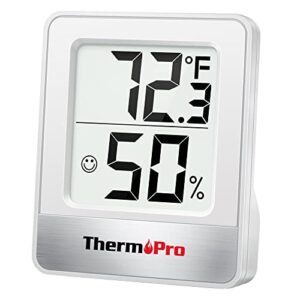
ThermoPro’s digital hygrometer thermometer delivers ambient temperature readings within ±1.5 to ±2.0°F and humidity control accuracy of ±2 to ±3% RH—performance that enables reliable reptile thermometer applications without breaking your budget.
You’ll mount the unit at your animal’s head height using the magnetic back, tabletop stand, or hanging option, then monitor both metrics on the LCD display that refreshes every ten seconds.
Digital calibration against a reference thermometer ensures consistent data, though you’ll need sensor maintenance and temperature logging to track long-term trends and catch drift before readings mislead your husbandry decisions.
| Best For | Budget-conscious reptile keepers who need reliable ambient temperature and humidity monitoring at their pet’s head height without investing in high-end climate controllers. |
|---|---|
| Display Type | Digital LCD |
| Measures | Temperature & Humidity |
| Material | Plastic |
| Power Source | Alkaline Battery |
| Mounting | Tabletop/Magnetic/Hanging |
| Temperature Scale | Fahrenheit/Celsius |
| Additional Features |
|
- Accurate enough for most setups with ±1.5-2°F temperature and ±2-3% humidity readings that refresh every 10 seconds
- Flexible mounting options let you position it at the right height using the magnetic back, tabletop stand, or hanging hook
- Affordable way to track both temperature and humidity on one display without needing separate devices
- No backlight makes nighttime checks impossible without external lighting
- Measures only ambient air temperature, so you’ll still need an infrared thermometer for basking spot surfaces
- Sensors can drift over time and need periodic calibration checks against a reference thermometer to stay accurate
5. Inkbird Digital Thermometer Hygrometer Monitor
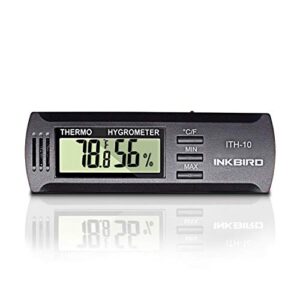
Inkbird’s ITH10 and similar models combine temperature and humidity sensing with ±1.8°F accuracy and ±3% RH precision. These specifications meet reptile thermometer reviews’ benchmarks when you place probes at head height and confirm sensor calibration against a known reference.
Digital displays refresh continuously, and data logging tracks fluctuations over days. Probe placement flexibility lets you monitor basking zones or retreats without sensor damage from curious animals.
Battery-powered Inkbird features support multi-zone monitoring, giving you gradient mapping that dial gauges simply can’t deliver for temperature-dependent species.
| Best For | Reptile keepers who need affordable digital tracking of both temperature and humidity across multiple zones in their enclosures. |
|---|---|
| Display Type | Digital LCD |
| Measures | Temperature & Humidity |
| Material | Plastic |
| Power Source | CR2032 Battery |
| Mounting | Portable |
| Temperature Scale | Fahrenheit/Celsius |
| Additional Features |
|
- Combines temp and humidity in one compact unit with continuous digital readout and min/max memory to spot fluctuations
- Probe placement at head height gives you accurate microclimate readings where your reptile actually lives
- Battery-powered and portable design works in any enclosure setup without needing outlets or complicated installation
- Calibration isn’t adjustable, so you’ll need to verify accuracy with the salt test or a reference thermometer
- Some users report the display can fail or show inconsistent readings over time
- ±3% humidity accuracy might not be tight enough for species that need precise moisture control
Maintaining and Verifying Measurement Accuracy

You can’t rely on a thermometer reading alone—equipment drifts, probes shift, and batteries fail without warning. Regular checks and consistent logging help you catch problems before your reptile suffers from undetected temperature swings or faulty humidity readings.
Here’s how to maintain accurate measurements and verify your monitoring equipment stays reliable over time.
Regular Equipment Checks and Calibration
Even reliable instruments drift over time—that’s why you need quarterly calibration methods using reference standards at both temperature extremes. Inspect each thermometer for corrosion or battery leakage, then cross-check your hygrometer probe and thermostat probe readings against traceable benchmarks.
Document every calibration session with date and adjustments made, ensuring sensor accuracy and swift drift detection before equipment maintenance becomes emergency intervention.
Logging Daily Temperature and Humidity Readings
Consistent record-keeping transforms raw data into actionable insight. You’ll build a running log with date, time, and readings from each thermometer and hygrometer probe in your enclosure. Track both basking-spot surface temperature and ambient air humidity daily, using standardized units (Celsius, percent) and location labels for temperature and humidity control. This discipline reveals temperature trends, bolsters sensor calibration verification, and enables strong data analysis when logging best practices meet real-world husbandry.
- Record date, time, exact temperature, and humidity values at each sensor location daily.
- Label each probe clearly (basking spot, cool side, ambient) to maintain data integrity.
- Store logs in CSV format with columns for timestamp, location, temperature, humidity, and notes.
- Calculate daily mean, min, max values to assess gradient stability and species-specific tolerance compliance.
Identifying and Addressing Equipment Malfunctions
Suspect a probe failure when temperature readings diverge by more than ±2°C across your digital thermometers. Sensor drift or loose connections often underlie inconsistent data, requiring thermometer probe inspection and malfunction troubleshooting. Replace leaking batteries before calibration; sensor calibration against known 25°C and 40°C references quarterly maintains measurement integrity, while alarm systems and probe maintenance safeguard temperature control and measurement accuracy.
| Malfunction Indicator | Probable Cause | Corrective Action |
|---|---|---|
| Erratic readings | Low battery or probe damage | Replace power source; reseat connectors |
| Persistent ±2°C variance | Sensor drift | Calibrate against reference points |
| Alarm failure | Disabled logging | Enable data-logging and review stored logs |
| Consistent offset | Placement error | Verify probe position and insulation |
Adjusting Monitoring Frequency Based on Tank Conditions
You’ll want to tighten monitoring intervals when your thermometer or hygrometer registers temperature fluctuations or humidity thresholds approaching species limits—shift from 15-minute checks during tank stability to 5-minute sampling when alarm systems flag hotspots.
Scale back during ideal conditions to avoid redundant data, then ramp up again after substrate changes or lighting adjustments that compromise reptile tank temperature and humidity control.
Frequently Asked Questions (FAQs)
How often should I replace my thermometer batteries?
You should replace your digital thermometer batteries every 6 to 24 months, depending on display brightness and sensor activity—but don’t wait for sluggish response or inaccurate readings to signal power depletion.
Can I use a smartphone app for tank monitoring?
Yes—Bluetooth or Wi‑Fi sensors paired with smartphone apps deliver real-time temperature and humidity data, alert systems, cloud storage for historical logs, and data visualization, though you’ll still need sensor calibration checks and physical thermometer cross-verification for reliable reptile care.
Whats the ideal temperature gradient for bearded dragons?
Your bearded dragon needs a basking spot between 95–110°F and a cool end around 75–85°F—this 15–35°F gradient lets them thermoregulate naturally, supporting digestion and metabolic health.
Do ceramic heat emitters affect thermometer readings?
Ceramic emitters throw a curveball at your thermometer—radiant heat skews surface readings high while ambient probes lag behind.
You’ll need strategic sensor placement and cross-checks with infrared guns to capture true thermal gradients in your reptile enclosures.
Should I monitor nighttime temperatures differently than daytime?
Track nighttime temperatures with the same rigor you apply during the day—nocturnal temperature dips beyond species thresholds trigger stress and illness.
Consistent overnight monitoring verifies thermal cycles, heat patterns, and basking zone stability across diel fluctuations.
Conclusion
Think of temperature monitoring as the invisible scaffolding that holds your husbandry together—when it fails, everything else collapses with it.
The best way to measure reptile tank heat isn’t a single device but a deliberate system: dual probes tracking gradients, infrared guns verifying contact zones, and daily logs that catch drift before it becomes damage.
Your reptile can’t tell you the basking rock is too hot; your thermometer can.