This site is supported by our readers. We may earn a commission, at no cost to you, if you purchase through links.

Your snake’s enclosure isn’t just a home—it’s a life support system. A few degrees too hot, and your pet risks dehydration or burns. A few degrees too cold, and digestion stalls while their immune system weakens.
Unlike mammals that generate their own heat, snakes rely entirely on their environment to power everything from metabolism to fighting off infections. That’s where precise temperature control becomes non-negotiable.
The difference between a thriving snake and a sick one often comes down to how well you’ve mastered the thermal gradient. Getting it right means understanding your species’ specific needs, choosing the proper heating equipment, and monitoring temperatures with clinical accuracy.
Table Of Contents
- Key Takeaways
- Why Temperature Regulation is Vital for Snakes
- Creating The Ideal Thermal Gradient
- Choosing The Best Heating Equipment
- Installing and Positioning Heat Sources Safely
- Monitoring and Maintaining Cage Temperature
- Frequently Asked Questions (FAQs)
- How to control temperature in an enclosure?
- How to cool down a reptile enclosure?
- What temperature should a snake’s cage be at?
- How to control temperature in a terrarium?
- How does room temperature affect snake cage heating?
- Can snakes share enclosures with different temperature needs?
- What backup heating options exist during power outages?
- How often should heating equipment be replaced?
- Do baby snakes need different temperatures than adults?
- Conclusion
Key Takeaways
- Snakes are ectothermic and depend entirely on external heat sources to power metabolism, digestion, and immune function, making precise temperature control non-negotiable for survival.
- A proper thermal gradient requires a warm zone at 88-92°F and a cool zone at 75-82°F, allowing snakes to shuttle between temperatures based on their physiological needs.
- Always pair heating equipment (heat mats, ceramic emitters, or lamps) with a calibrated thermostat to prevent fatal burns, heat stroke, or immune-compromising cold stress.
- Digital thermometers with probes positioned in both warm and cool zones provide the accurate monitoring needed to catch temperature drift before health problems develop.
Why Temperature Regulation is Vital for Snakes
Getting the temperature right in your snake’s cage isn’t just about comfort—it’s about survival. Your snake depends on external heat to power everything from digestion to immune function, and even a few degrees off can trigger serious health problems.
If you’re not sure whether your setup is dialed in, watch for warning signs that your snake’s enclosure is too cold—like sluggish behavior, skipped meals, or incomplete sheds.
Proper cage temperature isn’t comfort for your snake—it’s survival, powering digestion and immunity with every degree
Let’s break down exactly why precise temperature control matters so much and what happens when things go wrong.
Effects of Incorrect Temperatures on Health
Temperature control isn’t just a convenience—it’s life or death. When you miss the mark on that thermal gradient, your snake’s body can’t function properly.
Here’s what goes wrong:
- Thermal stress raises internal temperature, causing dizziness and heat exhaustion
- Metabolic issues disrupt digestion, reducing nutrient absorption and causing weight loss
- Respiratory problems develop from cold environments weakening mucous membranes
- Skin conditions emerge when temperature swings disrupt normal shedding cycles
- Health risks multiply as immune function drops, increasing infection susceptibility
Get the temperature range right, and you’ll protect your snake’s health from these serious metabolic impairments.
Species-Specific Temperature Requirements
Your snake’s exact thermal needs depend entirely on where its wild ancestors lived.
Ball pythons thrive with a gradient from 28 to 32°C ambient and basking spots at 32 to 35°C. Corn snakes prefer cooler zones around 24 to 28°C and warm sides reaching 32 to 34°C.
Species profiles and heat mapping guarantee your temperature control matches these species-specific thermal needs perfectly.
Scientists have found that thermal tolerance varies with latitude in ectothermic animals, which helps explain why different snake species need zone-specific temperatures.
Risks of Overheating and Underheating
When your thermal gradient goes off track, the consequences can be severe and develop quickly.
Heat stroke happens when basking spots exceed safe limits by just 5 to 10 degrees Fahrenheit. Watch for these red flags:
- Rapid gular pumping and loss of coordination
- Burns from prolonged contact with hot surfaces
- Dehydration risks including sunken eyes and lethargy
Cold zones cause digestion problems, weakened immunity, and respiratory infections. It’s important to recognize that heat-related illness symptoms can develop quickly in both humans and animals under temperature stress.
Creating The Ideal Thermal Gradient
Your snake’s enclosure isn’t a sauna or a refrigerator—it’s a carefully designed climate zone. Think of it like creating a miniature ecosystem where your snake can move between warmth and coolness as needed.
Getting this balance right involves understanding temperature gradients, humidity levels, and monitoring techniques—all covered in detail in our complete ball python care guide.
Let’s break down how to set up these temperature zones, what the numbers should actually be, and why your snake’s natural behavior depends on getting this right.
Setting Up Warm and Cool Zones

Your goal is to create a horizontal gradient—think of it like a slider your snake can move along. Place a heat source under one end to establish the warm zone, then leave the opposite side unheated for the cool zone.
Use a thermostat to dial in precise climate control, and install separate thermometers at each end to confirm the thermal gradient. Add a thermal refuge, like a hide box, on the warm side so your snake can soak up heat safely.
Recommended Temperature Ranges
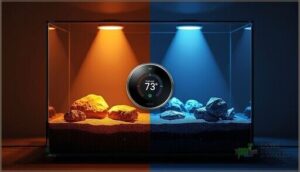
A proper basking zone should hit 88 to 92°F, while your cool side needs to stay around 75 to 82°F. Desert species can handle up to 95°F, but tropical snakes do best with gentler warmth.
Use a thermostat to lock in these temperature zones within ±2°F, and place probe sensors on both ends to monitor your gradient control accurately.
Importance of Thermal Gradients for Snake Behavior

Thermoregulation isn’t just about survival—it’s how your snake decides when to digest, rest, or explore.
A proper thermal gradient lets them shuttle between warm zones around 86°F for digestion and cooler spots near 78°F to conserve energy.
This behavioral adaptation mirrors their natural habitat, reducing stress indicators like irregular breathing while boosting daily activity and overall health.
Choosing The Best Heating Equipment
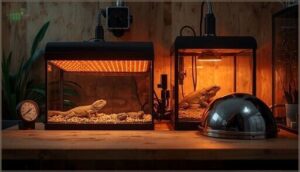
You’ve got the temperature ranges mapped out—now it’s time to pick the tools that’ll make it happen.
The heating equipment you choose shapes how well your snake thrives, and there’s no one-size-fits-all answer here. Let’s break down your main options so you can match the right heat source to your setup and species.
Heat Mats, Pads, and Tapes
You’ll find heat mats are your go-to for reliable bottom warmth in most snake cages. These thin electric pads stick under your enclosure, generally ranging from 5 to 25 watts and sized from small 4×6 inches up to large 12×24 inches. Always pair them with a thermostat for safe temperature control!
- Heat mat basics: Adhesive backing secures mats for stable heat transfer through substrate
- Heating pad technology: Flexible elements with thermal cutoffs prevent dangerous overheating
- Tape applications: Cut-to-length strips create custom warm zones along shelves or hides
Ceramic Heat Emitters and Radiant Panels
Ceramic emitters deliver infrared heat without disrupting your snake’s night cycle—no light means no stress. These durable elements reach full power in about 5 minutes and pair beautifully with radiant panels for even warmth.
Mount panels overhead for gentle downward heat, choose wattages from 25W to 100W based on your snake enclosure size, and always connect them to a thermostat for safe temperature control!
Heat Lamps and Basking Spots
Heat lamps create focused basking spots through tight beam delivery—think spotlight instead of floodlight.
A 50-watt lamp positioned 6 to 8 inches above a slate surface hits that sweet 85 to 95°F zone for thermal control. Spot lighting means heat distribution stays precise, letting your snake move between zones safely while you maintain the thermal gradient with solid lamp safety practices.
Selecting The Right Equipment for Your Snake Species
Your snake’s species-specific warmth needs determine which gear actually works. Ball pythons demand different heating equipment types than corn snakes, so match your setup to their temperature range:
- Ball pythons: heat mat with thermostat set to 88–92°F warm side
- Corn snakes: heat lamp creating 85–90°F basking zone
- Garter snakes: moderate heat avoiding sustained highs above 85°F
- Rosy boas: higher humidity setup with 85–90°F gradient
- Boa constrictors: thermostat compatibility across 82–90°F warm zones
Safe installation means checking wattage limits before plugging anything in.
Installing and Positioning Heat Sources Safely

Getting your heating equipment into the cage is where theory meets reality. You need to position everything so your snake stays warm without getting burned, and that means thinking through placement before you plug anything in.
Let’s walk through the safety essentials that keep your setup working properly.
Proper Placement of Heating Devices
Where you position your heating equipment determines whether your snake thrives or faces injury. Heat mats sit under one end of the enclosure—never the full floor—secured on a stable, nonflammable surface. Heat lamps mount at least 6 inches above substrate with clear clearance from decorations. Device mounting and cable management prevent entanglement while thermal barriers shield against direct contact.
| Heat Source | Best Placement | Safety Tip |
|---|---|---|
| Heat mat | Under warm-side floor | Pair with thermostat always |
| Ceramic emitter | Ceiling or caged side | 12″ clearance from wood |
| Radiant panel | Mounted on warm end | Route cords behind enclosure |
| Heat lamp | Elevated basking spot | Use drip loops near water |
Keep devices away from water bowls and route all cables along the back with clips. A grounded outlet and monthly inspections catch wear before problems start!
Preventing Burns and Overheating
Even with perfect placement, temperature regulation demands safeguards against thermal burns. Shielding heat sources with guards prevents direct contact—keep at least a 1.5 cm air gap between any heating element and your snake’s body.
Substrate safety means avoiding loose materials like sand that mask heat injuries. Watch for behavior cues: excessive curling or rapid retreat signals overheating before damage occurs.
Using Thermostats for Temperature Control
A thermostat transforms guesswork into precision. You’ll set your target temperature range—say, 88°F for the warm end—and the controller modulates your heat mat automatically.
Key benefits you can’t ignore:
- Temperature sensors feed real-time data to prevent dangerous spikes
- Automated control adjusts power delivery without your constant supervision
- Thermostat calibration fine-tunes accuracy within ±1°F
This setup maintains your thermal gradient reliably, day and night.
Monitoring and Maintaining Cage Temperature
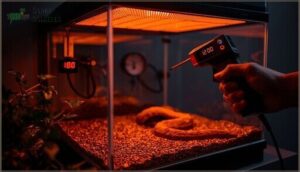
Getting your snake’s temperature right is one thing—keeping it that way is another. You’ll need the right tools to track what’s happening inside the cage, plus a backup plan when something goes sideways.
Let’s walk through the monitoring gear that’ll keep your snake comfortable and the fixes for when temps start misbehaving.
Using Accurate Thermometers and Hygrometers
You can’t dial in perfect temps without the right tools. Digital thermometers with ±0.5°C accuracy standards beat analog gauges every time—they’re faster, sharper, and reliable. Pair them with capacitive humidity sensors for solid thermal monitoring and humidity control.
Calibrate your temperature probes and sensors against a known standard before use, then recheck after battery swaps or if readings drift beyond 1°C. Temperature sensors and thermostats work together to keep your snake safe, so choose devices built for precision and recalibrate regularly for foolproof temperature control.
| Device Type | Accuracy Range | Best For |
|---|---|---|
| Digital Thermometer | ±0.5°C | Temperature probes & monitoring |
| Capacitive Hygrometer | ±2% RH | Humidity control & stability |
| Smart Thermostat | ±0.3°C | Automated temperature control |
Probe Placement for Reliable Readings
Your digital thermometers are only as trustworthy as their sensor placement. Follow these thermal monitoring essentials for spot-on air temperature readings:
- Mount probes mid-height in open air, away from surfaces, to capture ambient temperature instead of localized hot spots.
- Deploy at least two temperature sensors—one near the basking area, one in the cool zone—to track your thermal gradient accurately.
- Keep probe tips 1+ inch from objects to prevent contact skew and false readings.
- Perform monthly probe maintenance checks and recalibrate after thermostat adjustments for consistent temperature control.
Automated and Smart Temperature Control
Modern smart thermostats give you WiFi-enabled control over your snake’s climate right from your phone. These digital sensors log real-time temperature readings and automated heating cycles adjust instantly when gradients drift.
IoT devices pair temperature algorithms with remote monitoring so you’ll receive alerts before problems escalate. Many systems auto-tune themselves, maintaining stable conditions even during cage maintenance or seasonal shifts.
Troubleshooting Common Temperature Issues
When readings jump around by 2 to 5 degrees, you’re likely facing sensor drift issues that need fixing within six months.
Temperature fluctuations often stem from heating element failures, dirty probes, or environmental interference like drafts near your enclosure.
Recalibrate your thermostat, check for damaged heat mat wiring, and reposition sensors away from direct basking spots to restore a stable thermal gradient and reliable temperature control.
Frequently Asked Questions (FAQs)
How to control temperature in an enclosure?
Control temperature in an enclosure using a reliable heat source paired with a thermostat to maintain a thermal gradient.
Place temperature probes in both warm and cool zones for accurate climate control.
How to cool down a reptile enclosure?
You can lower ambient temperature by using calibrated thermostats, air conditioning, or cooling pads positioned away from direct snake contact.
Monitor humidity balance alongside temperature control to prevent excessive drying while implementing environmental cooling strategies.
What temperature should a snake’s cage be at?
Steady snake health starts with striking the sweet spot: aim for a warm side between 80 and 90 degrees Fahrenheit and a cool side around 75 to 82 degrees Fahrenheit for most species.
How to control temperature in a terrarium?
You’ll need a quality thermostat paired with your heat mat or ceramic emitter to maintain steady thermal balance.
Position temperature sensors at both warm and cool zones, then monitor for any temperature fluctuation daily.
How does room temperature affect snake cage heating?
Your ambient temperature sets the baseline for heat loss in the snake enclosure.
A cooler room forces your heat mat and thermostat to work harder, maintaining gradient control and thermal stability within the target temperature range.
Can snakes share enclosures with different temperature needs?
Mixing snakes with different temperature needs is like forcing roommates to share a thermostat—it rarely works.
You’ll need separate enclosures or multi-zone setups with independent heat sources and thermostats for proper temperature control.
What backup heating options exist during power outages?
Power outages require backup heating like propane heaters, kerosene units, or wood stoves for room warmth.
Battery heaters offer short-term heat. Always monitor temperature control with a thermostat and maintain proper ventilation during emergencies.
How often should heating equipment be replaced?
Heat sources wear out, thermostats drift, and temperature sensors fail.
Replace heat mats and ceramic emitters every ten to fifteen years.
Upgrade thermostats every five to ten years, or sooner if repairs mount.
Do baby snakes need different temperatures than adults?
Yes, baby snake temperatures differ from adults.
Hatchlings usually need a warmer heat mat zone—around 80 to 90°F—to support rapid growth, digestion, and healthy reptile care through proper temperature control in their snake enclosure.
Conclusion
Think of temperature regulation as your snake’s invisible armor—protecting them from illness, stress, and metabolic breakdown every single day.
Now you know how to regulate snake cage temperature with the right equipment, precise monitoring, and strategic heat placement. Your thermostat isn’t optional; it’s essential. Your thermometer readings aren’t suggestions; they’re survival data.
Master these fundamentals, and you’ll create an environment where your snake doesn’t just survive—it actually thrives with measurable health improvements.