This site is supported by our readers. We may earn a commission, at no cost to you, if you purchase through links.

Your ball python eyes a thawed rat, and you wonder: is this meal too thick? Get it wrong, and you’re facing regurgitation, respiratory distress, or worse—a snake that refuses to eat for weeks.
Prey thickness isn’t about length or weight; it’s the diameter at the widest point, and it’s the single most critical measurement in snake feeding. Misjudge by even half an inch, and you’ve compromised your snake’s digestive mechanics.
The right prey thickness matches your snake’s anatomical capacity, ensuring smooth passage through the esophagus and efficient nutrient extraction. Master this measurement, and you’ll prevent the feeding disasters that land countless snakes in veterinary emergencies.
Table Of Contents
Key Takeaways
- Prey thickness—the diameter at the widest point—is the single most critical measurement in snake feeding, directly determining whether your snake can safely swallow and digest its meal without choking, regurgitation, or esophageal damage.
- Safe prey should measure 0.8 to 1.2 times your snake’s midbody girth (0.6 to 1.0 for hatchlings), with thickness mattering far more than length because your snake’s jaw anatomy constrains cross-sectional diameter much more rigidly than linear dimensions.
- Incorrect prey thickness triggers a cascade of health problems: oversized meals cause airway obstruction, chronic regurgitation, and digestive stress, while undersized prey leads to nutritional deficiencies, stunted growth, and weakened immune function.
- You must measure both your snake’s girth and prey diameter with precision tools like calipers or flexible tape, then adjust prey size incrementally as your snake grows—jumping sizes too quickly or feeding based on guesswork puts your animal’s life at risk.
What is Prey Thickness in Snake Feeding?
Prey thickness is the diameter of the food item at its widest point—and it’s the single most critical measurement you’ll make as a snake keeper. Get it wrong, and you’re looking at regurgitation, impaction, or even choking hazards that can kill your animal. Matching prey thickness to your snake’s widest body diameter is the most important feeding decision you’ll make—get species-specific feeding protocols right to prevent life-threatening complications.
Prey thickness is the single most critical measurement in snake feeding—get it wrong, and you risk regurgitation, impaction, or fatal choking
Understanding what prey thickness means, why it matters more than length, and how it relates to your snake’s anatomy will transform your feeding confidence and protect your pet’s health. Feeding prey that’s too thick can cause serious digestive stress and lead to dangerous regurgitation issues that compromise your snake’s health.
Definition of Prey Thickness
Prey thickness defines the cross-sectional diameter you measure perpendicular to the prey’s length. This critical snake feeding metric directly impacts digestion dynamics and feeding safety because your snake must compress this girth during ingestion. Understanding thickness measurement separates successful reptile nutrition from dangerous mistakes: Proper prey thickness—matching 1 to 1.5 times your snake’s girth—ensures safe corn snake feeding without regurgitation or digestive complications.
- Maximum width at the prey’s broadest point
- Circumferential dimension your snake must swallow
- Distinct from linear length measurements
- Essential prey size metrics for snake anatomy compatibility
- Foundation for proper feeding techniques and snake care protocols
Accurate measurements are vital for maintaining methodological rigor in snake feeding practices.
Why Prey Thickness Matters for Snakes
Thickness directly governs your snake’s feeding success. If prey diameter exceeds your snake’s gape capacity, you risk choking, airway obstruction, and regurgitation—outcomes that compromise digestive health and trigger feeding aversion. Proper prey sizing prevents regurgitation and ensures your snake can safely swallow meals that match its body thickness and gape capacity.
Snake anatomy dictates strict biomechanical limits: constriction techniques and jaw kinetics only accommodate prey matching body width. Snakes can swallow prey significantly wider than their own bodies thanks to highly flexible jaws and specialized anatomical adaptations that allow extreme stretching.
Proper prey selection aligned with feeding ecology prevents nutritional deficiencies and bolsters ideal reptile nutrition. Thickness isn’t optional—it’s physiological law.
Differences Between Prey Length and Thickness
You can’t treat length and girth as interchangeable dimensions—they govern distinct feeding mechanics. Length dictates how many swallowing motions your snake executes, while thickness determines whether prey fits through gape limits at all.
Snake anatomy constrains cross-sectional diameter far more rigidly than linear measurement. Misjudge prey dimension, and you’ll face regurgitation or airway blockage regardless of prekilled prey advantages.
Prioritize thickness alignment for snake health and safe digestion process.
How to Measure Snake and Prey Size
Accurate measurement separates successful feeding from dangerous guesswork. You need precise dimensions of both your snake’s body and its prey to prevent choking, regurgitation, and serious digestive complications.
Let’s break down the exact tools and techniques that guarantee safe prey selection every single time.
Measuring Your Snake’s Girth Accurately
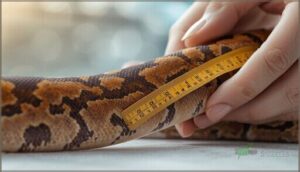
You can’t feed your snake safely without knowing its true girth. Use a flexible tape at your snake’s widest midbody point—snug contact, no compression.
Here’s your protocol:
- Measure when calm: Resting posture prevents distortion
- Average three readings: Consistency beats single snapshots
- Track monthly: Baseline data informs prey size decisions
- Record precisely: Note date, feeding status, measurement site
This measurement frequency guideline protects snake health across all snake species and feeding schedules.
Tools and Methods for Prey Measurement

Precision tools eliminate guesswork. Vernier calipers deliver thickness readings to 0.01 inch—align jaws perpendicular to your frozen prey’s widest axis. Digital scales convert mass to grams, enabling 10-15% body weight calculations for ideal snake feeding. Flexible tapes measure circumference for irregular shapes, while rulers provide quick visual prey sizing checks before purchase.
| Tool | Measurement Type | Precision |
|---|---|---|
| Vernier Calipers | Width/Thickness | 0.01 inch |
| Digital Scale | Mass/Weight | 0.1 gram |
| Flexible Tape | Circumference | 1 mm |
These measurement techniques protect snake health across all feeding gauges and prey size scenarios.
Comparing Prey Thickness to Snake Body Width

Feeding mechanics hinge on a critical ratio. Measure your snake’s midbody girth, then hold prey alongside—prey thickness should match or fall slightly below that width. When prey diameter exceeds body width by more than 10-15%, swallowing strain triggers regurgitation risk.
Snake anatomy dictates this rule across species: proper prey selection respects jaw spread limits while maximizing digestive efficiency and safe constriction techniques for healthy snake feeding.
Choosing The Right Prey Thickness

You’ve got the measurements down—now comes the critical decision. Selecting prey thickness isn’t guesswork; it’s a precise calculation based on your snake’s age, species, and current physical capacity.
Let’s break down the three essential factors that determine whether you’re feeding safely or courting disaster.
Age and Species Considerations
Juvenile snakes demand thinner prey than adults—their narrower esophageal diameter and faster metabolic rates make them intolerant of oversized meals. Hatchlings require newborn prey matched to their delicate anatomy, while species variation matters enormously: constrictors with flexible jaws tolerate thicker items than specialized feeders.
Your snake’s growth stage directly governs feeding acceptance and digestive health, so adjust prey thickness as your animal matures.
Safe Prey Size Guidelines
Prey thickness should match 0.8 to 1.2 times your snake’s girth at its widest point—this ratio protects digestive health while supporting steady snake nutrition.
Hatchlings tolerate 0.6 to 1.0 times body width; use prey size charts to track progression. Measure monthly as your snake species matures, adjusting frozen prey incrementally.
When feeding frequency increases, reduce prey thickness proportionally.
Risks of Incorrect Prey Thickness
Misjudge prey selection and you’ll trigger a cascade of feeding complications. Oversized prey causes choking, airway obstruction, and chronic esophageal damage during swallowing. Undersized options starve your snake species of nutrients, stunting growth and weakening immune response.
Repeated digestive issues from incorrect sizing escalate stress, alter snake behavior, and risk regurgitation. Proper feeding frequency with accurate prey size prevents snake injury and maintains feeding safety.
Health Impacts of Prey Thickness Selection
Getting prey thickness wrong doesn’t just create feeding drama—it puts your snake’s health on the line. Oversized prey triggers regurgitation and digestive stress, while undersized meals starve your snake of essential nutrients over time.
Let’s break down exactly how prey thickness affects your snake’s body, from digestion to development to preventing life-threatening feeding accidents.
Digestive Health and Regurgitation
Regurgitation causes often trace back to improper prey size—oversized meals strain your snake’s digestive system. When prey thickness exceeds safe limits, gut health deteriorates rapidly.
You’ll see feeding complications like chronic regurgitation, which triggers dehydration and electrolyte imbalances. Snake nutrition suffers as gastric stasis blocks nutrient absorption.
Digestive issues escalate when feeding frequency doesn’t match digestive capacity, creating a cascade of problems that demands immediate correction.
Growth, Nutrition, and Development
Your snake’s growth patterns depend on matching prey size to developmental stages—get it wrong and you’ll stunt skeletal development. Proper prey thickness drives nutrient uptake efficiency, supporting:
- Muscle tissue synthesis during molt cycles
- Calcium-phosphorus balance for bone health
- Stable gut microbiome for reptile nutrition and diet
- Ideal body condition through each growth phase
Smart feeding strategies adjust thickness as your snake matures, ensuring snake health and wellness through consistent energy intake at every feeding frequency.
Preventing Choking and Feeding Complications
Beyond nutrition lies a minefield: choking hazards and regurgitation strike when you misjudge prey selection. Oversized meals obstruct airways and trigger digestive complications. Master feeding safety through precise prey size measurement—your snake’s life depends on it.
| Risk Factor | Warning Sign | Prevention |
|---|---|---|
| Airway blockage | Gular swelling, distress | Prey narrower than midbody |
| Regurgitation | Post-feed vomiting | Gradual size increases |
| Esophageal jam | Failed swallowing | Calm feeding environment |
Match prey thickness to your snake’s anatomy carefully to avoid these risks.
Practical Tips for Safe Feeding Practices

Knowing the theory is one thing—applying it safely is another. You need practical techniques that work in real feeding situations, not just measurements on paper.
Here’s how to turn size guidelines into confident, safe feeding decisions every time you approach your snake’s enclosure.
Visual and Physical Comparison Techniques
Your eyes are your first defense. Hold the prey item horizontally at jaw level and check whether its diameter exceeds your snake’s midbody girth—if it bulges beyond that width, swap it for something slimmer.
Use calipers or a flexible measuring tape around the prey’s thickest point, then compare that number to your snake girth measurement for foolproof prey size estimation and feeding technique safety.
Adjusting Prey Size as Snakes Grow
Track growth rate monitoring every quarter or after each shed—your snake’s girth expands fast. Start hatchlings at 0.3–0.5 times body width, then scale prey thickness by 1–2 mm after two successful meals without regurgitation.
Jump too quickly and you’ll see digestive health optimization problems; inch upward and your snake development stages stay on track, feeding habits and prey selection improving with each achievement.
Feeding Frequency and Prey Thickness
Feeding schedules hinge on prey thickness—thicker meals digest slower, extending intervals between feedings. Your snake nutrition depends on this balance:
- Hatchlings: Feed every 5–7 days with appropriately thin prey for rapid digestive health optimization.
- Juveniles: Shift to 7–10 day intervals as prey size increases.
- Adults: Feed every 10–14 days with thicker prey selection.
- Post-shed: Resume normal feeding frequency after skin renewal completes.
Match feeding techniques to your snake’s current metabolic demands.
Frequently Asked Questions (FAQs)
Can snakes eat prey wider than their head?
Yes, snakes can swallow prey slightly wider than their head thanks to jaw flexibility and stretchy ligaments. However, exceeding gape limitations risks regurgitation, airway obstruction, and esophageal injury—proper prey selection prevents these complications.
Does prey shape affect digestion speed or efficiency?
Prey geometry influences feeding dynamics and initial snake anatomy challenges. Angular prey extends handling time, while shells slow digestion rates.
However, nutrient absorption and enzymatic processes remain largely unaffected once prey size matches proper snake feeding guidelines.
How does temperature influence acceptable prey thickness?
Warmer temperatures boost digestion rates through metabolic shifts, letting you offer slightly thicker prey. Cooler conditions narrow thermal tolerance, demanding thinner options to prevent regurgitation—temperature effects directly reshape feeding adaptations and acceptable prey size.
Are there thickness differences between rodent types?
Absolutely. Rats possess thicker body diameters than mice, while gerbils fall between the two. Hamsters trend thinner than rats but vary by breed, and juvenile rodents measure markedly narrower than adults across all rodent types.
Should injured snakes receive thinner prey temporarily?
Yes—during injury recovery, thinner prey can reduce regurgitation risk and digestive strain.
Adjust feeding strategies gradually based on species, injury type, and healing protocols. Monitor snake behavior closely and consult veterinary guidance for ideal snake nutrition during recovery.
Conclusion
Precision prevents problems—mastering snake feeding prey thickness protects your pet from preventable trauma. You’ve learned the biomechanics: measure girth, match diameter, monitor digestion.
Now apply this knowledge with surgical exactness. Every feeding is a calculated decision, not a guess. Your snake’s esophageal capacity doesn’t accommodate approximations.
When you hold that next prey item, you’re not just feeding—you’re engineering ideal nutrition while eliminating respiratory distress, regurgitation, and digestive failure. Measure twice. Feed once. Your snake’s survival depends on it.
- https://arxiv.org/html/2507.17948v2
- https://www.scribd.com/document/683678057/Academic-Research-Manual-V1-1-April-2016
- https://www.sciencedirect.com/science/article/pii/S0749208123000268
- https://github.com/tugcekonuklar/msc-computer-science-notes/blob/main/research-methods/Home.md
- https://libguides.kean.edu/ResearchProcessGuide