This site is supported by our readers. We may earn a commission, at no cost to you, if you purchase through links.

Your ball python’s clouded eyes signal a shed—but three days later, patches of old skin still cling to its body like stubborn wallpaper. That’s humidity failure in action, and it’s one of the most common yet preventable problems reptile keepers face.
Understanding humidity needs for reptiles isn’t just about avoiding stuck sheds; it’s the foundation of respiratory health, proper hydration, and stress-free living. Too dry, and you’ll battle dehydration and incomplete molts. Too wet, and respiratory infections and fungal growth take hold.
The challenge? Each species evolved in wildly different environments—from rainforest canopies holding 80% humidity to desert floors barely reaching 30%. Getting it right means learning to measure accurately, adjust strategically, and create microclimates that mirror your reptile’s natural habitat.
Table Of Contents
- Key Takeaways
- Why Humidity Matters for Reptile Health
- Ideal Humidity Ranges for Reptile Species
- Signs of Improper Humidity in Reptiles
- Measuring Humidity in Reptile Enclosures
- Substrate Choices for Humidity Control
- Methods to Increase Humidity Levels
- Managing Humidity With Enclosure Design
- Creating Humidity Gradients and Microhabitats
- Seasonal and Environmental Adjustments
- Essential Equipment for Humidity Maintenance
- Frequently Asked Questions (FAQs)
- Can reptiles sense humidity changes before humans detect them?
- Does humidity affect reptile egg viability during storage?
- How does altitude impact reptile enclosure humidity requirements?
- Are there natural humidity indicators besides commercial hygrometers?
- Does water temperature influence evaporation rate and humidity?
- Conclusion
Key Takeaways
- Humidity directly controls three critical reptile functions—shedding success through skin hydration, respiratory health via mucous membrane moisture, and kidney function through proper urate concentration—making it a physiological necessity rather than an environmental preference.
- Species-specific humidity targets vary dramatically by native habitat, from desert reptiles requiring 20–40% to tropical species needing 60–80%, with measurement accuracy depending on digital hygrometers placed at mid-height away from heat sources and calibrated every 3–6 months.
- Creating humidity gradients through strategic substrate choices (moisture-retentive coconut fiber for tropicals versus breathable paper for desert species), humid hides with damp sphagnum moss, and live plants allows reptiles to self-regulate by moving between distinct moisture zones rather than forcing uniform enclosure-wide levels.
- Warning signs of improper humidity manifest as stuck shed with constricting bands around digits, respiratory symptoms like wheezing and nasal discharge, or opposing extremes of dehydration (sunken eyes, wrinkled skin) versus fungal infections (scale rot, skin lesions) depending on whether levels run too low or too high.
Getting these three systems in balance is easier when you understand the underlying biology—how humidity affects reptile respiration, shedding, and kidney health breaks it down in practical terms.
Why Humidity Matters for Reptile Health
Humidity isn’t just background noise in your reptile’s enclosure—it’s a fundamental driver of physiological processes that keep your animal alive and thriving. When moisture levels drift outside the ideal range, you’ll see cascading effects across multiple body systems, from the outermost scales to internal organs.
Pairing optimal humidity with thoughtful hiding spaces for your snake creates microclimates that support natural thermoregulation and stress reduction throughout the enclosure.
Humidity isn’t background noise—it’s the fundamental driver of physiological processes keeping your reptile alive and thriving
Let’s break down exactly how humidity influences three critical aspects of reptile health.
Role of Humidity in Shedding and Skin Health
Moisture balance is the invisible hand guiding every successful shed. When humidity levels drop, that essential lymph-like separation layer between old and new skin can’t form properly—you’ll see dull, stuck patches instead of clean sloughs. Young reptiles shed more often, so they’re especially vulnerable. Proper humidity gradients let your animal choose the microclimate it needs.
If you’re keeping ball pythons, you’ll want to dial in those specific water and humidity needs to avoid stuck sheds and respiratory problems.
- Skin hydration facilitates enzymatic separation during shedding cycles
- Low humidity causes dysecdysis and retained shed complications
- Species-specific targets prevent constriction around digits and tails
- Humidity control through moist hides reduces reptile dermatology issues
Winter heating often creates shedding problems by drying enclosures. Maintaining the right humidity levels is crucial for preventing dysecdysis.
Impact on Respiratory Function
Your reptile’s lungs depend on balanced humidity to keep mucous membranes moist and functional. When levels drop too low, those protective barriers dry out and crack—inviting bacterial and fungal infections. Too high? You’re creating a breeding ground for pathogens that cause airway obstruction and trigger compromised immune response.
Listen for wheezing or open-mouth breathing—both signal respiratory distress from poor humidity control. Proper management of respiratory infections requires understanding respiratory disease causes to prevent and treat them effectively.
Hydration and Kidney Function
Healthy kidneys need proper water balance to filter waste and concentrate urine effectively. When humidity levels drop, your reptile’s hydration suffers—forcing kidneys to work overtime concentrating uric acid and straining renal function. Chronic dehydration leads to gout-like symptoms from urate crystals forming in soft tissue.
Here’s how humidity control aids kidney health and reptile hydration:
- Desert species conserve water through highly efficient renal reabsorption mechanisms
- Tropical reptiles rely on ambient moisture to maintain proper urine concentration capability
- Adequate misting aids nephron function and smooth uric acid clearance
- Chronic imbalance alters hydration status and increases long-term renal stress
- Regular monitoring catches early dehydration signs before kidney damage occurs
Ideal Humidity Ranges for Reptile Species
Different reptiles evolved in wildly different environments, so their humidity needs vary just as much. A desert gecko and a rainforest python have opposite requirements—and getting this wrong can derail your pet’s health fast.
Let’s break down the specific humidity ranges for tropical, desert, aquatic, and arboreal species so you know exactly what your reptile needs.
Tropical Vs. Desert Reptile Needs

Your tropical chameleon and desert bearded dragon couldn’t be more different in terms of humidity needs. Tropical species thrive at 60–80% relative humidity—they need regular misting and moisture-retentive substrates to support healthy shedding.
Desert reptiles prefer 20–40% humidity with excellent ventilation and arid substrates. Species-specific humidity control prevents respiratory stress and skin problems in both groups.
Humidity for Aquatic and Arboreal Species

Semi-aquatic turtles need 50–70% ambient humidity to mirror wetland conditions and prevent shell rot. Arboreal species like chameleons demand 60–80% humidity, with nighttime peaks near 100%. Use automated misting and a hygrometer at multiple heights to track vertical humidity gradients.
A quality reptile fogger or mister paired with a reliable hygrometer ensures you maintain these precise humidity levels consistently.
Tall enclosures naturally create moisture zones: drier upper basking areas and humid lower foliage. Position water features near heat for added humidity control through evaporation.
A compact thermometer-hygrometer designed for small vivariums helps you track these gradients accurately when placed at mid-height between zones.
Species-Specific Examples (Ball Python, Bearded Dragon, Chameleon)
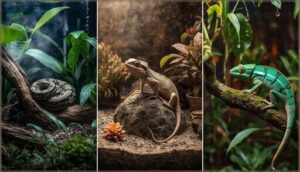
You can’t apply one-size-fits-all humidity levels across species—each reptile demands its own microclimate. Here’s what proven ball python care, bearded dragon health, and chameleon habitat research tells us about species-specific targets:
- Ball pythons thrive at 50–60% baseline, spiking to 70–80% during sheds
- Bearded dragons need arid 30–40% to prevent respiratory infections
- Panther chameleons require 50–60% daytime, 70%+ at night
- Veiled chameleons tolerate drier 30–40% days with humid nights
- Jackson’s chameleons prefer moderate 30–60% with strong airflow
Match your hygrometer readings to your animal’s native climate, not generic reptile humidity charts.
Signs of Improper Humidity in Reptiles
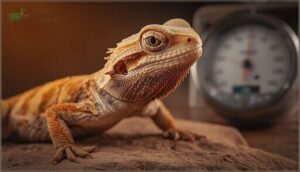
Your reptile’s body will tell you when humidity isn’t right—you just need to know what to look for. These warning signs range from minor annoyances during shedding to serious health threats that require immediate attention.
Understanding these symptoms helps you adjust conditions quickly, and choosing the right enclosure setup—including proper terrarium design that supports stable humidity—makes prevention much easier.
Let’s break down the three most common problems you’ll encounter and how to recognize them early.
Shedding Problems and Stuck Shed
When humidity dips below 35%, you’ll notice your reptile struggling with dysecdysis—the technical term for stuck shed. Look for patchy, adherent skin that won’t come off in one piece, especially around tail tips and digits where constricting bands can cut circulation.
Common Stuck Shed Warning Signs:
| Location | What You’ll See | Risk Level |
|---|---|---|
| Digits & tail tips | Constricting rings of dry skin | High—can cause tissue death |
| Spectacles (eyes) | Cloudy, wrinkled layers building up | Medium—impairs vision over time |
| Body & dorsum | Dull, patchy areas refusing to slough | Low to medium—signals poor conditions |
Humidity therapy works best: try 15-20 minute warm soaks followed by gentle rubbing with a damp cloth. Never force removal—soften first with moisture or your vet’s ophthalmic gel.
Long-term reptile dermatology shows maintaining species-appropriate humidity control (usually 35-70%) prevents recurrence better than any shedding aids after the fact.
Respiratory Infections and Symptoms
Wrong humidity levels don’t just cause shedding issues—they open the door to respiratory disease. You’ll catch early reptile pneumonia through these breathing disorders:
- Open-mouth breathing and wheezing: Your snake or lizard gasps, pops, or whistles with each breath
- Nasal discharge: Watch for mucus ranging from clear to thick, yellow-green secretions
- Lethargy and appetite loss: Reduced activity appears before obvious respiratory distress
Humidity therapy and infection control demand immediate veterinary attention—delayed treatment worsens prognosis markedly.
Dehydration and Fungal Issues
When humidity swings too far in either direction, you’re setting the stage for two opposing but equally dangerous health crises: dehydration from bone-dry air and fungal infections from swampy conditions.
Proper humidity control prevents both extremes, safeguarding reptile health through balanced moisture management.
| Humidity Imbalance | Health Impact |
|---|---|
| Too Low (Under 30%) | Dehydration signs: sunken eyes, wrinkled skin, lethargy |
| Too High (Over 80%) | Fungal infection: skin lesions, respiratory mycosis |
| Rapid Fluctuations | Reptile stress: weakened immunity, behavioral changes |
| Chronic Low | Kidney strain, metabolic dysfunction |
| Chronic High | Scale rot, respiratory pathogens |
Measuring Humidity in Reptile Enclosures
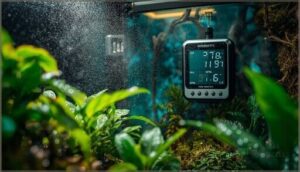
You can’t manage what you can’t measure—and regarding humidity, guessing just doesn’t cut it. Your reptile’s health depends on accurate readings, which means you need the right tools and know-how to use them properly.
Let’s break down the equipment options, where to place them, and how to keep them working reliably.
Digital Vs. Analog Hygrometers
You’ll find digital hygrometers deliver exceptional accuracy—generally ±1–2% compared to analog’s ±5%—making them essential for precise humidity control in your reptile habitat. Digital sensors respond within 10 seconds to humidity changes and display readings clearly, while analog devices can overestimate humidity levels by roughly 10 percentage points.
Though analog units don’t need batteries, digital hygrometers minimize humidity drift with proper sensor calibration, ensuring reliable measurement speed and device durability for sensitive species.
Hygrometer Placement for Accurate Readings
Accurate hygrometer placement transforms your humidity mapping from guesswork into science. Position your device at mid-height—never touching substrate or glass walls—to capture true airflow dynamics within your reptile habitat.
Keep sensors 1–2 inches from surfaces and away from heat sources that skew moisture gradients. Monitor multiple zones over several days to establish proper humidity baselines, ensuring your enclosure layout aids effective humidity control through strategic sensor calibration.
Calibration and Maintenance Tips
Even digital hygrometers drift over time, so device calibration every 3–6 months keeps your humidity levels honest. Use a salt-test kit or manufacturer standards to verify hygrometer accuracy within ±2–5%.
If you’re not sure your readings are trustworthy, this step-by-step guide to reading a humidity gauge walks you through spotting drift before it throws off your enclosure’s climate.
Schedule sensor cleaning with isopropyl alcohol and log each check in your maintenance scheduling routine. Consistent equipment upkeep ensures your misting and humidity control decisions stay grounded in real data—not drifting numbers.
Substrate Choices for Humidity Control
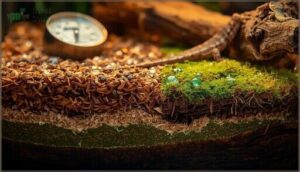
Your substrate isn’t just bedding—it’s the foundation of your entire humidity strategy. The material you choose determines how much moisture your enclosure holds, how quickly it dries out, and whether your reptile can maintain healthy hydration levels.
Let’s break down the key substrate types and how to use them effectively.
Moisture-Retentive Vs. Breathable Substrates
Your substrate choice shapes your reptile habitat’s humidity profile directly. Moisture-retentive options like coconut fiber and sphagnum moss hold several times their weight in water, creating elevated humidity zones perfect for tropical species and bioactive systems.
In contrast, breathable substrates—paper towels, newspaper, or arid mixes—limit water retention, supporting microclimate creation while preventing fungal growth in desert-adapted reptiles.
Using Coconut Fiber, Sphagnum Moss, and Alternatives
You’ll find coconut fiber (like Zoo Med Eco Earth) expands to 7–8 liters per brick when hydrated, holding moisture beautifully for tropical species. Sphagnum moss works as localized humidity zones in hides or mixed 10–20% by volume with coconut fiber.
Consider these proven combinations:
- Coconut fiber alone—damp for tropicals, dry for desert dwellers
- Sphagnum moss in humid hides—70–100% localized RH
- Mixed substrate—coconut fiber + sphagnum for ball pythons (60–80% range)
- Cypress mulch blends—moisture retention with aeration
- ABG bioactive mix—orchid bark, tree fern, peat, sphagnum, charcoal
Always monitor with your hygrometer and spot-clean weekly to prevent mold. Mix substrates to match your reptile habitat’s exact humidity levels without waterlogging.
Cleaning and Replacing Substrate
Damp, soiled substrate breeds bacteria and mold—threats to your reptile’s skin and lungs. Spot-clean daily, removing waste and replacing affected sections to preserve humidity levels without total overhauls.
Non-absorbent tiles need deep cleaning monthly; loose substrates require full replacement every 4–6 weeks in high-humidity setups.
Bioactive systems? Skip full changes—target problem zones, top-dress with fresh leaf litter, and monitor for mold or musty odors signaling immediate action.
Methods to Increase Humidity Levels
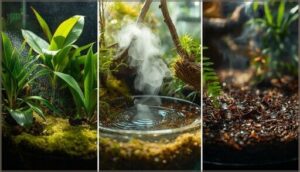
When your reptile’s humidity drops too low, you need practical ways to raise it quickly and safely. You have several reliable methods at your disposal, each with distinct advantages depending on your species and setup.
Let’s explore three proven techniques you can use to boost moisture levels in your enclosure.
Hand Misting Techniques
Hand misting gives you full control over your reptile’s humidity levels without complicated equipment. A basic trigger-bottle sprayer delivers targeted moisture when you need it—but technique matters more than you’d think.
Key hand misting essentials:
- Spray from above to mimic natural rainfall patterns, not directly at your reptile’s face
- Mist for several minutes until water runs off leaves and branches for adequate drinking opportunity
- Use fine mist nozzles under 100 microns to raise ambient humidity without over-saturating surfaces
- Check your hygrometer before and after sessions to confirm you’re hitting species-specific humidity targets
- Schedule two to three sessions daily for arboreal species requiring consistent moisture
Automated Misting and Fogging Systems
Automation takes the guesswork out of daily misting routines. Programmable misting timers deliver precise bursts at scheduled intervals, while fogging systems disperse ultrafine vapor for broad humidity coverage.
The best automated sprayers connect to humidity sensors and hygrometers, adjusting output when levels drop below your target.
Water recirculation features in premium foggers reduce refill frequency—essential for busy keepers managing multiple enclosures.
Water Bowls and Evaporation Strategies
Water bowls do double duty—hydration and passive evaporation. Larger, shallow bowls placed near your heat source boost evaporation rates faster than small, deep dishes tucked in cool corners.
Key evaporation strategies:
- Water Bowl Placement near warm zones accelerates moisture release into the air
- Bowl Maintenance with daily freshwater changes prevents bacterial buildup
- Microclimate Creation using multiple bowls establishes localized humidity chambers
Monitor changes with your hygrometer, adjusting bowl size and position until you hit target humidity levels.
Managing Humidity With Enclosure Design
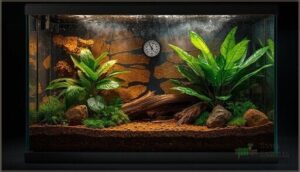
Your enclosure’s physical design shapes humidity just as much as misting or substrate choices. The materials you select, the airflow you allow, and the size of your setup all work together to create—or undermine—the moisture levels your reptile needs.
Let’s break down the key design decisions that’ll give you real control over your enclosure’s humidity.
Ventilation and Airflow Solutions
Your reptile enclosure needs balanced airflow, not maximum ventilation. Positioning vents low on the cool side and high on the warm end creates cross ventilation—passive air exchange that refreshes oxygen without stripping humidity. Target four to eight air changes per hour.
For stubborn heat or stagnant zones, add a small computer fan (55 CFM for most setups) to gently push airflow while preserving your thermal gradients and moisture levels.
Solid Tops Vs. Mesh Lids
Your choice between solid tops and mesh lids shapes humidity retention more than any misting schedule. Solid-topped PVC or wood enclosures hold moisture far longer—glass tanks with full mesh lose 30 to 50 percent of humidity through constant air exchange.
For tropical species, seal the top. Desert reptiles tolerate mesh, but partial coverage still improves stability and airflow management.
Enclosure Size and Microclimates
Larger enclosures don’t just offer more room—they create stable humidity gradients and distinct microclimate zones. A 4×2×2-foot setup can support both dry basking spots and humid retreat areas, letting your reptile habitat self-regulate.
Vertical stratification matters too: taller spaces develop natural moisture layers, with lower zones staying damper near substrate and water sources.
Spatial complexity through hides, plants, and varied enclosure depth amplifies these effects without constant misting or ventilation adjustments.
Creating Humidity Gradients and Microhabitats
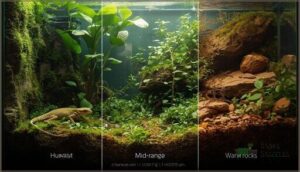
Your reptile doesn’t need one uniform humidity level throughout its enclosure—it needs choices. Creating a gradient with distinct microhabitats lets your animal self-regulate, moving between drier and damper zones as its body requires.
Here are three proven strategies to build those essential humidity options into your setup.
Humid Hides for Localized Moisture
A dedicated humid hide creates a microclimate where moisture lingers long after your enclosure-wide humidity drops.
Fill a plastic or resin hide with damp sphagnum moss or coconut fiber—these substrates grip water without dripping. Place it on the warm end so gentle heat evaporates moisture slowly.
Check humidity levels inside with a separate hygrometer probe, and swap substrate every two to four weeks to prevent mold.
Live Plants for Natural Regulation
Pothos, philodendrons, and ferns aren’t just décor—they’re living humidity machines. As roots pull water from bioactive substrates, leaves release vapor through transpiration, boosting ambient moisture by several percentage points and smoothing out daily humidity gradients.
Dense plantings can cut your misting frequency in half while creating natural microclimate pockets your reptile will instinctively seek.
Providing Multiple Humidity Zones
While plants smooth humidity swings, smart microclimate design gives each species what it needs. Humidity zoning divides your enclosure into distinct moisture pockets—think arid basking platforms paired with saturated humid hides—so desert and rainforest lovers can coexist without compromise.
- Position multi-zone systems with barriers or tall décor to contain humidity levels
- Use selective ventilation to prevent zone drift
- Place hygrometers in each pocket for moisture mapping
- Schedule zone maintenance to recalibrate after plant growth
Seasonal and Environmental Adjustments
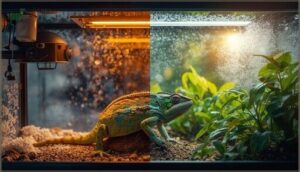
Your reptile’s enclosure doesn’t exist in a vacuum—it reacts to the world around it. Winter heating, summer air conditioning, and even seasonal breeding cycles all shift humidity in ways you need to anticipate.
Let’s walk through how to adapt your setup when the environment throws you a curveball.
Adapting to Climate and Room Changes
Your reptile’s enclosure doesn’t exist in a vacuum—room humidity and temperature fluctuations shift with seasons, HVAC cycles, and even window placement. Environmental adaptation starts with proactive airflow management and humidity control.
Recalibrate your humidity levels when you move tanks or adjust thermostats. Check your hygrometer after climate shifts, boost misting near vents, and tweak ventilation to counter dryness.
Monitoring During Shedding and Breeding
Track humidity levels closely during shedding cues—cloudy eye caps signal you need steady moisture, not sudden spikes. Boost misting slightly but avoid over-saturating, which invites mold and shedding problems.
For breeding humidity, stable zones support egg incubation and sperm viability.
Use your hygrometer with humidity logging to catch abrupt shifts that stress reptile health and skin health.
Preventing Rapid Humidity Fluctuations
Stability is your reptile’s best defense against stress-induced illness. Sudden humidity swings—dropping from 70% to 40% in minutes—trigger respiratory distress and shedding failures. Gradual Adjustments over hours, not minutes, protect physiological balance.
Pair Calibration Techniques with dual-zone humidity monitoring to catch unintended shifts early. Adjust misting frequency and ventilation incrementally, creating predictable Microclimate Management that fosters Stress Prevention and consistent humidity control year-round.
Essential Equipment for Humidity Maintenance
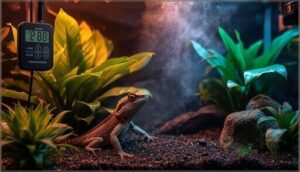
You can’t wing humidity control with guesswork and cheap tools. The right equipment transforms daily reptile care from constant stress into a smooth routine—accurate readings, consistent output, and fewer surprises.
Let’s break down the essential gear that keeps your enclosure dialed in year-round.
Recommended Hygrometers and Monitors
Accurate readings start with the right tools. Digital hygrometers deliver ±2% precision—far better than analog models—so you can trust your humidity monitoring. Place humidity sensors near basking spots and hides to capture real gradients.
Calibration tips: test against a 75% salt solution every six months.
High-end units offer data logging and alerts, ensuring your humidity control stays dialed in without constant guesswork.
Top Humidifiers and Foggers for Reptiles
You’ll need hardware that delivers consistent humidity without constant babysitting. Ultrasonic foggers like the Zoo Med Repti Fogger produce fine mist through a 3-foot hose and shut off automatically when empty—ideal for tropical species.
High-pressure misting systems such as the REPTI ZOO can connect up to 20 nozzles across multiple enclosures, offering timed cycles that mimic natural rainfall and maintain precise humidity control effortlessly.
Investing in Quality Products for Consistency
Think of quality equipment as insurance—not expense. You’ll want digital hygrometers with ±3-5% accuracy from proven brands, paired with calibrated controllers that don’t drift. Prioritize CE/UL-certified misting systems and foggers that specify tested humidity ranges.
Product research and brand comparison matter here: one reliable humidifier beats three cheap ones.
Regular equipment calibration and maintenance schedules keep your humidity control rock-solid long-term.
Frequently Asked Questions (FAQs)
Can reptiles sense humidity changes before humans detect them?
Yes, your reptile likely detects humidity shifts before you do. Chemosensory and thermosensory systems in their skin and mucosa register moisture changes, triggering behavioral responses—seeking humid hides or adjusting posture—well ahead of human perception.
Does humidity affect reptile egg viability during storage?
Humidity levels critically affect reptile egg viability. Maintaining 75-90% relative humidity minimizes water loss through species-specific eggshell permeability, while excessive moisture above 95% invites fungal growth and embryo mortality during storage conditions.
How does altitude impact reptile enclosure humidity requirements?
At higher elevations, atmospheric pressure drops and ambient air becomes drier. You’ll need stronger humidity control methods—targeted foggers, moisture-retentive substrates, and localized humid hides—to maintain proper humidity gradients in your reptile’s enclosure.
Are there natural humidity indicators besides commercial hygrometers?
You can observe animal behavior—like shedding issues or open-mouth breathing—as natural humidity indicators.
Plant cues, water evaporation rates, condensation patterns, and substrate moisture also reveal humidity levels without relying solely on commercial hygrometers.
Does water temperature influence evaporation rate and humidity?
Turning up the heat really does steam things up. Water temperature directly drives evaporation rate—warmer water releases vapor faster, boosting humidity levels.
That’s why heated water bowls and misting systems create effective microclimate management through thermal gradients.
Conclusion
Ironically, the smallest adjustment—a better hygrometer, a humid hide, or switching substrate—often solves what feels like an overwhelming problem. Understanding humidity needs for reptiles doesn’t require expensive equipment or higher education. It demands observation, consistency, and willingness to adapt.
Your reptile’s clouded eyes, smooth shed, and steady breathing tell you everything. Read those signs correctly, respond precisely, and you’ve mastered the invisible factor that separates surviving reptiles from thriving ones.