This site is supported by our readers. We may earn a commission, at no cost to you, if you purchase through links.

A thermostat failure at 3 a.m. doesn’t announce itself—your animal does, usually too late.
Most hobbyists learn this once, then never trust a basic on/off unit again.
The difference between a $20 controller and a proper proportional unit isn’t marketing; it’s ±3 °C of swing versus ±0.5 °C, and that margin matters when you’re keeping species with tight thermal tolerances.
Experienced keepers know that temperature precision drives everything downstream—feeding response, digestion, immune function, breeding cycles.
Choosing among reptile thermostats for experienced hobbyists means weighing control modes, probe accuracy, load capacity, and redundancy before anything else.
Table Of Contents
- Key Takeaways
- Key Features in Advanced Reptile Thermostats
- Proportional Vs. Non-Proportional Thermostat Technologies
- Smart Monitoring and Remote Access Features
- Top 10 Reptile Thermostats for Experienced Hobbyists
- 1. Exo Terra Electronic Terrarium Thermostat
- 2. Vivosun Digital Heat Mat Thermostat
- 3. iPower Digital Heat Mat Thermostat
- 4. BN Link Reptile Thermostat Controller
- 5. Bayite Digital Temperature Controller Thermostat
- 6. Willhi Digital Temperature Controller
- 7. Hydrofarm Digital Heat Mat Thermostat
- 8. Aiicioo Reptile Heat Mat with Thermostat
- 9. SensorPush HT1 Temperature Humidity Sensor
- 10. Flukers Digital Thermometer Hygrometer
- Matching Thermostat Type to Your Heating Setup
- Probe Placement Strategies for Accurate Readings
- Maximizing Safety and Redundancy in Reptile Heating
- Installation, Calibration, and Ongoing Maintenance
- Frequently Asked Questions (FAQs)
- What are the different types of thermostats for reptiles?
- Can you use a thermostat with a basking bulb?
- How do reptile thermostats affect breeding cycles?
- Can thermostats integrate with smart home systems?
- What warranty options do reptile thermostats offer?
- How do thermostats perform in bioactive enclosures?
- Are reptile thermostats safe for venomous species setups?
- How do I winterize a thermostat for brumation?
- Can one thermostat run multiple enclosures safely?
- What humidity ranges pair with temperature control?
- Conclusion
Key Takeaways
- thermostat’s control mode to your heat source — pulse for mats and ceramics, dimming/PID for basking bulbs — is what separates a stable enclosure from a frustrating one.
- The gap between a $20 on/off controller and a proportional unit isn’t marketing; it’s the difference between ±3 °C swings and ±0.5 °C precision that directly affects feeding, digestion, and breeding cycles.
- Probe placement determines what your thermostat actually controls — position sensors where your animal rests, not where it’s convenient, and verify readings weekly against an independent thermometer.
- No single thermostat is enough; layer thermal fuses, high/low alarms, and a UPS with 20–25% wattage headroom to catch the failures your primary controller will eventually miss.
Key Features in Advanced Reptile Thermostats
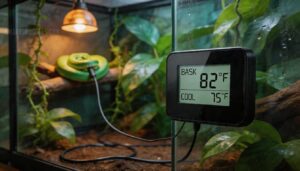
Not every thermostat deserves a spot in an experienced keeper’s setup. The features that separate a solid unit from a frustrating one come down to five things worth knowing before you buy.
Before committing to any unit, it’s worth checking this breakdown of thermostats built specifically for vacation home setups to see how each feature holds up in real-world use.
what to look for.
Temperature Control Modes (On/Off, Pulse, Dimming)
Three control modes define how your thermostat controls heat. On/off switches are fully on or off, creating 2–4 °C swings — simple, low cost, but imprecise. Pulse proportional mode fires short bursts, holding temperature within ±0.5 °C with faster response time and minimal noise. Dimming (PID) modulates voltage continuously, maximizing mode energy consumption efficiency for basking lamps up to 300 W.
mode compatibility matrix to your heat source.
Thermostat 300W provides precise temperature regulation for reptile terrariums.
Probe Types and Placement Options
Control mode shapes how heat is delivered — but placement determines what your thermostat actually reads. Stainless steel probes handle high-humidity builds without probe drift mitigation issues. Tape-mount sensors lock flat against basking surfaces for precise surface contact. Elevated perch placement captures true ambient temperature for arboreal species.
- Match cable length selection to enclosure depth
- Secure every probe to prevent positional drift
- Position sensors where your animal actually rests
Multi-Device Control and Outlet Configuration
Probe placement locks in accuracy — but when you’re managing a multizone heating setup, one thermostat often isn’t enough. Host-client architecture lets one device coordinate up to two clients, centralizing control without chaos.
Use outlet naming conventions to track every socket clearly. Independent outlet scheduling, group scene automation, priority power allocation, and dual relay outputs give you precise, load-balanced control across the whole enclosure network.
Power Handling and Load Capacity
Once your outlets are mapped, the next question is raw power.
Most reptile thermostats handle 100–600 W, but high‑wattage thermostats like the Ve‑300 series reach 1500 W.
Never load a unit to its ceiling — Wattage Headroom and Thermostat Rating Margins matter.
Inrush Current Management and Current Surge Tolerance protect contacts during startup spikes.
Apply smart Load Distribution Strategy and dual outlet load balancing strategies to keep electric load capacity well within limits.
Safety Certifications and Overheat Protection
Wattage limits mean nothing if the unit fails dangerously. Look for ETL Testing or UL Certification on the label — these confirm independent electrical safety evaluation. CE Marking covers EU standards.
Inside, a Thermal Fuse acts as a permanent one-time backup; a Self-Resetting Cutout mitigates recoverable faults. Overheat relay protection and temperature alarm thresholds form redundant safety systems that enforce safety protocols to prevent thermal runaway before conditions become critical.
Proportional Vs. Non-Proportional Thermostat Technologies
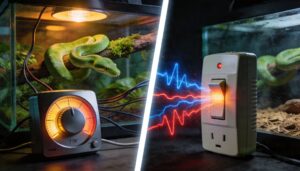
Not all thermostats handle temperature the same way — and that difference matters more than most keepers realize. The technology behind how a unit maintains your set point directly affects animal health, equipment lifespan, and your electricity bill.
Here’s how proportional and non-proportional control stack up.
How Hysteresis Affects Temperature Stability
Hysteresis is the hidden variable most keepers overlook. Your thermostat’s deadband width tradeoff is straightforward: narrow the band, tighten temperature stability, but raises switching frequency impact on relays. Widen it, and equipment wear balance improves — but temperature swing effects grow.
| Factor | Narrow Band |
|---|---|
| Temperature accuracy | ±0.5 °C |
| Switching frequency | High |
| Relay wear | Accelerated |
| Sensor lag effects | Amplified |
| Thermal inertia interaction | Overshoot risk |
A proportional thermostat sidesteps this entirely. Temperature hysteresis reduction techniques start with sensor placement — because the deadband is only as stable as your probe’s signal.
Pulse Proportional Control for Heat Mats and Ceramics
Pulse proportional thermostats deliver heat in timed bursts — not a blunt on/off switch.
That pulse frequency optimization matters most with heat mats and ceramics, where thermal mass holds residual heat between cycles.
Thermal lag mitigation keeps readings tight, and component longevity improves because relays cycle less aggressively.
| Factor | Heat Mat | Ceramic Emitter |
|---|---|---|
| Thermal mass | Low–Medium | High |
| Pulse response | Fast | Gradual |
| Temperature sensor accuracy | ±0.5 °C | ±0.5 °C |
| Noise reduction | Moderate | High |
| Energy savings | Moderate | Significant |
PID Dimming for Basking Lamps and Energy Efficiency
PID control doesn’t guess — it calculates. Dimming thermostats measure actual basking lamp output, then adjust voltage continuously to hold your setpoint within ±0.5 °C.
That precision delivers real light consistency for diurnal species and cuts filament stress dramatically. Less hard cycling means better lamp longevity — 8 to 12 months versus far shorter with on/off switching. Thermal efficiency improves too, since power savings come from never running full wattage unless the enclosure actually needs it.
PID dimming extends lamp life to 8–12 months by running only the wattage your enclosure actually needs
| Factor | PID Dimming | On/Off Control |
|---|---|---|
| Temperature accuracy | ±0.5 °C | ±2–4 °C |
| Basking lamp longevity | 8–12 months | Considerably shorter |
| Energy efficiency | High | Lower |
Choosing The Right Mode for Your Heat Source
Match the mode to the heat source — not the other way around. Heat mats and ceramics pair with pulse for tight temperature swing minimization. Basking bulbs need dimming or PID to protect bulb longevity and manage power surges smoothly.
| Heat Source | Best Mode | Mode Stability Tradeoffs |
|---|---|---|
| Heat mat | Pulse | Narrow swing, no flicker |
| Ceramic emitter | Pulse/On-Off | Stable, slight lag |
| Basking bulb | Dimming/PID | Precise, extends bulb life |
| Radiant panel | Pulse/Dimming | Consistent output |
| Heat tape | Pulse/Dimming | Requires higher load rating |
Heat source matching through correct temperature control modes — pulse, dimming, or dual outlet — keeps your setup stable and your animals safer.
Smart Monitoring and Remote Access Features
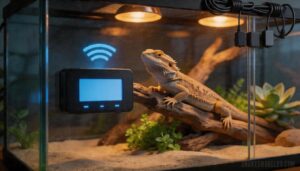
Modern smart thermostats go well beyond simple temperature control. Wi-Fi connectivity, data logging, and remote alerts give you a level of oversight that’s hard to match with analog setups.
Here’s what to look for in each of these features.
Wi-Fi Connectivity and App-Based Control
Wi-Fi thermostats connect over the 2.4 GHz Band using QR Code Pairing — setup takes under a minute.
Your remote monitoring app then gives you full control from anywhere with internet. Change set points, receive remote alerts, and share access through Multi‑User Permissions. Geolocation Triggers can automate schedule shifts when you leave home.
Cloud Firmware Updates keep the system current without manual intervention.
Data Logging and Trend Analysis
Beyond remote control, app‑based logging captures your enclosure’s full thermal history. Sampling Interval Optimization lets you record every 30 seconds during heat-up cycles or every 10 minutes for overnight basking.
Multi-Channel Correlation ties temperature and humidity together on one Visualization Dashboard Design.
Long-Term Drift Analysis and Anomaly Detection Algorithms flag subtle probe shifts before they become real problems.
CSV export keeps your records portable.
Remote Alerts and Push Notifications
All that logging data means nothing if you’re not notified when something goes wrong.
Remote alert systems depend on proper Notification Permissions — deny access on iOS or Android 13+, and push delivery stops cold.
Payload Design determines whether your app triggers sound, badge, or a heads-up alert.
Delivery Services like FCM and APNs handle routing, but set Priority Levels to urgent and configure Expiration TTL so stale alerts don’t pile up while you’re away.
Smart Home Integration (IFTTT, Home Assistant)
Alerts do the heavy lifting — but pairing your IoT thermostat with IFTTT or Home Assistant takes control further. Cross-Platform Triggers let one temperature breach cascade into real actions:
- Cut power to secondary devices via WiFi automation
- Trigger Voice Assistant Integration for hands‑free status checks
- Share Automation Blueprint sharing configs across enclosures
Local Cloud Balance keeps core functions running even offline — smart monitoring and remote access for reptile enclosures, without a single‑point failure.
Top 10 Reptile Thermostats for Experienced Hobbyists
Finding the right thermostat comes down to matching real specs to your actual setup — not guesswork. Each pick below earned its spot through wattage capacity, control precision, and long-term reliability.
Here’s what experienced keepers are running in 2026.
1. Exo Terra Electronic Terrarium Thermostat
The Exo Terra PT2456 supports ON/OFF, pulse proportional and dimming modes in one unit — that’s rare at $34.95. Its 6-ft waterproof probe works in high-humidity builds without drifting.
The recessed dial prevents accidental setpoint changes during routine maintenance. Don’t pair it with light-emitting bulbs; the manual is explicit, and ignoring that warning risks inaccurate control.
Load limit is 300W, so verify your ceramic or heat mat falls within range before wiring it in.
| Best For | Reptile keepers who use non-light heat sources like heat mats or ceramic heaters and need accurate, stable temps in humid or aquatic setups. |
|---|---|
| Price | $34.95 |
| Temperature Display | Analog dial |
| Sensor Probe | 6 ft waterproof |
| Power Source | 120V AC |
| Housing Material | Plastic |
| Temp Unit Selection | No |
| Additional Features |
|
- Waterproof probe handles high-humidity and wet environments without losing accuracy
- Recessed dial keeps your temperature setting locked in during routine tank maintenance
- Electronic control holds the set point more precisely than old-school thermostats at a solid price point
- Can’t be used with heat bulbs or any light-emitting source — that’s a hard limit
- Some users report early unit failures, so long-term reliability is a bit of a question mark
- Only controls temperature; you’ll need separate gear for humidity and lighting
2. Vivosun Digital Heat Mat Thermostat
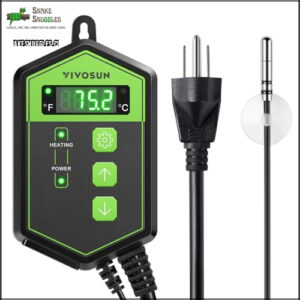
The Vivosun Digital Heat Mat Thermostat keeps things simple — and sometimes that’s exactly what you need. It controls loads up to 1000 W across a 40–108 °F range, with ±0.9 °F accuracy.
The 6.4-ft sensor probe reaches most enclosure setups without straining the cord. No Wi‑Fi, no app — just a three-button interface and an LCD readout.
At $18.99, it’s a reliable on/off controller for heat mats where pulse or dimming control isn’t required.
| Best For | Hobbyists and small-scale growers who want straightforward heat mat control without the fuss of smart features or complicated setup. |
|---|---|
| Price | $18.99 |
| Temperature Display | LCD |
| Sensor Probe | Integrated |
| Power Source | 230V AC |
| Housing Material | Plastic |
| Temp Unit Selection | Yes |
| Additional Features |
|
- Dead simple three-button interface — no learning curve, just set your temp and go
- Works with any standard heat mat, so you’re not locked into one brand or setup
- Tough plastic housing holds up well in humid grow spaces where metal would rust
- No app or remote monitoring, so you have to physically check and adjust it on-site
- Capped at 108 °F, which won’t cut it if your setup needs higher temps
- LCD can be tough to read under bright grow lights
3. iPower Digital Heat Mat Thermostat
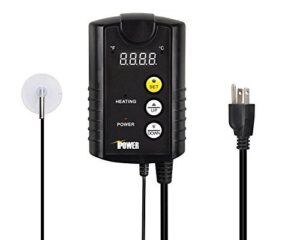
The manages loads up to 1000 W across a 40–108 °F range — the same core specs as the Vivosun, but with a metal housing that feels more durable in humid setups.
The copper sensor probe reads accurately down to 0 °C, and error codes E1, E2, and E3 flag out-of-range temps or sensor failure immediately.
Settings survive power loss.
At roughly $20, it’s a no-frills on/off controller built for heat mats, not basking lamps.
| Best For | Gardeners, reptile owners, and hobbyist brewers who need a reliable, no-fuss thermostat to keep a heat mat at a steady temperature. |
|---|---|
| Price | Not specified |
| Temperature Display | Digital LCD |
| Sensor Probe | Included |
| Power Source | 120V AC |
| Housing Material | Metal |
| Temp Unit Selection | Yes |
| Additional Features |
|
- Metal housing holds up better in humid environments than plastic alternatives
- Copper sensor probe catches temperature issues fast with clear E1/E2/E3 error codes
- Handles up to 1000 W, so it works with most standard heat mats right out of the box
- Only does on/off control — it can’t fine-tune or boost heat output
- Sensor probe can’t get wet, which limits placement options in some setups
- Tops out at 108 °F, so it won’t work for applications that need higher temperatures
4. BN Link Reptile Thermostat Controller
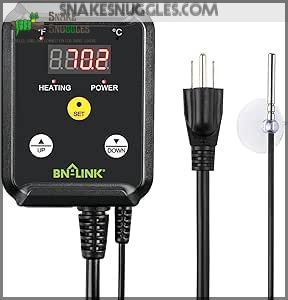
BN-Link BNQ-T7H keeps things simple — and sometimes that’s exactly what you need. It controls loads up to 1000 W across a 40–108 °F range, with a 4.92 ft probe and a clean three-button interface.
ETL listed, 120 VAC only. The LCD backlight and LED indicators make monitoring straightforward at a glance.
It’s an on/off controller, so expect 2–4 °C swing. heat mats.
basking lamps.
| Best For | Hobbyists running reptile tanks, seed-starting mats, fermentation setups, or small brooders who just need reliable, no-fuss heating control. |
|---|---|
| Price | Not specified |
| Temperature Display | Digital LCD |
| Sensor Probe | 4.9 ft removable |
| Power Source | 120V AC |
| Housing Material | Plastic |
| Temp Unit Selection | Yes |
| Additional Features |
|
- Simple three-button setup with a clear LCD backlight — easy to read and use right out of the box.
- Comes with a nearly 5 ft probe, giving you decent flexibility on where to place the sensor in your enclosure.
- ETL listed and handles up to 1000 W, so it covers most common heating mats and pads without issue.
- Only controls heating — no cooling support, which limits it if your setup needs two-way temperature management.
- Tops out at 108 °F, which won’t cut it for species or applications that need higher temps.
- On/off cycling means a 2–4 °C temperature swing, and some users have reported inconsistent performance over time.
5. Bayite Digital Temperature Controller Thermostat
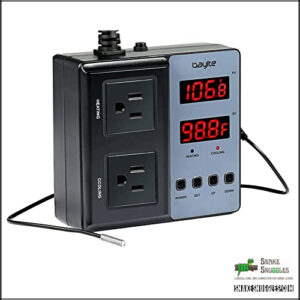
The Bayite BTC211 does something most single-unit controllers can’t — it manages heating and cooling simultaneously through dual relay outputs, each rated at 1100 W on 110 V.
That matters when your setup demands tight temperature swings.
The adjustable differential runs from 0.1 °F to 25 °F, so you dial in exactly the hysteresis you need.
Its 9.8 ft waterproof probe covers large enclosures, and the measurement range of –58 °F to 230 °F makes it genuinely adaptable across species.
| Best For | Hobbyists and small-scale growers who need to control both heating and cooling in one unit — think reptile enclosures, fermentation setups, or seasonal pool equipment. |
|---|---|
| Price | Not specified |
| Temperature Display | Dual-window LCD |
| Sensor Probe | 3 m waterproof |
| Power Source | 110V AC |
| Housing Material | Plastic |
| Temp Unit Selection | Yes |
| Additional Features |
|
- Dual relay output lets you run a heater and cooler at the same time from one controller, no extra hardware needed.
- The 9.8 ft waterproof probe gives you flexible placement, and the wide temperature range covers just about any use case.
- Built-in alarms and compressor delay protection help keep your equipment safe from temperature swings.
- The controller itself isn’t waterproof, so you’ll need to keep it sheltered even if the probe is out in the elements.
- Capped at 1100 W per relay on 110 V — fine for small setups, but won’t cut it for larger HVAC units.
- SmartThings integration sounds handy, but it may need a compatible hub and extra setup to actually work.
6. Willhi Digital Temperature Controller
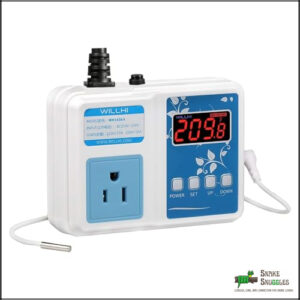
The Willhi WH1436A keeps things simple — and that’s exactly the point: plug-and-play setup, no wiring required, and a 9.8 ft waterproof probe that covers most enclosure sizes without repositioning hassle.
It reads from –58 °F to 230 °F at 0.1 °F resolution, with ±0.5 °F accuracy.
Temperature alarms are built in, though disabled by default — enable them.
Settings survive power loss, so your setpoint doesn’t reset after an outage.
For on/off control up to 1100 W, it’s reliable and straightforward.
| Best For | Anyone who needs simple, reliable temperature control for brewing, fermentation, seedling germination, or small enclosures without dealing with wiring or complex setup. |
|---|---|
| Price | Not specified |
| Temperature Display | Digital LCD |
| Sensor Probe | 3 m waterproof |
| Power Source | 110V AC |
| Housing Material | Plastic |
| Temp Unit Selection | Yes |
| Additional Features |
|
- Plug-and-play with no wiring — just plug in your heater or cooler and go
- Remembers your settings after a power outage, so no reprogramming needed
- Works for both heating and cooling with tight 0.1 °F resolution and solid ±0.5 °F accuracy
- 110 V only, so it won’t work in countries or setups using 220 V power
- Tops out at 1100 W, which rules out higher-draw appliances
- No wireless connectivity — all adjustments have to be made by hand on the unit
7. Hydrofarm Digital Heat Mat Thermostat
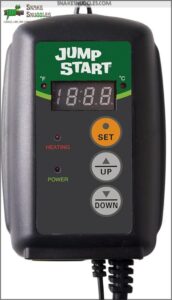
The Hydrofarm Digital Heat Mat Thermostat is purpose-built for one job — and it does it well. Rated at 1000 W and 8.3 A, it manages most heat-mat setups without breaking a sweat.
The adjustable range runs 68 °F to 108 °F, with a 6-ft water-resistant stainless-steel probe you position directly in the root or rest zone.
ETL-certified, three-prong grounded, and easy to read via LED indicators.
No Wi-Fi, no pulse mode — just reliable on/off control where simplicity is the right call.
| Best For | Growers, reptile keepers, and homebrewers who want simple, reliable temperature control without any complicated setup. |
|---|---|
| Price | Not specified |
| Temperature Display | Digital LCD |
| Sensor Probe | 6 ft stainless steel |
| Power Source | 120V AC |
| Housing Material | Plastic |
| Temp Unit Selection | Yes |
| Additional Features |
|
- Covers a wide temp range (68°F–108°F) with easy up/down adjustments and a clear LED display
- ETL-certified with a grounded plug and water-resistant probe — solid safety credentials
- Handles up to 1000 W, so you can run multiple heat mats off one controller
- No built-in timer, so scheduled on/off cycles mean buying extra hardware
- The 6-ft probe can feel bulky in smaller trays and needs careful placement to read accurately
- Tops out at 1000 W, which limits how many mats you can run at once
8. Aiicioo Reptile Heat Mat with Thermostat
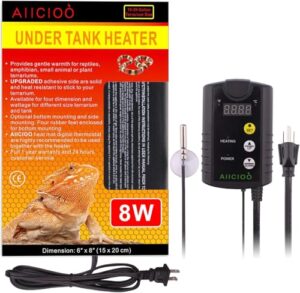
Where the Hydrofarm keeps things industrial, the Aiicioo targets hobbyists who want a complete starter kit.
The combo includes a 6 × 8 in, 8 W heat mat plus a digital thermostat — plug-and-play out of the box.
The control range runs 68 °F to 108 °F, accurate enough for pixie frogs and hermit crabs.
Mount it under the tank or on the side using the adhesive backing.
Glass only — no acrylic, no wood, no exceptions.
| Best For | Reptile and amphibian hobbyists who want a simple, all-in-one heating solution right out of the box. |
|---|---|
| Price | Not specified |
| Temperature Display | Digital LCD |
| Sensor Probe | Included |
| Power Source | 120V AC |
| Housing Material | PVC/Plastic |
| Temp Unit Selection | Yes |
| Additional Features |
|
- Comes as a combo — heat mat and digital thermostat included, so there’s nothing extra to buy
- Flexible mounting options (bottom or side) fit a variety of terrarium setups
- Digital thermostat makes it easy to dial in the right temp for your specific animal
- Only works on glass tanks — acrylic, wood, and plastic are all off-limits
- The 6 × 8 in pad is on the smaller side, so it may not cut it for larger enclosures
- Covering the pad is a no-go, which can limit how you arrange substrate or décor near it
9. SensorPush HT1 Temperature Humidity Sensor
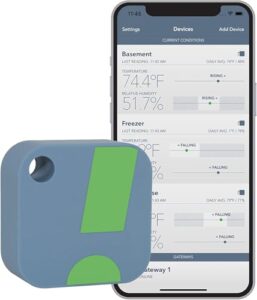
The SensorPush HT1 isn’t a thermostat — and that distinction matters. It’s a monitoring device, measuring temperature to ±0.3 °C and humidity to ±3% RH, logging data every minute for up to 20 days onboard.
Pair it with the optional G1 Gateway and you get remote alerts from anywhere.
For tracking overnight humidity swings or verifying your thermostat’s accuracy independently, it’s hard to beat.
Small enough at 40 mm × 40 mm to mount inside almost any enclosure.
| Best For | Anyone who wants reliable, hands-off temperature and humidity tracking — think wine cellars, instrument cases, freezers, or greenhouses — especially if you need data logs you can actually export and analyze. |
|---|---|
| Price | Not specified |
| Temperature Display | App only |
| Sensor Probe | None |
| Power Source | CR2477 battery |
| Housing Material | Plastic |
| Temp Unit Selection | Yes |
| Additional Features |
|
- Solid accuracy (±0.3 °C / ±3% RH) with 20 days of onboard logging and unlimited cloud storage via the free app
- Tiny footprint with a mounting hole, so it fits just about anywhere — inside enclosures, on walls, or tucked into tight spaces
- Two-year battery life means you can set it and forget it, even in hard-to-reach spots
- No built-in display — you’re fully dependent on your phone to see any data
- The 325 ft Bluetooth range is best-case; walls and metal will shrink that fast
- Remote alerts and internet access require buying the G1 Gateway separately, which adds to the cost
10. Flukers Digital Thermometer Hygrometer
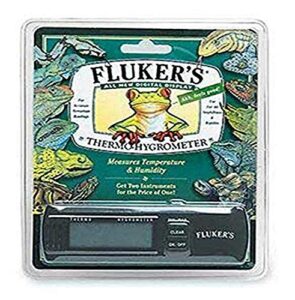
Where the SensorPush logs, the Fluker’s Digital Thermometer Hygrometer reads — right now, on the wall of your enclosure.
It tracks both temperature (32–122 °F) and humidity (10–99% RH) on one small LCD unit, with MAX/MIN memory so you can catch overnight swings.
Accuracy runs ±3 °F and ±5–10% RH, so don’t treat it as your primary control device. Use it as a quick-check backup.
At $31.60, it earns its spot.
| Best For | Reptile and amphibian owners who want a simple, affordable way to keep an eye on temperature and humidity without spending big on a full monitoring system. |
|---|---|
| Price | $31.60 |
| Temperature Display | Digital LCD |
| Sensor Probe | None |
| Power Source | Battery |
| Housing Material | Plastic |
| Temp Unit Selection | No |
| Additional Features |
|
- Tracks both temperature and humidity on one compact unit — no need for two separate devices
- MAX/MIN memory lets you catch overnight swings without watching it all night
- Adhesive or Velcro mounting makes it easy to reposition as your enclosure layout changes
- Accuracy variance (±3 °F and ±5–10% RH) means it’s better as a backup than a primary control device
- Adhesive can stick too well — if it falls, it could injure small pets
- Some users reported humidity readings failing after just a month of use
Matching Thermostat Type to Your Heating Setup
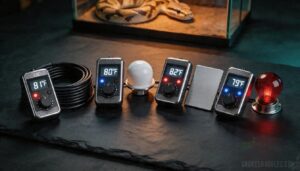
Not every thermostat works well with every heat source — the wrong pairing causes temperature swings, wasted energy, and shorter equipment life. Knowing which control mode fits your specific setup is what separates a stable enclosure from a frustrating one.
Here’s how each heating element matches up.
Heat Mats and Ceramic Emitters
Heat mats and ceramic emitters are non-light heat sources — and that distinction drives every thermostat decision. Both pair best with on/off or pulse proportional control.
Pulse mode improves heat distribution uniformity and extends ceramic emitter lifespan by avoiding thermal cycling stress.
For mat placement safety, position your probe at the warm zone, not on the element itself.
digital thermostat rated above your mat’s wattage manages temperature regulation and energy efficiency without strain.
Basking Bulbs and Radiant Heat Panels
Basking lamps and radiant heat panels demand different thermostat strategies. A dimming thermostat matches a basking lamp’s light spectrum and beam angle precisely — it modulates voltage smoothly, avoiding temperature cycling that shortens filament life.
Mounting height affects thermal inertia, so your probe placement matters.
Radiant panels pair well with pulse or dimming control.
Dual outlet controllers let you run both simultaneously for species lighting that mirrors natural gradients.
High-Wattage Heat Tape and Large Enclosures
Run Length Optimization starts with knowing your load. A 12-inch heat tape draws roughly 23 watts per foot — at 36 feet, you’re pushing 828 watts. This demands a thermostat rated at 1000 watts minimum for safe headroom.
Never overlap tape; that’s Overlap Prevention Safety in practice. Keep runs under 36 feet, with the probe flat on the tape, to ensure compliance.
Maintain your Enclosure Gradient Management with one-third maximum floor coverage. This balances efficiency and safety across the system.
Dual-Stage Control for Heating and Cooling
Some species need cooling as much as heating — that’s where a dual-stage thermostat earns its place. Stage Sequencing Logic activates heating first, then triggers an Independent Cooling Relay only when temperatures keep climbing.
Adaptive Setpoint Change and Temperature Differential Control minimize swings. Combined with PID control and temperature hysteresis reduction techniques, Dual-Stage Load Balancing manages both outputs cleanly.
Temperature alarm features flag failures before conditions become dangerous.
Probe Placement Strategies for Accurate Readings
Your thermostat can be perfectly calibrated and still fail you if the probe is in the wrong spot. Placement determines what your controller actually reacts to — and that changes everything for your animal’s health.
Here’s what you need to know about positioning probes correctly for your setup.
Surface Vs. Ambient Temperature Monitoring
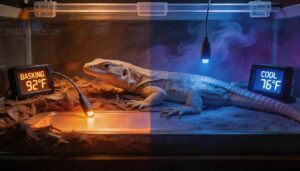
Surface probe accuracy and ambient gradient mapping solve different problems — don’t treat them as interchangeable. A heat mat surface sensing probe reads what your reptile actually contacts; an ambient probe captures the air temperature range surrounding it.
Rapid surface fluctuations from airflow impact won’t show on ambient readings alone. Dual sensor validation confirms both zones are stable, giving you a complete picture of your temperature gradient before problems develop.
Dual-Probe Configurations for Gradient Control
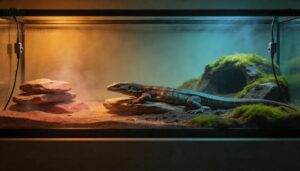
One thermostat, two zones — that’s the real advantage of a dual-probe setup. Each sensor locks onto its own zone setpoint, and probe pairing logic ties each probe directly to a separate outlet. No cross-zone compensation guesswork.
- Fix probe placement accuracy at the hot end and cool end separately
- Thermal lag balancing lets the warm side cycle harder while the cool side drifts
- Dual-stage thermostat wiring schemes eliminate Y-splitters in multi-zone builds
- Dual heating and cooling capability provides precise gradient precision across long enclosures
Probe Placement for Arboreal and Terrestrial Species
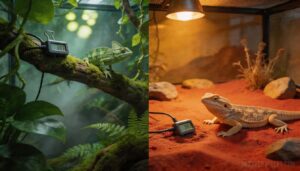
Arboreal and terrestrial enclosures demand completely different probe placement strategies for accurate temperature readings.
In a bioactive arboreal build, vertical gradient positioning is everything — fix your temperature probe high on the branch wall, mounting near the canopy, where the animal actually spends time.
For terrestrial reptile enclosure design, ground-level probe alignment directly under the basking zone gives you true heat source proximity and real perch-mounted sensor control.
Avoiding Common Probe Positioning Mistakes
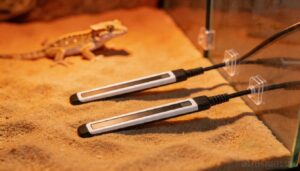
Even probe placement falls apart when the angle is wrong. Keep the sensor flat — a tilted probe reads a different surface than your reptile actually contacts.
Secure contact matters too: air gaps skew readings quickly. Route cables cleanly to prevent drift after maintenance.
Run verification checks with a backup thermometer, comparing readings at the same time daily. Proper distance from the heat source seals everything.
Maximizing Safety and Redundancy in Reptile Heating
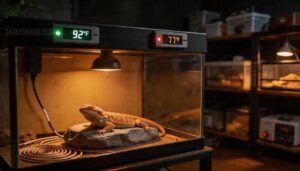
good thermostat does most of the heavy lifting, but it’s never your only line of defense. Experienced keepers layer multiple safeguards to catch what any single device might miss.
Here’s what that redundancy actually looks like in practice.
Preventing Overheating and Thermal Runaway
Thermal runaway doesn’t announce itself — it builds quietly until your basking zone hits dangerous levels. Your thermostat’s first line of defense is accurate probe placement, but that’s not enough alone.
- Thermal Fuse Integration cuts power at a fixed threshold, independent of the controller.
- Redundant Cutoff Switch adds a second failsafe if the primary relay sticks.
- Heat Sink Ventilation prevents internal component failure from continuous load.
- Current Surge Protection guards against relay-welding spikes that lock heat on.
- Probe Drift Compensation catches sensor creep before it lets temperatures climb unchecked.
High and Low Temperature Alarm Systems
A failsafe that cuts power means nothing if you don’t know why it tripped.
That’s where high/low temperature alarms earn their place.
Set your alarm threshold settings independently — upper and lower — and enable latching alarm behavior so excursions stay logged even after temperatures recover.
Hysteresis band settings prevent false triggers near the limit.
Multi-channel alerts, display feedback, and temperature logging complete your monitoring loop.
Backup Power and UPS Solutions
Alarms alert you — but only power keeps your animals alive through an outage.
Battery Runtime Planning starts with one formula: watt-hours divided by load watts.
A 600 W heating setup drains a small UPS fast.
That’s why UPS Topology Selection matters — line‑interactive units add voltage regulation without burning battery reserves on minor fluctuations.
- Lithium-ion Advantages include higher energy density and longer cycle life than lead‑acid alternatives.
- Remote UPS Monitoring lets you track battery voltage and load status before an outage exposes a weak cell.
- Transfer Bypass Safety keeps your heating elements running during inverter faults — without backup protection.
Size for 20–25% headroom above your actual draw.
Using Independent Thermometers for Verification
thermostat is only as trustworthy as its probe. A secondary thermometer placed at the same spot gives you a direct cross-check — this is the core of Cross-Check Methodology and aligns with NIST Calibration Standards for single-point verification.
Check weekly for Probe Drift Detection. digital thermometer readings that diverge by more than 1 °F signal recalibration.
Temperature probe placement matters: wrong position hides dangerous hot spots entirely.
Installation, Calibration, and Ongoing Maintenance
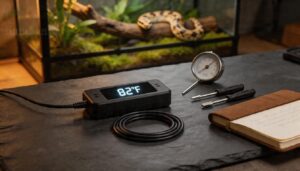
Getting your thermostat installed correctly is half the battle — the other half is keeping it accurate over time. A few focused steps cover everything from first-time setup to weekly checks that catch problems before your animals feel them.
Here’s what experienced keepers do at every stage.
Initial Setup and Stabilization Best Practices
Getting the initial power-up sequence right saves hours of troubleshooting later. Before flipping the switch, complete these three steps:
- Route and secure probe cable management away from glass walls and substrate.
- Allow heat source pre-heat to run 2–3 hours for warm-up duration guidelines to apply.
- Monitor system drift across the warm, middle, and cool zones.
Probe placement strategies for accurate temperature readings matter most here — position the sensor where your animal actually rests.
Calibrating Thermostat Accuracy to ±0.5 °F
Accurate calibration starts with Reference Thermometer Selection — pick a unit with better accuracy than your thermostat. Ice Bath Calibration gives you a fixed 32.0 °F reference point. Run the Offset Adjustment Procedure in small steps until digital thermostat accuracy holds within ±0.5 °F.
| Step | Action | Target |
|---|---|---|
| Reference Check | Compare against calibrated thermometer | ±0.5 °F match |
| Ice Bath | Submerge probe in ice water | 32.0 °F confirmed |
| Stability Verification | Monitor reading for 15+ minutes | Steady, no drift |
Calibration Log Maintenance catches sensor drift before it costs an animal.
Programming Day/Night Temperature Cycles
Day/night temperature cycles are the backbone of realistic reptile husbandry. Set your Cycle Timing Settings first — enter current time, then day start, then night start.
From there, dial in your Night Drop Calibration and User-defined Temperature Profiles for each season.
- Enable Gradual Power Shift so basking lamps dim smoothly
- Use Schedule Sync via WiFi for consistent day/night temperature cycles
- Program seasonal simulation profiles for species needing winter cooling
Weekly Maintenance and Probe Integrity Checks
Weekly maintenance takes maybe ten minutes, but it prevents the failures that matter most. probe tips with isopropyl alcohol weekly — contamination shifts readings fast.
Your Cable Inspection Schedule should catch cuts, kinks, or loose connectors before they misread the enclosure. Recheck Mounting Security so probes stay in the control zone.
Cross Check readings against an independent thermometer to maintain accuracy ±0.5°F.
Frequently Asked Questions (FAQs)
What are the different types of thermostats for reptiles?
There are five main types: on/off, pulse proportional, dimming, dual-stage, and digital thermostat models.
Each manages heat differently, balancing energy efficiency, cost analysis, and control precision for your specific setup.
Can you use a thermostat with a basking bulb?
Yes, but only with a dimming thermostat.
It gradually reduces voltage instead of switching the bulb off repeatedly, which improves heat distribution uniformity, extends bulb lifespan, and keeps your basking lamp stable.
How do reptile thermostats affect breeding cycles?
Thermostats are the quiet conductor behind every breeding cycle. Precise brumation scheduling, hormonal triggers, incubation stability, and sex ratio outcomes all hinge on temperature control you can actually trust.
Can thermostats integrate with smart home systems?
Smart home integration is real. Wi-Fi-enabled IoT thermostat models support Voice Assistant Compatibility, Matter Interoperability, and Automation Scripts.
Use app-based logging, remote power management, and Energy Usage Optimization.
Network Security matters — secure your Wi‑Fi.
What warranty options do reptile thermostats offer?
Warranties vary widely. Most units carry a 1-year limited warranty; Exo Terra extends to 2 years, with free 3-year registration upgrades.
Vivarium Electronics offers lifetime coverage. Keep your receipt — claims require proof of purchase.
How do thermostats perform in bioactive enclosures?
Bioactive enclosures add real complexity. Substrate heat transfer, thermal mass effects, and humidity interaction all slow temperature response. Place probes where your animal rests — microclimate stability depends on it.
Are reptile thermostats safe for venomous species setups?
Yes — when matched to the heater and installed correctly. Pair with independent thermometers, heat guards, and fail-safe circuit breakers.
Stable control reduces disturbance. Species-specific thresholds and daily checks handle the rest.
How do I winterize a thermostat for brumation?
Lower your setpoint gradually over days, not hours. Recheck probe placement, adjust alarm thresholds for cooler targets, confirm pre-season calibration, and have a backup power plan ready before temperatures drop.
Can one thermostat run multiple enclosures safely?
One thermostat, one probe — that’s one enclosure it can truly govern. Rack Thermal Coupling helps, but Failure Isolation and Probe Redundancy demand a dualzone thermostat for genuine multi-enclosure safety.
What humidity ranges pair with temperature control?
Tropical species need 50–80% humidity; desert species run 30–50%. During shedding, bump humidity up temporarily—even arid species benefit. Match your humidity range to the animal’s native environment, not your room.
Conclusion
Exploring the domain of reptile thermostats is like charting a precise course through thermal waters. Your mission is clear: maintain a stable environment where your animals thrive.
With the right tools, you can guarantee temperature stability and safety. When selecting reptile thermostats for experienced hobbyists, prioritize accuracy and control.
A reliable thermostat is your ally, safeguarding against thermal mishaps. Choose wisely, and your reptiles will flourish under your precise care and attention always.