This site is supported by our readers. We may earn a commission, at no cost to you, if you purchase through links.

A snake refusing food, rubbing against the glass, or coming out of its shed in ragged patches often gets blamed on lighting, temperatures, or handling schedules — but the hide is the first thing worth checking.
Snakes aren’t just shy; they’re hardwired to feel exposed without a tight, body-hugging retreat, and that sense of vulnerability bleeds into almost every aspect of their behavior.
Chronic stress from a bad hide suppresses appetite, triggers defensive responses, and even disrupts the shedding process.
These five signs your snake needs a better hide are easy to spot once you know what you’re looking at.
Table Of Contents
Key Takeaways
- A hide that’s too big or too exposed is often the real reason your snake refuses food, acts defensively, or sheds in ragged patches — not the temperature or your handling routine.
- Your snake needs a snug, body-hugging hide on both the warm and cool sides; one hide is a starting point, but two is what actually lets it relax and behave normally. A hide that fits snugly also helps a stressed animal recover, and these tips on how to calm a nervous snake show what else you can do.
- A humid hide packed with damp sphagnum moss on the warm side solves most shedding problems — it gives your snake a concentrated moisture pocket that ambient enclosure humidity simply can’t match.
- Restless pacing, glass surfing, hiding under the water bowl, and stress‑striking during handling are all your snake’s way of saying it can’t find a safe retreat — fix the hide, and most of those "behavior problems" disappear on their own.
Refusing Food or Eating Poorly
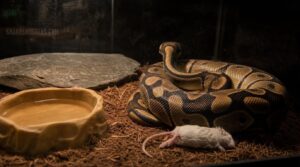
A snake that suddenly stops eating is trying to tell you something — and a bad hide is often the culprit. Stress, vulnerability, and post-feeding insecurity can all kill appetite fast. Here’s what to look for.
Watch for subtle warning signs like lethargy and gradual weight loss — they’re easy to miss, but early snake illness symptoms can escalate quickly without a proper setup.
Stress-related Appetite Loss
When your snake skips a meal, the hide might be the culprit. Chronic stress triggers a hormonal cascade — adrenaline floods the system, glycogenolysis kicks in, and digestion slows to a crawl. The body shifts into survival mode, not mealtime mode. Here’s what’s happening internally:
- Stress hormones suppress appetite by signaling the hypothalamus to reduce hunger cues
- Noradrenaline directly inhibits feeding drive, even when prey is available
- Delayed gastric emptying makes eating feel uncomfortable
- Serotonin activity linked to feeding motivation circuits increases, paradoxically reducing interest in food
A snake without a secure hide lives in a constant low-grade stress state — and stress-induced anorexia is a real, physiological consequence of that.
Vulnerable Feeding Behavior
Even when stress-induced anorexia isn’t the full picture, your snake’s feeding behavior can still reveal a hide problem. Watch for cover proximity feeding — your snake may only strike when it can keep part of its body inside the hide. It hesitates if the food lands too far from that safe retreat point.
| Feeding Signal | What It Suggests |
|---|---|
| Strikes, then immediately releases | Feels exposed during prey contact |
| Only eats in low light | Needs visual security to commit |
| Repeatedly approaches, then retreats | Safety and timing cues aren’t aligning |
Scent trail influence matters too. If your snake can’t follow the prey’s scent while staying near cover, it may ignore the meal entirely. A tight-fitting hide placed close to the feeding zone gives it the confidence to commit — and commit fully.
Post-feeding Insecurity
What happens after the meal matters just as much as the meal itself.
An insecure snake often vanishes the moment it swallows — retreating immediately rather than settling.
You might notice an "eat then vanish" routine: it takes the prey, then disappears into the darkest corner and stays there far longer than usual, skipping water, skipping basking, barely shifting position.
Hide Size and Feeding
Hide size matters more than most keepers realize. A hide that’s too roomy can actually undermine feeding — your snake needs that snug interior fit to feel secure enough to eat and digest calmly. Think of it like trying to sleep in a gymnasium. Ensuring proper hide sizing can dramatically reduce stress and improve overall health.
- Tight-fitting hide: body touches the walls when coiled
- Entry opening comfort: wide enough to enter, narrow enough to feel covered
- Feeding hide placement: warm side promotes proper food digestion temperature
- Dual hides feeding: lets your snake pick the spot that feels safest
Hiding in Unusual Places
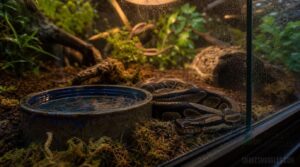
If your snake keeps avoiding its hide and showing up in random spots around the enclosure, that’s a clue worth paying attention to. Snakes don’t squeeze behind a water bowl or burrow under substrate for fun — they’re telling you the provided hide isn’t cutting it. Here’s what to watch for.
Under Water Bowls
Finding your snake wedged under its water bowl is a classic red flag — it’s telling you the provided hide just doesn’t cut it.
Snakes are wired to seek the tightest, darkest spot available, so understanding why snakes hide and what drives the behavior can help you choose a hide that actually satisfies that instinct.
A proper bowl hide should let your snake fully enter and turn around comfortably, with smooth interior lining to protect its skin.
Clean it weekly with a reptile-safe disinfectant to prevent bacterial buildup.
Your boa snake tank design and layout choices can also influence how easily you access and clean every surface each week.
For safe material choices and sturdy setups, see this guide to climbing structures for pet snakes.
For extra ideas on keeping your enclosure both clean and cozy, check out these corn snake habitat setup tips tailored to healthy growth.
Behind Enclosure Decor
When your snake squeezes behind plants, rock textures, or background murals instead of using its provided hide, that’s a clear message — the enclosure decor feels safer than the actual shelter you’ve offered.
- Foliage cover and artificial retreats block sightlines, which reduces stress
- Lighting gradients can make an open hide feel uncomfortably exposed
- A tight-fitting hide with proper placement beats decorative options every time
Burrowing Under Substrate
When your snake digs under the substrate instead of using its hide, it’s telling you something important. Burrowing signals insecurity — the snake is hunting for a tighter, more sheltered microclimate on its own terms. A proper, snug hide that contacts its body on multiple sides eliminates that need entirely.
Avoiding The Provided Hide
Sometimes a snake ignores its hide for reasons that have nothing to do with the hide itself — and that’s worth paying attention to.
- Entrance too small or awkwardly angled for smooth entry
- Wrong thermal zone — hide placed on the cool side when your snake wants warmth
- Strong cleaning product scent still lingering inside or around it
- No clear escape route from the hide’s position
- Recently moved hide with unfamiliar scent and orientation
Check placement first. A tight-fitting hide dropped in the wrong temperature zone gets ignored every time, no matter how perfect the size.
Signs Hide Feels Exposed
A hide that feels exposed tells you more than you’d think — and your snake’s body gives it away before behavior does.
Watch for head tucking, where your snake presses its head tight against its body or toward corners, minimizing what’s visible.
Tail flicking frequency rises under stress. Breathing rate increases.
Corner preference patterns — that repetitive corner-pressing — signal your snake can’t find true cover.
Roaming, Escaping, or Acting Restless
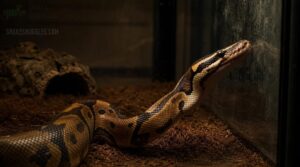
Restless behavior is one of the clearest distress signals a snake can send you. When a snake can’t find security in its enclosure, it stops settling — and starts searching. Here’s what that actually looks like.
Daytime Wandering
If your snake is restless during the day, that’s your first real clue something’s off.
- Roaming during daylight hours often signals a lack of secure shelter
- Repeated warm-side pacing points to thermal preference shifts the current hide can’t meet
- "Stop-and-start" movement shows the snake is evaluating for safety before committing
- A tight-fitting hide eliminates the need to roam for comfort
- Reducing light sensitivity by using an opaque hide cuts daytime wandering fast
Glass Surfing
Glass surfing — that repetitive pressing and sliding along the enclosure walls — is your snake basically saying, "I don’t feel safe here."
| What You See | What It Signals |
|---|---|
| Body pressed to glass | No secure retreat found |
| Ignoring the hide entirely | Hide humidity or warmth feels wrong |
| Lingering near bright walls | Light exposure stress pulling it away from shelter |
| Restless during rest hours | Thermal gradient preference unmet by current hide placement |
Check your hide placement and humidity first. A dry hide on the wrong end of the gradient forces your snake to choose between warmth and security — and it’ll wander rather than compromise.
Frantic Escape Attempts
When glass surfing tips into full-on frantic escape attempts, you’re watching a stress flight response in real time. Your snake isn’t curious — it’s panicking.
- Rapid direction changes with tense, straight body posture
- Repeated head-first probing at lid seams or corners
- Hugging enclosure edges instead of crossing open floor
- Returning obsessively to the same weak boundary point
- Brief hide entries followed by immediate, restless exits
A tight-fitting hide fixes this fast.
Large Open Enclosures
Big enclosures can work against a hide-shy snake. More open floor space means more exposure — and young snakes especially struggle to settle in large setups without adequate cover.
Place hides across multiple thermal zones, add burrowable substrate, and use visual barriers like cork bark. More cover options mean fewer stress-driven roaming circuits across that wide-open floor.
Lack of Secure Territory
A snake without a defined territory won’t settle — it’ll keep searching. That restless circuit around the enclosure is it trying to claim space it never feels safe enough to own.
Two hides, one warm-side and one cool, give your snake distinct anchors. Each becomes a secure territory it can reliably return to, finally replacing that anxious roaming with confident, calm routine.
Bad Sheds or Retained Skin
Bad sheds are one of the clearest signs that your snake’s hide setup isn’t doing its job. Without the right humidity microclimate, skin comes off in dry, ragged pieces — and that’s not just ugly, it’s a health risk. Here’s what to look for and how the right hide fixes it.
Retained Eye Caps
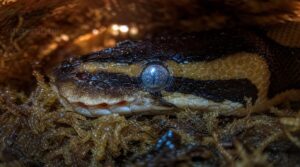
That filmy, cloudy look covering your snake’s eye after a shed? That’s a retained eye cap — and it’s one of the clearest signs your setup is missing a tight-fitting humid hide. Without that pocket of moisture on the warm side, shed skin dries before it releases cleanly, leaving the delicate eye cap stuck.
| Warning Sign | What It Means |
|---|---|
| Milky or opaque eye after shed | Eye cap didn’t release during shedding |
| Snake rubbing face on decor | Irritation from stuck cap |
| Partly closed eye post-shed | Discomfort or reduced vision |
| Repeated incomplete sheds | Chronic humidity deficiency |
| Swelling or eye discharge | Urgent — see a vet immediately |
Moisture therapy — placing your snake in a small, damp container for 20–30 minutes — often loosens a stuck cap enough for safe eye cap removal. Never pull at it dry. If it won’t budge after gentle soaking, vet intervention is the right call, not a second attempt with tweezers.
Preventive care is simpler than it sounds: a black Tupperware container packed with damp sphagnum moss on the warm side gives your snake that near-100% humidity pocket it needs, mimicking the natural burrows wild snakes rely on for successful shedding and genuine stress reduction.
Dry, Patchy Sheds
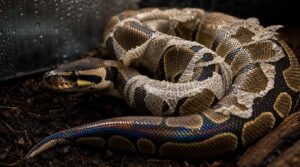
Unlike the clean, single-piece peel of a healthy shed, a dry, patchy shed tears apart in flakes and irregular strips — leaving matte, chalky remnants clinging to scale edges, body seams, and ventral transitions. The shed film never hydrates enough to loosen the keratin layer uniformly, so detachment stalls partway through.
Here’s what dry, patchy shedding actually looks like up close:
- Shed comes off in small, uneven strips rather than one continuous sheet
- Leftover skin looks dull or slightly rough next to freshly shed areas
- Progress stalls mid-shed, with the tail freeing first while the body lags behind
- Scale edges and mouth corners trap stubborn skin fragments that won’t budge
- The next skin layer looks temporarily spotty or mottled where pieces were left behind
That uneven sloughing pattern is your enclosure’s humidity telling on itself. When conditions are too dry, the old skin simply can’t soften fast enough — and once the shed tears mid-process, it rarely finishes cleanly without immediate humidity improvement.
Missing Humid Hide
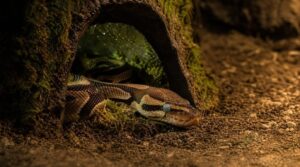
A dry, patchy shed is often the moment you realize your setup is missing something critical — a humid hide. Without one, your snake has no dedicated spot to access concentrated moisture during the shed window. It relies entirely on ambient enclosure humidity, which almost never delivers the shedding hydration a snake actually needs when old skin starts separating.
Think of it this way: a humid hide acts like a personal humidifier your snake can step into on demand. The humidity microclimate inside that small enclosed space keeps moisture concentrated right where the snake’s body is — not spread thin across a dry enclosure. That’s a completely different experience than hoping general air humidity does the job.
A humid hide is your snake’s personal humidifier — concentrated moisture exactly where it’s needed, not scattered thin across a dry enclosure
| Without a Humid Hide | With a Humid Hide |
|---|---|
| Relies on ambient enclosure humidity | Accesses concentrated moisture access directly |
| Shed dries out mid-process | Skin stays hydrated through the full cycle |
Hide moisture delivery — using damp sphagnum moss or a moist sponge inside the hide — keeps that microclimate stable without waterlogging the rest of the enclosure. That balance matters, because a constantly damp enclosure invites mold and raises the risk of respiratory infections. A humid hide solves the humidity problem without creating a new one.
The moist hide benefits go beyond shedding too. Proper enclosure humidity balance means your snake’s skin stays conditioned between sheds, reducing the compounding dryness that leads to chronic shed problems over time.
Warm-side Moist Hide
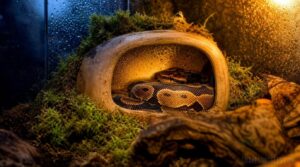
Placement matters more than most keepers expect.
Your moist hide belongs on the warm side — close enough to benefit from the thermal gradient, but not so close to the heat source that it dries out within hours. That balance keeps sphagnum moss damp and the humidity microclimate stable right where your snake needs it most during shed.
Humidity Microclimate Needs
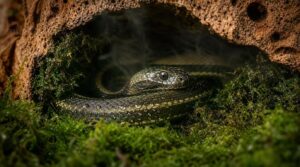
Think of your humid hide as a personal humidity bubble — a small, stable zone that mimics the near-100% moisture of a wild burrow.
Damp sphagnum moss or coco coir inside a snug container creates that humid microenvironment, your snake needs to hydrate its skin fully before shedding.
Keep enclosure air dry overall — the humidity gradient does the work, so mold doesn’t.
Defensive or Stressed Handling Behavior
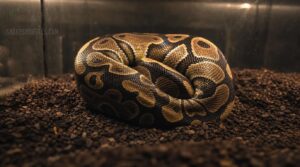
If your snake turns into a ball of nerves the moment you pick it up, the problem often starts inside the enclosure — not with you. A snake that hisses, strikes, grips too tight, or tucks its head away is telling you it doesn’t feel safe at home. Here are the key stress signals to watch for during handling.
Hissing or Striking
A hissing snake isn’t being dramatic — it’s telling you something important. Hissing is a warning, part of a "prepare to defend" sequence that escalates to striking if the threat doesn’t back off. If you’re hearing that sound from your own pet, this guide to why ball pythons hiss breaks down the common triggers and what they’re really trying to tell you.
Watch for these strike-readiness cues:
- Head held elevated, body angled forward
- Sudden stillness replacing normal movement
- Tongue flicking stops or changes rhythm
- Body flattened to appear larger
Stress-induced defensive behavior like this often traces back to an inadequate hide. A snake that can’t retreat to a tight, secure hide carries that anxiety into every interaction.
Tail Rattling
Hissing might be the opening act, but tail rattling turns up the volume. When a snake rapidly vibrates its tail against the enclosure floor or decor, that buzzing sound isn’t random — it’s a deliberate "back off" warning, mimicking the iconic rattlesnake display even in species with no rattle organ.
A snake doing this feels cornered and exposed, often because it lacks a tight, secure hide to retreat to.
Tight Gripping
When hissing and tail rattling don’t work, some snakes escalate to tight gripping — clamping down during handling and simply not letting go.
The jaw locks, the neck tenses, and the whole anterior body goes rigid.
It’s not a quick defensive nip; it’s a sustained hold that says, "I don’t feel safe, and I’m not releasing until I do.
Hiding The Head
Sometimes the stress doesn’t come out as a strike — it comes out as a quiet, deliberate tuck. Your snake buries its head into your palm or sleeve and simply won’t come out. That’s stress-induced hiding behavior, and it mirrors exactly what a snake does when its hide fails it at home.
Here’s what that head-hiding posture is actually telling you:
- Head tuck preference signals your snake craves a dark, enclosed space it can’t find in its enclosure.
- Entrance obstruction matters — without a partially blocked opening at home, the head never feels truly hidden.
- A dark interior is non-negotiable; bright or open hides leave the head feeling exposed.
- Hide size fit is the fix — a tight-fitting hide lets the whole body coil while the head stays fully surrounded.
When the hide checks those boxes — correct size, temperature match, dark walls, narrow entry — your snake stops looking for security in your hands.
Multiple Hides Reduce Stress
One hide is a starting point — two hides is a real setup. When your snake has secure retreat choice on both the warm and cool sides, it stops burning energy scanning for safety and starts behaving normally: eating, shedding, resting.
| Hide Position | Key Benefit |
|---|---|
| Warm-side hide | Aids thermoregulation while staying concealed |
| Cool-side hide | Offers security without overheating |
| Humid warm-side hide | Creates a humidity microclimate for clean sheds |
| Two hides combined | Dramatically reduces stress-induced anorexia |
Frequently Asked Questions (FAQs)
How often should snake hides be cleaned?
Ironically, most snake keepers obsess over hide placement but forget the basics — spot clean weekly, deep clean every two to three months, and always inspect for mold before returning hides to the enclosure.
Can transparent hides cause stress in snakes?
Yes — transparent hides stress snakes. A see-through hide still lets light and outside movement in, so your snake never feels truly concealed. Opaque hides block that visibility and help your snake relax.
What materials are safest for DIY snake hides?
Think of it like choosing food containers — non-porous plastic wins for easy cleaning.
Food‑grade containers like Tupperware‑style boxes are dishwasher‑safe.
Cork bark retains humidity naturally, making it perfect for a tight‑fitting humid hide.
How do hides support snake health after feeding?
After a meal, a snake needs postfeeding rest in a warm, enclosed space. A tight-fitting hide delivers digestive security, thermal comfort, and humidity recovery — cutting stress-induced anorexia and reducing the risk of infections.
Do snakes need separate hides for each life stage?
As your snake grows, hide size must grow too. A hatchling house snake needs a snug fit; an adult needs a larger one. Two hides — warm and cool — cover every life stage well.
Conclusion
Your snake isn’t being dramatic — it’s quietly telling you something isn’t right. The signs your snake needs a better hide aren’t always loud; sometimes they show up as a skipped meal, a restless night, or a shed that came off in pieces.
A hide that fits properly isn’t a luxury — it’s the foundation of a calmer, healthier animal.
Get that one thing right, and you’ll likely find several other "problems" solve themselves.