This site is supported by our readers. We may earn a commission, at no cost to you, if you purchase through links.

A ball python stuck in a bad shed isn’t just frustrating to watch—it’s a sign the enclosure is failing the snake at a fundamental level. Low humidity during shedding causes the old skin to dry and grip, sometimes cutting off circulation to the tail tip.
The substrate sitting at the bottom of that enclosure is usually the reason humidity holds or collapses. Coconut fiber, sphagnum moss, cypress mulch, and orchid bark each manage moisture differently, and choosing the wrong one means fighting your hygrometer every single day.
The bedding you pick does most of the humidity work before you ever reach for a spray bottle.
Table Of Contents
- Key Takeaways
- Best Bedding for Humid Snake Enclosures
- Top 5 Coconut Snake Substrates
- What Substrate Holds Humidity Well?
- Humidity Needs by Snake Species
- Coconut Bedding Humidity Benefits
- Safe Bedding Choices for Snakes
- Blending Substrates for Better Humidity
- Maintaining Healthy Enclosure Humidity
- Frequently Asked Questions (FAQs)
- Conclusion
Key Takeaways
- Your substrate does more humidity work than your spray bottle ever will — coconut fiber, sphagnum moss, and cypress mulch hold moisture steadily between mistings, while poor choices like pine or cedar release toxic oils that harm your snake.
- Sphagnum moss holds up to 20 times its weight in water, making it the single most powerful humidity stabilizer you can add to a tropical enclosure like a ball python’s setup.
- Blending substrates — such as coconut fiber with sphagnum moss, or cypress mulch with coco coir — gives you better moisture balance, drainage, and odor control than any one material can deliver on its own.
- Ball pythons need 60–80% humidity during the day and 80–100% overnight, so matching your bedding choice to your snake’s specific species requirements is what separates clean sheds from vet visits.
Best Bedding for Humid Snake Enclosures
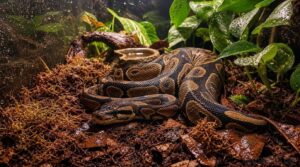
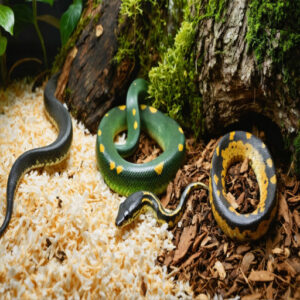
Picking the right bedding makes a bigger difference than most snake owners expect. The substrate you choose directly controls how well your enclosure holds humidity — and that affects everything from shedding to hydration.
If you’re already struggling with stuck sheds, this guide to natural remedies for snake shedding problems walks you through practical fixes that start with getting your substrate right.
Here are the five best options to keep things balanced.
Coconut Fiber
Coconut fiber — also called coconut coir — is one of the most reliable substrates for humid enclosures. It absorbs water slowly and releases it gradually, keeping moisture levels stable without soaking the floor. Brown coir fibers offer high abrasion resistance, making them durable for long‑term use. It is a genuinely eco‑friendly option, and compressed bricks like those from Riare 10LB Coconut Chip and BabiChip Coconut Chip store easily until needed.
- Fiber grade variations affect texture — coarser grades suit burrowing species best
- Moisture retention stays consistent for days between mistings
- Sourcing sustainability matters — always choose additive‑free, pesticide‑free coir
Coconut Chips
If coconut fiber is your everyday workhorse, think of coconut chips as the upgrade.
These thicker, chunky pieces create natural pockets that lock in moisture longer, giving you more stable humidity regulation in snake enclosures without constant misting.
Their sustainable sourcing and cost efficiency makes them practical, and the natural aesthetics blend beautifully into any setup — substrate moisture management that actually looks good.
Sphagnum Moss
Sphagnum moss takes moisture retention to another level entirely. Its unique moss tissue structure — built from hollow hyaline cells — makes it a hygroscopic substrate that holds up to 20 times its weight in water.
Sphagnum moss holds up to 20 times its weight in water, making it nature’s most powerful humidity stabilizer for snake enclosures
That means serious, stable humidity regulation without hourly misting.
Rooted in peatland formation and acidic environment conditions, it also provides genuine microhabitat support, making it ideal for tropical species like ball pythons.
Cypress Mulch
Cypress mulch brings a different kind of reliability to the enclosure. Its natural oil benefits help deter pests while supporting humidity control and natural odor control — two things that matter daily.
Mulch longevity factors like slow decomposition reduce how often you’re digging everything out.
Applied 2–3 inches deep, it creates genuine enclosure microclimate effects: moisture retention stays consistent, evaporation slows, and respiratory infection prevention improves noticeably.
Orchid Bark
Orchid bark offers a different kind of humidity control — one built around Root-like Drainage rather than raw moisture absorption. Its chunky fir or pine pieces (Fir vs Pine both work, though fir breaks down slower) create air pockets that regulate moisture without soaking.
Sterilization Methods, like boiling before use, prevent pathogens.
Bark Moisture Balance and Longevity Factors make orchid bark one of the smarter reptile substrates for drainage-heavy setups.
Top 5 Coconut Snake Substrates
Coconut substrate comes in more varieties than you might expect, and each one works a little differently in the enclosure. The five options below cover everything from fine chips for small snakes to larger chunks built for burrowing species.
Here’s what to know before you pick one.
1. Riare Coconut Chip Substrate
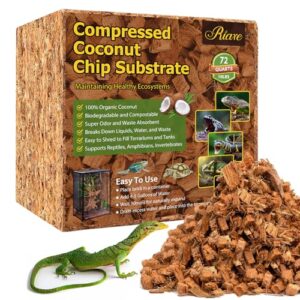
One brick, 72 quarts — that’s the math that makes Riare worth a second look.
You drop this 10 lb compressed coconut husk block into hot water, let it expand, squeeze out the excess, and your enclosure floor is ready in minutes.
The chips are soft, additive-free, and hold moisture steadily without turning soggy.
They’re especially practical for tropical species like ball pythons, where stable humidity around 60–80% isn’t optional — it’s the difference between a clean shed and a vet visit.
| Best For | Tropical reptile and amphibian keepers — especially ball python owners — who need reliable humidity control without constantly fussing with their setup. |
|---|---|
| Material | Coconut husk fiber |
| Organic | Yes, no additives |
| Humidity Control | High retention |
| Odor Absorption | Yes, waste odors |
| Form Factor | Compressed brick |
| Compostable | Yes, garden compost |
| Additional Features |
|
- One brick goes a long way — 72 quarts of substrate is a lot of enclosure coverage for the price.
- Absorbs waste odors and liquids well, so you’re not swapping out bedding every other week.
- Fully natural and compostable, so disposal is as easy as tossing it in the garden.
- Takes some prep time — you need water and a few minutes before it’s actually ready to use.
- Not a great fit for desert species; this stuff holds moisture, which is the last thing a bearded dragon needs.
- Can get chunky, so if your animal prefers a finer texture, you may need to break it down by hand.
2. BabiChip Coconut Reptile Substrate
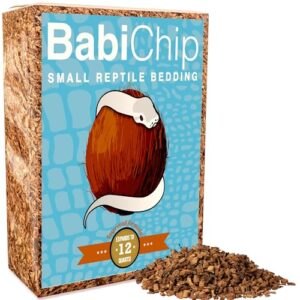
BabiChip keeps things simple — small coconut husk chips that come ready to use, no expansion brick required. The 12-quart bag weighs just over 2 lbs, making it easy to handle and store.
It’s dust-free, 100% organic, and works well for geckos, small snakes, and tropical species that need steady humidity without constant misting. Add a little water to dial in your moisture level.
For tighter budgets, though, $21.95 price tag per 12 quarts may feel steep compared to bulk alternatives.
| Best For | Small reptiles and amphibians like geckos and baby snakes that need adjustable humidity without the hassle of expanding a brick. |
|---|---|
| Material | Coconut husk chips |
| Organic | Yes, sustainably sourced |
| Humidity Control | Adjustable, dry or wet |
| Odor Absorption | Yes, waste encapsulating |
| Form Factor | Loose bagged chips |
| Compostable | Yes, organic |
| Additional Features |
|
- Ready to use straight from the bag — no soaking or expanding needed
- Small chip size lowers impaction risk for tiny or low-profile species
- Naturally controls odor and humidity; just add water to dial it in
- At $21.95 for 12 quarts, it’s pricier than bulk substrate options
- Some chips feel sharp, making it a poor fit for large or heavy-bodied snakes
- Humidity performance drops if you don’t keep up with watering in tropical setups
3. RediChip Medium Coconut Reptile Bedding
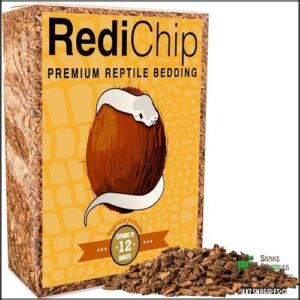
RediChip takes a straightforward approach — medium coconut husk chips, 100% organic, ready to use straight from the bag. No brick soaking, no prep.
The chips absorb moisture steadily without staying waterlogged, which makes hitting that 80–85% humidity sweet spot for ball pythons genuinely easier.
Odor control is solid too, encapsulating waste without chemical additives.
Natural odor absorption without additives pairs well with proper depth, as covered in this ball python bedding buyer’s guide that walks through substrate choices for burrowing and thermoregulation.
One consideration: the 12-quart bag won’t fill a large 55-gallon setup on its own, so budget for supplemental substrate if your enclosure is on the bigger side.
| Best For | Reptile and amphibian keepers who want a fuss-free, ready-to-use substrate that handles humidity and odor without a lot of prep work. |
|---|---|
| Material | Coconut husk chips |
| Organic | Yes, eco-friendly |
| Humidity Control | Adjustable, dry or wet |
| Odor Absorption | Yes, no deodorizers |
| Form Factor | Loose bagged chips |
| Compostable | Yes, sustainable |
| Additional Features |
|
- No soaking or prep needed — just open the bag and go
- Holds moisture well without getting waterlogged, making humidity targets easier to hit
- Naturally absorbs odors without relying on chemical additives
- The 12-quart bag is too small to fill a large enclosure on its own
- Some dust on first handling — a quick shake or rinse helps
- Pricier per volume than bulk alternatives, which adds up for bigger setups
4. Halatool Organic Coconut Fiber Substrate
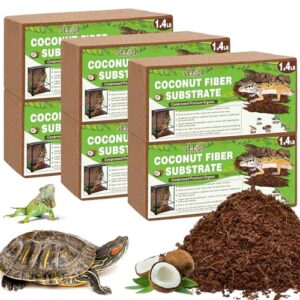
Halatool keeps things simple — six compressed bricks, each weighing about 1.4 pounds, that expand 8 to 10 times their weight once soaked.
That’s a serious amount of substrate from a compact package.
The organic coco coir holds moisture steadily, helping you maintain that 60–80% humidity range without constant misting.
It’s soft enough for burrowing species and breaks down waste naturally, reducing odor between cleanings.
At $22.79 for the pack, it’s a budget-friendly option for hobbyists managing multiple tanks.
| Best For | Reptile and amphibian keepers who need a reliable, humidity-stable substrate across multiple enclosures without spending a lot. |
|---|---|
| Material | Coconut husk fiber |
| Organic | Yes, 100% natural |
| Humidity Control | Stable moisture |
| Odor Absorption | Yes, waste decomposing |
| Form Factor | Compressed bricks |
| Compostable | Yes, natural breakdown |
| Additional Features |
|
- Expands 8–10x its weight, so six small bricks go a surprisingly long way
- Naturally controls odor and breaks down waste, cutting down on how often you need to clean
- Works for a wide range of animals — geckos, frogs, spiders, hermit crabs — and even doubles for indoor gardening
- You have to soak and fluff it before use, which takes a little time and can get messy
- Animals that chew or dig through substrate might accidentally ingest it, so you’ll want to keep an eye on them
- If it stays too wet for too long, mold can develop, so moisture balance matters
5. Legigo Coconut Fiber Terrarium Substrate
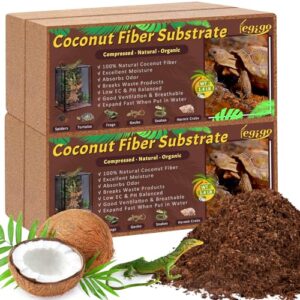
Legigo packs four compressed coir bricks into a single 5.7-pound set — compact enough to store easily, but capable of expanding into a deep, fluffy bedding layer once hydrated.
Each brick is 100% natural coconut fiber with no dyes or synthetic binders, so you’re not introducing anything harmful into your snake’s home.
It retains moisture for days, releasing it slowly to keep humidity stable without soaking the floor.
A solid pick for tropical species that need consistent, gentle humidity around the clock.
| Best For | Reptile and amphibian owners — especially those keeping tropical species like snakes, frogs, or geckos — who want a natural, humidity-friendly bedding they can trust. |
|---|---|
| Material | Coconut husk fiber |
| Organic | Yes, no chemicals |
| Humidity Control | Stable, high-humidity |
| Odor Absorption | Yes, urine and waste |
| Form Factor | Compressed bricks |
| Compostable | Yes, soil amendment |
| Additional Features |
|
- 100% natural coir with no chemicals or synthetic binders, so it’s safe for even sensitive animals
- Holds moisture well and releases it slowly, helping you maintain steady humidity without constant misting
- Absorbs waste and odors quickly, making spot cleaning a lot easier day to day
- Bricks have to be soaked before use — dry, they’re rock hard and not ready for any animal
- No instructions in the box, so first-timers will need to look up how to hydrate and prep them
- Occasional foreign material has been reported in the substrate, so it’s worth doing a quick visual check before adding it to the enclosure
What Substrate Holds Humidity Well?
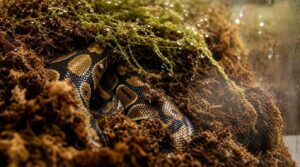
Not all substrates are created equal regarding holding humidity. The right one works quietly in the background, keeping moisture steady without turning your enclosure into a soggy mess.
Here’s what actually matters when you’re choosing.
Water Absorption Capacity
Water absorption capacity — or WAC — measures how much moisture a substrate actually holds.
Coconut coir bedding scores around 6–8 grams of water per gram of dry fiber, making it one of the most absorbent bedding options available. Sphagnum moss exceeds 10g/g in WAC measurement tests.
Particle size, temperature, organic matter role, and humidity history influence how efficiently these natural moisture-retaining properties perform for your snake.
Slow Moisture Release
High WAC is only half the story — how your substrate releases that moisture matters just as much. Coconut coir bedding excels here through capillary dynamics and pore networks that hold thin water films, letting them evaporate steadily rather than all at once.
Polymer binding and decomposition release adds a slow, background drip of vapor.
Microbial balance keeps this process stable without tipping into mold territory.
Airflow and Drainage
Moisture retention only works when airflow keeps things balanced. Without proper substrate aeration techniques and smart vent placement strategies, humidity stagnates and substrate clumping prevention becomes impossible.
- Aim for 0.5–2 air changes per hour for humidity-ventilation balance
- Keep drainage layer depth at 1–2 inches beneath substrate
- Use open-textured materials for breathability and moisture-wicking properties
- Position vents on opposite sides for air exchange optimization
Mold Resistance
Good airflow helps, but it won’t save you if your substrate feeds mold.
For moisture management and condensation management that actually protect your snake’s health, choose humidity control bedding with natural antifungal properties — orchid bark and coconut fiber both resist fungal colonies well.
Budget options like compressed coco bricks still offer solid breathability and built-in mold prevention without breaking the bank.
Burrowing Support
Snake bedding that can’t hold a tunnel is basically useless for burrowers. Coconut fiber and coco coir are your best bets — their natural elasticity bolsters collapse prevention while moderate particle size impact keeps walls firm without smothering airflow. Humidity’s role here is real: evenly moist substrate holds shape far better than dry.
- Burrow ventilation improves with chunky coconut fiber layers
- Safety depth guidelines suggest at least 4–6 inches of substrate
- Moisture absorption stays consistent with coco coir blends
Humidity Needs by Snake Species
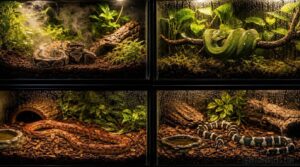
Not every snake needs the same humidity level — and getting this wrong is one of the fastest ways to cause health problems.
Ball pythons, green tree pythons, corn snakes, and king snakes all have different requirements, and your bedding choice has to match.
Here’s what each species actually needs to stay healthy and shed cleanly.
Ball Python Humidity
Ball pythons need daytime humidity between 60 and 80 percent, rising to 80–100 percent overnight — mimicking their rainforest home. Coconut coir excels here because its natural moisture-retaining properties support consistent humidity retention through slow moisture absorption and release. Watch for sunken eyes or sluggish movement as health indicators of low humidity.
| Condition | Humidity Target | Purpose |
|---|---|---|
| Daytime ambient | 60–80% | Shedding support, hydration sources |
| Nighttime ambient | 80–100% | Seasonal adjustments, microclimate |
| Humidity gradients | Warm-to-cool variation | Behavioral thermoregulation |
Green Tree Python Humidity
Green tree pythons demand more precise care than most snakes — keep humidity between 60 and 80 percent, with brief spikes to 85–90 percent during misting for seasonal adjustments.
Coconut coir’s natural moisture-retaining properties and orchid bark’s drainage make an excellent humidity retention combo.
Watch for these signs that your setup works:
- Complete, clean sheds
- Vibrant coloration maintenance
- Calm perching with minimal stress behaviors
- Active movement with good appetite
Corn Snake Humidity
Corn snakes are more forgiving than tropical species, but that doesn’t mean humidity is an afterthought.
Keep balanced humidity between 40 and 60 percent year-round, nudging it toward 60 to 70 percent during shedding.
Coconut chip substrate’s moisture-retaining properties make seasonal humidity shifts easy to manage.
Watch for humidity stress signs like sunken eyes or cracked skin — both signal that your heat-humidity balance needs adjusting.
King Snake Humidity
King snakes are refreshingly adaptable, but don’t let that fool you into ignoring enclosure humidity stability.
Target 40–60% relative humidity, using coconut chip’s natural moisture-retaining properties to maintain a steady baseline.
A proper Humid Hide Setup and Microhabitat Zones support the Temperature-Humidity Balance your snake needs, with real Gradient Humidity Benefits for immune system impact.
- Keep ambient humidity between 40–60%
- Use coconut chip substrate for humidity retention
- Add a moss-filled humid hide during shedding
- Create dry and damp Microhabitat Zones
- Monitor with a digital hygrometer daily
Shedding and Hydration Needs
Shedding is when hydration really shows its work.
During molting, bump humidity to 70–90% depending on species — this softens old skin and prevents molting problems in snakes like retained eye caps or torn patches.
Coconut coir and sphagnum moss both shine here, offering excellent humidity retention and natural moisture-retaining properties that support skin health.
Watch for dehydration signs like sunken eyes or dull, stuck shed — your microhabitat use of a damp hide solves both problems fast.
Coconut Bedding Humidity Benefits
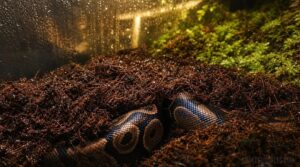
Coconut bedding does a lot of heavy lifting in maintaining humidity stable without constant intervention. It’s one of those substrates that works quietly in the background, handling moisture, mess, and odor all at once.
Here’s a closer look at the specific benefits that make it such a reliable choice for snake keepers.
Long-lasting Moisture Retention
Coconut coir’s fiber density is what makes it such a standout for humidity-dependent species — those natural moisture-retaining properties work quietly in the background for days between misting. Unlike substrates that dry out fast, coconut fiber resists substrate aging well, especially when you layer sphagnum moss on top.
Smart ventilation balance keeps airflow moving without sacrificing excellent humidity retention, giving your snake a consistently stable microclimate.
Easy Spot Cleaning
Keeping a clean enclosure doesn’t have to mean starting from scratch every time. Coconut chip substrate makes spot cleaning genuinely easy — just target soiled patches without disturbing the rest of the bedding.
- Use Cloth Blotting Methods to lift waste without spreading it
- Apply Stain Removal Tips: work inward from the stain’s edge
- Run Cleaner Safety Checks before using any product on snake bedding
- Follow Moisture Control Steps — let treated spots dry fully before your snake returns
- Use Waste Lift Techniques to remove solids cleanly with low dust levels
Natural Odor Control
Beyond cleanliness, odor control is where coconut fiber and coconut chip substrates quietly shine. Their natural structure fosters beneficial bacteria balance — good microbes that outcompete smell-producing ones daily.
Enzymatic odor breakdown manages waste at the source, while natural mineral absorbers trap ammonia before it builds up. Unlike aspen bedding or sphagnum moss, coconut fewer changes to stay fresh.
Comfortable Burrowing Texture
Odor control is just one piece of the puzzle — your snake’s comfort while burrowing matters just as much.
Coconut fiber and coconut coir pack into stable tunnels without collapsing, supporting natural digging behavior far better than aspen bedding.
Humidity in burrows stays consistent thanks to moisture trapped within the substrate.
Stick with medium particles; loose, small chip sizes improve tunnel stability factors while following basic texture safety tips.
Space-saving Compressed Bricks
Storage might be the last thing on your mind when setting up a snake enclosure, but compressed brick coconut coir changes the equation completely. Each organic brick expands to roughly 72 quarts of substrate — just soak it in hot water, squeeze out the excess, and it’s ready.
Brick Storage Tips start with keeping unused bricks dry; their Eco-Friendly Packaging and Long-Term Durability Factors make bulk buying a genuinely Cost-Effective Solution without sacrificing enclosure humidity stability.
Safe Bedding Choices for Snakes
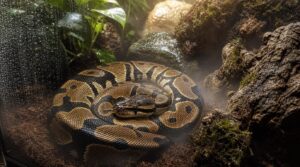
Not every bedding that holds humidity well is actually safe for your snake.
Some substrates hide real risks — toxic oils, sharp edges, or fine dust that can cause serious harm.
Here’s what to watch for before you buy.
Avoid Pine and Cedar
Pine and cedar shavings might look harmless, but they’re genuinely dangerous for snakes. Both release toxic wood oils — phenolic compounds and thujone — that compromise enclosure air quality and trigger respiratory hazards, skin irritation risks, and appetite loss.
Hatchling vulnerability is especially serious, since smaller airways absorb these irritants faster.
Stick to coconut cork, sphagnum moss, or orchid bark — all offer natural moisture-retaining properties without the toxins.
Choose Larger Particles
Particle size matters more than most keepers realize.
Larger pieces — think coconut coir chunks or orchid bark — offer real advantages: better airflow enhancement between pieces, stronger compaction resistance under your snake’s weight, and slower evaporation for stable humidity profiles. Bigger particles also make spot cleaning easier, since waste sits on top rather than mixing in.
Smaller, finely milled substrates pack down fast and lose moisture quickly.
Avoid Dusty Substrates
Dusty substrates are a quiet threat you might overlook. Fine particles under 75 micrometers can irritate your snake’s airways, leading to chronic wheezing over time. Dust health risks are real — and respiratory health depends on your particle size selection.
Choose low-dust bedding options that balance humidity-dust balance naturally:
- Coconut fiber and chips: dust free and natural moisture-retaining properties keep humidity stable
- Sphagnum moss: binds moisture, resists becoming airborne
- Orchid bark: coarse structure controls dust particles effectively
- Cypress mulch: larger cuts minimize airborne release
- Low-dust cleaning with dampened tools prevents stirring settled particles
Substrate prep methods matter — slightly moisten dry substrates before placing them.
Check for Sharp Pieces
A hidden splinter can do real damage before you ever notice it. Before laying any snake bedding, run your fingers through it slowly — feel for jagged edges, sharp bark chips, or glassy fragments. Substrate inspection tips like this take under two minutes, but cut injury risk dramatically.
| Warning Sign | Action |
|---|---|
| Swelling or abrasions post-change | Remove substrate immediately |
| Frequent nicks in shed skin | Inspect for sharp fragment prevention |
Coconut coir’s moisture-retaining properties make it a safer choice — rounded particles, no splinters.
Prevent Accidental Ingestion
Snakes don’t know the difference between food and substrate — and that instinct creates real impaction risks.
Feed your snake in a separate feeding zone, away from bedding entirely.
Do regular substrate inspections, removing any loose small chip fragments before they’re swallowed.
Train your family on safe handling. Keep emergency kits nearby. Install enclosure locks. Spot cleaning daily keeps substrate safety tight.
Blending Substrates for Better Humidity
No single substrate does everything perfectly, and that’s actually good news.
Mixing two or three materials lets you balance moisture, drainage, and texture in ways a solo substrate can’t match.
Here are the best combinations worth trying in your enclosure.
Coconut Fiber and Moss
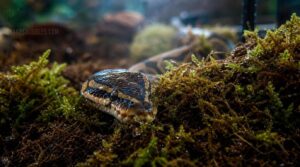
Blending coconut fiber with sphagnum moss is one of the smartest DIY substrates you can build for humidity-dependent species.
This eco-friendly choice creates a two-tier microclimate setup that delivers real hydration support without daily misting battles.
Here’s why it works:
- Coconut coir holds base moisture through natural moisture-retaining properties
- Sphagnum moss absorbs up to 20x its weight, releasing vapor slowly
- Combined, they offer cost efficiency by extending replacement intervals
Cypress Mulch and Coco
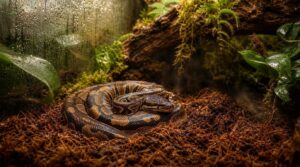
Another great pairing worth trying is cypress mulch mixed with coconut coir. Using roughly equal mulch‑coco ratios by volume, you get real humidity synergy — the mulch holds structure while the coir’s natural moisture‑retaining properties extend the hydration duration throughout the day.
Compared to fine substrates, this blend also lowers impaction risk and doubles as one of the better odor control methods for snake bedding.
Orchid Bark Drainage Layer
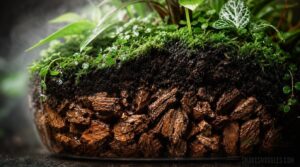
Orchid bark works well as a drainage layer beneath your main substrate. Its chunky, ½- to ¾-inch pieces create open air pockets that support root aeration and moisture balance — pulling excess water down while sustaining humidity stability above.
This layer setup suits humidity-dependent species especially well, since bark durability means it holds its structure for months without breaking down like finer substrate mixing options often do.
Moss Humidity Top Layer
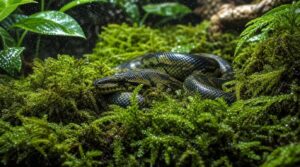
Adding a top layer of sphagnum moss or other live mosses over your base substrate gives humidity-sensitive reptiles a real buffer.
Moss types like sphagnum hold up to 20 times their weight in water, supporting moisture dynamics that can raise enclosure humidity by 5–15 points post-misting.
These natural moisture-retaining properties support microhabitat moisture and habitat support throughout the day.
Bioactive Substrate Options
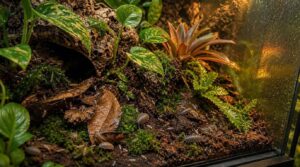
If you’re ready to level up your enclosure, bioactive setups offer real, long-term microbial benefits that standard substrates simply can’t match.
Coconut coir paired with sphagnum moss creates moisture-retaining properties that support stable humidity gradients across distinct microhabitat zones.
Fine-tuning that balance becomes much easier when you understand how each material behaves, as explored in this guide to substrate materials for humidity control.
Cleanup crews — springtails and isopods — handle nutrient cycling naturally, breaking down waste while live plant integration keeps the system balanced and self-sustaining.
Maintaining Healthy Enclosure Humidity
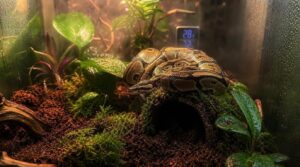
Getting the humidity right is only half the battle — keeping it stable is where most keepers slip up. A few consistent habits make all the difference between a thriving enclosure and one that’s constantly fighting mold or dryness.
Here’s what to stay on top of.
Mist Without Soaking
Mist without soaking is easier than it sounds. A properly set up misting system uses dry fog benefits to your advantage — tiny droplets under 20 micrometers evaporate before pooling on absorbent bedding. Nozzle tech basics matter here: position nozzles high, aim for 1,000–1,500 psi, and let evaporation rates impact how your species mist adjustments work.
- Run shorter misting cycles for corn and king snakes (40–60% humidity targets)
- Increase mist duration during your ball python’s pre-shed phase
- Pair moisture-retaining properties of coconut fiber with a calibrated misting system for humidity control that holds steady
Remove Wet Waste Quickly
Wet waste left sitting is humidity’s quiet enemy — it spikes ammonia, breeds mold, and undoes everything your absorbent bedding works to maintain.
Remove urine spots within 6 hours using a dedicated scoop, then apply enzyme cleaners directly to the soiled zone. Your substrate’s natural odor control and moisture-wicking properties do the rest.
| Task | Timing | Tool |
|---|---|---|
| Urine Spot Removal | Within 6 hours | Scoop + enzyme cleaner |
| Secure Waste Disposal | Immediately after removal | Sealed bag |
| Humidity Reset Tips | Within 2 hours | Hygrometer + spot mist |
Replace Bedding Regularly
Even spot-cleaning loses the battle eventually.
A consistent replacement schedule — every 1 to 3 weeks for high-humidity setups — is your real defense against humidity fluctuations and hidden microbial buildup.
Full substrate changes restore the moisture-retaining properties that worn, compacted bedding can’t deliver.
During turnover, treat it as a full hygiene practice: inspect decorations, check drainage corners, and confirm your enclosure moisture level rebounds to target after resettling.
Monitor Humidity Daily
A digital hygrometer is your enclosure’s vital signs monitor — skip it, and you’re flying blind. Place the sensor at snake level for accurate Daily Fluctuation Logs, away from heat mats or water dishes that skew readings.
- Sensor Placement Tips: Position at mid-enclosure height, never above moisture sources.
- Calibration Techniques: Verify accuracy within ±3% monthly using a reference unit.
- Misting Impact Analysis: Log humidity before and after misting to track substrate response.
- Species-Specific Alerts: Flag readings outside your snake’s target range immediately.
Prevent Mold and Bacteria
Mold doesn’t knock — it just moves in quietly when moisture and organic waste pile up. Remove uneaten prey and waste immediately, since leftover material is mold’s favorite fuel.
Good Ventilation Systems and UV Sterilization keep airborne spores in check, while Humidity Buffers and Natural Inhibitors like enzyme additives suppress bacterial growth.
bark bedding absorption and breathability make absorbent bedding and decorations easier to maintain, supporting odor control in reptile enclosures naturally.
Frequently Asked Questions (FAQs)
What substrate holds humidity well?
Coconut fiber and sphagnum moss lead the pack for moisture-retaining properties.
Both score high on water retention tests, with sphagnum holding up to 20 times its weight — ideal for humidity zone setup.
Can water dishes affect enclosure humidity levels?
Yes — a water bowl directly affects your enclosure moisture level.
Evaporation rate factors like heat source proximity and water dish sizing create humidity microclimates, helping with passive humidity regulation without misting.
How does enclosure size impact humidity retention?
Bigger enclosures lose humidity faster — more air volume means faster evaporation and drier gradients.
That’s why misting a snake’s enclosure during shed becomes especially important in larger setups, where dry pockets can form before you notice.
Use deeper substrate, multi-sensor monitoring, and scaled misting to maintain stable humidity retention across your entire vivarium.
Do humidity hides differ from standard snake hides?
Humidity hides create targeted microclimates — interior humidity can reach 70–90%, well above ambient levels. Standard hides prioritize concealment.
Structural difference directly affects shedding efficiency, substrate choice, and cleaning requirements for humidity-sensitive reptiles.
What temperature ranges support ideal humidity balance?
Keep your snake enclosure between 22–26°C for balanced humidity.
Too hot drops moisture fast; too cool invites condensation.
That sweet spot lets reptile substrates breathe, hold vapor, and support healthy, stable conditions.
Conclusion
Think of your substrate like the foundation of a house—everything built on top of it either holds or crumbles. Keepers who obsess over misters and humidity gauges, but ignore what bedding keeps snake enclosures humid, are patching a leaky roof without fixing the gutters.
Coconut fiber, sphagnum moss, and cypress mulch do the quiet, consistent work that no spray bottle can replace. Choose the right base layer, and your snake’s next shed will practically take care of itself.