This site is supported by our readers. We may earn a commission, at no cost to you, if you purchase through links.
A boa that eats too often gets fat, and one that eats too rarely stalls out, yet most keepers guess somewhere in between and hope for the best.
Guessing works until it doesn’t. A hatchling that regurgitates its first meal loses weeks of progress, while an adult fed weekly can pack on weight that strains its heart and liver. Each stage of life needs a different rhythm, from small mice every five to seven days to rats every two to four weeks.
A solid boa constrictor growth feeding plan replaces guesswork with numbers you can track. Here’s how to build one, from hatchling to adult.
Table Of Contents
- Key Takeaways
- Build a Boa Constrictor Growth Feeding Plan
- Choose Boa Prey Types, Sizes, and Portions
- Prepare and Offer Frozen-Thawed Prey Safely
- Support Boa Digestion Before and After Feeding
- Track Boa Growth and Adjust Feeding
- Frequently Asked Questions (FAQs)
- What is the recommended feeding schedule for a boa constrictor?
- How big should a 3 year old boa be?
- How quickly do boa constrictors grow?
- How long can boa constrictors go without eating?
- How do I introduce feeding after illness recovery?
- What causes a boa to refuse food suddenly?
- Should I feed multiple boas in the same enclosure?
- How does breeding season affect a females appetite?
- What size enclosure does a growing boa need?
- Do boas need UVB lighting for healthy growth?
- Conclusion
Key Takeaways
- Your boa’s feeding rhythm should slow as it grows, moving from small mice every 5 to 7 days as a hatchling to rats every 2 to 4 weeks as an adult, since overfeeding strains the heart and liver while feeding too soon after a meal risks regurgitation.
- Match prey width to your snake’s midbody (about 1:1, never beyond 1.5x), and stick with captive-bred, frozen-thawed rodents warmed to roughly 98 to 100°F all the way through, because a cold center is a common trigger for refusal or regurgitation.
- Support digestion by keeping the basking spot warm, leaving fresh water out, and skipping handling for 48 hours after a meal, then watch for defecation within 7 to 14 days as proof the meal has passed.
- Track weight and body condition on a regular schedule, adjust prey size or spacing when your boa looks too round or too thin, and call a reptile vet if a juvenile misses two meals, weight drops, nothing passes after 21 days, or you notice regurgitation, wheezing, or discharge.
Build a Boa Constrictor Growth Feeding Plan

A boa’s feeding needs change a lot as it grows, so your plan should change with it. Below, you’ll find the schedule broken out by life stage, from hatchling through adult, so you can match each meal to your snake’s size and age. Think of it as a growth-stage roadmap you can adjust as you learn how your boa responds.
For a closer look at prey sizing, feeding frequency, and what to do when your snake refuses a meal, see this boa constrictor feeding guide.
Hatchling Feeding Schedule
Most boa hatchlings are ready for a first meal about four to five weeks after birth, once the yolk is absorbed and the first shed is done. Offer appropriately sized mice every 5 to 7 days, warmed to roughly 100–105°F.
Keep feeding frequency steady, and use growth rate monitoring to guide changes in hatchlings and juveniles alike, without ever rushing. Each meal should be fully digested and defecated before the next one is offered, since regurgitation of half-digested prey causes significant fluid loss and, when chronic, has killed many boas.
Juvenile Feeding Schedule
Once your boa is past the hatchling stage, you’ll feed less often. Offer food every 7 to 10 days with appropriately sized mice, then stretch the gap as growth slows:
- Check midbody width before each meal.
- Use body condition scoring monthly.
- Practice growth rate monitoring with weights.
- Plan feeding frequency adjustment gradually.
Patience keeps your boa growing steadily without regurgitation.
Subadult Feeding Schedule
As the juvenile snake growth rate slows, your boa moves to meals every 7 to 10 days. Bump up to medium and large rats through careful prey size matching, aiming for a noticeable but not extreme bulge. Frozen rodent feeding keeps this simple.
If your boa seems hesitant after a meal or you’re unsure about ideal portion sizes, this complete snake care sheet covers temperatures, humidity, and feeding adjustments as your snake grows.
Use body condition scoring in snakes to adjust, stretching to every 10 to 14 days when needed.
Adult Feeding and Seasonal Adjustments
Once your boa matures, adult feeding frequency settles into meals every 2 to 4 weeks. Five habits keep it steady:
- Use prey size matching, about 10 to 15% of body weight.
- Offer rats, which beat mice nutritionally.
- Keep basking spots at 90 to 95°F.
- Use body condition scoring in snakes monthly.
- Stop feeding before seasonal brumation.
Watch feeding response triggers.
Choose Boa Prey Types, Sizes, and Portions
The right prey size matters more than most keepers realize, and it’s easier to get right than you’d think. Keep the prey width to snake ratio near 1:1 at midbody, since anything beyond 1.5x raises regurgitation risk.
Your boa’s age sets the prey type. Juvenile reptile care calls for hopper and jumbo mice, while subadults and adults move to rats. Adult snake maintenance also means smaller portions, roughly 5 to 10% of body weight, so a steady feeding schedule beats bigger meals.
If you’re unsure whether your boa is ready to move up a size, this guide to feeding pet snakes mice shows how to match each meal to your snake’s girth.
- Choose captive-bred, frozen-thawed rodents from reputable suppliers.
- Skip guinea pigs, hamsters, and gerbils because of fat content.
- Offer quail or chicks only occasionally, since they’re fattier.
- Never use wild-caught prey.
- Size up 25 to 50% for gravid females.
Prepare and Offer Frozen-Thawed Prey Safely

by treating thawing as a process, not a shortcut. Seal the rodent in a waterproof bag, then soak it in cold water for 30 to 60 minutes before moving it to warm water. Skip the microwave and hot water, since they cook the outside and leave dangerous hot spots.
Check the center with an instant-read thermometer; you want roughly 98 to 100°F all the way through. A warm surface can hide a cold center, and that’s a common trigger for regurgitation or feeding refusal.
Grip frozenthawed prey with 12 to 18 inch tongs and dangle it by the scruff to mimic movement. Match prey size to your feeding schedule, and wash up thoroughly afterward.
Support Boa Digestion Before and After Feeding
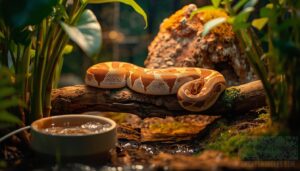
Think of digestion as a slow cooker: steady heat, a sensible portion, and no lid-lifting. Get those right and your boa does the rest.
Digestion works like a slow cooker: give it steady heat and a sensible portion, then leave the lid alone
Here’s what helps most:
- Match prey size to the widest part of your boa’s body, so the meal makes a noticeable but not extreme bulge.
- Keep the basking spot at 88-92°F for 48 hours afterward.
- Leave fresh water out at all times, since dehydration slows digestion.
- Respect a 48-hour postfeeding handling interval to avoid regurgitation.
- Watch for defecation within 7-14 days, a sign digestion finished.
Feeding frequency matters too: if your boa shows a lump from the last meal, wait. Judge body condition before offering again, and call your vet if nothing passes after 21 days.
Track Boa Growth and Adjust Feeding

A feeding plan only works if you check it against how your boa is actually growing. The sections below walk you through weight logs and body condition, how sex and locality shape growth, and when to adjust portions up or down. You’ll also find the signs of feeding refusal that deserve a call to your vet.
Weight Logs and Body Condition
Does your boa’s scale tell the whole story? Not quite. Pair weight logs with a quick hands-on check of body condition, since a healthy boa feels firm and loaf-shaped, never squishy. A digital kitchen scale for reptiles with a tare button and gram-level precision makes it easy to catch small weight changes early.
| Check | Frequency | Look For |
|---|---|---|
| Hatchling | Weekly | Fast gain |
| Juvenile | 2–4 weeks | Steady gain |
| Adult | Monthly | Stable weight |
| Any age | Each weigh-in | Square body shape |
Adjust prey size if numbers drift.
Sex and Locality Growth Differences
Does your boa’s growth trajectory match the book numbers? It might not, and that’s often fine. Females usually outgrow males, with the gap showing around one year and widening through the subadult stage. A male adult may top out near 6 to 8 feet, while a female reaches 7 to 10.
Locality matters too. Dwarf island forms stay small, so judge each boa against its own lineage.
Overfeeding and Underfeeding Adjustments
Is your boa round or triangular? Check body condition monthly, then adjust:
- Overfeeding symptoms, like skin wrinkling and squishy fat rolls, mean longer feeding frequency gaps and prey item sizing near 1 to 1.25x midsection.
- Underfeeding symptoms, like a visible spine and prominent ribs, call for weekly adult meals and 1.5x prey.
- Weigh weekly; a 5% change warrants feeding adjustments.
Feeding Refusal and Veterinary Red Flags
Even with a well-tuned plan, your boa may skip a meal. Feeding refusal often comes from shedding, breeding season, or stress-induced anorexia after a move. Before offering again, run temperature verification before feeding, and avoid prey unfamiliarity refusal by sticking to the usual type.
Call a reptile vet if a juvenile misses two meals, weight drops, or you notice regurgitation risk, wheezing, or discharge.
Frequently Asked Questions (FAQs)
What is the recommended feeding schedule for a boa constrictor?
Adult boas eat about 12 times yearly. Your feeding schedule: hatchlings eat every 7 to 10 days, juveniles every 10 to 14 days, subadults every 14 to 21 days, adults every 21 to 30 days.
How big should a 3 year old boa be?
Smaller isn’t automatically a problem. Expect roughly 5 to 7 feet and 5 to 4 kg.
Track growth trajectory with feeding logs, meal frequency, body condition, and prey creating a noticeable but not extreme bulge.
How quickly do boa constrictors grow?
Like a spring wound tight, your boa’s growth trajectory starts fast, then eases. Expect roughly 4 feet within a year.
Use feeding logs to track weight and growth, adjusting meal frequency and prey size accordingly.
How long can boa constrictors go without eating?
Healthy adult boas can fast roughly four to six months. Hatchlings manage one to two.
Every 7 to 10 days or every 10 to 14 days, check feeding refusal causes: temperature thats off, seasonal slowdown.
How do I introduce feeding after illness recovery?
Waiting two weeks feels too long, but it protects your boa. Rule out feeding refusal causes and stress-induced anorexia first, keep temperatures stable, offer one small mouse in the enclosure, no larger than mid-body width.
What causes a boa to refuse food suddenly?
Pre-shed boas often refuse meals for one to two weeks.
Stress-induced anorexia follows handling stress and feeding attempts, so protect temperature stability; compare enclosure feeding vs separate container.
Feeding Refusal with lethargy needs a vet.
Should I feed multiple boas in the same enclosure?
Housing them together saves space, but it isn’t worth it. Feed each boa in its own secure enclosure, where you can easily watch behavior, keep stress low, and avoid bites or accidentally swallowing each other.
How does breeding season affect a females appetite?
Think of your female boa as a pantry closing for renovations. During breeding season, her metabolic demands shift toward reproduction, so expect feeding refusal.
Keep your feeding schedule, offer smaller prey, rule out stress-induced anorexia.
What size enclosure does a growing boa need?
Picture a hatchling lost in a ballroom, unable to hold body temperature. Go 20 gallons, 40, 6x2x2, 6x3x
Run growth tracking every 7 to 10 days; with medium and large rats, recheck Enclosure Size Guide.
Do boas need UVB lighting for healthy growth?
Think of UVB as a bonus rather than a lifeline. Boas can grow well on a properly formulated whole-prey diet, but a low-output UVB tube, paired with proper temperature gradients, helps vitamin D3 synthesis and stronger bones.
Conclusion
An adult boa eating just once every two to four weeks sounds almost too easy, yet that slow rhythm is exactly what keeps its heart and liver healthy. Your boa constrictor growth feeding plan works because it turns that rhythm into numbers: weight, prey size, and spacing.
Weigh your snake, log every meal, and adjust before problems show up. Stay patient through refusals, and call your vet when something looks off. You’re no longer guessing.
- https://www.boa-constrictors.com/en/Interesting_facts_about_Boa_constrictor/Boa_constrictor_Care/Feeding_Boa_constrictor/Feeding_and_Defecation
- https://petstore.com/blogs/reptiles/boa-constrictor-care-size-feeding-and-what-people-underestimate
- https://ghostconstrictors.com/blogs/news/boa-constrictor-feeding-guide