This site is supported by our readers. We may earn a commission, at no cost to you, if you purchase through links.
Most boa constrictors don’t die from overfeeding. A well-meaning keeper pushes meals too frequently; the snake packs on visceral fat, and organ failure follows years before it should.
Adult boas are built for patience; their metabolism runs on a completely different clock than yours.
A consistent adult boa constrictor feeding routine—timed correctly, sized precisely, and supported with proper post‑meal conditions—is what separates a boa that thrives for 30 years from one that quietly declines. Get the schedule, prey weight, and digestion window right, and the rest falls into place.
Table Of Contents
Key Takeaways
- Adult boas thrive on a strict 3–4 week feeding schedule, with prey sized at 5–10% of their body weight — overfeeding is the fastest route to organ failure, not underfeeding.
- Prey width should never exceed your boa’s thickest mid-body point, and a slight visible lump after feeding confirms you got the size right.
- The 48–72 hours after a meal are critical — keep the warm side at 88–92°F, skip handling entirely, and watch for early regurgitation signs like head lifting or neck tension.
- Monthly weigh-ins before feeding are your early warning system — a 10% shift in either direction means something in your routine needs to change.
Set Your Adult Boa Schedule

Adult boas don’t need to eat as often as you might think — and overfeeding is one of the most common mistakes keepers make. Getting the schedule right depends on your snake’s sex, reproductive status, and the time of year. Here’s what that looks like in practice.
Age plays a big role too — check out this boa constrictor feeding schedule by age to see exactly how often juveniles versus adults should be eating.
Standard 3–4 Week Routine
Adult boas do best on a 3–4 week feeding schedule. Start counting from the day the meal was finished — not from when you bought the prey.
A 3-week interval suits a boa in active growth with solid body condition.
Shift to 4 weeks if the snake looks fuller or digestion seems slower than usual.
Adult Male Feeding Intervals
Male boas usually weigh 2–6 kg and need every 3–4 weeks between meals. Their smaller body mass means they accumulate fat faster than females, so tighter intervals do real damage over time.
- Skip feeding if he’s in shed — vision impairment kills feeding response
- Wait until he’s fully warmed to 88–92 °F before offering prey
- Delay the next meal if digestion isn’t complete
Adult Female Feeding Intervals
Females weigh heavier than males — 3–10 kg — and that extra mass slows their metabolism considerably. Feed your adult female every 3–4 weeks.
A gravid female shifts to every 2 weeks with slightly larger prey. Watch body condition closely; if she feels soft or doughy, extend the interval flexibility plan to 4–5 weeks immediately.
According to reptile experts, adult boa feeding intervals are generally every 14–21 days.
Seasonal Feeding Adjustments
Once your female’s interval is locked in, seasons will test it. When your enclosure or room cools noticeably in winter, extend feeding intervals by 2–3 weeks. Cooler temperatures slow digestion — food sitting too long raises regurgitation risk.
If your boa enters brumation-like reduced activity, delay the next meal until she resumes normal movement.
Gravid Female Considerations
Pregnancy changes everything about your feeding schedule. Gravid females need meals every 2 weeks, but keep prey on the conservative side — internal space is already occupied. Shift to smaller, frequent offerings during late gestation to reduce regurgitation risk. If she refuses, delay the next attempt rather than forcing it.
| Stage | Prey Size | Feeding Frequency |
|---|---|---|
| Early gestation | 5–8% body weight | Every 14 days |
| Late gestation | 4–6% body weight | Every 14 days |
| Post-birth recovery | Gradual return to normal | Every 3–4 weeks |
Post-birth recovery starts slowly — resume feeding only once normal behavior returns.
Choose The Right Prey
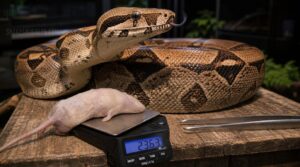
Picking the right prey isn’t guesswork — it’s math. A few key measurements tell you exactly what your boa needs at every meal. Here’s what to look at before you buy.
Once you’ve nailed the sizing, brush up on safe frozen prey thawing and warming techniques so every meal is ready to serve safely.
Rat and Rabbit Options
Two prey types dominate the adult boa feeding guide: rats and rabbits. Large rats work well for most adults, usually weighing 200–600 g depending on your boa’s size. Rabbits suit larger females over 6 kg whose meal mass needs exceed what a single rat can meet. Both deliver the whole-prey nutrition — muscle, organs, bone — your boa requires.
Choose based on these five factors:
- Your boa’s body weight — prey should equal 5–10% of total mass
- Rat nutrient profile — high protein, easily sourced, consistent sizing
- Rabbit calcium content — slightly higher mineral density suits fast-growth phases
- Prey size comparison — rabbits are bulkier; don’t jump sizes too fast
- Meal mass ratio — one appropriately sized item per feeding, not multiple small ones
Switching prey types is fine, but do it gradually. Sudden changes can trigger feeding refusals.
Prey Width Rule
One rule governs prey sizing above all others: match prey width to your boa’s thickest body point — not its head. Boas swallow by girth, so if prey is wider than that measurement, the jaw can’t open fully.
That’s when you see repeated repositioning, stress, and failed swallows. After each shed, remeasure your boa’s thickest section before selecting the next meal.
Prey Weight Percentage
Weight is the second check after width.
Keep each meal between 5–10% of your boa’s body weight — that’s the sweet spot where digestion stays smooth and regurgitation risk drops. A 4 kg adult needs 200–400 g of prey. Stick to that range consistently.
Jumping between small and oversized meals disrupts digestion timing and makes body condition changes harder to catch early.
Slight Post-Meal Lump
After feeding, check for a slight visible lump along your boa’s body — that’s your confirmation that the prey size was right.
The bulge should be noticeable but not dramatic. If it looks extreme or causes visible distension, the meal was too large.
A correctly sized meal produces a smooth, contained lump that clears within 48–72 hours as digestion progresses.
Avoid Oversized Meals
Oversized prey is one of the fastest ways to derail your boa’s health.
- Keep prey width at 1.0–1.5× mid-body diameter
- Limit meal mass to 5–10% of body weight
- Downsize immediately after any swallowing difficulty signs
- Adjust future meals if weight gain exceeds 10%
- Never compensate with larger prey after a skipped feeding
Prepare Frozen-Thawed Prey Safely
How you handle frozen-thawed prey matters more than most keepers realize. From sourcing to serving, each step directly affects whether your boa eats safely or ends up sick. Here’s what to get right before the prey ever reaches the enclosure.
Buy Quality Feeders

Not all feeder rodent containers are created equal. For your adult boa, prioritize stainless steel options or BPA-free plastics — both resist corrosion and prevent chemical leaching onto prey.
Look for anti-jam mechanisms and easy cleaning design features like removable tubes and smooth interiors.
A well-built feeder protects prey quality from storage to delivery.
Thaw in Refrigerator
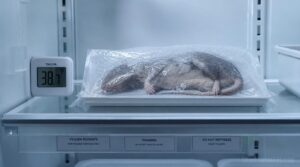
Once you’ve sourced quality prey, the next step is thawing it properly.
Place frozen-thawed prey in leak-proof packaging and set it on a tray in the refrigerator. Keep your refrigerator temperature at or below 40°F. Plan for a 24-hour thawing duration.
Before offering prey to your adult boa, confirm it’s pliable with no icy pockets at the center.
Warm Before Offering

Once prey is fully thawed, it’s time to warm it up before offering it to your boa.
Fill a container with warm water at 98–102°F and submerge the prey for 20–25 minutes. This prey aroma boost — warmer surface temperatures release stronger scent signals — triggers a reliable feeding response. Check warmth by hand: the prey should feel body-warm, never hot.
Never Microwave Prey

Skip the microwave entirely.
Uneven heating risks are real — microwaves create hot spots that can scald your boa’s mouth while leaving the core dangerously cold. That cold center also sits in bacterial growth danger zones long enough to support pathogen regrowth.
The warm water bath from the previous step is all the temperature control you need.
Discard Uneaten Prey
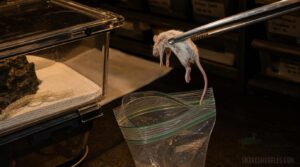
If your boa doesn’t take the prey, remove it within 1–2 hours. Thawed rodents spoil fast at room temperature, and lingering odors from old food can trigger refusals at future feedings.
Use feeding tongs — not bare hands — to retrieve it safely. Discard it in a sealed bag.
Never refreeze or reoffer uneaten prey.
Support Digestion After Feeding

Feeding your boa is only half the job — what happens after matters just as much. The next 48 to 72 hours are critical for smooth digestion, and a few simple steps make a real difference. Here’s what to do once the meal is down.
Maintain Warm-Side Temperatures
After a meal, your boa’s body does the heavy lifting — but only if the enclosure cooperates. Keep the warm side at 88–92°F for 48–72 hours post-feeding.
Use a heat mat paired with a thermostat-controlled probe to hold that range steady. A proper thermal gradient lets your boa settle exactly where digestion works best.
Avoid Handling After Meals
Once your boa swallows a meal, your job is simple: leave it alone. Wait at least 48 hours before any handling. Moving a digesting snake stresses its gut motility — the muscular contractions that push food through — and raises regurgitation risk fast.
Keep the enclosure closed, lights dimmed, and activity nearby minimal. That stillness isn’t passive. It’s doing real work.
Watch for Regurgitation
Regurgitation doesn’t always announce itself loudly. Watch for head lifting or neck tension after eating — subtle signs the digestive process is already failing. Foam around the mouth, restless repositioning, and a tight coil that suddenly relaxes are all red flags.
Four triggers that raise regurgitation risk:
- Oversized prey exceeding 10% body weight
- Chilling after feeding — dropping below 88°F on the warm side
- Handling within 48 hours post-meal
- Consecutive feeding schedule too compressed for adult metabolism
If it happens, pause the feeding schedule immediately. Reduce prey size at the next meal and wait until appetite fully returns. Any regurgitation paired with open-mouth breathing or audible wheezing needs a reptile vet — don’t wait.
Check Humidity Levels
Humidity does more for digestion than most keepers realize. After a meal, your boa needs 88–92°F warm side conditions — but humidity matters just as much.
Keep enclosure humidity between 60–80%. Use a hygrometer placed mid-enclosure, away from misting streams or glass walls.
Check both the warm and cool zones — readings often differ by zone.
Keep Feeding Records
A feeding log is your diagnostic tool — not just a journal.
Track the date, prey type, prey weight, and whether your boa accepted or refused each meal. Note the interval since the last feeding in days.
Log your boa’s weight weekly, and review entries monthly to catch gradual changes before they become serious problems.
Adjust for Health and Weight
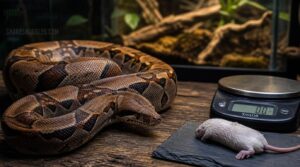
Getting your boa’s feeding schedule right is only half the job. The other half is watching how their body responds over time and adjusting when something’s off. Here’s what to keep an eye on.
Weekly weigh-ins paired with a quick check for wheezing, stuck shed, or regurgitation make it much easier to spot trouble early, and this baby boa constrictor care guide breaks down exactly what healthy growth should look like at each stage.
Monitor Body Condition
Every feeding decision you make either protects or erodes your boa’s long-term health — and body condition monitoring is how you catch problems early. Weigh your boa consistently, noting date and pre- or post-meal status. A sustained downward trend across multiple weigh-ins signals a husbandry problem, not just a picky eater.
Every feeding decision either protects or erodes your boa’s health — consistent weight tracking reveals the difference
Run your hand firmly along the spine. A healthy boa feels firm but not bony. If the backbone becomes sharply outlined, muscle mass is declining. If the sides feel soft and padded, fat is accumulating. Neither extreme is acceptable.
Check abdominal contour between meals — not right after feeding. Persistent fullness unrelated to a recent meal often indicates excess fat storage. Also assess skin tightness; thin boas show noticeable looseness around the body contours. Finally, shedding quality matters: complete, single-piece sheds indicate stable overall condition, while repeated incomplete sheds frequently accompany chronic stress or nutritional imbalance.
Watch activity and posture between feeding days. Reduced locomotion paired with weight change is a red flag worth investigating immediately.
Prevent Power Feeding
Once you’ve spotted a weight trend, the next step is making sure your feeding routine isn’t the cause. Power feeding — offering meals too frequently or too large — is the fastest route to liver disease and obesity in boas.
Stick to the Single Meal Rule:
- One prey item per session, never two
- Enforce a Digestive Rest Period of 3–4 weeks between adult meals
- Cap prey at 10% of your boa’s body weight
Spot Obesity Warning Signs
Once you’ve cut power feeding, don’t assume the problem is solved. Your boa can still be carrying excess weight from months of overfeeding.
Look for fat deposits along the spine — if the vertebral ridge disappears under soft tissue, that’s a red flag. Skin folds near the cloaca and a visibly round, heavy midsection signal obesity already underway.
Track Monthly Weight Changes
Spotting the signs is one thing — measuring the change is another.
Weigh your adult boa monthly, always before feeding and at the same time of day. Use the same scale every session.
A 10% or greater weight shift in either direction signals a problem.
Log the date, weight, and last feeding date so your trend data actually means something.
Call a Reptile Veterinarian
Your weight logs are only useful if a vet can act on them. Follow-up visits let your vet track changes against your baseline records and adjust care accordingly.
If your boa shows open-mouth breathing, clicking sounds, repeated regurgitation, swollen abdomen, or prolonged food refusal, contact a reptile veterinarian immediately.
Many feeding problems start with prey that’s too large or handled too roughly, so this beginner’s guide to boa constrictor feeders can help you choose the right size and avoid regurgitation.
Exotic veterinary care includes physical exams, radiographic imaging, and sedation when needed.
Frequently Asked Questions (FAQs)
How do I handle a boa that refuses food?
A boa refusing food isn’t always a crisis. Check temperatures, humidity, and stress factors first. Scenting frozen-thawed prey with a fresh mouse can help. If refusal extends past two meals, consult a reptile vet.
Should I supplement vitamins for my adult boa?
Most adult boas don’t need daily vitamins. Whole prey covers the basics. What matters is calcium with vitamin D3, dusted every 2–3 feedings for juveniles, monthly for adults.
What prey alternatives exist beyond rats and rabbits?
Beyond rats and rabbits, whole quail, poultry chicks, guinea pig portions, small fish, and lizards offer variety. Match prey size to your boa’s mid-body width every time.
Because a snake’s girth changes as it grows, check what size feeder rodent suits your boa constrictor at each stage, aiming for prey 70 to 85 percent of its widest point.
How does brumation affect adult boa appetite?
Brumation cuts metabolic rate by up to 50%, suppressing digestive enzyme activity and killing appetite for weeks or months. Hormonal shifts reinforce this fast. Once temperatures rise, appetite rebounds gradually — not overnight.
Conclusion
A clock doesn’t rush its hands to reach midnight faster—it keeps perfect, unbroken rhythm. Your boa operates the same way.
Every 3–4 weeks, correctly sized prey, proper warmth, and zero handling post‑meal: that’s the entire framework. Your adult boa constrictor feeding routine isn’t complicated, but it demands consistency over convenience.
Respect that rhythm, track what you observe, and you won’t just keep a boa alive—you’ll watch it thrive across decades.
- https://www.thecritterdepot.com/blogs/news/boa-constrictor-care-guide
- https://www.boa-constrictors.com/en/Interesting_facts_about_Boa_constrictor/Boa_constrictor_Care/Feeding_Boa_constrictor/Feeding_and_Defecation
- https://www.wilbanksreptiles.com/blogs/boa-constrictors/feeding-boa-constrictors-health-tips