This site is supported by our readers. We may earn a commission, at no cost to you, if you purchase through links.
boa constrictor outgrows its first enclosure faster than most new keepers expect—sometimes within six months. That 20-gallon starter tank feels adequate until you’re watching a 4-foot juvenile press its snout against the glass, testing every seam.
Choosing the wrong reptile terrarium for boas isn’t just an inconvenience; it creates chronic stress, disrupts thermoregulation, and turns a manageable animal into an escape risk.
The enclosure has to match the snake’s current size, anticipate the next growth stage, and hold humidity without rotting at the seams.
From hatchling dimensions to adult floor space requirements, the right setup makes every other aspect of boa husbandry easier.
Table Of Contents
- Key Takeaways
- Best Boa Terrarium Sizes
- Top 4 Boa Terrarium Products
- Boa-Safe Terrarium Materials
- Heating, Lighting, and Humidity
- Substrate, Security, and Enrichment
- Frequently Asked Questions (FAQs)
- What is the best enclosure for a boa constrictor?
- Can multiple boas share the same terrarium?
- How often should substrate be completely replaced?
- What signs indicate a terrarium is too small?
- Do boas need different setups during breeding season?
- How to transition from juvenile to adult enclosure?
- How often should I feed my boa?
- Can boas be housed together safely?
- What live plants are safe for boas?
- How long should new boas be quarantined?
- Conclusion
Key Takeaways
- Enclosure size must match your boa’s current stage — hatchlings do fine in a 20-gallon, but adults need a minimum 8×3-foot footprint, and skipping intermediate upgrades causes chronic stress and thermoregulation failure.
- PVC outperforms glass and acrylic for long-term humidity retention and heat stability, making it the most practical material choice for a snake that demands 55–75% relative humidity and a 75–92°F thermal gradient.
- Security isn’t optional — cam locks, dual-point latches, and rust-resistant hardware are non-negotiable, because a determined boa will exploit any weak seam, loose lid, or unsecured climbing structure.
- Substrate depth (2–4 inches), a properly placed humid hide at 85–95% RH, and a cool-side water bowl work together as a system — get one wrong and the others can’t compensate.
Best Boa Terrarium Sizes
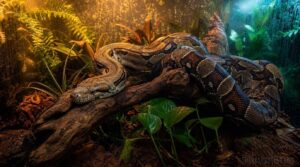
Getting the size right is the single most important decision you’ll make for your boa’s enclosure.
Get it wrong and your boa will suffer for it — this boa constrictor enclosure size guide walks you through exactly what to look for.
Too small, and your snake can’t thermoregulate properly — too large too soon, and it becomes a stress trap for a young animal.
Here’s a breakdown of what works at each stage of growth.
Hatchling Starter Dimensions
Most new keepers underestimate just how little space a hatchling actually needs. At 12–18 inches long, neonates thrive in an 18–24 inch hatchling tank length — a standard 20-gallon terrarium covers neonate space needs comfortably for the first several months.
Prioritize secure lid designs to prevent escapes, a safe burrowing depth of 2–3 inches of coconut fiber, and a temperature gradient with a heat mat under hide. Consider a stackable design rack for future growth and easy expansion.
Juvenile Growth Upgrades
Once your boa hits six months, that 20-gallon starter feels cramped fast. Bump enclosure size to 40–60 gallons and raise your basking height to 6–12 inches above the substrate.
A solid temperature gradient — 85–90 °F warm side, 78–82 °F cool side — keeps metabolism on track.
Add climbing structures, increase substrate depth to 3–4 inches for a bioactive setup, and tighten feeding schedules to every 5–7 days.
Adult Boa Floor Space
Adult boas don’t just grow longer — they grow wider, heavier, and more demanding of real floor space.
A minimum 8×3-foot footprint accommodates coiled resting needs and linear stretch zones comfortably. For females pushing past 8 feet, bump that to 10×3 feet for proper tail clearance space.
A 4x2x4 reptile enclosure works short-term, but large enclosures — like 120-gallon wood reptile enclosures or a 48x24x48 240 gallon red tail boa enclosure V3 — become non‑negotiable long-term.
Tight on room? Room conversion tips help optimize usable floor space without compromising your snake’s movement.
Height for Climbing Boas
Floor space tells only half the story. Boa climbing habits are well-documented — juveniles regularly ascend 18 to 24 inches, while larger individuals benefit from enclosures at least 1.5 times their body length in height. A 4x2x4 reptile enclosure accommodates this well, and the 48x24x48 240 Gallon Red Tail Boa Enclosure V3 excels for full-grown adults.
Key vertical enrichment priorities:
- Single climbing branch placement near center creates elevated basking spots without crowding the floor
- Vertical growth adjustments become necessary as boas gain mass and confidence
- Enclosure height safety depends on secure lids — climbers test every gap
- Climbing space needs scale with the snake’s length, not just weight
Custom Enclosure Planning
Planning a custom build means thinking years ahead, not just months. Map your thermal gradient carefully — warm side at 29–32 °C, cool side at 22–26 °C — and design around arboreal structure integration from the start.
Include a maintenance access hatch and drainage system design beneath the substrate composition layer.
Modular expansion kits let you scale enclosure size as your boa grows.
| Feature | Specification | Purpose |
|---|---|---|
| Temperature Gradient | 22–32°C range | Thermal gradient mapping |
| Substrate Drainage | 1-inch floor gap | Moisture control |
| Modular Expansion | Horizontal/vertical kits | Species-specific care scaling |
Top 4 Boa Terrarium Products
Once you’ve nailed down the right size, picking the actual enclosure is where things get real. Not every terrarium on the market can handle a boa’s heat, humidity, and sheer size over the long haul.
Here are four options worth serious consideration.
Each one is backed by practical guidance, like the safe snake enclosure setup tips covering branch diameter and cork tube anchoring to keep your snake comfortable and secure.
1. Terroute Dual Reptile Terrarium Cabinet Stand
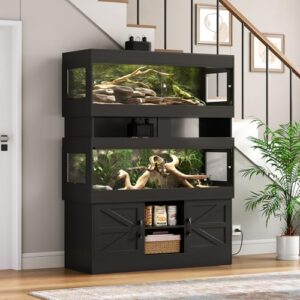
The Terroute Dual Reptile Terrarium Cabinet Stand gives you two separate 60-gallon acrylic enclosures side by side — 120 gallons total — which works well if you’re housing different species or keeping juveniles apart.
The integrated storage cabinet underneath keeps substrate, hides, and feeding tools organized, and the built-in 4-outlet power strip simplifies your wiring considerably.
Just note that the mesh top lacks a latch, so you’ll want to add securing hardware if your boa is larger or particularly determined.
| Best For | Reptile owners who want to house two different species — like a bearded dragon and a gecko — in one compact setup without doubling their floor space. |
|---|---|
| Capacity | 120 gal total (2×60 gal) |
| Door Type | Front-opening acrylic |
| Ventilation | Removable mesh top |
| Storage | Integrated cabinet beneath tanks |
| Frame Material | MDF engineered wood |
| Price | $379.99 |
| Additional Features |
|
- Two fully separate 60-gallon enclosures let you keep different animals with different needs side by side
- The built-in power strip and storage cabinet keep your setup clean and organized — no extension cords sprawling across the floor
- Front-opening doors and a removable mesh top make feeding and cleaning quick without stressing your animals
- The mesh top has no latch, so if you’ve got an escape-prone snake, you’ll need to add your own securing hardware
- Assembly is a two-person job, and the instructions have a genuinely confusing step involving flipping the enclosures upside-down
- Some panels — especially the back and cabinet sides — feel thin for a $380 price tag, and shipping damage has been a common complaint
2. Terroute Dual Reptile Terrarium Stand
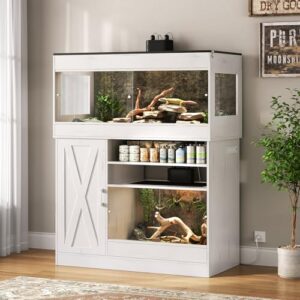
If you need a dedicated support structure rather than a second enclosure, the Terroute Dual Reptile Terrarium Stand is worth considering.
It’s built around a powder-coated steel frame — rust‑resistant and genuinely rigid — with a reinforced MDF top panel rated for up to 150 pounds.
Adjustable leveling feet handle uneven floors without fuss, and the integrated cable management keeps your heat mat and thermostat cords from becoming a tangled hazard.
Assembly usually runs under 45 minutes with basic hand tools.
| Best For | Reptile owners who want to house two medium-sized species in one organized, space-saving setup. |
|---|---|
| Capacity | 180 gal total (120+60 gal) |
| Door Type | Sliding acrylic |
| Ventilation | Full-opening mesh lid |
| Storage | Cabinet and open shelving |
| Frame Material | Engineered wood |
| Price | $389.99 |
| Additional Features |
|
- Two separate enclosures (120 gal 60 gal) let you keep different species side by side without sacrificing space for either.
- Built-in power strip and storage shelves keep cords, supplies, and equipment neatly in one place.
- Sliding acrylic doors make daily feeding and cleaning quick and low-stress for both you and your animals.
- Acrylic doors scratch easily with active reptiles like bearded dragons, and you may end up swapping them out for glass.
- Assembly takes 2–3 hours and really needs two people — plus the two-box shipping means parts might not all show up at once.
- The lower tank’s built-in shelf can get in the way of basking lamps and overhead lighting setups.
3. Herture 120 Gallon Reptile Terrarium with Stand
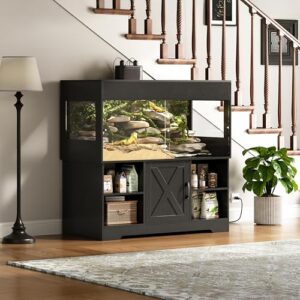
The Herture 120 Gallon Reptile Terrarium with Stand delivers a 48 × 24 × 47.63‑inch footprint — enough floor space to comfortably house a young adult boa through its first major growth phase. Sliding acrylic front doors make feeding and spot‑cleaning straightforward, while the fully openable mesh lid manages ventilation without fuss.
The integrated four‑outlet power strip keeps your heat lamp, UVB fixture, and thermostat organized in one place. Just note: MDF doesn’t tolerate prolonged high humidity, so monitor moisture levels carefully.
| Best For | Reptile owners who need a spacious, all-in-one setup for medium-to-large species like bearded dragons, boas, or large lizards and want their gear organized without cord chaos. |
|---|---|
| Capacity | 120 gal |
| Door Type | Sliding acrylic |
| Ventilation | Lockable mesh lid |
| Storage | Dual side compartments + central door |
| Frame Material | MDF with metal reinforcement |
| Price | Not listed |
| Additional Features |
|
- Sliding front doors and a fully openable mesh lid make feeding, cleaning, and daily checks genuinely easy
- The built-in four-outlet power strip keeps your heat lamp, UVB bulb, and thermostat plugged in and tidy without hunting for a spare outlet
- The integrated storage cabinet underneath is a nice touch — lamps, substrate bags, and spare gear all have a home
- MDF isn’t water-tight, so high-humidity or bio-active setups are a real risk for warping and wear over time
- The mesh lid only locks on one side, which could be a concern with escape-prone species or if you need to run thermostat wires cleanly
- Assembly takes patience, and since it ships in two separate boxes, damaged panels aren’t unheard of — inspect everything right away
4. Coco Design 45 Gallon Reptile Terrarium
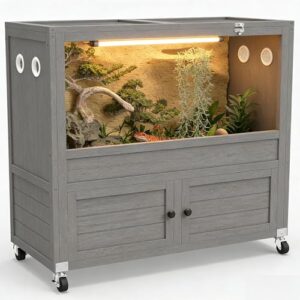
Coco Design 45 Gallon Terrarium works best as a starter setup for hatchlings and juveniles under 3 feet. Its 24 × 18 × 24-inch interior accommodates early growth without overwhelming a small snake, and the front-opening tempered glass doors make feeding and spot-cleaning genuinely painless.
The locking lid is solid, the bottom frame accommodates a heat mat, and coconut fiber substrate fits right in.
Just know — once your boa hits the 4-foot mark, it’ll be time to upgrade.
| Best For | Reptile owners looking for a solid starter enclosure for dry-habitat species like bearded dragons, lizards, or smaller snakes. |
|---|---|
| Capacity | 45 gal |
| Door Type | Lockable sliding acrylic |
| Ventilation | Breathable metal mesh top |
| Storage | Lower storage compartment |
| Frame Material | Solid wood |
| Price | Not listed |
| Additional Features |
|
- The solid wood build holds heat well, so your basking setup stays consistent without your lamp working overtime.
- Front-opening acrylic door makes feeding and spot-cleaning easy — no awkward reaching from the top.
- Built-in storage stand keeps all your supplies right there, which is a small thing that makes a real difference day-to-day.
- Wood and moisture don’t mix, so this isn’t the right fit for any semi-aquatic or high-humidity species.
- The mesh top can let small feeder insects slip out (or in), which might mean adding extra screening depending on your setup.
- In a warm room, heat retention can work against you — you’ll want a thermometer in there to stay on top of temps.
Boa-Safe Terrarium Materials
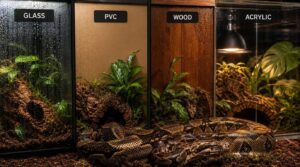
The material your boa’s enclosure is built from affects everything — heat retention, humidity stability, and how long the setup actually lasts.
Glass, PVC, wood, and acrylic each behave differently, and knowing those differences helps you avoid costly mistakes.
Here’s what you need to know about each one before committing to a build.
Glass Heat Loss
Glass looks sleek, but it’s a thermal liability. A glass enclosure loses heat fast through glass conduction, and without Low‑E coatings or insulating glass layers, thermal bridges form at the frame edges — quietly undermining your temperature gradient. That instability forces your heating equipment to work harder.
For consistent thermal regulation and heat retention, wood reptile enclosures simply outperform glass at every level.
PVC Humidity Retention
PVC reptile enclosures handle humidity control far better than glass. The non-porous polymer surface resists moisture loss, and solid PVC sealing techniques — tight edge bonds, airtight joint compounds — reduce vapor leakage by up to 60%.
Hydrophobic surface benefits include less condensation buildup and reduced mold risk. Balanced ventilation humidity balance keeps RH stable without stagnation, directly supporting your boa’s shedding cycles and respiratory health.
Wood Sealing Requirements
Wood holds humidity well, but it demands proper prep. Without reptile-safe sealants covering every surface — faces, joints, and especially end grain — moisture seeps in fast, causing rot and mold.
Apply two thin coats, allowing full sealer curing time between each. For humidity control, this reliable, reapplication schedules every one to three years keep wood outperforming glass long-term:
- Seal end grain separately with a UV-resistant sealant
- Use only non-toxic materials rated food-contact or reptile-safe
- Inspect annually for peeling or mold prevention failures
Acrylic Durability Concerns
Unlike wood or PVC, acrylic looks clean at first — but it won’t stay that way long.
Surface scratching from routine cleaning dulls visibility quickly, and UV‑Induced Yellowing can reduce transparency by up to 20% over time. Inside a boa constrictor enclosure, which demands consistent temperature‑gradient management, thermal‑warping risks become real — heat lamp and UVB light exposure accelerate panel bowing. Chemical vulnerability to common cleaners and impact‑resistance limits near edges make acrylic a poor long‑term investment.
| Acrylic Issue | Enclosure Impact |
|---|---|
| UV-Induced Yellowing | Reduces viewing clarity |
| Thermal Warping Risks | Misaligns lids and seams |
| Chemical Vulnerability | Crazes surface over time |
Non-reflective Wall Benefits
Acrylic’s reflection problems point to a broader truth: what your boa sees matters as much as what you measure on a thermometer.
NONREFLECTIVE SURFACES REDUCE REFLECTIONS that disorient boas, supporting genuine stress reduction for reptiles in captivity. The Zen Habitat 30 uses matte paneling for exactly this reason. Benefits include:
- Snake Stress Reduction through a calmer visual field
- Reduced Glare and Photography‑Friendly observation angles
- Easy Cleaning with Smudge Resistance built into the finish
Heating, Lighting, and Humidity
Getting the thermal environment right is honestly where most boa setups succeed or fall short. Your boa can’t regulate its own body temperature, so the enclosure has to do that work for it — from basking zones down to cool‑side retreats.
Your boa’s enclosure must do the thermoregulating work your snake simply cannot do itself
Here’s what you need to dial in before choosing your setup.
Basking Zone Temperatures
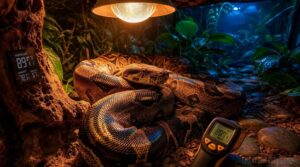
Your boa’s metabolic engine — get it wrong and digestion stalls.
Maintain a temperature basking spot between 88–92°F using a dedicated basking bulb or ceramic heat emitter, and always verify surface temps with an infrared thermometer.
Thermostatic control is non-negotiable for overheating prevention.
A well-executed thermal gradient design lets your boa thermoregulate on its own terms.
Cool-side Temperature Range
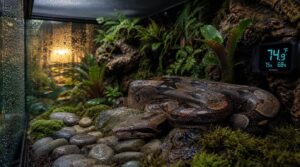
While your basking zone gets the spotlight, the cool side quietly does the heavy lifting for your boa’s temperature regulation and long-term health.
Keep it between 75–80°F (22–26°C) for effective thermal gradient design and temperature gradient balance.
Cool Monitoring checklist:
- Place dual-sensor thermometers at mid-height
- Log 24-hour data for seasonal adjustments
- Watch substrate influence on cool-side microclimate
- Achieve ideal cooling via passive ventilation
- Track health impacts from fluctuations exceeding 3°C
Thermostat-controlled Heat Mats
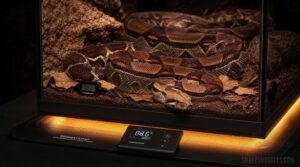
A thermostat-controlled heat mat is the backbone of reliable heat gradient management for your boa’s enclosure.
PID Controllers deliver smoother temperature regulation than simple on/off switching, maintaining warm hides at 86–88°F with minimal drift.
Prioritize Overheat Protection, careful Sensor Placement, and Mat Compatibility — the Exo Terra Heat Mat 4 Watt suits smaller setups well.
| Feature | StandardMat | Thermostat‑ControlledMat |
|---|---|---|
| Temperature Regulation | Manual only | Automated via PID Controllers |
| Energy Efficiency | Higher waste | Reduced by cycling off when stable |
| Overheat Protection | None | Automatic shutoff included |
Safe UVB Placement
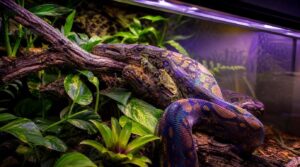
UVB placement isn’t guesswork — get it wrong and your boa either misses the benefit entirely or risks overexposure.
UVB Distance Rules: mount your reptile lighting fixtures like the Arcadia Forest or a T5 HO at 12 inches minimum, targeting a basking zone width of 6–12 inches.
Use a Solarmeter for UVB intensity measurement, keeping UVI under 3.0.
Adjust Fixture Tilt Angles for even coverage and replace bulbs every 6–12 months per your Bulb Lifespan Guide.
Shedding Humidity Targets
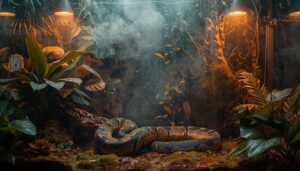
Shedding is when humidity management really earns its keep.
Keep your Boa constrictor’s enclosure at 55–75% relative humidity normally, then push toward 70–90% when Shedding Cycle Signs appear — cloudy eyes, dull skin.
A misting system makes hitting those Ideal RH Ranges easy.
Follow Hygrometer Calibration Tips monthly, use two hygrometers across a Humidity Gradient Setup, and keep a moisture‑rich humidity hide ready.
Substrate, Security, and Enrichment
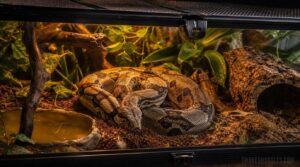
Getting the substrate, security, and enrichment right can make or break your boa’s long-term health and comfort.
Every choice — from what lines the floor to what locks the lid — plays a direct role in how well your snake thrives.
Here’s what you need to know about each element before choosing your setup.
Boa-safe Substrate Depth
Substrate depth isn’t just comfort — it’s function. For boas, maintaining 2–4 inches of coconut fiber or a bioactive soil depth blend (topsoil, reptile soil, play sand) facilitates burrowing behavior benefits, stress reduction, and microbial activity support for waste breakdown.
substrate moisture balance prevents impaction by keeping tunnels stable.
Shallow substrate under 2 inches disrupts species-specific care and limits natural substrate layering entirely.
Humid Hide Setup
Once your substrate is dialed in, the humid hide becomes your boa’s private recovery zone — especially during pre-shed. For Humidity Monitoring, place a hygrometer near the hide targeting 85–95% relative humidity inside. Secure Hides should sit on the warm side, filled with sphagnum moss or coconut fiber for steady moisture retention.
For effective Humid Hide Setup:
- Use sphagnum moss or coconut fiber as Moisture Mediums — they hold humidity for 24–72 hours
- Practice smart Hide Placement: warm side, angled entrance, away from vents
- Follow consistent Cleaning Methods — sanitize monthly, refresh moss every 1–2 weeks
- Check commercial reptile hides for smooth interiors that won’t trap shed debris
Locking Lids and Doors
A boa that wants out will find any weakness in your setup — that’s just reality.
Cam locks and dual-point Escape-Proof Latching are your best defense, while Tamper-Evident Seals confirm the enclosure hasn’t been disturbed.
Choose Rust-Resistant Hardware rated for high humidity and prioritize Quick-Access Locks on front-opening doors so feeding stays low-stress.
Never underestimate a determined snake.
Anchored Branches and Vines
While your locks hold the perimeter, what happens inside matters just as much. Branch Anchoring Techniques keep climbing structures — Cork Branch Large, Cork Branch Small, and Natural branches — from shifting under a boa’s full weight.
Rough bark and irregular vine texture benefits grip over smooth finishes every time.
Design your climbing path design with branches spaced 6–12 inches apart, mix horizontal and diagonal angles for genuine boa grip surfaces, and install vertical enrichment at multiple heights.
Safety inspection routines every 4–6 weeks catch splinters and loose anchors before they cause problems.
Large Water Bowl Placement
Inside the enclosure, water bowl placement shapes both humidity gradients and temperature gradients in ways that matter daily. Use wide, heavy shallow water bowls anchored in a corner on the cool side—at least 6 inches from any heat‑mat edge. Keep Bowl Stability Tips simple: low‑profile, substrate‑level positioning prevents tipping.
For Enrichment Accessibility, don’t block hide routes. Natural habitat replication starts with a bowl your boa actually uses.
Frequently Asked Questions (FAQs)
What is the best enclosure for a boa constrictor?
The right enclosure can make or break your boa constrictor’s health.
For most keepers, a PVC build with a stable temperature gradient and consistent humidity hits the sweet spot between enclosure cost comparison and long-term function.
Can multiple boas share the same terrarium?
Cohabitation is generally discouraged for boa constrictors. Social stress signs, disease transmission risk, resource competition, and unintended breeding make shared snake enclosures risky.
Species-specific care standards recommend individual housing for the safest outcome.
How often should substrate be completely replaced?
Think of substrate like a filter — it silently absorbs waste until it can’t anymore. Replace it fully every 6–12 months, or every 4–6 months for bioactive substrate setups. Spot clean weekly.
What signs indicate a terrarium is too small?
A boa constrictor in a cramped enclosure shows it fast.
Restricted movement patterns, wall aggression signs, feeding hesitation, scale wear, and climbing frustration behaviors all signal your snake has outgrown its space.
Do boas need different setups during breeding season?
Yes — breeding season calls for subtle but meaningful adjustments. Fine-tune your temperature gradients, dial back handling, and time feedings carefully. A well-managed setup makes all the difference in pairing success.
How to transition from juvenile to adult enclosure?
Wait until your juvenile hits 400–600 grams before upgrading enclosure size. Move during a completed shed, then monitor feeding response within two weeks to confirm stress reduction and successful adjustment.
How often should I feed my boa?
Like clockwork with room for flexibility — hatchlings eat every 5–7 days, juveniles every 7–10, and adults every 10–14 days, adjusted by body condition, season, and your boa constrictor’s digestive health signs.
Can boas be housed together safely?
Housing boas together isn’t safe. Social Dynamics don’t apply here — boas are solitary.
Aggression Risks, Stress Indicators, and Disease Transmission make cohabitation dangerous.
Breeding Exceptions aside, reptile husbandry standards require individual enclosures always.
What live plants are safe for boas?
Pothos (Epipremnum aureum), Philodendron species, Sansevieria trifasciata, Bromeliads, and Nephrolepis exaltata are all non-toxic varieties that double as humidity-boosting flora, easy-care greenery, and climbing vines — always avoid toxic species.
How long should new boas be quarantined?
New Boa constrictors need a minimum 90‑day quarantine.
This isolation setup’s essential period lets you run full health monitoring protocols — tracking appetite, shedding, and breathing — before post‑quarantine integration into your main collection.
Conclusion
Think of your boa’s enclosure the way a shipwright thinks of a hull—every material choice, every seam, every measurement either holds or fails under pressure. The right reptile terrariums for boas don’t just house a snake; they create the conditions where one can actually thrive.
Nail the sizing, lock in the thermal gradient, and secure the humidity, and husbandry stops feeling like damage control. A well-built enclosure makes you the keeper your boa deserves.