This site is supported by our readers. We may earn a commission, at no cost to you, if you purchase through links.
A boa constrictor pressed flat against the glass, pacing the same 12 inches back and forth, isn’t being territorial—it’s telling you cage is wrong.
Most keepers get the snake right and the enclosure wrong, usually because pet store advice still leans on gallon ratings instead of actual dimensions.
A 100-gallon tank sounds impressive until you realize a 6-foot boa needs 6 feet of floor length, full stop. Getting boa constrictor enclosure size right isn’t complicated, but it does require throwing out a few common assumptions and working from the snake’s body, not the tank’s label.
Table Of Contents
- Key Takeaways
- Boa Constrictor Cage Size Rules
- Enclosure Dimensions by Boa Length
- Pick The Best Cage Material
- Build Safe Heat and Humidity
- Maintain a Healthy Boa Enclosure
- Frequently Asked Questions (FAQs)
- What size enclosure for a boa constrictor?
- How big of a cage do you need for a boa constrictor?
- How long can a boa live in a 20 gallon tank?
- How cold is too cold for a boa?
- What size tank do you need for a boa constrictor?
- What size habitat does a boa constrictor need?
- How big should a snake enclosure be?
- What size enclosure for boa constrictor?
- How much room does a boa constrictor need?
- Can a red tail boa live in a 75 gallon tank?
- Conclusion
Key Takeaways
- Gallon ratings are meaningless for boa enclosures — what actually matters is floor length matching your snake’s adult body length, starting at 6 ft × 3 ft × 3 ft for a full-grown boa.
- Size your enclosure around where your boa is headed, not where it is now — a baby needs 2 ft × 1.5 ft × 1 ft, a juvenile needs 4 ft × 2 ft × 2 ft, and an adult needs at least 6 ft × 3 ft × 3 ft.
- Constant glass-surfing, incomplete sheds, and thermal restlessness aren’t personality quirks — they’re your boa telling you the enclosure is too small.
- Material choice shapes everything: PVC locks in humidity, glass gives you a clear view of your heat gradient, and wood works only if every interior surface is fully sealed before your snake moves in.
Boa Constrictor Cage Size Rules

Getting the cage size right is the single most important decision you’ll make for your boa. It’s not about gallons — it’s about dimensions, and your snake’s adult length drives everything.
Use this boa minimum enclosure size guide to match floor space and height to your snake’s expected adult size.
A good rule of thumb: aim for an enclosure at least two-thirds the snake’s body length, as covered in this boa constrictor enclosure sizing guide.
Here’s what the numbers actually look like at each stage of growth.
Why Enclosure Length Matters More Than Gallons
Gallon ratings tell you how much water a tank holds — not how far your boa can actually move. Linear movement freedom is what matters.
A 6-foot boa needs a 6 ft × 3 ft × 3 ft space for natural coil formation, thermal gradient stability, and activity level increase. Minimum dimensions aren’t suggestions.
They’re the baseline for a snake that stays healthy. A 6‑foot enclosure offers extended linear space for natural walking and sprinting.
Adult Length as The Baseline for Sizing
Your adult boa’s projected full length is the starting point for every enclosure decision. Most boa constrictors reach 6–10 feet, so build around that Adult Forecast Buffer — not where your snake is today.
The Length Ratio Rule keeps it simple: enclosure length should match adult length. That Baseline Volume Calculation prevents undersizing before it becomes a health problem.
Minimum Length, Width, and Height Ratios
Once you have that adult length estimate, the math gets straightforward.
Your Length Width Ratio target is 2:1 — so a 6-foot boa needs at least 3 feet of width. Height Ratio Guidelines follow the same logic: match height to roughly half the snake’s length.
These Growth Scaling Ratios aren’t arbitrary — they give your boa room to coil, stretch, and thermoregulate without wall contact.
When to Choose a Larger-than-minimum Cage
Minimums are a floor, not a goal. If your boa shows any of these Behavioral Stress Indicators, it’s time to upsize:
- Constant pacing or glass-surfing signals cramped conditions
- Shedding Complications often trace back to insufficient humidity volume
- Vertical Space Needs go unmet when height is ignored
- Growth Projection Forecast near 8+ feet demands planning ahead
- Multiple Occupancy Issues require additional square footage immediately
Size up before problems appear.
Enclosure Dimensions by Boa Length
Boa size changes fast, and the enclosure needs to keep up.
Getting the dimensions right from the start saves you money and keeps your snake healthy at every stage.
Here’s what your boa actually needs, from hatchling to full-grown adult.
Baby Boa Enclosure Requirements
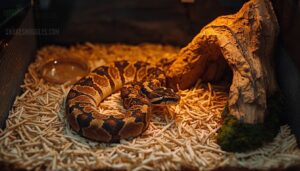
Baby boas under 2 feet don’t need a mansion — but they do need room to move. Start with a minimum of 2 ft × 1.5 ft × 1 ft. That clearance space lets your snake stretch without coiling against walls.
As your boa grows, you’ll want to revisit your setup — this boa constrictor enclosure size guide breaks down exactly how to scale space with age and length.
Good ventilation also matters — a mesh or screen top helps balance airflow and humidity in boa enclosures without letting things get stuffy or soggy.
| Boa constrictor enclosure dimensions by age | Minimum Recommended Dimension |
|---|---|
| Baby (shorter than 2 ft) | 2 ft × 1.5 ft × 1 ft |
| Space requirements for movement | 1-inch clearance on all sides |
| Heat source distance from snake | Mounted, no direct contact |
| Substrate moisture control | Aspen or cypress mulch |
Keep ventilation slots clear and an observation window accessible for daily checks.
Juvenile Boa Enclosure Requirements
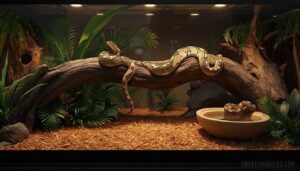
Once your juvenile boa hits 2 feet, the cozy starter tank is done. For snakes between 2 and 5 feet, the minimum recommended dimension jumps to 4 ft × 2 ft × 2 ft — no exceptions.
Key space requirements for juvenile boa setups:
- Substrate depth of 2–4 inches for burrowing comfort
- Vertical enrichment through climbing structures and secured branches
- A water dish size large enough for full submersion
- Consistent lighting schedule to support natural activity rhythms
- Boa constrictor enclosure dimensions by age should guide every upgrade decision
Adult Boa Enclosure Requirements
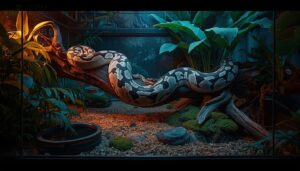
Once your boa hits 6 feet, the space requirements shift dramatically. A 6 ft × 3 ft × 3 ft enclosure is the baseline — that’s roughly 18 square feet of floor area, with enough habitat height for arboreal snakes to use climbing branch placement effectively.
Dial in thermal spot calibration across that gradient, establish humidity buffer zones, fit a water dish size suitable for soaking, and install secure lock mechanisms.
Large Adult Boa Enclosure Requirements

Once your boa pushes past 8 feet, the space requirements aren’t negotiable. You’re looking at a minimum 8 ft × 4 ft × 4 ft enclosure — 32 square feet of floor coverage plus real vertical space for climbing.
Prioritize modular cage design with cleaning access points built in.
Water feature integration helps maintain humidity, and power backup keeps temperatures stable when it matters most.
How to Measure Your Boa Correctly
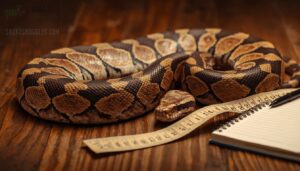
Getting the snake length wrong means the enclosure size you pick is wrong from the start. Use a flexible measuring tape along the natural resting curve — no stretching.
Record total length, midbody girth, and tail length separation separately for accurate data logging.
Measure every three to six months at consistent timing and the same time of day, tracking each growth stage to match space requirements before your boa outgrows the current setup.
Pick The Best Cage Material
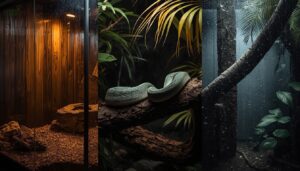
The material your boa’s enclosure is made from affects everything — heat retention, humidity, durability, and your daily maintenance load. Not every option works equally well for every snake or every keeper.
Here’s a breakdown of the most common cage materials and what each one actually delivers.
Glass Terrariums for Heat and Visibility
Glass terrariums give you something PVC can’t: a clear, unobstructed view of your thermal gradient in action. Low-iron glass clarity means truer color and no guesswork about where your heat lamp placement lands.
Edge-sealed joints lock in warmth, and glass condensation indicators tell you humidity at a glance.
Pair a front-opening terrarium with glass aquarium lid clamps, and UVB coverage ratio becomes easy to dial in precisely.
PVC Enclosures for Humidity Control
PVC panels do what glass can’t: hold humidity steady without constant misting. Non-porous surfaces resist moisture absorption, and sealed joints stop humidity from leaking at seams. UV-resistant PVC withstands prolonged lamp exposure without degrading.
Position integrated vent placement on opposing sides for cross-airflow without drafts. Mount digital humidity sensors at head height — that’s your boa constrictor enclosure’s actual breathing zone.
Wood Enclosures and Waterproof Sealing
Wood works well for custom builds, but untreated wood rots fast in a humid enclosure. Seal every interior surface before your boat moves in.
Marine Polyurethane Seal stays flexible from -20°C to 80°C. Epoxy Coating bonds hard at over 25 MPa. Silicone Flex Seal won’t crack under temperature swings. Acrylic Breathable Finish and Oil Penetrating Seal are solid indoor options too — just confirm the label says VOC-free.
Why Storage Bins Are Not Suitable
Storage bins might seem like a budget fix, but they fail on every front that matters:
- Stagnant air builds fast — poor ventilation and airflow requirements for boa cages go unmet, trapping moisture and heat.
- Temperature hotspots form near any heat source, with no room to correct the gradient.
- Limited vertical space and structural weakness make escape prevention methods nearly impossible.
Skip the plastic storage tub with ventilation holes. It’s not a solution.
Front-opening Vs Top-opening Designs
Once you’ve ruled out storage bins, the next call is door design. Front-opening terrariums win on access speed — you reach in without looming over your boa, which cuts stress for both of you.
Heavy-duty screen tops work for glass tanks but lose points on humidity retention. Front-opening designs also score better on space efficiency inside tight rooms.
Build Safe Heat and Humidity
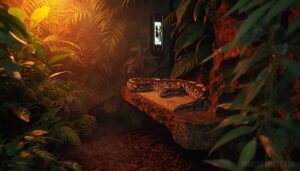
Getting the heat and humidity right isn’t complicated, but the details matter more than most people expect. A wrong gradient or a stuffy, over-dried enclosure can quietly stress your boa before you notice anything’s wrong.
Here’s what you need to nail each part of it.
Creating a Proper Warm-to-cool Gradient
Think of your enclosure’s temperature gradient as a slow fade, not a hard line. Warm color temperature zones (around 2700K) anchor the basking end, while cooler tones rise toward the top.
Use LED dimming control to smooth transitions and avoid hot spots. Good vertical light placement helps your boa thermoregulate naturally. Use gradient calibration tools — a quality thermometer trio works fine — and recheck after any substrate change.
Basking Spot Placement and Temperature Targets
Your basking spot does more work than most keepers realize. Aim for a surface temperature of 90–95°F — measured directly on the platform, not in the air above it.
Lamp distance calibration matters here: small adjustments shift readings quickly. Keep your thermostat sensor position close to the basking area, and use an infrared gun for accurate surface temperature measurement.
The basking platform size should let your boa lie flat comfortably.
Humidity Ranges for Healthy Shedding
During shedding, your boa’s shedding humidity range needs to hit 70–80%. Outside that window, keep ambient levels at 60–70%.
Don’t soak the whole enclosure — targeted humidity zones using a humid hide give you humidity spike management without triggering mold prevention problems.
Substrate humidity retention matters too; cypress mulch holds moisture longer than aspen.
Mist strategically — misting schedule optimization means raising levels during ecdysis, then allowing ventilation drying cycles to reset the enclosure between sessions.
Ventilation Balance Without Drying The Enclosure
Good ventilation isn’t the enemy of humidity — poor design is. A Cross Ventilation Layout, with vents positioned high and low on opposite walls, keeps air moving without gutting moisture levels.
Airflow Zone Balancing prevents stagnant corners where mold hides. Use Adjustable Fan Control and Humidity Sensor Positioning to monitor and respond in real time.
Moisture-Retaining Filters do the rest.
Using Thermometers and Hygrometers Correctly
Bad data is worse than no data. Follow these Sensor Placement Guidelines to stay accurate:
- Mount thermometers at heart level, away from lamps — this provides reliable temperature monitoring.
- Position hygrometers where air circulates freely for honest humidity regulation.
- Sensor Type Selection matters — thermistors beat resistive hygrometers for stability.
- Practice Calibration Frequency every six months, logging results for avoiding sensor drift.
- Data Logging Practices reveal patterns, guesswork never will.
Maintain a Healthy Boa Enclosure
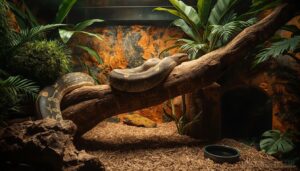
Getting the size right is only half the job. A well-maintained enclosure keeps your boa healthy, stress-free, and safe long-term. Here’s what you need to cover on the maintenance side.
Adding Hides, Branches, and Floor Space
Your boa needs more than open floor space — it needs a world.
For hide placement, put one on the cool side and one on the warm side, each with a single entrance and interior width matching your snake’s girth plus two inches.
Branch anchoring matters too: secure every branch to hold ten pounds without wobbling, spaced six to eight inches apart for coiling.
That’s your microhabitat layout.
Choosing Safe Substrate for The Cage Size
Now that hides and branches are set, the floor beneath them matters just as much.
Substrate selection and maintenance for snake enclosures comes down to three things: dust-free bedding, absorbent substrate, and non-toxic materials. Aspen shavings and cypress mulch both work well. Aim for two to three inches of burrowing depth for moisture control. Skip cedar — the oils will hurt your boa.
Preventing Escapes With Secure Latches
Substrate sorted — now lock it down. Boas are escape artists, and a loose latch is all the invitation they need.
Use heavy-duty steel latches with a minimum 2.5 mm thickness, backed by magnetic auxiliary locks for a secondary hold. Tamper-resistant screws, self-aligning latch seals, and nylon bushings prevent wear-related gaps.
Test every latch weekly. One overlooked gap means a missing snake.
Test every latch weekly, because one overlooked gap means a missing snake
Cleaning Routines That Protect Enclosure Conditions
Latches keep your boa in — cleaning keeps conditions stable. Pull feces and uneaten food immediately; that’s your Spot Waste Removal baseline.
Wash the water dish daily — Water Dish Hygiene prevents bacterial buildup fast.
Monthly, do a full Substrate Deep Reset: remove everything, disinfect surfaces with proper Disinfectant Contact Time, dry completely. Skipping drying is how mold wins — and mold wrecks humidity control overnight.
Warning Signs The Enclosure is Too Small
Even a spotless enclosure fails if it’s too small.
Watch for these red flags:
- Restricted movement: your boa presses against walls instead of exploring
- Thermal frustration: it switches spots constantly without settling
- Hide scarcity: hides block each other, leaving no real retreat
- Stress pacing and shedding issues: incomplete sheds signal space allocation isn’t matching your boa’s growth stage
Wrong size = rising stress levels, guaranteed.
Frequently Asked Questions (FAQs)
What size enclosure for a boa constrictor?
"Measure twice, cut once" applies here too. For a boa, enclosure size follows the snake’s projected adult length — commonly a 6×3×3 ft minimum, scaled up as your boa grows.
How big of a cage do you need for a boa constrictor?
At minimum, plan for a 6 × 3 × 3 ft enclosure for a full-grown boa. But honestly, bigger always wins — more square footage means a healthier, calmer snake.
How long can a boa live in a 20 gallon tank?
Not long — and not well.
A 20-gallon tank is roughly 24 inches long, far too cramped for a boa’s longevity factors, stress impact, and basic health risks tied to poor reptile housing size.
How cold is too cold for a boa?
Below 75°F causes metabolic slowdown, feeding suppression, and shedding problems. Nighttime temperature drops are fine, but never let it fall under 68°F or cold stress signs appear fast.
What size tank do you need for a boa constrictor?
For an adult 6 to 8 feet long, you need at least a 6×3×3-foot enclosure. Large adult longer than 8 feet requires 8×4× Always plan for future growth.
What size habitat does a boa constrictor need?
For a boa constrictor, you need at least 6 feet long by 3 feet wide by 3 feet high — that’s your floor-level baseline before factoring in vertical space or future growth planning.
How big should a snake enclosure be?
For most snakes, enclosure size should match the animal’s full length plus at least 50 percent extra.
That square footage facilitates natural movement, proper habitat layout, and species-specific space requirements without crowding.
What size enclosure for boa constrictor?
Size follows the snake, not the store shelf. A baby needs 2×5×1 ft, a juvenile 4×2×2 ft, and a full adult at least 6×3×3 ft.
How much room does a boa constrictor need?
Room depends on length. Adults need at least 6×3×3 feet — floor space ratio, vertical climbing area, and space for shedding all matter. Match enclosure size to growth projection planning.
Can a red tail boa live in a 75 gallon tank?
75-gallon tank might work temporarily for a juvenile, but it won’t support future growth long-term.
Most adult red tails need at least a 6-foot enclosure — square footage matters far more than gallon rating.
Conclusion
The smaller the mistake, the bigger the consequence—and nothing proves that faster than a boa constrictor in the wrong enclosure. Getting boa constrictor enclosure size right isn’t about generosity; it’s about function. Correct floor length drives thermoregulation, natural movement, and long-term health.
Once you stop measuring by gallons and start measuring by the snake in front of you, the setup stops feeling complicated. Your boa doesn’t need more stuff—it needs the right space.