This site is supported by our readers. We may earn a commission, at no cost to you, if you purchase through links.
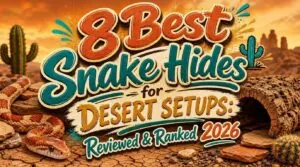
A desert snake spending 80% of its active time wedged under the same flat rock isn’t being lazy—it’s doing exactly what millions of years of evolution designed it to do. That instinct doesn’t disappear inside an enclosure, and ignoring it creates a snake that won’t eat, won’t shed cleanly, and cycles through chronic low-grade stress until something breaks.
The right snake hide for desert setups works with this biology rather than against it, giving your animal a dark, snug microclimate it can retreat to on its own terms. What separates a good hide from a bad one comes down to entrance sizing, material density, substrate stability, and placement—details that are easy to get right once you know what to look for.
Table Of Contents
- Key Takeaways
- Top 8 Desert Snake Hides
- 1. Desert Rock Hide Cactus Cave for Small Reptiles
- 2. Jihaqua Resin Aquarium Skull Hide
- 3. FCALIVV Large Reptile Hide Box
- 4. Tfwadmx Human Skull Terrarium Decor
- 5. AWXZOM Resin Dinosaur Human Skulls Reptile Decor
- 6. Kathson Desert Cactus Reptile Hide
- 7. BNOSDM Reptile Hide Cave Basking Platform
- 8. Cosyall Reptile Hide Cave
- Choosing Secure Desert Snake Hides
- Warm and Cool Hide Placement
- Desert Substrate and Hide Stability
- Cleaning and Monitoring Hide Use
- Frequently Asked Questions (FAQs)
- Conclusion
Key Takeaways
- A desert snake’s instinct to hide isn’t laziness — it’s millions of years of survival wiring, and a snug, opaque hide on both the warm and cool ends of the enclosure is what lets that instinct work for you instead of against you.
- Hide sizing, entrance diameter, and material choice directly shape feeding response, shed quality, and stress levels, so matching those specs to your snake’s body dimensions is the single highest-leverage decision you’ll make for the enclosure.
- Where you place each hide matters as much as which hide you choose — warm-side temps should hold at 88–95 °F at floor level, cool-side at 72–80 °F, and both hides should sit away from high-traffic zones to cut stress signals by up to 50%.
- A 50/50 play sand and topsoil blend gives your substrate the structural integrity to keep hides stable and support natural burrowing, while unsafe options like silica sand or cedar shavings introduce impaction risk, respiratory irritation, and chemical off-gassing you can’t afford.
Top 8 Desert Snake Hides
Each hide on this list was chosen with desert-dwelling snakes in mind — think proper sizing, opaque walls, and materials that hold up in dry, warm enclosures. Some are built for function, others double as naturalistic décor, but all of them check the boxes that actually matter for your snake’s comfort and stress levels.
If you’re unsure where to start, understanding how many hides corn snakes actually need helps you build a setup that covers all the right spots.
Here’s what made the cut.
1. Desert Rock Hide Cactus Cave for Small Reptiles
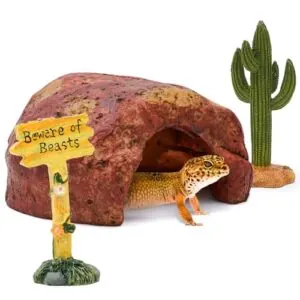
The Desert Rock Hide Cactus Cave is designed for small reptiles — snakes, leopard geckos, and similar species — offering a snug, secure retreat. Its 5.8 x 5.8 x 3-inch footprint creates a dim, tight interior that reduces stress and promotes thermoregulation when placed on the warm side of an enclosure.
The 3-inch entrance balances accessibility for pets with protection against unwanted intruders. Constructed from non-toxic resin, the hide is easy to maintain: just rinse and dry for hassle-free cleanup.
| Best For | Small reptile owners — especially those keeping leopard geckos, hatchling snakes, or chameleons — who want a functional hide that also looks great in a desert-themed tank. |
|---|---|
| Material | Resin |
| Hide Function | Yes |
| Species Compatibility | Snakes, geckos, lizards |
| Ease of Cleaning | Rinse with water |
| Size Category | Small |
| Desert Theme | Yes |
| Additional Features |
|
- Creates a humid microclimate inside, which is a real win for shedding and egg-laying
- Non-toxic resin is easy to rinse clean, so upkeep takes about 30 seconds
- The desert aesthetic actually looks good in the tank — not just a plain plastic box
- It’s small — only fits hatchlings or tiny adults, so your reptile will outgrow it fast
- Resin can arrive cracked, and the paint chips if you’re not gentle with it
- Lightweight enough that an active or larger reptile can knock it over pretty easily
2. Jihaqua Resin Aquarium Skull Hide
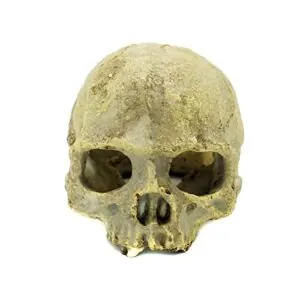
The Jihaqua Resin Aquarium Skull Hide blends desert-bone aesthetics with practical design. Its matte, sandy-beige finish reduces glare, minimizing stress for sensitive reptiles, while the dark, narrow interior cavity provides a secure retreat for juveniles and smaller snakes.
Constructed from non-toxic resin, the hide resists moisture and cleans easily with mild reptile-safe soap. Rounded edges prevent snags during shedding, ensuring safety for delicate skin.
For optimal use, place the hide on the warm side of the enclosure, partially buried under 2–4 inches of substrate. This positioning enhances both thermal regulation and naturalistic integration.
| Best For | Small reptile and aquarium keepers who want a natural-looking hide or decor piece for juvenile snakes, geckos, shrimp, or other tiny critters. |
|---|---|
| Material | Resin |
| Hide Function | Yes |
| Species Compatibility | Snakes, lizards, invertebrates |
| Ease of Cleaning | Rinse with water |
| Size Category | Small |
| Desert Theme | No |
| Additional Features |
|
- Hollow design gives small animals a real sense of shelter, and fish can swim right through the eye and nose openings
- Resin holds up well in wet or humid setups and is easy to wipe clean
- Works across a bunch of different enclosures — aquariums, desert tanks, rainforest builds, even as a prop
- Edges can be sharp out of the box, so you’ll want to sand them down before dropping it in
- It’s pretty light, so in aquariums with any water movement it can drift or float unless you anchor it
- The interior is small — great for babies and tiny species, but adult or larger reptiles won’t fit
3. FCALIVV Large Reptile Hide Box
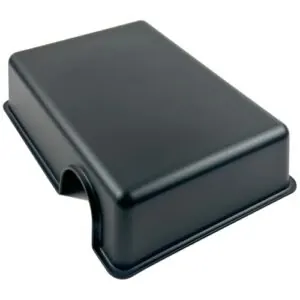
The FCALIVV Large Reptile Hide Box leans purely functional — and for medium to large desert snakes, that’s exactly what you want.
At 16.5 by 11 by 4.5 inches, it fits mid-sized terrariums without crowding the layout. The offset door opening (3.75 by 3.25 inches) limits front exposure, which directly promotes calmer resting behavior.
Polypropylene construction keeps it non-porous and warp-resistant, even in humid desert conditions.
At $9.98, it’s a practical choice for keepers running multiple enclosures.
| Best For | Budget-conscious reptile keepers who need a simple, easy-to-clean hide for snakes, geckos, bearded dragons, or tarantulas. |
|---|---|
| Material | Plastic |
| Hide Function | Yes |
| Species Compatibility | Snakes, geckos, dragons |
| Ease of Cleaning | Disassemble and rinse |
| Size Category | Medium |
| Desert Theme | No |
| Additional Features |
|
- At $9.98, it’s easy to grab a few without breaking the bank — great if you’re running multiple tanks.
- Smooth plastic interior wipes down fast and doesn’t hold onto bacteria or odors.
- The enclosed cave design gives reptiles a real sense of security, which cuts down on stress.
- It’s plain — no texture, no natural look. If you want your setup to look good, this won’t help much.
- Only one opening, so you’ll want to double-check it fits your specific animal before buying.
- Plastic doesn’t hold heat the way cork or wood does, which matters for species that rely on surface warmth.
4. Tfwadmx Human Skull Terrarium Decor
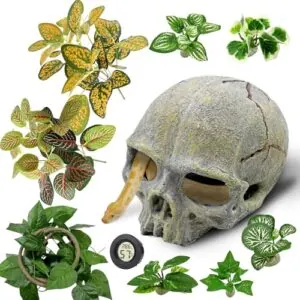
The Tfwadmx Human Skull Terrarium Decor flips the function-form equation, offering both aesthetic appeal and practicality. Its compact size—5.5 × 3.9 × 4.3 inches—makes it ideal for smaller desert species like juvenile corn snakes or hognose snakes.
The resin skull’s rough surface actively facilitates shedding, while the included hygrometer allows real-time monitoring of temperature and humidity. This dual focus on utility and design ensures the decor enhances both habitat functionality and visual appeal.
Before use, sand any sharp edges and soak the skull for 15 minutes to prepare it for your reptile’s environment. This simple maintenance ensures safety and longevity.
| Best For | Small reptile and invertebrate owners who want a spooky, functional terrarium setup with built-in humidity monitoring. |
|---|---|
| Material | Resin |
| Hide Function | Yes |
| Species Compatibility | Snakes, geckos, lizards |
| Ease of Cleaning | Water soak recommended |
| Size Category | Small-Medium |
| Desert Theme | No |
| Additional Features |
|
- The rough resin skull doubles as a climbing structure that helps reptiles shed their skin naturally.
- Comes with a hygrometer so you can keep tabs on temperature and humidity without buying a separate one.
- The 11-piece set gives you a lot to work with for creating a fully decorated, themed enclosure.
- The skull runs smaller than most people expect, so it’s not a great fit for medium or large reptiles.
- Some suction cups don’t hold well on glass and may need a little extra help to stay put.
- There are reports of green dye leaching from the plant pieces in humid environments, which could be a concern for sensitive animals.
5. AWXZOM Resin Dinosaur Human Skulls Reptile Decor
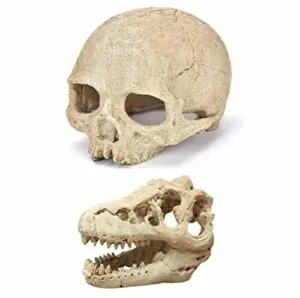
The AWXZOM set offers two distinct skull shapes — a dinosaur skull (2.7 × 2 × 2 in) and a cattle skull (4 × 5 × 1.5 in) — enabling you to build visual depth without overcrowding enclosures. Both are cast from non-toxic resin with hand-painted fossil textures that blend naturally into desert setups.
If you’re pairing these skulls with a desert setup, tucking one near a humid hide for snake shedding gives your snake a functional microclimate that still looks natural and on-theme.
The hollow interiors provide real shelter for smaller species, enhancing both functionality and habitat design.
Worth noting: Submersion has caused paint bubbling for some keepers, so inspect the finish before placing it near water dishes.
| Best For | Reptile and amphibian keepers who want themed skull décor for smaller species like bearded dragons, geckos, or arachnids. |
|---|---|
| Material | Resin |
| Hide Function | Yes |
| Species Compatibility | Reptiles, amphibians, arachnids |
| Ease of Cleaning | Rinse with water |
| Size Category | Extra Small |
| Desert Theme | No |
| Additional Features |
|
- Two unique skull shapes give you layout options without eating up tank space
- Non-toxic resin means it’s safe for both dry enclosures and aquariums
- Hollow design actually works as a hide for smaller critters, not just decoration
- Paint has been known to bubble when submerged, which is a problem for water-heavy setups
- Pretty small — not much use as a hide for anything medium-sized or larger
- At around $16, the price feels a bit steep for how light and fragile these are
6. Kathson Desert Cactus Reptile Hide
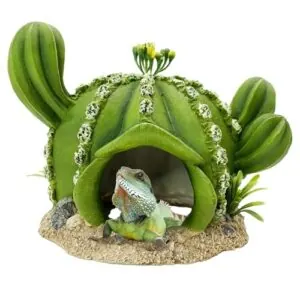
The Kathson Desert Cactus Reptile Hide earns its place in desert setups by doing exactly what a good hide should — staying put. Its stable, rock-shaped resin base resists tipping on sandy substrates, while the textured cactus exterior blends naturally into desert aesthetics.
At 7.2 × 5.5 × 5.3 inches, it comfortably accommodates small to medium species like leopard geckos. The non-porous resin ensures easy cleaning with mild soap, maintaining hygiene in reptile habitats.
Check interior edges before placement — some units arrive sharp and may require light sanding to prevent potential injury.
| Best For | Small to medium reptile owners — like leopard gecko or juvenile snake keepers — who want a sturdy, desert-themed hide that looks good and cleans up easy. |
|---|---|
| Material | Resin |
| Hide Function | Yes |
| Species Compatibility | Snakes, geckos, dragons |
| Ease of Cleaning | Soap or disinfectant |
| Size Category | Medium |
| Desert Theme | Yes |
| Additional Features |
|
- Rock-shaped base stays stable on sand and loose substrates without tipping over
- Non-porous resin wipes clean fast and handles mild disinfectants no problem
- The cactus design actually looks the part in a desert terrarium setup
- Some units arrive with sharp edges or chipped spots that need sanding before use
- Decorative pieces like flowers or grass can pop off if your animal is even a little rough with it
- Too small for adult or larger reptiles — you may need an extra hide as they grow
7. BNOSDM Reptile Hide Cave Basking Platform
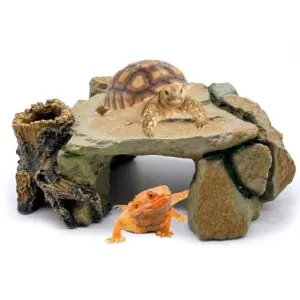
The BNOSDM Reptile Hide Cave offers a dual shelter and basking solution in a compact design. Measuring 9 × 6.3 × 3.9 inches, its resin cavity comfortably accommodates corn snakes, ball pythons, and leopard geckos.
The top platform absorbs heat from overhead lamps, retaining warmth for up to two hours after lights off to support thermoregulation into the evening. Thick cavity walls ensure even heat distribution, effectively avoiding hotspots.
Maintenance is straightforward: clean with mild soap and inspect for cracks regularly. Priced at $19.99, it combines durability with functional efficiency.
| Best For | Small reptile owners — leopard geckos, ball pythons, corn snakes, and juvenile bearded dragons — who want a hide and basking spot in one affordable piece. |
|---|---|
| Material | Resin |
| Hide Function | Yes |
| Species Compatibility | Snakes, geckos, dragons |
| Ease of Cleaning | Rinse, rust-free |
| Size Category | Medium |
| Desert Theme | Yes |
| Additional Features |
|
- Two entrances plus a top basking platform means your reptile gets shade, warmth, and a dark retreat all from one decoration.
- Resin holds up well over time — it won’t rust, warp, or fade, and you can just rinse it off when it gets dirty.
- At $19.99, it’s a solid deal for something that pulls double duty in the enclosure.
- The interior is on the smaller side, so adult or larger reptiles will quickly outgrow it.
- Resin can crack if it takes a hard knock during shipping or setup, so handle it carefully out of the box.
- It only comes in one size and one color, which is limiting if you need something bigger or want a different look for your habitat.
8. Cosyall Reptile Hide Cave
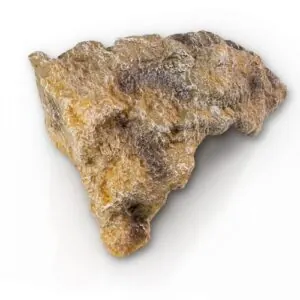
The Cosyall Reptile Hide Cave is compact by design, but do not let the size fool you. At 5.9 × 3.5 × 2.4 inches, it fits hatchlings and small adults comfortably, with an inner cavity that creates just enough snug pressure to reduce exploratory stress.
The weighted resin stays stable on sandy substrates, and the natural yellow rock texture blends cleanly into desert setups.
Clean it with warm water and a soft brush every two to three weeks — maintenance doesn’t get simpler than that.
| Best For | Small reptile and invertebrate owners — think hatchling geckos, juvenile snakes, hermit crabs, or spiders — who want a simple, low-maintenance hide that looks the part in a desert or tropical setup. |
|---|---|
| Material | Resin |
| Hide Function | Yes |
| Species Compatibility | Snakes, geckos, invertebrates |
| Ease of Cleaning | Warm water and brush |
| Size Category | Small |
| Desert Theme | Yes |
| Additional Features |
|
- Weighted resin base keeps it from tipping on loose substrates like sand or coconut fiber
- Smooth, rounded edges make it safe for delicate hatchlings and small adults
- Easy to clean — just warm water and a soft brush, no fuss
- Fragile in shipping, so it occasionally arrives cracked if packaging is lacking
- Color can look a bit artificial up close and may fade with repeated cleaning
- Cavity size rules it out for anything larger than a juvenile — not a long-term fit as your animal grows
Choosing Secure Desert Snake Hides
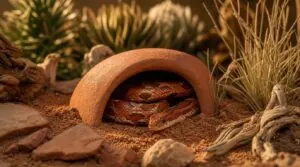
Picking the right hide isn’t just about looks — it directly affects how safe and settled your desert snake feels day to day. The wrong size, material, or shape can quietly work against you, driving up stress and suppressing feeding.
Here’s what to look for before you buy.
Snug Entrance Sizing
The entrance diameter on a desert vivarium hide does more work than most keepers realize. Size it to 10–12% of your snake’s body length, with the lip blocking roughly three-quarters of their girth. Snug-fitting hides with correct entry diameters—usually 1.5–2.5 inches for smaller desert species—cut escape attempts by 40%.
Account for material shrinkage effects and substrate pressure impact by verifying tolerances monthly.
Opaque Hide Benefits
Opaque materials aren’t just aesthetic—they’re functional armor for your desert-dwelling snake’s nervous system. A solid snake hide box blocks external light completely, cutting stimulation during rest and speeding acclimation considerably. Thick walls also deliver real thermal insulation, stabilizing the thermal gradient inside without constant heating adjustments.
Opaque hides don’t just look natural — they shield your snake’s nervous system from light, stress, and heat fluctuations all at once
- Light Blocking: Reduces glare and external movement cues
- Stress Mitigation: Lowers anxiety-driven behavior by up to 50%
- Thermal Insulation: Maintains stable microclimates inside the desert vivarium
- Durable Construction: Dense resins resist cracking and substrate pressure
- Hygiene Maintenance: Non-porous opaque materials simplify cleaning cycles
Rough Interior Textures
Beyond blocking light, the surface inside a hide significantly influences a snake’s sense of security. Textures mimicking natural environments—such as desert terrain or rocky crevices—reduce stress and restless movement. For example, gritty resin walls and sand-infused finishes replicate desert habitats, lowering movement-induced stress by approximately 18%. Similarly, stone emulation textures and micro-cavity grip patterns provide tactile feedback akin to natural hiding spots, while ceramic roughness ensures mold resistance and easy maintenance.
| Texture Type | Key Benefit |
|---|---|
| Gritty Resin | Stable grip, heat-resistant |
| Stone Emulation | Simulates natural crevices |
| Sand-Infused Finish | Humidity retention, desert feel |
| Ceramic Roughness | Mold-resistant, easy cleaning |
| Micro-Cavity Grip | Reduces restless movement |
Practical options like the Pangea Medium Rock Cave effectively integrate these textures. For a more organic approach, cork, bamboo, and terra cotta pots serve as natural, stress-reducing alternatives within desert vivariums.
Non-porous Safe Materials
Material choice matters just as much as texture. In a desert vivarium, nonporous surfaces prevent bacterial buildup between cleanings. Polycarbonate sheets, ceramic glazes, aluminum alloys, epoxy coatings, and carbon fiber composites all resist liquid absorption and wipe clean easily.
Whether you’re using glass enclosures or PVC enclosures, these materials hold up in arid environments without trapping moisture or pathogens.
The lack of capillary action leads to rapid runoff, thanks to surface tension causing beading.
Escape-proof Hide Shapes
Shape does more work than you’d think. A Minimal Curve Design with Tapered Rear Edges removes the wedge points snakes use to pry their way out, while a Symmetrical Cross Section makes rolling resistance predictable from every angle.
Narrow Front Lips, sized to snout width, cut escape attempts by 40%.
Smooth Wall Transitions and snug-fitting hides leave no gaps — strategic hide placement does the rest.
Warm and Cool Hide Placement
Where you place each hide matters just as much as which hide you choose. A well-positioned warm-side hide and a properly spaced cool-side option give your desert snake the thermal control it needs to eat well, shed cleanly, and settle in fast.
For deeper guidance on sizing and placement across enclosure types, boa constrictor hide setups for rescue owners walks through real-world examples that translate well to most desert species.
Here’s what to get right before you arrange anything in the enclosure.
Warm-side Hide Positioning
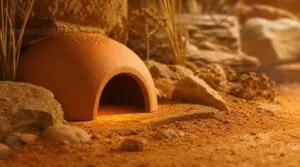
Your warm-side hide is your desert snake’s thermal anchor — get the placement wrong, and everything else falls apart. Position it directly over or beside the heat source, with the entrance facing away to block direct heat glare. That’s Heat Source Alignment done right. Measure floor-level temps with an infrared thermometer to confirm you’re hitting the species’ target warm zone.
For Secure Base Placement on loose substrate, follow these four steps:
- Press the hide firmly into the substrate before adding your snake.
- Confirm zero wobble by gently nudging the hide.
- Verify the entrance points toward the enclosure center for Direct Gradient Access.
- Check that the warm-side temperature reads 88–95 °F at floor level.
Wobble-Free Mounting matters more than most keepers realize — a tipping hide triggers stress responses fast in desert-dwelling snakes.
Cool-side Hide Distance
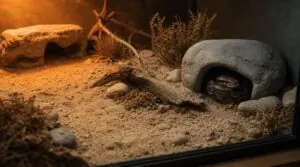
Your cool-side hide defines the other half of your snake’s thermal environment, complementing the warm-side hide. End-wall Positioning places it at the enclosure’s far end, while Distance Calibration ensures floor temperatures remain between 72–80 °F.
Proper Gradient Zone Spacing and Cool Hide Reach provide clear thermal zone planning. This strategic arrangement transforms basic hide placement into a cohesive system.
Ultimately, thoughtful hide positioning creates a functional Substrate Buffer Zone, optimizing your snake’s habitat for comfort and health.
Nighttime Temperature Drops
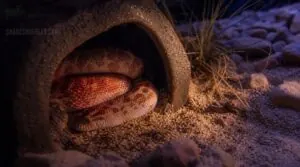
Once the sun sets, radiative cooling occurs rapidly—clear skies draw surface heat upward, causing the enclosure’s temperature gradient to shift. Desert snakes anticipate this natural rhythm. A 5–10 °F nighttime drop through the boundary layer triggers a metabolic slowdown, aligning with their wild behavioral patterns.
- Switch to red night bulbs
- Allow the warm side to drop 5–8 °F
- Let the cool side settle near 68–72 °F
- Monitor dew formation near humid hides
- Account for elevation cooling in drafty rooms
Low-traffic Enclosure Zones
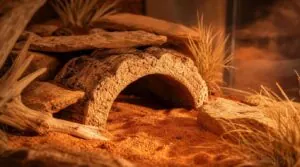
Strategic hide placement inside quiet corner design zones cuts stress signals by up to 50%. Position your desert-dwelling snake’s hide away from enclosure doors and foot traffic, incorporating acoustic dampening materials like cork or coconut husk nearby. This approach minimizes disturbances while fostering a secure environment.
Such microhabitat design establishes a genuine microclimate buffer—a thermal sweet spot your snake will actively utilize. Complement this setup with substrate noise reduction and secure access points to fully address your reptile’s need for tranquility and safety.
Feeding Response Support
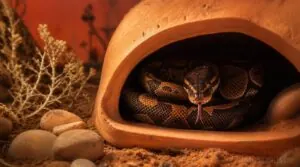
Strategic hide placement directly shapes your desert-dwelling snake’s feeding response — and the numbers back it up. Proper Thermal Feeding Zones and Scent Cue Integration trigger prey detection within seconds of presentation.
- Size entry diameters to match snout width — cuts escape attempts by 40%
- Use Prey Access Design with opaque walls for Secure Feed Enclosure confidence
- Monitor Feeding Behavior Indicators: coiling, reduced tail flicking, head tilt
- Keep feeding stimulation consistent with stable thermal positioning
Consistent application of these principles ensures optimized prey engagement and reduces stress-related feeding reluctance.
Desert Substrate and Hide Stability
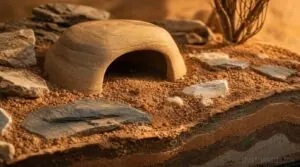
The substrate beneath your desert snake’s hide does more work than most keepers realize — it affects hide stability, burrowing access, and long-term enclosure safety all at once. Getting this layer right means your snake can actually use its hide the way nature intended.
Here’s what you need to know before setting anything up.
Sand and Topsoil Blends
The right substrate composition isn’t decorative — it’s structural. A 50/50 blend of play sand and topsoil provides your desert-dwelling snake with stable footing, reliable moisture retention, and natural texture layers that mimic wild terrain.
Regularly test pH management to maintain safe levels for desert plants and burrowing zones alike.
| Blend Factor | Specification |
|---|---|
| Drainage Ratios | 50% sand / 50% topsoil |
| Nutrient Balance | Topsoil contributes minerals |
| Texture Layers | Coarse sand over fine topsoil |
| Moisture Retention | Stable around shallow burrows |
| pH Management | Test for desert-safe range |
Burrowing Depth Needs
Depth tells the whole story for a desert-dwelling snake. Your substrate choices directly shape how well your snake regulates temperature, retains moisture, and maintains burrow structural integrity.
- Small species need 15–40 cm for stable excavation energy cost and thermal balance
- Mid-sized snakes benefit from 40–70 cm, supporting deeper depth temperature gradient stability
- All burrowers rely on soil moisture retention to sustain ecological burrow use year-round
Avoid Unsafe Substrates
Not every substrate is safe just because it looks natural. Silica sand poses real risks — ingestion can cause impaction, and dust inhalation can irritate your desert-dwelling snake’s respiratory tract.
Cedar, pine, and VOC-emitting materials introduce substrate toxicity through chemical off-gassing, while porous organic mixes breed mold without proper ventilation, making mold prevention non-negotiable.
| Substrate | Primary Risk | Safer Alternative |
|---|---|---|
| Silica sand | Impaction, dust inhalation | Play sand/topsoil blend |
| Cedar/pine shavings | Substrate toxicity, VOC exposure | VOC-free materials like coco fiber |
| Clay-based mixes | Sharp edges, crumbling | Inert mineral substrate |
Preventing Hide Collapse
Unsafe substrates do more than harm your snake — they undermine hide stability too. Loose, shifting sand lets hides tip and collapse, especially when your snake burrows underneath. Compact your base layer firmly and use a support membrane between substrate and hide to address this.
Choose hides with a low center of gravity for added stability. Stainless steel fasteners prevent corrosion, while internal structural bracing ensures everything remains upright when it matters.
Naturalistic Desert Layouts
Stability sets the stage — but a naturalistic setup takes it further. Arrange rocks in organic, irregular clusters that mirror how a desert-dwelling snake actually experiences its environment. Curved pathway design between hides creates texture and rhythm, fostering a lived-in rather than staged atmosphere.
Artificial succulents and native plant groupings enhance this balance, blending seamlessly with the terrain. These elements work together to establish a cohesive, naturalistic foundation.
Changing shade microhabitats formed by rock overhangs give your snake genuine behavioral choices throughout the day, encouraging exploration and natural activity patterns.
Cleaning and Monitoring Hide Use
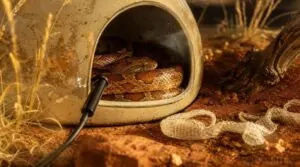
A clean hide is a healthy hide — and knowing when and how to maintain yours makes a real difference in how your snake behaves. Keeping tabs on humidity levels, shed cycles, and feeding patterns also tells you a lot about whether your setup is actually working.
Here’s what to watch for and how to stay on top of it all.
From recognizing the early signs of a pre-shed to knowing exactly how to mist your enclosure during shedding, a little preparation goes a long way toward a smooth, stress-free shed.
Resin Hide Cleaning Schedule
A consistent cleaning schedule is the backbone of biosecurity in enclosures.
Give your resin hide a weekly dust wipe with a soft cloth, then run a mild soap routine every two to four weeks.
Thorough drying after each wash prevents mold in hollow cavities.
Keep up with crack inspection and cleaning log tracking to protect your desert-dwelling snake’s long-term reptile health.
Porous Hide Replacement
Porous hides won’t last forever — most need replacing every 2–3 months, depending on wear.
Watch for these replacement signals:
- Cracked or crumbling breathable ceramics that compromise airflow efficiency
- Clogged pores reducing mold resistance and pore durability
- Visible substrate abrasion affecting your desert-dwelling snake’s grip
- Failed humidity control inside the hide’s core
- Worn modular sizing no longer fitting your reptile enclosure design snugly
Humidity Checks Inside Hides
Check humidity weekly — desert-dwelling snakes require 40–60% RH for clean sheds.
Place your sensor at the deepest rest point to ensure accuracy, and maintain a fogger timing schedule to prevent overnight spikes above 70%.
Temperature correlation also matters: warmer days may necessitate a 5% humidity adjustment.
Humidity data logging helps detect gradual drifts before they stall a shed.
Stress Behavior Signs
Your snake can’t tell you something’s wrong — but its behavior will. Rapid eye movement, tight spiral coiling, and increased hissing are early stress signals worth taking seriously.
Watch for rising feeding latency or irregular shedding, both reliable indicators that snake stress hormones are elevated. Targeted environmental enrichment — stable hides, correct thermals — drives meaningful stress reduction and restores normal snake behavior.
Shedding and Feeding Observations
Shedding and feeding patterns provide critical insights into enclosure health. Opaque eye caps signal imminent ecdysis, serving as a cue to verify humidity regulation. Juveniles shed more frequently, making Shedding Frequency Trends essential for anticipating early needs.
- Eye Cap Indicators and retained shed fragments directly reflect Hydration Impact and humidity gaps
- Feeding Time Preference peaks at dawn, when cooler temperatures enhance feeding response
- Weight Gain Metrics, tracked monthly, reveal whether snug-fitting hides and strategic hide placement support shedding success
Monitoring these patterns ensures proactive adjustments to maintain optimal enclosure conditions.
Frequently Asked Questions (FAQs)
What is the best substrate for desert snakes?
A 50/50 blend of play sand and topsoil is your best ‘ground floor’ decision — fine grain size minimizes dust, facilitates burrowing, and keeps moisture management and substrate hygiene effortlessly on point for any desert-dwelling snake.
Where do snakes hide in the desert?
Desert snakes tuck into Rock Crevices, Burrow Tunnels, Plant Hollows, and Sand Burrows — using Shade Pockets and moisture gradients to stay cool, safe, and hidden throughout the day.
How big should a hide be for a snake?
Think of it as a second skin — snug, not spacious.
The right hide matches your snake’s girth-based dimensions, offering just enough floor area ratio and vertical clearance for a secure, stress-reducing coil.
How often should desert snake hides be rotated?
Rotate desert snake hides every 4 to 8 weeks. Increase rotation frequency during shedding cycles, monitor for wear, and log each swap to track how your desert-dwelling snake responds over time.
Can multiple snakes share the same hide safely?
Multiple snakes sharing one hide is a recipe for tension, bite injury risk, and pathogen transmission. Species compatibility aside, hide hierarchy stress signals trouble fast.
Individual hide provision is non-negotiable.
What hide colors blend best with desert substrates?
Tan browns, sand apricots, and muted khaki tones anchor desert tone palettes best. Substrate color matching matters — speckle patterning, matte finish importance, and edge irregularities keep your desert-dwelling snake’s hide virtually invisible against natural desert substrates.
Conclusion
Studies show that snakes denied adequate cover experience cortisol spikes that suppress feeding responses for up to two weeks—a hidden cost most keepers never connect to a missing or poorly fitted hide. Getting your snake hides for desert setups right eliminates that stress at the source.
A snug, opaque retreat on both the warm and cool ends doesn’t just complete the enclosure—it completes the animal’s ability to regulate, recover, and thrive on its own terms.