This site is supported by our readers. We may earn a commission, at no cost to you, if you purchase through links.

Reptiles can’t shiver. They can’t generate their own body heat, which means a cold belly isn’t just uncomfortable—it shuts down digestion entirely, leaving food to rot in the gut rather than breaking down. This is why substrate temperature in your enclosure matters far more than most keepers initially realize.
A heat mat resolves this problem at the source, warming the glass floor of the tank and conducting that heat upward directly into your reptile’s abdomen.
Understanding how heat mats work for reptiles—the resistive elements inside, how infrared energy moves through glass and substrate, and why thermostat placement changes everything—turns a simple product into a precision tool you can actually trust.
Table Of Contents
- Key Takeaways
- Heat Mats Create Controlled Belly Heat
- How Heat Mats Generate Warmth
- How Heat Reaches Your Reptile
- Conductive Versus Radiant Heating
- Creating a Safe Thermal Gradient
- Choosing The Right Mat Size
- Installing Heat Mats Correctly
- Thermostats Prevent Dangerous Overheating
- Substrate Affects Heat Transfer
- Monitoring and Maintaining Heat Mats
- Frequently Asked Questions (FAQs)
- Conclusion
Key Takeaways
- Heat mats warm your reptile’s belly from below, mimicking sun-baked ground, which directly drives digestion — without that contact warmth, food can rot in the gut rather than break down.
- A thermostat isn’t optional: without one, an unregulated mat can exceed 110°F and cause burns before you notice anything is wrong.
- Substrate depth and type controls how much heat actually reaches your reptile — anything past 5 cm, or loose materials like coconut fiber, can drop surface temperatures by 5–8°C and defeat the mat entirely.
- The mat should cover only 30–50% of the tank floor, creating a warm side and a cool side so your reptile can move between them and regulate its own body temperature naturally.
Heat Mats Create Controlled Belly Heat

Heat mats work by warming your reptile from the ground up, the same way sun-baked soil does in the wild.
That’s why they’re especially popular in classroom settings, where reptile heat mats create a safe, consistent warmth that mimics natural basking conditions without open heat lamps.
They run silently, emit no light, and suit ground-dwelling species better than almost any other heating method.
Here’s what makes them work the way they do.
Under-tank Warming Explained
Unlike overhead bulbs, an undertank heater warms your reptile from below — exactly how sun‑heated ground works in nature. The mat sits beneath the tank, conducting warmth upward through the glass into the substrate, creating a reliable thermal gradient without the heat loss prevention concerns that overhead setups often create. For best results, aim for 33‑50% floor coverage.
Your reptile gains:
- Consistent belly contact warmth supporting digestion
- A stable warm zone anchored by correct thermostat probe placement
- Long-term heat pad safety through controlled, low‑wattage output
No Visible Light Emitted
Heat mats operate entirely within the non-visible spectrum — infrared radiation, not light. This ensures your reptile’s sleep cycle stays undisturbed, as there’s no glow to signal daytime. The invisible radiation adheres to blackbody spectrum principles, producing a dark surface glow at wavelengths your eyes simply can’t detect.
Thermal emissivity determines how efficiently the mat radiates warmth upward, enabling consistent temperature control without disrupting the photoperiod. This reliance on emissivity ensures stable thermal output, maintaining the reptile’s environment while preserving natural sleep-wake patterns.
Best for Ground-dwelling Reptiles
Ground-dwelling reptiles like leopard geckos, corn snakes, and ball pythons rely on belly contact with warm substrate to digest food and regulate metabolism. Heat mats suit them perfectly, delivering an expanded warm footprint across the tank floor.
Use a moisture-controlled substrate kept shallow, and consider a dual-mat configuration for larger enclosures. This setup ensures efficient heating distribution.
A solid thermal gradient lets burrowing species’ bedding stay accessible on the cool side, maintaining essential temperature variation for their well-being.
How Heat Mats Generate Warmth
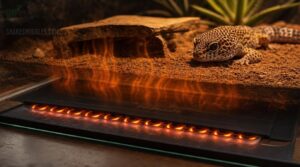
Understanding what’s actually happening inside a heat mat changes how you use it.
These aren’t simple warming pads — there’s a real process behind the heat they produce, and knowing it helps you set things up safely.
Here’s a closer look at the key mechanisms that make heat mats work.
Resistive Heating Elements
Inside every heat mat sits a resistive element—commonly nichrome wire or carbon fiber—that fights the flow of electricity, converting it directly into heat. Nichrome alloys handle this job reliably, while Kanthal durability makes it last longer under stress.
Wire form and ribbon foil designs spread resistance evenly across the mat, providing consistent warmth without hot spots.
Joule Heating Process
When current passes through the nichrome wire resistive element, electrons scatter against the material’s resistance, releasing energy as heat—this is Joule Heating. The heat generation rate follows a precise rule: doubling the current quadruples the output.
Resistance influence, temperature coefficient, and thermal mass all shape how quickly the mat stabilizes.
Pulse modulation, driven by your thermostat, fine-tunes average heat by cycling power on and off.
Infrared Heat Output
Infrared heat — invisible radiation that warms surfaces directly, not the air — is released as the resistive element heats up. Spectral distribution shifts with emission temperature effects, pushing radiant power density into wavelengths optimally absorbed by a reptile. Infrared coating technology further refines wavelength efficiency for enhanced ground contact.
Key facts about infrared heating output:
- Penetrates only a few millimeters into substrate and skin.
- Emits no visible light, safeguarding your reptile’s photoperiod.
- Radiant power density increases as the emitter temperature rises.
Carbon-fiber Versus Wire Mats
Carbon fiber and wire mats both use a resistive element for conductive heating, but they differ where it counts.
| Feature | Carbon Fiber | Wire Mat |
|---|---|---|
| Power Efficiency | 20–30% lower draw | Higher energy use |
| Weight Comparison | Lightweight, flexible | Heavier, stiffer |
| Durability Differences | Resists warping | Solder joints degrade |
| Corrosion Resistance | Excellent | Oxidizes over time |
| Installation Flexibility | Fits curved tanks easily | Requires extra hardware |
Carbon fiber wins on heat mat lifespan and thermal conductivity.
How Heat Reaches Your Reptile
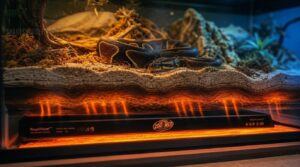
Heat generation is only half the story — what matters is how that warmth travels from the mat to your reptile’s body. The path it takes depends on a few key factors, and understanding them helps you set things up right.
Here’s what’s actually happening inside that enclosure.
Heat Through Glass
Glass isn’t a perfect wall — it actually lets infrared energy pass through via radiative transmission, warming the substrate above. Glass conductivity sits around 1 W/m·K, so heat rises through glass steadily but not instantly. Thermal inertia causes a short lag, meaning your glass terrarium bottom takes a few minutes to stabilize.
Low‑E coatings or glass emissivity differences can slow this transfer on the warm side noticeably.
Substrate Temperature Effects
What’s sitting between your heat mat and your reptile matters more than most keepers realize. Substrate acts like a thermal filter — controlling heat distribution, altering thermal gradient formation, and shaping temperature regulation across the floor.
- Dense substrates (sand, bark) support efficient substrate heating, delivering target temperatures in 10–15 minutes.
- Airy materials (coconut husk) drop surface temperatures by 5–8°C, disrupting heat retention in substrate.
- Depth beyond 5mm greatly reduces warmth reaching your reptile’s belly.
Belly Heat for Digestion
Belly heat does more than keep your reptile warm — it actively drives digestion. When the heat mat warms your reptile’s abdomen, digestive blood flow increases, delivering nutrients to gut tissues faster.
Belly heat doesn’t just warm reptiles — it actively drives digestion by boosting abdominal blood flow
This enhanced circulation triggers abdominal muscle relaxation, which supports peristalsis and aids gas transit through the intestines.
Such physiological shifts activate gut-brain modulation, easing your animal into a calm, post-meal warmth state.
Ultimately, precise temperature regulation boosts metabolic function and delivers overall digestive support, optimizing your reptile’s well-being.
Limited Air Warming
Heat mats function through surface contact rather than air convection, warming reptiles from the bottom up. This method creates a thermal gradient within the enclosure.
A key limitation arises because air convection restricts upward warmth transfer, leaving the upper area of the enclosure significantly cooler than the heated base.
Opening the tank accelerates heat loss, further disrupting the thermal balance.
Reptiles perceive this gradient primarily through belly contact, not surrounding air, relying on direct surface warmth to regulate their body temperature.
Conductive Versus Radiant Heating

Heat mats don’t work alone — they’re one piece of a larger heating puzzle. Depending on your reptile’s habits, you may need conductive floor heat, overhead radiant warmth, or a careful balance of both.
Here’s how each approach works and when it matters most.
Floor Heat Transfer
Conduction is the quiet workhorse behind under-tank mats — and understanding it helps you get the setup right. Heat mats push warmth upward through glass, directly into your substrate and your reptile’s belly. Substrate conductivity determines how much of that warmth actually arrives. Poor choices here kill your thermal gradient fast.
Watch for these factors:
- Bottom insulation reflects heat upward instead of losing it downward
- Moisture impact raises conductivity but risks mold without proper management
- Gradient uniformity depends on consistent heat mat placement across the warm zone
- Probe accuracy ensures your thermostat reads true surface temps, not air
Overhead Basking Heat
Under-tank mats handle the floor, but arboreal and basking species need heat from above.
Halogen basking bulbs deliver focused radiant heat with visible daylight simulation, while radiant overhead panels spread warmth evenly without light.
Ceramic heat emitters and infrared heat bulbs add overhead warmth without disrupting photoperiod — offering no fire risk or guesswork.
For targeted temperature control, pair either with proportional thermostat control.
Nighttime Heating Benefits
At night, your reptile still needs metabolic support — digestion doesn’t pause after dark. A heat mat delivers thermal consistency through the substrate, giving nocturnal reptiles steady belly warmth without bright light. That thermal inertia stabilizes core temperature, reducing stress and preserving appetite even during cooler hours.
The result is reliable temperature regulation, better energy efficiency, and a calmer, healthier animal overall.
Photoperiod Protection
Unlike overhead lights, heat mats don’t interfere with Light Cycle Timing — they warm without disrupting Melatonin control or natural rest. Your thermostat maintains ambient temperature stability, supporting Gradual Dawn transitions and Dark Phase Duration:
- Seasonal Light Shifts stay consistent without temperature fluctuations
- Overheating prevention keeps thermal safety intact after dark
- No visible light means uninterrupted circadian rhythms
That’s quiet, invisible support your reptile actually needs.
Creating a Safe Thermal Gradient

A proper thermal gradient isn’t complicated, but it does require intentional setup. Your reptile needs distinct warm and cool zones to move between freely, since that movement is how they regulate their own body temperature.
Here’s what each part of that gradient looks like in practice.
Warm Side Placement
Place the mat on one end only—that’s your warm side of enclosure, delivering heat from the bottom up across roughly 30–50% of the floor. This setup ensures heat is distributed effectively.
The Edge Overhang Design extends the mat at least 100 mm past the glass edge, supporting Side Length Coverage and enabling Zonal Temperature Calibration. This extension helps maintain consistent temperatures across different areas.
Combine Air Gap Optimization with proper Cable Routing Safety underneath to build a reliable temperature gradient without hot spots. This integration ensures efficient heat distribution and prevents overheating.
Cool Side Escape
The cool side of the enclosure is not just empty space—it’s a deliberate Shaded Refuge your reptile needs to self-regulate. Maintain this cold side at least 5–10°C cooler than the warm side using Airflow Design and Non-toxic Materials.
Confirm the temperature gradient through regular Temperature Monitoring. Ensure the Escape Route Width remains clear, allowing your reptile to retreat from the heat mat without obstruction.
Warm and Cool Hides
Every hide you place shapes a private microclimate your reptile depends on. Material selection matters — ceramic and plastic retain stable temperatures far better than wood.
A snug entrance locks in warmth or cool air, keeping microclimate stability tight.
Follow these five essentials for proper hide setup:
- Position warm hides on the warm side, cool hides on the cool side
- Confirm interior temperature checks with an infrared thermometer weekly
- Match hide size so your reptile contacts three walls
- Apply a cleaning protocol using reptile-safe disinfectant monthly
- Space hides to reinforce the full habitat temperature gradient
Behavioral Thermoregulation
Your reptile isn’t just wandering — it’s making calculated microhabitat choices to stay within 2–5°C of its ideal body temperature.
Watch for postural adjustments like body flattening near the basking spot to absorb more heat. Hydration influence and reproductive thermoregulation also shift those preferences seasonally.
A proper temperature gradient gives your animal full control over its own thermoregulation through natural reptile behavior.
Choosing The Right Mat Size
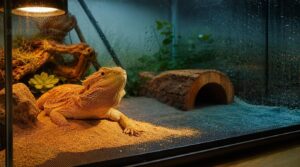
Picking the right mat size isn’t complicated, but getting it wrong affects everything — your reptile’s comfort, safety, and ability to thermoregulate properly.
The mat should cover 30–50% of the tank floor, so knowing your enclosure’s footprint before you buy saves a lot of hassle. Here’s what to keep in mind when sizing up your options.
Cover Partial Floor Space
Your heat mat should cover 30–50% of the tank floor — that warm zone ratio creates a temperature gradient, giving your reptile a warm side and cool side to move between freely. Mat edge placement matters: position the pad on one side of the enclosure only.
Insulation behind unheated areas improves energy efficiency gains, and an adjustable patch size lets you fine-tune the right heating mat for your species.
Match Tank Footprint
Matching pad size to the size of its enclosure matters more than most keepers realize. A good footprint-to-tank ratio keeps warmth centered and edge bleed control prevents heat from bleeding into the cool zone.
- Use linear side alignment along one end
- Apply corner placement strategy to minimize heat drift
- Adjust seasonal footprint shifts as ambient temperatures change
Choose the right size heating mat for consistent results.
Avoid Oversized Pads
Bigger isn’t always better — an oversized pad causes restricted mobility, uneven pressure, and temperature hotspots that actively harm your animal.
| Problem | Consequence |
|---|---|
| Oversized pad | Behavioral avoidance of warm zone |
| Shifting edges | Hygiene complications during cleaning |
| Uneven contact | Inconsistent belly heat |
| Bulk material | Heat mat failure modes increase |
| Poor pad size match | Disrupted heat source selection |
Follow heat mat instructions and choose the right size heating mat.
Consider Wattage Needs
Size matters, but so does wattage. A mat that’s too weak won’t hold temperature when your room drops at night.
- Match your Species Power Rating to tank size — 8–15W for 20-gallon setups, 15–25W for 40-gallon enclosures.
- Build in a Wattage Buffer of 10–20% to handle Ambient Temperature Adjustments and Power Surge Margin safely.
- Choose low-watt output mats for desert species; ground-dwellers need higher heat mat power consumption ratings.
Installing Heat Mats Correctly
Getting the mat installed right makes all the difference between a safe setup and a dangerous one. A few straightforward steps cover everything from surface prep to airflow, and skipping any of them can cause uneven heating or worse.
Here’s what you need to do.
Clean Glass Bottom
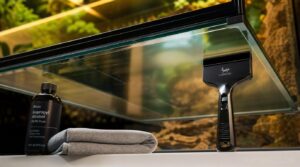
Before installing a heat mat in a glass enclosure, ensure the bottom glass is spotless. Begin by wiping it with a glass cleaner, then follow up with isopropyl alcohol to eliminate residue. This two-step process guarantees a clean surface free of streaks or contaminants.
Use a magnetic scraper for streak-free cleaning and micro-scratch prevention, as it ensures precision without damaging the glass. Avoid water during this step, as moisture trapped under the mat can disrupt heat transfer and impair visibility below. Prioritizing dryness maintains both functionality and clarity in the enclosure.
Apply Adhesive Evenly
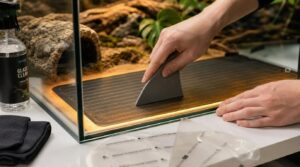
Getting the adhesive backing right makes or breaks a heat mat installation. Press self-adhesive pads from the center outward, maintaining consistent pressure across the entire surface to create a uniform adhesive layer without air pockets.
Follow these steps to avoid adhesive pooling and bond failure:
- Verify your surface cleaning protocol is complete — no dust, oil, or moisture
- Peel the adhesive backing slowly and steadily
- Use consistent pressure from center to edges
- Smooth out bubbles immediately using a flat edge
- Allow full tack time before setting the tank down
Place on One End

Position the heat mat under one side of the enclosure only — never the full floor. Single-side heating creates an end-zone gradient that lets your reptile move freely between the warm and cool sides.
This behavioral heat zone facilitates natural thermoregulation and ensures energy-saving placement.
It also enables thermal edge isolation, keeping the opposite end genuinely cool.
Add Airflow Clearance

Once the mat is in place, raise the tank on plastic or stainless-steel feet to create a ¼-inch air gap beneath the enclosure. This gap height establishes airflow pathways that prevent heat dissipation from stalling beneath the glass. Edge clearance at the mat’s border maintains low thermal resistance, facilitates ventilation under the enclosure, and ensures straightforward clearance inspection. Your thermostat will thank you.
Avoid Unsafe Surfaces

Never place heat mats on carpet, rough wood, foam, or plastic — these surfaces trap moisture, block heat transfer, and create serious fire risk. Smooth glass is the only safe choice for adhesive-backed pads.
Clean the surface thoroughly before installation, and maintain edge clearance so airflow isn’t blocked.
Check regularly for cracks or delamination, and remove the mat immediately if water exposure or material compatibility issues arise.
Thermostats Prevent Dangerous Overheating
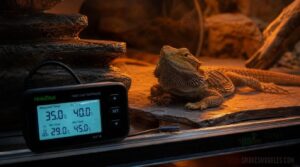
A thermostat isn’t optional — it’s the one thing standing between your reptile and a serious burn. Without one, an unregulated mat can push past 110°F and cause real harm before you even notice.
Here’s what you need to get thermostat control right.
Probe Placement Matters
Where you place the temperature probe decides whether your thermostat reads reality or a lie. Stick the sensor directly above the mat’s center — that’s your Center Zone Positioning — so it catches true belly-heat temperatures, not cooler edges. Follow this Routine Inspection Protocol every time you rearrange the enclosure:
- Set the probe tip 1–2 mm below substrate for accurate surface-contact temperature monitoring
- Maintain Uniform Depth Setting across all tanks for reliable comparisons
- Maintain Clear Probe Visibility by routing cords along the tank edge, away from curious animals
- Practice Airflow Neutral Placement — keep the digital probe thermometer away from water dishes and vents
- Inspect the sensor placement monthly for debris, corrosion, or drift that creates dangerous hot spots
Species-specific Set Points
Every species runs on its own internal clock — and temperature is what winds it. Digestion Thresholds, Metabolic Rate Targets, and Immune Readiness all hinge on species-specific heating within the ideal temperature range. Ontogenetic Shifts mean juveniles may tolerate slightly cooler temperatures than adults.
Reproductive success and species suitability depend critically on precise thermal conditions, making temperature monitoring non-negotiable.
| Species | Warm-Side Set Point |
|---|---|
| Leopard Gecko | 28–30 °C |
| Ball Python | 30–32 °C |
| Corn Snake | 26–28 °C |
Digital Temperature Control
Once you’ve nailed your specific set points, a digital thermostat keeps those numbers locked in automatically. Unlike basic analog units, digital temperature control uses PID algorithms to read your temperature sensor in real time and adjust output without overshooting.
Enhanced models add:
- Remote monitoring via Wi-Fi or Bluetooth
- Data logging and alarm management alerts
- Sensor redundancy with automatic temperature calibration
Your temperature monitoring device does the watching so you don’t have to.
Burn Prevention
Burn prevention comes down to three things working together: probe placement, barriers, and thermostat calibration. Your Probe Securing Method matters more than most keepers realize — a probe that lifts off the surface reads falsely low, letting the mat overheat before the Thermostat Cutoff Calibration kicks in.
| Risk Factor | Prevention Step |
|---|---|
| Hot spots from mat compression | Regular inspection of mat contact |
| Thermal burns from direct contact | Barrier Layer Choice between mat and reptile |
| Probe drift causing overheating | Cord Integrity Checks and probe re-securing |
Always verify Surface Temperature Limits at multiple warm-zone points — especially after rearranging decor.
Fire Risk Reduction
Fire risk goes beyond burns. A degrading mat with frayed wiring is a genuine electrical hazard — regular electrical inspection catches this before it becomes dangerous.
Keep flammable storage away from heated enclosures, never run mats through surge protectors, and install a ground fault circuit interrupter at the outlet.
Fire hazard mitigation here is straightforward: inspect, separate, and protect.
Substrate Affects Heat Transfer
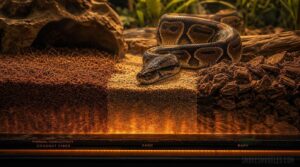
What sits between your heat mat and your reptile matter more than most keepers realize. The type of substrate you choose directly controls how much warmth actually reaches your animal — and getting it wrong means the mat works overtime for nothing.
Here’s what you need to know about how different bedding options handle heat transfer.
Thin Substrate Works Best
Substrate thickness is your biggest variable for conductive warmth. Keep substrate depth between 1 and 2 cm, and you’ll see a quick heat response — the low insulation value lets warmth reach your reptile’s belly without thermal inertia slowing things down.
Thinner layers also improve gradient precision, giving your thermostat accurate readings and maintaining temperature uniformity across the warm zone.
Deep Bedding Blocks Heat
Deep bedding is the quiet enemy of your heat mat’s performance. Once substrate depth climbs past 3 inches, microbial heating and thermal mass start working against you — trapping warmth below where your reptile actually rests.
- Bedding composition slows conduction when airy materials like coconut husk drop surface temperatures by 5–8 °C
- Poor moisture management creates uneven heat pockets throughout the substrate depth
- High thermal mass in thick layers delays heat response by 10–15 minutes
- Inadequate aeration cycles cause heat retention in lower zones, not the contact surface
- Deep substrate effectively insulates the glass, not your reptile
Dense Materials Conduct Warmth
Dense materials like ceramic tile, slate, or polished stone provide a thermal mass advantage because their conductivity-density tradeoff works in your favor. They absorb heat steadily, distribute it evenly across the tank floor without hot spots, and deliver a gradual cool-down effect after the heating mat cycles off.
Moisture-enhanced conduction further boosts efficiency in wet dense substrates. However, substrate depth still controls how quickly surface warmth reaches your reptile, even with these optimized materials.
Loose Substrate Cautions
Loose substrates like coconut fiber and aspen shavings can cut surface temperatures by 5–8 °C, disrupting temperature uniformity and impairing your reptile’s temperature regulation.
Beyond heat loss, these substrates introduce critical risks:
- Dust inhalation from fine particles irritates airways
- Impaction risk rises when animals ingest loose material
- Microbial hygiene suffers in damp, poorly maintained substrate
Keep burrowing depth practical, not excessive.
Monitoring and Maintaining Heat Mats
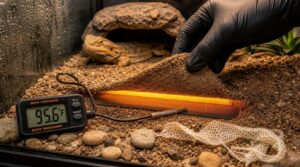
A heat mat doesn’t run itself — it needs your regular attention to keep your reptile safe. Once a month, a quick check can catch problems before they turn serious.
Since belly heat drives digestion far more than ambient air temperature, choosing the right reptile heating pad for your terrarium setup makes those monthly checks far more meaningful.
Here’s what to monitor and maintain.
Check Temperatures Monthly
Monthly checks catch problems before your reptile feels them. Pick a fixed date, then record both the warm and cool side readings in a Monthly Data Log — this simplifies Trend Analysis. Track Substrate Moisture Notes separately, as damp substrate distorts heat transfer and inflates surface readings.
| What to Check | Why It Matters |
|---|---|
| Consistent Probe Depth | Ensures comparable monthly readings |
| Calibration Verification | Prevents thermostat drift |
| Temperature Swings | Flags failing mats early |
| Regular Maintenance Log | Documents corrective actions |
Use Infrared Thermometers
A temperature gun gives you an instant, non-contact surface reading without disturbing your reptile. Aim perpendicular to the substrate and practice Distance Optimization — staying within the manufacturer’s specified range keeps Spot Size Selection accurate.
Adjust Emissivity Calibration for your substrate type, and maintain lens cleanliness to prevent skewed data.
Log every reading for baseline temperature logging, supporting consistent temperature regulation and thermal management between thermostat calibration checks.
Inspect Cords and Cracks
Your power cord tells a story — you just have to know how to read it. Run your fingers along the full length, checking for cord insulation cracks, cable burn marks, or kinked substrate pressure points where cords are pinched under tank components.
Plug end fraying and loose connection arcing are early signs of heat mat failure.
- Check for exposed wires or frayed cords at the plug
- Look for discoloration indicating overheating
- Replace any unit showing cracks or delamination immediately
Watch for Hot Spots
Even after checking cords, hot spots deserve their own attention. Substrate compression hotspots form where bedding presses unevenly against glass, and probe misplacement can mask a localized burn danger entirely.
Use an infrared thermometer to spot temperature spikes and map your hot zones before your reptile finds them first.
Uneven heating often signals a worn or damaged mat, developing cracks, or delamination underneath it.
Replace Damaged Mats
A worn or damaged mat will not recover on its own — heat mat degradation only gets worse. When you spot cracking, delamination, or uneven output, replace the mat promptly.
Check replacement sizing against your tank footprint and confirm power compatibility with your thermostat. Conduct post-installation testing before reintroducing your reptile.
Inspect the safety seal and review warranty claims if the unit fails prematurely.
Frequently Asked Questions (FAQs)
How do reptile heating mats work?
Reptile heating mats use resistive elements to convert electrical current into belly-warming conduction heat. A thermostat regulates temperature precisely.
Carbon-fiber designs improve heat distribution uniformity and energy savings without emitting visible light.
What are the disadvantages of heating pads?
Heating pads carry real risks, including burn hazards from unregulated temperatures and mortality from overheating when a broken thermostat or heat pad failure goes unnoticed.
Additional dangers include electrical shock from exposed wires and skin irritation.
Users may also develop behavioral reliance on belly heat, alongside a dehydration risk, further compromising safety.
Can heat mats be used with bioactive enclosures?
Yes, heat mats work well in bioactive enclosures. Carbon Fiber Benefits include even heat distribution and protecting microfauna safety.
Monitoring moist substrate conductivity and using temperature feedback integration to maintain a stable root zone temperature without overheating.
Are heat mats safe for use during reptile brumation?
Heat mats stay safe during brumation only when paired with a reliable thermostat. Brumation temperature control prevents dangerous overheating, ensuring the enclosure’s environment remains stable.
Maintaining the cold side of the enclosure is critical, as it allows reptiles to regulate naturally without temperature drift, supporting their physiological needs during dormancy.
Conclusion
Heat mats warm the belly, support digestion, and protect your reptile from the silent damage of cold substrate. Understanding how heat mats work for reptiles means knowing where to place the probe, how deep your substrate runs, and why a thermal gradient isn’t optional—it’s survival.
Get these details right, and your enclosure stops being a box your animal tolerates and starts being an environment it actually thrives in.
- https://www.tfp-tech.com/en/electric-heating-elements/carbon-heating-mats/
- https://www.thebiodude.com/blogs/reptile-and-amphibian-lighting-faqs-and-help/here-s-why-you-shouldn-t-be-using-a-heat-mat-for-your-reptile?srsltid=AfmBOoohEcTbovIDaJcsGSn4sJecBtR9o4Sq-lfoHX9GzbC5JF2t9s5W
- https://crabstreetjournal.org/blog/how-to-properly-use-a-thermostat-with-a-heat-mat-for-land-hermit-crabs/