This site is supported by our readers. We may earn a commission, at no cost to you, if you purchase through links.

A reptile sitting on substrate that’s either too cold or scorching hot isn’t just uncomfortable—it’s a slow health crisis unfolding inside your enclosure. Temperature regulation sits at the core of reptile biology, driving digestion, immune response, and behavior.
Get it wrong, and no amount of perfect feeding or habitat décor will compensate.
A heating pad seems deceptively simple from the outside: plug it in, slide it under the tank, done. But understanding how a reptile heating pad works—what actually generates that warmth, how heat moves through glass and substrate, and what keeps temperatures safe—transforms you from someone guessing at dial settings into a keeper who genuinely controls the climate their animal depends on.
Table Of Contents
Key Takeaways
- reptile heating pad works by running electricity through a resistive element that converts the energy into steady, low‑watt heat, which then conducts upward through glass and substrate to warm your animal from below.
- Without a thermostat, you’re not controlling your enclosure—you’re just hoping for the best, because unregulated pads can overheat your reptile before you notice anything is wrong.
- The warm side/cool side gradient isn’t a bonus feature—it’s the whole point, since reptiles can’t regulate their body temperature without the ability to move between heat zones.
- Substrate depth, pad size, and wattage all affect each other, so matching these three factors to your specific tank and species is what separates a safe setup from a costly mistake.
How Reptile Heating Pads Create Heat

Ever wondered what’s actually happening inside that thin pad sitting under your reptile’s tank?
It’s simpler than you’d think, and understanding it makes everything else — setup, safety, thermostat choices — click into place. Here’s what’s going on beneath the surface.
Once you understand the basics, avoiding common mistakes — like the ones behind snake thermal burns and how to treat them — becomes a lot more straightforward.
Resistive Heating Element Inside The Pad
Inside every heating pad is a resistive element — usually nichrome wire or carbon fiber — that acts as your reptile’s primary heat source. Material selection matters here because each manages current density differently.
Your pad’s element layout and resistance tuning determine how evenly warmth spreads:
- Nichrome resists oxidation reliably
- Carbon fiber flexes without breaking
- Insulation layers guarantee heat pad safety
- Thermal protection prevents dangerous spikes
Choosing materials with strong oxidation resistance for durability helps extend pad life.
Electrical Energy Converted Into Thermal Energy
Once the resistive element gets current flowing through it, Joule Heating takes over.
Electrons collide with atoms, and that friction becomes warmth — that’s your heat source doing its job.
Power Dissipation follows the Voltage-Current Relationship directly: more current means more heat generated.
Understanding your pad’s Heat Generation Rate and Thermal Resistance helps you pair it with the right thermostat for safe, reliable temperature regulation and a stable thermal gradient.
| Factor | What It Means | Why It Matters |
|---|---|---|
| Voltage-Current Relationship | Higher current = more heat | Affects overall power output |
| Thermal Resistance | Resistance to heat flow | Determines surface warmth |
| Heat Generation Rate | Speed heat builds up | Impacts thermal gradient stability |
Heat Rises Through Glass and Substrate
Once that heat is generated, it travels upward through glass via conduction — glass thermal resistance and contact pressure influence how quickly warmth reaches your substrate.
Substrate conductivity impact and depth then shape how heat spreads across the floor.
Edge insulation effects and radiant emissivity coatings help lock heat in, building a reliable thermal gradient that facilitates your reptile’s temperature regulation needs.
Continuous Low-watt Output for Steady Warmth
That steady conduction sets the stage for something equally important: controlled, low-watt output that keeps warmth consistent without burning through energy.
Most pads run between 5 and 15 watts, making energy efficiency a real advantage over bulbs. Here’s what that low draw actually delivers:
- Power consumption metrics stay predictable and low
- Infrared heat benefits warm surfaces directly, not just air
- Thermal inertia keeps temperatures stable between thermostat cycles
- Long-term reliability with appropriate wattage matched to your tank size
Smart temperature regulation means fewer safety considerations become urgent problems.
Where Heat Goes in The Enclosure

Once the pad starts working, heat doesn’t just fill the whole tank evenly — it moves in a specific pattern that your reptile actually depends on. Understanding where that heat goes and why helps you set things up in a way that truly works for your animal.
Here’s what’s happening inside the enclosure.
Warm Side Versus Cool Side
Your heating pad creates two distinct zones: a warm side directly above the heat source, and a cooler retreat on the opposite end. Reptiles depend on this split for temperature regulation and basking behavior.
Getting that placement right from the start matters more than most people realize, so it’s worth checking common reptile heating pad mistakes and how to avoid them before you set anything up.
The warm side drives digestion and activity, while the cool side prevents heat loss from becoming a problem. Together, they support species preferences and help maintain humidity balance across the enclosure.
How a Thermal Gradient Forms
A temperature gradient doesn’t appear by accident — it builds as thermal energy moves outward from your pad through conduction, slowing as it reaches cooler substrate further away.
Thermal inertia keeps the warm zone stable even during brief thermostat cycling, though temperature probe lag can cause minor fluctuations.
Gradient stability depends on consistent heat output, ambient temperature, and a reliable thermostat maintaining your ideal temperature gradient from one end to the other.
Why Heat Spreads Unevenly Under Substrate
Even with proper placement, substrate heat rarely spreads in a perfect sheet. Thermal conductivity variations between dense and porous zones shift the heat front sideways.
The adhesive layer insulation slows lateral spread, while air gap contact points create hot spots wherever contact isn’t flush. Substrate material density and heat spreader materials both influence your temperature gradient — so where you position the heating pad matters as much as the size of the heating pad you choose.
Effects of Substrate Depth on Heat Flow
Substrate depth quietly controls everything about how heat behaves in your enclosure. Here’s what it actually does:
- Thermal mass effect increases with depth, slowing diffusion speed to the surface
- Gradient steepness drops as substrate thickens, softening sharp temperature swings
- Response lag grows longer, delaying substrate heat recovery after the pad cycles off
- Uniform heat spread improves slightly with depth, but diminishing returns set in fast
- Temperature regulation suffers if depth exceeds 2–3 inches without adjusting your heat source combination for reptile enclosures
What Size and Wattage You Need

Getting the size and wattage right makes a bigger difference than most people expect. Too small and your reptile never gets warm enough; too large and you’re fighting overheating before the day even started.
Here’s what to look at when choosing the right pad for your setup.
Matching Pad Size to Tank Footprint
Size matters more than you might think.
rectangular reptile enclosures, your pad should extend at least 100 mm beyond each side of the tank base — this ensures proper footprint clearance and enhances energy efficiency optimization.
Pad shape compatibility matters too: round tanks need round pads.
Don’t forget substrate thickness influence; deeper substrate demands broader coverage.
Edge insulation prevents heat from escaping sideways, keeping your temperature regulation consistent.
Choosing Wattage for Enclosure Size
Wattage is where most beginners guess wrong. Small reptile enclosures generally need 10–40 watts, while medium setups call for 40–80 watts paired with a thermostat. Ambient temp influence and insulation impact both shift those numbers, so always check species heat needs first.
- Match wattage to your reptile enclosure — not just pad size
- Factor in energy cost estimation before buying
- Consider a multiple pad strategy for larger tanks
How Substrate Thickness Affects Output Needs
Think of substrate like insulation under your floor — the thicker it gets, the harder your reptile heating pad has to work. Greater thermal resistance slows heat transfer, increasing temperature lag and energy consumption. Thinner layers mean faster response time, but risk hot spots.
| Substrate Depth | Effect on Pad Output |
|---|---|
| Under 1 inch | Fast response, higher peak temps |
| 2–3 inches | Balanced heat capacity, stable thermal regulation |
| Over 3 inches | Increased energy consumption, consider higher wattage |
When a Larger Pad Becomes Too Powerful
Bigger isn’t always better. A pad that covers too much floor area can create gradient steepness that eliminates cooler resting zones entirely.
Your reptile needs that cool side to regulate itself.
Oversized pads also trigger hot spot formation under rocks or hides, spike energy consumption, and push thermostat overload risk higher if regulation fails.
Choosing an appropriate heating pad size protects your animal and keeps temperature monitoring accurate.
How to Install a Heating Pad
Installing a heating pad isn’t complicated, but the order you do things matters more than you’d think. few small steps done right from the start will keep your setup safe, effective, and easy to maintain.
Here’s exactly how to get it done.
Cleaning The Tank Bottom First
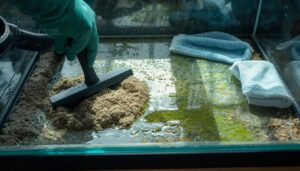
Before you stick anything down, clean the enclosure bottom thoroughly. Debris removal is step one — use a soft scraper to lift stuck matter, then vacuum loose sediment with a siphon.
Algae scraping keeps biofilm from interfering with adhesion. heavy substrate disturbance that muddies the glass.
Finish with bottom drying using a clean towel, and confirm the surface is fully clear.
Applying The Adhesive Backing Correctly

With the tank dry, surface prep is done — now it’s time to apply the pad. Peel a small section of the adhesive backing and use an alignment technique to line up the pad before full contact. Then press firmly using a steady pressure application from the center to the edges.
- Wipe with isopropyl alcohol first
- Air dry for five minutes
- Press edges for 30 seconds
- Wait 24 hours before adhesive testing
Positioning The Pad on One Side
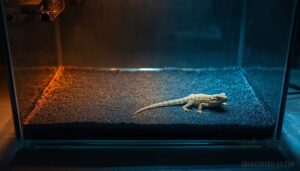
Once the adhesive is set, slide the pad to one lateral side of the tank bottom — never centered. Edge alignment matters here: the pad should run flush with the tank’s side wall without crowding a corner.
This creates the thermal gradient your reptile needs.
Darker substrate color impact amplifies heat absorption, so factor that into placement.
Keep cable routing clean and away from edges for safe, unobstructed airflow management.
Using Tank Feet for Airflow and Clearance
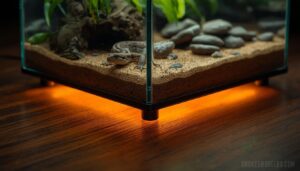
Once the pad is in place, attach the included plastic feet to lift your enclosure roughly a quarter inch off the surface. This small gap is everything — it lets air circulate underneath, preventing heat buildup and protecting your furniture.
For reptile husbandry that lasts, prioritize feet with corrosion resistance benefits; rubber or stainless steel hold up best. Adjustable height mechanisms let you fine-tune airflow gap optimization as your terrarium temperature needs change.
Why a Thermostat is Essential

heating pad without a thermostat is like a car with no brakes — technically functional, but heading for trouble.
A heating pad without a thermostat is technically functional, but heading for trouble
The thermostat is keeps temperatures dialed in and your reptile safe around the clock. Here’s what you need to know about how that control system actually works.
Turning The Pad on and Off at Set Temperatures
A thermostat is your heating pad’s brain. Using Thermostat Setpoint Logic, the temperature controller monitors the temperature constantly and cuts power once the target is hit — then kicks it back on when things cool down.
A built-in thermostat manages this automatically, but models with an Auto Off Timer, Sleep Wake Routines, or Dual Zone Switching give you tighter control.
That Safety Interlock Trigger? It’s your last line of defense.
Using a Probe or Surface Sensor
Where you place the sensor matters more than most keepers realize. Proper Sensor Placement — with the probe tip resting directly on the pad surface — gives your temperature controller accurate, real-time data. Pair that with Wiring Shielding and Moisture Resistance to prevent false readings from damp substrate.
Keep these three things right:
- Probe Calibration — verify within ±0.5°C weekly
- Response Time — quality sensors react in 2–5 seconds
- Adjust as necessary — built‑in thermostat readings drift; monitor the temperature consistently
Why Digital Thermostats Are Safer
Digital thermostats don’t just react — they think ahead.
Built-in Self Diagnostics confirm sensor integrity every startup, while Redundant Sensors cross‑check readings to catch failures before your reptile feels them.
Programmable Safety Profiles lock in species-specific temperature bands automatically.
| Feature | Benefit |
|---|---|
| Fail‑Safe Defaults | Shuts off if sensor signal is lost |
| Real‑Time Alerts | Notifies you instantly of dangerous spikes |
How Poor Regulation Causes Overheating
Without solid regulation, heat builds fast and unchecked. Thermostat Drift lets the setpoint creep higher over time, while Sensor Misplacement masks real surface temps.
PID Tuning Issues and Power Supply Fluctuations cause erratic cycling, and User Calibration Errors keep output higher than intended. Always monitor the temperature twice daily — because poor control is one of the most overlooked safety considerations for reptile heating pads.
What Safety Problems to Watch For
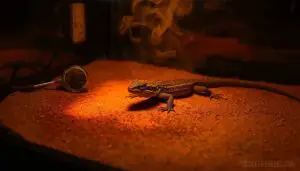
Even a well-set-up heating pad can cause problems if something goes wrong with the hardware. Knowing what to watch for keeps your reptile safe and your setup running longer.
Here are the main safety issues to stay on top of.
Overheating From The Wrong Wattage
Wattage mismatch risks are easy to overlook, but they cause real problems. pad too powerful for your tank concentrates heat under the substrate, triggering thermal cycling effects that stress your reptile and shorten pad life.
Sensor lag issues mean your built‑in thermostat reacts too slowly, allowing dangerous temperature spikes. Substrate degradation follows, weakening heat flow over time.
Always choose an appropriate heating pad size — it’s a core safety consideration for reptile heating pads.
Damage From Cracks or Delamination
Cracks don’t just look bad — they signal real danger inside the pad. Thermal Cycling Damage weakens the internal layers over time, and Layer Delamination Effects create air gaps that cause Hotspot Formation directly beneath your reptile.
Watch for these warning signs:
- Visible surface cracks
- Uneven heat zones
- Cold patches on the warm side
- Audible buzzing during operation
- Frequent thermostat tripping
Insulation Degradation and Mechanical Stress Points accelerate together — so clean or replace the heating pad immediately when any sign appears.
Water Exposure and Short-circuit Risks
Water is the silent threat most keepers overlook. Moisture Ingress under the pad degrades insulation fast — and once Conductive Residues build up, you’re risking a short circuit.
That’s why Waterproof Barriers and Seal Integrity matter.
A GFCI Activation is your safety net, but don’t rely on it alone.
If humidity levels stay high near the pad, clean or replace the heating pad immediately.
Cords Pinched Behind The Enclosure
Pinched cords are easy to miss — until something goes wrong. When your enclosure sits flush against a wall, Bend Stress builds silently, wearing through Insulation Wear points over time.
Heat Softening from the pad makes it worse, weakening the cable jacket where it bends most.
Smart Cable Routing and proper Cord Clearance fixes this fast:
- Pull the enclosure at least two inches from the wall
- Route cords along the side, not compressed behind
- Check bend points monthly for cracking or fraying
- Never let heat sources sit directly over cord paths
How to Monitor and Maintain It

Once your heating pad is installed and running, the work isn’t quite done. Staying on top of a few simple habits keeps your reptile safe and your setup running the way it should.
It’s also worth checking that your substrate still suits your snake’s needs, since choosing the right substrate liners for classroom enclosures can make humidity and cleaning routines far easier to manage.
Here’s what to check and when.
Checking Temperatures Regularly
Think of your daily temperature log as your reptile’s health diary — it tells you what’s working before problems show up.
Monitor the temperature on both sides every day at the same time. Your thermostat controls regulation, but it can’t catch gradual drift. That’s where Temperature Drift Analysis earns its place.
| Check Type | Probe Placement Tips | Target Range |
|---|---|---|
| Warm Side | Basking surface, away from pad | 88–92°F |
| Cool Side | Opposite end, near substrate | 70–75°F |
| Nighttime Temp Checks | Same probes, lights off | 5–15°F drop |
Keep a Log Review Schedule weekly. Monitoring and adjusting reptile habitat temperature consistently — especially with a built-in thermostat — is what separates guessing from real control. Even a 2°F drift matters.
Inspecting for Hot Spots and Wear
Run a monthly inspection alongside your regular temperature checks. Use thermal imaging to catch hot spots — temperature deviations of 2–3°C above surrounding areas signal trouble beneath the pad.
Check for adhesive degradation along lifted edges, perform an edge wear inspection for fraying or crumbling seals, and do a cord integrity check for kinks or cracks.
Substrate cracking under the pad? That’s reduced heat transfer waiting to happen.
Replacing Pads That Heat Unevenly
Once uneven heating shows up, don’t wait — replace the pad.
Start with a Pad Surface Inspection for cracks or delamination, then run Electrical Connection Testing to rule out wiring faults. Perform Adhesive Failure Checks, Uniform Thickness Verification, and a Thermostat Compatibility Review.
Safety considerations for reptile heating pads demand matching heating pad size to your thermostat specs, ensuring reliable, consistent warmth throughout your habitat.
Keeping The Setup Clean and Dry
A dirty, damp enclosure is a heating pad’s worst enemy. Check your substrate dryness weekly, and swap out any damp material fast.
Clean the tank bottom monthly, wiping cords with a dry cloth to maintain adhesive integrity.
Use spill guard placement near water bowls and prioritize airflow management by keeping the pad elevated.
Cleaning and maintaining reptile heating pads this way protects your moisture barrier long-term.
Frequently Asked Questions (FAQs)
Can reptile heating pads be used for amphibians?
Yes, but with caution. Amphibians have sensitive skin and strict species-specific temperature ranges.
A reptile heating pad can work, but always pair it with a thermostat to avoid bacterial growth risk and overheating.
How long do reptile heating pads typically last?
A quality reptile heating pad usually lasts three to five years. Cheaper models may fail within one to two years.
A built-in thermostat, proper sizing, and low humidity all extend lifespan considerably.
Do heating pads work inside bioactive enclosures?
Heating pads work well in bioactive enclosures, but substrate moisture effects and thermal inertia impact how heat moves.
deep, damp substrate slows heat transfer, so monitor temperatures closely and adjust your setup to meet species-specific heat needs.
Can two heating pads run in one tank?
You can run two pads in one tank, but each needs its own thermostat for safe Dual Pad Synchronization.
Without Circuit Isolation Techniques, hotspots form fast and temperatures spiral out of control.
Are heating pads safe during owner vacations?
With a thermostat and Heat Probe Redundancy in place, your setup can hold steady while you’re away.
A built-in thermostat manages daily regulation, but Pet Sitter Oversight adds the human backup every reptile needs.
Conclusion
A reptile that’s too cold doesn’t always show it—until digestion stalls, immunity drops, and the damage is already done.
That’s why understanding how a reptile heating pad works isn’t just technical knowledge; it’s the difference between a thriving animal and a struggling one.
With the right pad, proper thermostat control, and consistent monitoring, you’re not guessing anymore.
You’re managing a system. And your reptile’s health depends on exactly that.