This site is supported by our readers. We may earn a commission, at no cost to you, if you purchase through links.

A boa constrictor that can’t stretch its full body length will develop muscle atrophy within months—not years. Most keepers don’t realize this until the damage is done.
Size isn’t a comfort upgrade for these snakes; it’s a biological requirement. The right enclosure matches your boa’s length and gives it room to thermoregulate, move, and behave naturally.
Get the dimensions wrong, and no amount of premium substrate or perfect lighting fixes it. From hatchlings to eight-foot adults, every growth stage demands a different setup, and knowing exactly what your boa needs keeps it healthy for the 20-plus years it’ll share your space.
Table Of Contents
Key Takeaways
- A boa constrictor’s enclosure should match its full body length, with width and height each at least half that length — this isn’t optional, it’s what keeps your snake healthy.
- Muscle atrophy can set in within months when a boa can’t stretch out, so upgrading enclosure size at every growth stage matters more than any accessory or premium substrate.
- PVC or wood enclosures with front-opening access hold heat and humidity better than glass and reduce handling stress, making them the smarter long-term choice for adult boas.
- Cohabiting boas, overcrowded decor, and weak lids are the most common keeper mistakes — each one creates real health and safety risks that proper enclosure planning prevents.
Match Enclosure Length to Boa Length
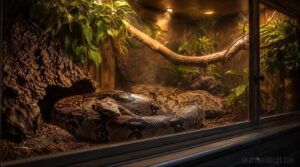
Getting the enclosure size right starts with one simple rule: match the length to your boa. From there, width, height, and floor space all follow a clear formula.
If space is tight, these tips on boa constrictor racks for small apartment setups show how to hit the right dimensions without sacrificing your living room.
Here’s what each dimension should look like.
Length Equals Boa Length
The enclosure length should match your boa’s total snake length — that’s the foundation of good enclosure size planning. Boas need linear movement space to stretch fully without cornering.
This Enclosure Length Formula isn’t just comfort; it’s stress reduction design. A boa stretching behavior interrupted by cramped walls causes real health problems.
Build in a growth margin needs a buffer, and you’re set. Be sure the enclosure length plus width meets or exceeds the boa’s total length as outlined in the recommended size formula.
Width at Least Half
Width builds on length. Once you’ve matched the enclosure size to your boa’s body, set the width and height at half its length — that’s your minimum. This Coiling Room keeps Movement Space open and facilitates Stress Reduction.
Follow these Design Guidelines for Width Benefits:
- Width equals at least half the enclosure length
- Coiling Room stays clear of decor blockage
- Movement Space supports natural slithering patterns
- Proper enclosure size separates basking and cooling zones
- Minimum dimensions prevent body compression during turns
Height at Least Half
Height follows the same rule as width: set it to at least half your boa’s length. This enables Vertical Stretching, creates Thermal Layers from floor to ceiling, and gives an Airflow Boost around hides. It also improves Humidity Stability. Use these minimum dimensions as your baseline:
| Life Stage | Boa Length | Minimum Enclosure Height |
|---|---|---|
| Baby | Under 2 ft | 1 ft |
| Juvenile | 2–5 ft | 2.5 ft |
| Adult | 6–8 ft | 4 ft |
| Large Adult | Over 8 ft | 4.5 ft |
| All Stages | Any | Half its length in width and height |
Proper enclosure height keeps Coiling Space functional and enclosure size safe.
Floor Space Comes First
Even with great height, floor space drives everything. Your boa spends most of its time on the ground — coiling, exploring, thermoregulating.
That’s where Stress-Free Movement and Activity Zone Design actually happen. Prioritize square footage first when planning Growth Floor Plans:
- Coil Space Needs: room for multiple relaxed coils.
- Floor vs. Height: floor area determines minimum enclosure size.
- Boa enclosure size: scales with body length, not tank volume.
Use The L × ½L Rule
Think of it as a simple formula: snake length × half snake length × half snake length.
That’s your minimum enclosure size, right there.
A 6-foot boa needs a 6 ft × 3 ft × 3 ft space — no guessing.
Once your boa hits 8 feet, you’ll want to size up fast — boa constrictor terrarium dimensions by length break down exactly when to jump to an 8×4×4 setup.
Enclosure Rule Basics give you clear enclosure dimensions calculation without overthinking it. Growth-Based Scaling means you adjust as your boa grows, and the Behavioral Space Impact of getting this right shows in calmer, healthier animals.
Boa Enclosure Sizes by Life Stage
Boa constrictors grow fast, and their space needs change just as quickly. right enclosure at each stage keeps your snake healthy, stress‑free, and easier to manage.
Here’s what you’ll need from hatchling to full‑grown adult.
Baby Boas Under Two Feet
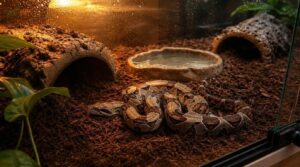
A baby boa under two feet doesn’t need a mansion — but it does need the right fit. Use the snake length x half snake length x half snake length formula to size the enclosure correctly. For a baby shorter than 2 feet, a 20‑gallon tank works well as a minimum tank size.
- Hide Setup: Two hiding spots, one warm, one cool
- Substrate Options: Cypress mulch or coconut fiber holds humidity well
- Growth Tracking: Measure monthly to plan your next upgrade
Juvenile Boas Two to Five Feet

Once your juvenile boa hits two feet, the stakes for enclosure size go up fast. A 4 ft × 2 ft × 2 ft enclosure fits the snake length x half snake length x half snake length formula perfectly for most juveniles.
| Juvenile Enclosure Size | Recommended Specs |
|---|---|
| Enclosure size | 4 ft × 2 ft × 2 ft |
| Climbing Structure Needs | Sturdy branches, 20+ in clearance |
| Enrichment Essentials | Two hides, soaking bowl |
| Substrate Safety Tips | Cypress mulch or coconut fiber |
Follow a Growth Upgrade Schedule every 12–18 months. The Health Space Link is real — tight quarters cause stress and muscle problems. Track your growth projection for boa constrictor annually to keep the juvenile enclosure right-sized.
Adult Boas Six to Eight Feet

An adult boa hitting six to eight feet needs an enclosure that matches its full length — minimum 6–8 ft L × 3 ft W × 3 ft H. These enclosure dimensions support Climbing Structures, Behavior Enrichment, and proper Shedding Support.
Tight minimum tank size stunts movement and harms Respiratory Health, cutting into Lifespan Factors. Don’t shortchange the adult boa — enclosure size directly shapes its quality of life.
Large Boas Over Eight Feet
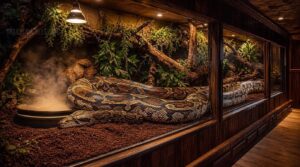
Once your boa crosses eight feet, standard tanks simply won’t cut it anymore. Large adults longer than 8 feet have serious space requirements — custom enclosures starting at 8 ft L × 4 ft W × 4 ft H are the baseline.
Custom design manages the handling challenges and facilitates health monitoring, enrichment strategies, and proper feeding requirements. Off-the-shelf options rarely meet these enclosure dimensions.
When to Upgrade Enclosure
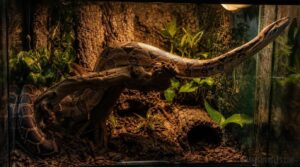
Don’t wait for a fixed birthday to upgrade — watch your boa’s growth thresholds instead.
Once it hits 2.5 feet, shift to a juvenile setup.
At five feet, reassess enclosure size immediately.
Annual assessments catch stress behaviors, shedding difficulties, and other health alerts before they escalate.
Matching enclosure size to each growth stage keeps space requirements ahead of your boa’s adult size.
Choosing The Best Enclosure Type
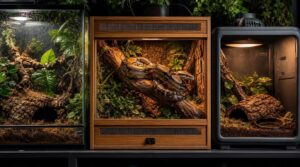
Not all enclosures are built the same, and the right one depends on your boa’s size, your setup, and how much work you want to put into maintenance. Each material controls heat, humidity, and visibility differently.
Here’s how the most common options stack up.
Glass Tanks for Young Boas
Glass aquariums are a solid choice for juvenile boas. A 20-gallon tank works as the minimum tank size for young snakes under two feet.
The enclosure size scales from there as your boa grows. Glass makes Lighting Setup and Tank Positioning straightforward, and Glass Cleaning is simple.
Add secure Hydration Stations and check all Decor Safety before placing anything inside.
PVC for Heat Retention
PVC panels take heat retention further than glass ever could. With thermal conductivity as low as 0.14 W/m·K, PVC holds warmth where your boa needs it most.
Key advantages worth knowing:
- Foam Core Benefits boost insulation without adding bulk
- Thermal Stabilizers protect panels through repeated heating cycles
- Reflective Coatings prevent surface overheating near basking zones
- Sealing Techniques eliminate heat-leaking gaps at joints
- Insulation Installation with gasketed doors locks in your temperature control
Wood Vivariums for Adults
When your adult boa hits six feet or more, wooden vivariums become the smarter choice. Built from kiln-dried hardwoods and sealed with non-toxic sealants, they offer thermal insulation that glass simply can’t match — meaning better energy efficiency and steadier temps with less effort.
Enclosure dimensions can be custom-built exactly to your boa’s size, making wood customization ideal for large adults.
Custom Large Boa Enclosures
For boas stretching beyond eight feet, custom enclosures aren’t a luxury — they’re a necessity. Standard off-the-shelf options simply don’t offer the enclosure dimensions a large adult needs.
Custom designs let you scale up solutions precisely: 8 ft × 4 ft minimum, with a proper temperature gradient built in from the start. DIY construction tips matter here — budget carefully, since large enclosure costs add up fast.
Front-opening Access Benefits
Front-opening terrariums make daily care noticeably easier — and your boa’s stress levels show it.
- Stress-Free Handling — Reach in calmly from the front instead of looming overhead, which triggers far less defensive behavior.
- Easy Maintenance — Spot cleaning with maintenance simplicity means less substrate spillage and faster turnaround.
- Climate Stability — Brief, targeted access preserves your temperature gradient better than lifting a full lid.
- Safety Access — An escapeproof design with secure latches beats relying on lid clamps alone.
- Modular Design — Hides and decor stay in place during every check, reducing setup disruption and supporting escape prevention.
Space for Heat and Humidity
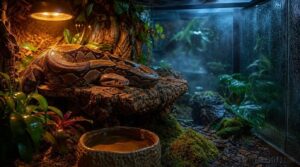
Getting the size right is only half the battle — what happens inside that space matters just as much. Your boa needs specific zones, moisture levels, and room to move comfortably.
Here’s what to get right.
Warm and Cool Zones
Your boa can’t regulate its own body temperature — that’s your job.
Thermal Gradient Design means splitting the enclosure into distinct thermal zones: a warm basking spot hitting 88–92°F and a cool hide zone dropping to 75–80°F. Hide Zone Placement facilitates natural Basking Behavior Patterns and meets Nighttime Cooling Needs.
Material Heat Retention in your chosen build affects how stable that temperature gradient stays throughout the day.
Safe Basking Area Size
Size your basking spot carefully — most people underestimate how much surface area a boa actually needs.
A good platform gives your snake room to spread fully, with a 2–3‑inch buffer on each side. Here’s what works:
- Basking Platform Materials — use textured, nonporous surfaces for grip and easy cleaning
- Heat Source Placement — position it to maintain an 88–92°F thermal gradient without hotspots
- Growth-Adjusted Platforms — upgrade when your boa outgrows full extension
Humidity Between 50–70%
Humidity levels make or break boa’s health. Keep the enclosure between 50–70% — too dry and shedding becomes a struggle; too high and respiratory infections creep in.
Use a digital hygrometer for accurate humidity measurement.
Coconut coir offers excellent substrate moisture retention and naturally stabilizes levels. Watch for retained shed or wheezing as humidity‑related health signs.
| Condition | Humidity Target |
|---|---|
| Normal daily range | 50–70% |
| During shedding | 65–70% |
Ventilation Without Heat Loss
Good ventilation doesn’t mean cold air rushing in. balanced ventilation setup moves fresh air through without tanking your temperatures.
Place humidity-safe vents high and low — this thermal vent design lets stale air exit without creating drafts. Energy-efficient airflow and draft-free systems protect enclosure insulation, supporting steady thermoregulation.
Your ventilation system should exchange air gently, keeping heat retention intact while meeting all ventilation needs.
Room for Soaking Bowls
Your boa needs room to soak — not just a bowl shoved in a corner.
For proper Water Access Design, choose a bowl 8 to 10 inches wide and at least 6 inches deep.
Best Bowl Placement keeps it away from heat sources so the water stays cool and stable.
This facilitates humidity control and Enclosure Water Zones without crowding floor space.
Non-slip bases prevent sliding.
Avoiding Dangerous Space Mistakes
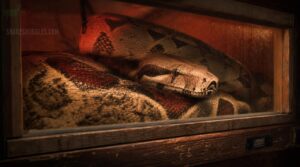
Even experienced keepers make enclosure mistakes that put their boas at risk. Most problems come down to a handful of common oversights — and they’re all avoidable once you know what to watch for.
Here are the five mistakes worth taking seriously.
Tanks That Are Too Small
Cramped quarters do real damage. When enclosure size falls short, your boa can’t express natural behaviors like full-body stretching or proper thermoregulation — and temperature stress follows fast.
Coiling constraints force unnatural postures that lead to muscular atrophy over time.
Watch for snake stress signs: pacing, reduced feeding, or constant wall contact.
Stunted growth and immune problems aren’t far behind.
Weak Lids and Escapes
A small tank isn’t your only risk — a weak lid is just as dangerous. Boas are natural escape artists, and a loose mechanism is all they need.
Check for these lid failures:
- Warped or thin material that bends under pressure
- Single-action locks a boa can nudge open
- Corrosion weakening the design over time
- Skipped maintenance checks that miss early wear
Use a secure, escape-proof enclosure with double-lock mechanisms.
Cohabiting Multiple Boas
Even with a secure lid, the enclosure itself can become a danger zone — especially if you’re housing more than one boa.
Don’t do it. Boa compatibility is a myth. These are solitary animals. Cohabitation risks include stress, immune suppression, and documented cannibalism.
Boa compatibility is a myth — these solitary animals risk stress, immune collapse, and cannibalism when housed together
| Risk | Cause | Result |
|---|---|---|
| Aggression | Territory competition | Injury |
| Stress signs | Shared basking zones | Immune decline |
| Health risks | Overcrowded enclosure size | Disease spread |
Separation strategies are your safest option.
Overcrowding Hides and Decor
Too much decor creates its own set of risks — separate from cohabitation but just as damaging.
Clutter shrinks usable space, turning a properly sized enclosure into cramped quarters. Visual obstruction hides the heat zone, misplaces hiding spots, and makes cleaning nearly impossible.
Watch for these placement mistakes:
- Hides blocking the basking area
- Decor merging into one visual mass
- Obstacles trapping waste near the hide
- Excess items creating a stress‑inducing illusion of space
Ignoring Adult Boa Size
Adult boas over eight feet need at least 12 feet of enclosure length — not a suggestion, a minimum. Squeeze a large snake into cramped quarters and you’ll see real consequences: stress behaviors, muscle atrophy, and thermoregulation issues that shorten lifespan.
Growth stage matters throughout a boa’s life. Match enclosure size to the actual animal in front of you, not the one you started with.
Frequently Asked Questions (FAQs)
Can a Kenyan sand boa live in a 20 gallon tank?
Yes, a 20-gallon tank works well for Kenyan sand boas.
A horizontal layout makes the most of that space, as explained in this guide to vertical vs. horizontal boa enclosure setups.
At 30 inches long, it meets minimum recommended dimensions for most males, supporting proper burrowing space essentials and life stage suitability for juveniles.
What is the best enclosure for a boa constrictor?
The best enclosure for a boa constrictor matches its body length, maintains a steady temperature gradient, and keeps humidity between 50–70%. PVC builds with front-opening access check every box reliably.
Can boas live outdoors in warm climates?
Boas can thrive outdoors in warm climates if temperatures stay between 78–92°F during the day and don’t dip below 70°F at night.
Predator protection, escape-proof enclosure design, and local legal housing requirements matter just as much as the heat.
How often should boa enclosures be deep cleaned?
Deep clean your boa’s enclosure once a month. Do a full substrate change every four weeks.
Spot clean daily to remove waste. This cleaning schedule prevents mold growth and aids humidity control.
What substrate works best for boa enclosures?
Coconut coir and cypress mulch top the list for reptile substrate. Both support burrowing behavior, retain moisture well, and stay skin-safe. Aim for 3–4 inches of substrate depth.
How does enclosure size affect a boas lifespan?
Enclosure size directly shapes a boa’s lifespan. Proper space promotes thermoregulation, stress reduction, and immunity.
Movement enhances longevity, while cramped tanks cause muscle loss and disease. Healthier, longer lives follow growth, stress reduction, and correct sizing.
Conclusion
Ironically, the most common mistake boa keepers make isn’t skipping premium lighting or forgetting supplements—it’s simply not giving their snake enough room to move. Knowing how big a boa enclosure should be isn’t complicated once you follow the length-matching rules.
Get the floor space right, account for each growth stage, and your boa won’t just survive—it’ll thrive for two decades.
The right enclosure isn’t a luxury. It’s the foundation everything else builds on.