This site is supported by our readers. We may earn a commission, at no cost to you, if you purchase through links.
Most boa constrictors don’t outgrow their enclosures overnight—they do it gradually, across shed cycles and slow weight gains, until the damage to muscle tone and behavioral health is already done. A snake that can’t complete a full lateral extension isn’t just uncomfortable; it develops postural abnormalities that compound over years.
Getting boa constrictor terrarium dimensions right from the start isn’t a preference, it’s a husbandry baseline. Snout-to-tail length, growth stage, and material choice each feed into a sizing formula that leaves no room for guesswork—and the math is simpler than most keepers expect.
Table Of Contents
Key Takeaways
- Enclosure size isn’t a preference—use the formula snake length × half snake length × half snake length, and upgrade before your boa outgrows the space, not after.
- Track snout-to-tail length after every shed and pair it with weekly or biweekly weight logs to catch growth shifts before they become husbandry problems.
- Gallon ratings measure volume, not usable space—floor area is what actually matters, so a wide 40-gallon can outperform a tall 75-gallon for a boa’s movement needs.
- Material choice directly affects heat retention and humidity control: PVC holds heat up to 20% longer than glass, making it the most practical option as enclosure size scales up.
Measure Your Boa First
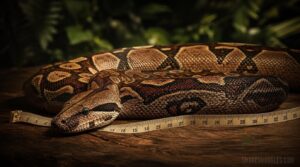
Before you buy a single piece of equipment, you need accurate numbers on your snake. Enclosure sizing isn’t guesswork — it’s math, and your boa’s current measurements are the starting point.
Start by measuring your snake from nose to tail, then use those numbers to work out the minimum footprint with this guide to appropriate snake tank dimensions.
Here’s what to check before anything else: your boa’s current measurements will guide your decisions.
Snout-to-tail Length
Measure your boa’s STL (snout-to-tail length) — this is your single most critical input for boa enclosure dimensions and size planning. STL tracking frequency matters: log measurements after each shed cycle, pairing STL record logs with girth assessments to build an accurate STL growth curve.
Seasonal STL changes and STL vs. girth ratios together reveal whether your minimum dimensions still hold.
Current Weight Check
Weight anchors your STL data. Use a calibrated digital scale — weigh weekly for juveniles, biweekly for adults — and log each reading with a timestamp in your digital logbook.
Stress-free weighing matters: handle calmly, then measure. Weekly trend analysis flags a 15% weight shift that demands a feeding adjustment.
Weight, paired with length, drives accurate boa enclosure dimensions and growth projection for boas.
Growth Stage Category
Once you’ve logged length and weight, those two numbers place your boa in a defined growth stage — and that stage drives everything from minimum enclosure size to health screening schedule.
- Baby (under 2 ft) — rapid growth rate monitoring weekly
- Juvenile 2 to 5 ft — stage-specific feeding adjustments and behavioral milestones
- Adult 6 to 8 ft — hormonal development stabilizes; boa enclosure dimensions are finalized
- Large adult (8+ ft) — size planning for pet snakes becomes critical
Upgrade Timing Signs
Once your boa’s stage is confirmed, watch for specific upgrade triggers. A sustained weight gain threshold — 10 percent over two consecutive monthly checks — signals the enclosure is falling behind the growth rate of boas.
Escalating thrashing, wall-scaling attempts, and restless activity after feeding indicate cramped boa enclosure dimensions.
Shedding difficulty and thermal stress cues point to size planning for pet snakes becoming overdue.
Space for Movement
Once you’ve confirmed your boa’s growth stage, the enclosure must accommodate full-body movement—not just resting posture. Horizontal clearance and vertical balance work together: minimum enclosure size follows length, width, and height proportionally, with smooth interior surfaces reducing scale snags.
Add gentle obstacles like branches and secure perches, but keep floor space open.
A 6-foot-long by 2-foot-wide by 4-foot-tall enclosure is a solid adult standard.
Choose Minimum Terrarium Dimensions
Boa enclosure sizing isn’t one-size-fits-all — what works for a hatchling will quickly become a liability for a six-foot adult.
The right dimensions depend entirely on where your snake falls in its growth trajectory.
Here’s what the minimum requirements look like at each stage.
Babies Under Two Feet
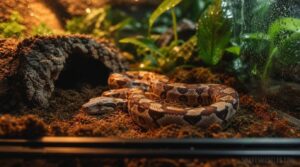
For a baby shorter than 2 feet, minimum enclosure size starts at 24 inches long by 12 inches wide by 12 inches high — non-negotiable. These dimensions represent the absolute baseline, not a recommendation.
Substrate choice, humidity levels, and temperature gradient all depend on adequate internal volume. Without sufficient space, these critical factors cannot be properly managed. Lighting needs and feeding frequency are irrelevant if the juvenile boa constrictor cannot thermoregulate effectively within the enclosure.
Juveniles Two to Five Feet
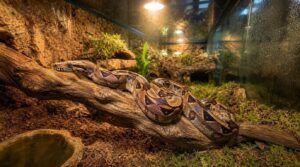
Once your juvenile boa constrictor reaches 2 feet, minimum enclosure size scales up — fast. A 4x2x2 enclosure (length x width x height) serves as the standard base for this growth stage, accommodating the lateral range required by a 2–5 ft snake for essential activities like thermoregulation, feeding adjustments, and shedding management.
Proper enclosure dimensions also support critical husbandry functions, including humidity control, growth tracking, and enrichment opportunities. These elements directly prevent stress-related health decline by ensuring the snake’s environment remains stable and engaging as it matures.
Adults Six to Eight Feet
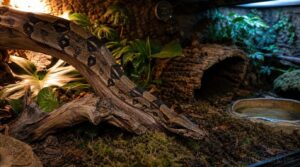
Adult boas reaching 6–8 ft require enclosures tailored to their physiology, not room constraints. Minimum dimensions follow the formula: snake length × half snake length × half snake length, resulting in 6 ft long × 3 ft wide × 3 ft tall. Proper enclosure size directly supports Thermal Gradient stability, Humidity Management, and Enclosure Security.
Key enclosure features include:
- Floor area of 6×3 ft allows full lateral extension without wall contact
- Thermal Gradient requires a 90°F basking zone and 78–80°F cool side
- UVB Benefits include improved skin condition and circadian regulation
- Feeding Frequency of every 1–2 weeks depends on body condition monitoring
Maintaining a stable thermal gradient ensures metabolic health, while UVB exposure supports calcium synthesis and behavioral rhythms. Consistent monitoring of feeding response and body condition guides adjustments to prey size and frequency, preventing obesity or malnutrition.
Large Adults Over Eight Feet
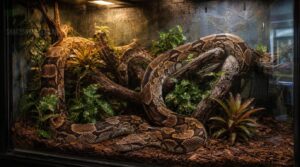
Once your boa surpasses 8 feet, the enclosure size stakes rise considerably. A large adult longer than 8 feet demands boa enclosure dimensions of at least 8×4×4 feet — and a 7×3×5 feet enclosure works well for individuals approaching that threshold.
Apply snake length × half snake length × half snake length consistently.
Terrarium Accessibility, Humidity Control, Feeding Logistics, Behavioral Observation, and routine veterinary checkups all become noticeably harder to manage when the space is undersized.
Length-width-height Formula
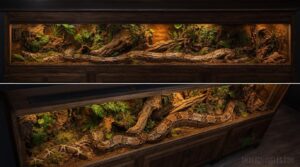
The formula driving every boa enclosure dimensions decision is straightforward: snake length × half snake length × half snake length. A 6-foot boa, for instance, requires 6 ft L × 3 ft W × 3 ft H — not 6 feet long by 2 feet wide by 4 feet tall, which sacrifices floor space efficiency for unnecessary vertical volume.
Dimensional consistency across measurement units ensures your volume calculation reflects actual usable space, not misleading aspect ratio trade-offs.
Plan Height and Floor Space
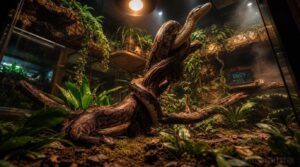
Floor space and height aren’t afterthoughts — they’re the difference between a boa that thrives and one that slowly deteriorates. Getting both dimensions right means accounting for climbing behavior, thermoregulation, and natural movement patterns specific to your snake’s size.
Here’s what you need to plan for.
Half-length Height Rule
The half-length height rule dictates enclosure dimensions as: snake length × half snake length × half snake length. For a 6-foot Boa Constrictor, this requires a 6 ft × 3 ft × 3 ft enclosure—not 2 ft in height.
Proper Height-to-Length Ratio directly enables Vertical Space Utilization, precise Heat Source Alignment across thermal gradients, and measurable Stress Mitigation in captive reptiles.
Climbing Branch Clearance
Height gets you nowhere if your climbing branches turn the enclosure into an obstacle course. Space each branch with a 12-inch Clearance Buffer on all sides, and use Offset Placement — staggered horizontals, never a straight-line ladder.
Sharp Edge Prevention matters too: kiln-dried wood only, fully deburred.
Keep Removable Branches for cleaning, and make certain Branch Spacing accommodates your adult boa constrictor’s full diameter without compression.
Stretching Room Needs
Branches handle the vertical dimension—now the floor must earn its keep. A full-grown adult boa constrictor requires unobstructed lateral space matching minimum enclosure dimensions: snake length × half snake length × half snake length.
- Floor traction via vinyl or sealed concrete
- Diffuse lighting at 300 lux minimum
- Temperature gradient maintained 75–82 °F
- Humidity stability held at 50–60 percent
Safety protocols complete the setup.
Basking Platform Placement
With floor space sorted, the basking platform is where heat source alignment determines whether your boa constrictor actually thermoregulates or merely tolerates its enclosure. Position the platform 2–6 inches below the heat lamp, maintaining a 32–38°C basking spot. Adjustable elevation, stability anchoring, and surface texture collectively define the clearance ratio within the enclosure size.
The heat lamp distance (2–6 inches) ensures ±2°C accuracy, while adjustable elevation accommodates growth for consistent basking spot access. Surface texture—such as cork or ceramic—promotes even dorsal heat distribution.
| Platform Factor | Requirement | Effect on Temperature Gradient |
|---|---|---|
| Heat lamp distance | 2–6 inches | Maintains ±2°C accuracy |
| Adjustable elevation | Scales with growth | Consistent basking spot access |
| Surface texture | Cork or ceramic | Even dorsal heat distribution |
Burrowing Depth Allowance
Substrate composition determines how effectively your boa retreats below the surface—and whether that retreat is safe. Adults six to eight feet require 12–18 inches of depth for meaningful thermal gradient access and moisture retention.
Juveniles manage well at 8–12 inches. Monthly depth monitoring prevents substrate compaction and failures, ensuring the substrate remains functional over time.
A bioactive substrate system with stable structure guarantees burrow safety and prevents collapse risks, providing a secure environment for your boa.
Match Materials to Dimensions
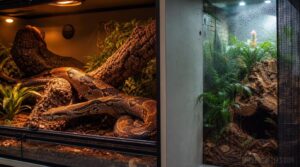
Not all enclosure materials scale the same way across boa size categories, and that difference matters more than most keepers expect. The material you choose directly affects how well your terrarium holds heat, regulates humidity, and stays secure as your snake grows.
Here’s how the most common options stack up against the dimensions your boa actually needs.
PVC Enclosure Sizing
PVC stands out as the practical workhorse of boa constrictor housing, primarily due to its thermal insulation properties. These properties retain heat up to 20% longer than glass, significantly reducing the thermostat’s workload.
A standard 4x2x2 enclosure—built using the formula snake length × half snake length × half snake length—offers reliable seal integrity, ventilation slots for airflow control, and modular expansion potential. This design also provides serious weight management advantages over comparable builds of the same size.
Glass Terrarium Limits
Glass terrariums offer visibility that PVC can’t match — low‑iron clarity renders your boa constrictor’s pattern without the green tint standard glass introduces.
For enclosure sizes up to 24 inches in length, width, and height, 4–5 mm wall thickness holds. Beyond that, tempered glass at 6 mm minimum prevents bowing.
Seam reinforcement with humidity‑rated silicone isn’t optional — it’s what keeps the structure sound under sustained thermal stress.
Wood Vivarium Builds
Wood vivarium builds give you something PVC and glass can’t — total dimensional control. Frame construction with 2×2 lumber and marine-grade plywood lets you dial in exact length, width, and height for your boa’s growth stage.
A proper moisture barrier between substrate and wood prevents rot, while integrated ventilation design, substrate shelf integration, and decorative hideaways make DIY enclosure construction genuinely functional — not just aesthetic.
Front-opening Access
Front-opening doors are not a luxury — they are a functional upgrade that directly affects how well you manage enclosure size, length, width, and height without stressing your boa. A front-opening terrarium lets you feed, clean, and monitor without looming overhead, which boas hard-wired to fear aerial predators genuinely need.
- Hinge durability keeps heavy panels aligned across years of daily use
- Magnetic sealing compresses gaskets tightly, locking in humidity and escape prevention
- Finger protection via soft-close mechanisms prevents injury during quick feeding routines
- Maintenance access is unobstructed — panels swing fully clear for substrate work
- Quick feeding happens with one-handed operation, minimizing handling stress on both keeper and snake
Escape-proof Lid Measurements
Lid diameter clearance must stay within 0.5 mm of the enclosure opening—beyond that, gasket tolerance fails and your boa finds the gap. A poorly fitting lid is an escape route waiting to happen.
Dual latch alignment distributes force symmetrically, while magnetic catch strength resists lateral movement up to 15 kg.
Run a seal pressure test after every reassembly.
Convert Dimensions to Gallons
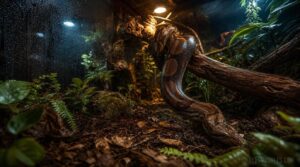
Gallon ratings are one of the most most misunderstood metrics in reptile keeping — they measure volume, not livable space, and that distinction matters more than most keepers realize.
A boa doesn’t swim through cubic inches; it moves across floor space, climbs vertically, and thermoregulates across a gradient.
Here’s how to make sense of the numbers before you buy.
24x24x48 Gallon Estimate
A 24×24×48 enclosure translates to roughly 62.5 gallons, but interior volume accounting matters more than that headline figure. Space utilization efficiency drops once substrate depth, hides, and a water bowl reduce usable floor area.
For an adult boa constrictor, this 4×2×2 enclosure meets the snake length × half snake length × half snake length formula. However, humidity capacity factor and thermal mass impact both increase with tighter configurations.
Feet-to-gallons Formula
Once you have your enclosure size in feet, the Cubic Foot Conversion is straightforward: multiply length, width, and height, then apply the 7.48052 multiplier for your Rounded Gallon Approximation. For example, a 4x2x2 enclosure yields 16 cubic feet, or roughly 120 gallons.
From there, apply these adjustments:
- Subtract Wall Thickness Adjustment (glass reduces interior dimensions)
- Apply Substrate Displacement Factor for depth
- Recalculate Effective Volume Calculation for your Boa Constrictor’s actual usable space
This process ensures accurate measurement of your reptile’s habitat.
Usable Space Versus Volume
Total volume tells you how much air your boa occupies — not how much space it can actually use. That’s the volume illusion.
A 4×2×2 enclosure clocks in at around 120 gallons, but dead-zone elimination matters more than raw numbers. Track your floor area ratio instead: usable horizontal priority beats height every time.
| Metric | What It Actually Measures |
|---|---|
| Total volume | Length × width × height combined |
| Floor area ratio | Movement efficiency metric per snake length |
| Usable space | Dead-zone-free crawling area |
| 7×3×5 feet enclosure | High volume, moderate horizontal priority |
| Snake length formula | Snake length × half snake length × half snake length |
Why Gallons Can Mislead
Gallons measure volume — not how your boa constrictor actually moves through a space. A tall, narrow 75-gallon tank can offer less usable floor area than a lower-profile 40-gallon built wide and long. Floor area importance wins over raw volume every time.
A 40-gallon wide enclosure can outperform a 75-gallon tall one — floor area beats volume every time
Length, width, and height each serve distinct roles: microclimate variability and heat distribution impact depends on horizontal spread, not liquid capacity.
Best Size by Age
Think of enclosure size as a tiered progression tied directly to Growth Milestones, not guesswork. Hatchlings start at 40–60 gallons, while juvenile boa constrictors scale to 90–110 gallons as Age-Based Volume demands increase.
Scaling Recommendations follow the formula: snake length by half the snake’s length by half the snake’s length. Once your boa reaches seven feet, target 150–250 gallons, factoring in Age-Specific Humidity needs and Lifecycle Feeding activity to optimize usable length, width, and height.
Frequently Asked Questions (FAQs)
How many gallons is a 24x24x48 terrarium?
Do the math and you’ll find a 24x24x48 terrarium holds roughly 119 usable gallons — calculated via cubic inch conversion (27,648 ÷ 231). Effective volume drops once substrate and décor reduce tank capacity.
How does enclosure size affect boa lifespan?
Cramped tanks suppress immune function, cause obesity, and disrupt thermoregulation efficiency, while properly sized terrariums with balanced thermal gradients support shedding success, stress reduction, and long-term snake health.
Ensuring the enclosure length plus width meets or exceeds the boa’s total length is essential for proper movement.
What humidity levels prevent difficult sheds?
Keep ambient RH between 60–75%, rising to 75–85% during sheds. A humidity hide, damp substrate, and morning misting eliminate retained shed before it starts.
Which substrate depth suits adult boas best?
Adult boas need 4–12 inches of substrate depth. A bioactive mix with leaf litter improves moisture retention, prevents substrate compaction, and facilitates thermal conductivity — giving full-grown adults room to burrow naturally.
How many UVB hours do boas need daily?
Think of light as a biological clock.
Your Boa Constrictor needs 10–12 hours of daily UVB duration on a consistent UVB photoperiod, supporting vitamin D synthesis and healthy calcium metabolism without disrupting nocturnal behavior.
What water bowl size keeps boas hydrated?
For subadults up to 4 feet, an 8–12 inch Bowl Diameter and 2–3 inch Bowl Depth works well. Use a Non‑Slip Base, practice Daily Water Change, and keep Cool Side Placement consistent.
Conclusion
Measure twice, house once—that’s the standard boa constrictors won’t let you ignore. Every keeper who shortcuts boa constrictor terrarium dimensions eventually confronts the same outcome: a compromised animal requiring corrective husbandry that proper sizing would have prevented entirely.
Snout-to-tail length, growth stage, and material constraints aren’t variables to revisit later—they’re calculations you run before the enclosure arrives.
Get the math right now, and your boa’s musculoskeletal health reflects that discipline for the next two decades.