This site is supported by our readers. We may earn a commission, at no cost to you, if you purchase through links.
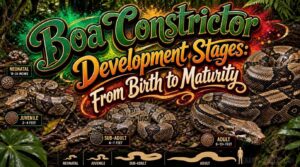
A boa constrictor enters the world as a 35-centimeter, 80-gram animal—then, over the next three to four years, transforms into a muscular predator stretching past three meters. This trajectory isn’t random. Each developmental stage carries distinct metabolic rates, feeding demands, shedding frequencies, and environmental thresholds that directly shape whether the animal thrives or stagnates.
Missing the signals in the neonatal window, for instance, can lead to feeding problems persisting for months. Similarly, mismatching humidity during juvenile growth may cause incomplete sheds compounding into chronic stress. These stages demand precise attention to avoid long-term issues.
Understanding the biological processes at each phase provides the precision to intervene early. This knowledge ensures caregivers can address specific needs, ultimately raising a genuinely healthy animal.
Table Of Contents
- Key Takeaways
- Boa Constrictor Development Stages Overview
- Birth and The Neonatal Stage
- Juvenile Growth Milestones and Feeding
- Shedding Patterns Across Development Stages
- Temperature and Humidity for Healthy Development
- Sexual Maturity and Reproductive Development
- Top 10 Products for Boa Constrictor Owners
- 1. Boa Constrictor Care Guide
- 2. LovesTown Wooden Double Sided Snake Puzzle
- 3. Snakes for Kids Junior Scientist Guide
- 4. TOSQP27 Wooden Snake Cube Puzzle
- 5. Wooden Jointed Wiggly Snake Toy
- 6. Everything You Need To Know Snakes For Kids
- 7. Junior Learning Sequencing Snake Cards
- 8. Wacky Wiggly Fidget Snake
- 9. Acrylic Snake Climbing Rings
- 10. Safari Corn Snake Figurine
- Frequently Asked Questions (FAQs)
- What are the 5 stages of a snakes life cycle?
- How long should a 3 year old boa be?
- How long do boa constrictors live in captivity?
- What is the lifespan of a wild boa constrictor?
- How large do female boas typically grow?
- When does a boas growth rate slow down?
- How heavy can adult female boa constrictors get?
- Conclusion
Key Takeaways
- Neonatal boas (30–40 cm, 60–100 g at birth) must complete its first shed within 7–14 days before feeding begins, and missing this window can trigger feeding problems that persist for months.
- Juvenile growth demands a weekly feeding schedule with prey sized at 8–12% of body weight, stable temperatures of 80–88°F, and humidity between 55–65%—any deviation flattens growth curves or causes incomplete sheds.
- Power-feeding during rapid juvenile growth builds fat faster than muscle, directly increasing the risk of musculoskeletal deformities, regurgitation, and long-term reproductive failure.
- Sexual maturity arrives between 2–4 years depending on sex and body condition, after which metabolic rate drops and husbandry precision—not feeding volume—becomes the primary driver of long-term health.
Boa Constrictor Development Stages Overview

Boa constrictors don’t just grow — they transform, moving through distinct biological phases that each demand something different from you as a keeper.
Each phase brings real shifts in feeding, shedding, and space needs — tracking boa constrictor growth milestones helps you stay a step ahead instead of scrambling to catch up.
Understanding those phases, from the first breath of a neonate to the slow, steady growth of a mature adult, shapes every decision you’ll make about feeding, housing, and husbandry.
Here’s how each stage breaks down.
What Development Stages Mean for Boas
Every stage of a boa’s life triggers distinct metabolic changes, hormonal regulation shifts, and sensory development milestones that directly shape how you care for the animal. Tracking these transitions matters because energy requirements, shedding frequency, juvenile growth rate, and eventual growth slowdown after maturity each demand different keeper responses:
- Neonatal metabolism runs hottest
- Juvenile growth accelerates rapidly
- Behavioral Shifts signal reproductive readiness
- Sexual maturity restructures nutritional needs
- Adult maintenance requires precision over volume
Neonatal, Juvenile, and Adult Phases
Boa constrictors move through three distinct phases — neonatal, juvenile, and adult — each demanding different keeper responses. Neonatal boa constrictors measure 40–60 cm at birth, with immune development and stress response systems still calibrating.
The juvenile growth phase accelerates rapidly through year one, requiring attentive care to support their dynamic physiological changes.
Adult boa constrictor size stabilizes around 2.5–3.5 meters, where metabolic rate drops and longevity factors tied to husbandry precision take over.
Why Stage-by-stage Growth Matters
Each phase you just read about carries real consequences for how you manage care. Stage-by-stage growth monitoring isn’t bookkeeping — it’s how you catch problems before they compound.
- Progress Tracking keeps feeding schedules aligned with actual juvenile growth rate
- Early Intervention flags stalled adult size development before it becomes irreversible
- Nutritional Planning prevents power-feeding damage during rapid growth stages
- Risk Identification catches incomplete sheds tied to habitat optimization failures
- Habitat Optimization shifts enclosure conditions precisely as growth stages change
Birth and The Neonatal Stage
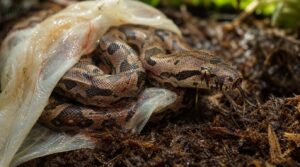
The neonatal stage is where everything begins, and it moves faster than most keepers expect.
From the moment a boa breaks free of its birth membrane, the clock is already running on its first shed, first meal, and first real test of your husbandry. Here’s what you need to know about those critical early days.
Size and Weight at Live Birth
Newborn boas arrive small but packed with potential. Neonates’ size varies noticeably—hatchling size variability stems directly from maternal health impact during gestation and clutch size effect within the litter.
Your birth weight range benchmarks to monitor:
| Measurement | Typical Range |
|---|---|
| Length | 30–40 cm |
| Weight | 60–100 g |
| Length-weight ratio | 2–5 g/cm |
| Litter size | 10–65 neonates |
| Gestation period | 100–150 days |
Larger broods often produce lighter individuals.
Rupturing The Birth Membrane
Each neonate arrives encased in a thin transparent membrane—a product of membrane composition layers, including the amnion and chorion, shaped during embryonic development.
Enzymatic weakening via matrix metalloproteinases thins this membrane just before parturition. Rupture timing is critical: neonates must breach it within minutes.
Watch for diagnostic signs like membrane retention, and apply management strategies—gentle assistance only if the birth method fails naturally.
First Shed and Independent Feeding
Within 7 to 14 days post-birth, your neonate will complete its first shed—and that’s your green light to begin feeding. Shedding quality tells you everything: a clean, single-piece shed signals proper initial hydration and membrane breach recovery.
Post-shed appetite usually kicks in immediately. Start with pinky mice sized-to-girth, establishing a juvenile feeding schedule of every 5 to 7 days to support the newborn’s weight gain.
Litter Size and Gestation Length
Gestation variability in boas is significant, with gestation periods ranging from 90 to 180 days. This duration is influenced by factors such as female body condition, maternal nutrition, and temperature during development.
Through ovoviviparity, embryos develop internally, and litters typically consist of 12 to 40 neonates. Larger litters often result in slightly smaller individuals at birth due to intrauterine competition.
Reproductive hormones and maturity directly impact the number of viable neonates a female delivers. Litter competition begins immediately after birth, further shaping survival outcomes.
For context, a dog gestation period averages roughly 63 days, highlighting reproductive differences across species.
Juvenile Growth Milestones and Feeding
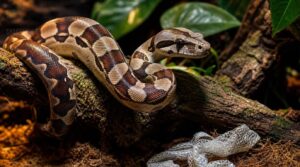
Once your boa clears that first shed, the real growth begins—and it moves faster than most keepers expect. The juvenile stage is where your husbandry decisions have the biggest impact on long-term health, size, and temperament.
Here’s what you need to track from year one onward.
Length and Weight by Year One
By the end of year one, your juvenile boa usually reaches 3 to 5 feet and 1.5 to 4 kilograms — a dramatic jump from neonate size.
Use monthly tracking and consistent measurement techniques to plot a growth chart reference. Weight benchmarks and length benchmarks vary by sex and feeding history, so document both carefully for accurate juvenile growth assessment.
Annual Growth Rate in Early Years
During rapid juvenile growth, your boa can add 15–45 cm annually — but that range isn’t random. Weight gain trends reflect feeding interval impacts directly: consistent weekly meals drive upward growth curves, while irregular schedules flatten progress fast.
Key developmental factors include:
- Genetic variance influences milestone timing across individuals
- Stable temperatures (80–88°F) accelerate growth through thermally dependent development
- Seasonal temperature drops below this range risk growth stagnation
- Humidity optimization ensures healthy ecdysis and nutrient absorption during growth surges
Environmental consistency remains critical for maximizing juvenile expansion potential.
Weekly Feeding Schedule for Juveniles
Stick to a weekly feeding schedule for your juvenile boa — consistency here is everything. Offer a single prey item sized at 8–12% of body weight, and track that number weekly for accurate prey size calculations and weight monitoring.
After each meal, enforce a 48–72 hour digestive rest period with no handling. Always ensure fresh water is available for proper hydration management and smooth digestion.
Prey Progression From Pinkies to Rodents
Once your juvenile reliably digests pinkies, prey size escalation follows a clear sequence built on girth matching and crushing power:
- Pinkies (2–4 g) — no fur, minimal soft prey texture shift
- Fuzzy mice — light fur, demanding stronger constriction
- Hoppers — increased muscle mass, testing nutritional protein requirements
- Appropriate-sized rodents — full prey size selection based on mid-body width
Track progression success metrics monthly.
Risks of Overfeeding and Power-feeding
Overfeeding and power-feeding drive obesity complications, with excess fat building faster than muscle. This imbalance directly threatens the boa’s health.
Regurgitation incidents follow when digestion cycles overlap, compounding metabolic stress over time. Such strain elevates risks of musculoskeletal deformities and reproductive inhibition, undermining long-term vitality.
Keep body condition lean — your boa’s sustained metabolic health hinges on this principle. Prioritize gradual, controlled feeding to avoid irreversible damage.
Shedding Patterns Across Development Stages
Shedding tells you more about your boa’s health than almost any other behavior. How often it happens — and how cleanly — shifts noticeably as your snake moves from juvenile to adult.
This transition highlights key changes in shedding patterns. What to watch for at each stage ensures you monitor your boa’s well-being effectively.
Shed Frequency in Juveniles Vs. Adults
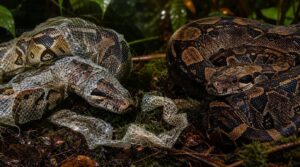
Shedding frequency drops sharply as your boa matures — and that shift reflects Hormonal Regulation and Growth Rate Correlation working in tandem.
In the first year, expect 4–6 sheds, with molting frequency peaking every 4–6 weeks. Adults average just 2–4 ecdysis cycles annually.
Poor shedding quality at either stage signals temperature sensitivity issues or health implications worth addressing promptly.
Signs a Boa is Entering Pre-shed
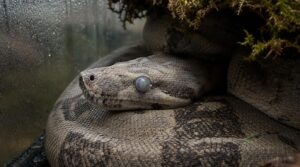
Once your boa enters pre-shed, the signs come in fast. Eyelid clouding appears first — that milky, veil-like opacity signals the old skin loosening beneath. You’ll notice color dulling across the head and dorsal scales, plus scale dryness giving the body a flat, matte look. Reduction in head rubbing and appetite decline follow closely:
- Eyes shift from clear to a dull, bluish-gray tone
- Skin texture turns slightly stiff and opaque along the midsection
- Activity drops as the molting process redirects energy
- The snake becomes reclusive, seeking moisture and avoiding handling
Humidity Levels for Complete Ecdysis
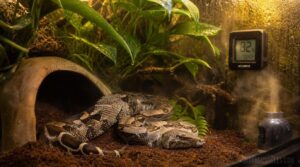
Humidity control is the single most direct lever you have over shedding quality. Keep ambient levels between 50–70%, rising toward 70% when pre-shed cues appear.
Damp hide utilization creates a targeted microclimate humidity zone without saturating the whole enclosure — your best tool against retained eye caps. Place your hygrometer at mid-enclosure height, never near heat sources.
Watch substrate humidity closely; oversaturation invites mold prevention failures fast.
What Incomplete Sheds Indicate
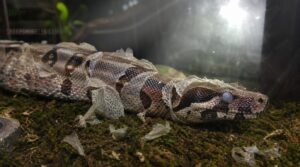
An incomplete shed isn’t just a nuisance — it’s a health stress indicator your boa is sending directly. Fragmented pieces signal a humidity imbalance, while retained eye caps suggest metabolic disruption or nutritional deficiency.
Recurrent failures can point toward skin infection or parasitic issues. These patterns underscore deeper concerns requiring immediate attention.
Shedding quality reflects your entire husbandry approach — temperature gradient, humidity control, and nutrition working together. Don’t ignore the pattern.
Temperature and Humidity for Healthy Development
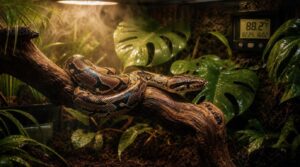
Getting temperature and humidity right isn’t optional — it’s the foundation everything else builds on. Your boa’s ability to digest, grow, and shed cleanly depends entirely on conditions inside the enclosure.
Here’s what you need to know to get it right.
Ideal Thermal Gradient for Growth
Getting the temperature gradient right isn’t optional — it’s the engine behind every growth turning point. Your enclosure needs a Thermal Gradient Range of 30–32°C in the basking zone and 26–28°C on the cool side, with Gradient Stability maintained within a 4–6°C difference.
- Basking Cycle Timing: Run the warm zone 12–14 hours daily
- Nighttime Temperature Minimum: Never drop below 24°C
- Uniform Heat Distribution: Eliminate cold spots that stall digestion
- Temperature-dependent development: Consistent heat gradient drives feeding regularity
How Low Temps Slow Metabolism
When temperatures drop below 80°F (27°C), a boa’s metabolic rate doesn’t just slow—it stalls. Thyroid hormone changes suppress enzymatic digestion, brown fat activation shifts toward energy conservation, and the reduced digestion rate means meals sit unprocessed for days. This ectothermic regulation failure disrupts temperature-dependent development at the cellular level.
Below 80°F, a boa’s metabolism doesn’t slow — it stalls, leaving meals unprocessed and development disrupted at the cellular level
| Temperature | Metabolic Impact |
|---|---|
| 80–88°F | Peak metabolic programming |
| Below 80°F | Hormonal stress response triggered |
Basking Spot Vs. Ambient Temperature
Think of your enclosure as a thermal ladder design—two distinct zones working together, not a single heat point. This setup provides a basking spot and an ambient area, enabling your boa to self-regulate effectively.
The basking spot maintains surface temperatures of 85–90°F to aid digestion, while the ambient temperature holds 78–82°F for thermoregulation. Together, they enable temperature-dependent development by giving your boa deliberate control over heat source placement.
- Surface temps elevate core body temperature faster than air alone.
- A defined thermal gradient lets boas self-regulate between feeding and rest cycles.
- Ambient humidity balance stays more stable when heat source placement prevents enclosure-wide overheating.
Humidity Ranges by Life Stage
Humidity isn’t one-size-fits-all across development stages. Neonates require 60–70% to support hydration and early ecdysis — neonatal humidity cues matter most in those first weeks.
Juveniles thrive at 55–65% humidity, though juvenile moisture fluctuations during pre-shed warrant a temporary boost to 65%.
Adults maintain best health at 50–60% humidity, with adult humidity stability as your baseline target.
Always track readings with a reliable hygrometer, and taper post-shed humidity back down promptly.
Sexual Maturity and Reproductive Development
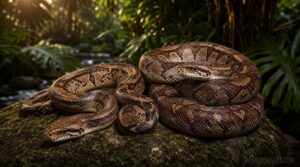
Sexual maturity in boa constrictors isn’t a single moment — it’s a biological threshold shaped by age, size, and physiology, and it unfolds differently depending on sex. Knowing exactly when your boa crosses that threshold helps you make informed decisions about breeding, nutrition, and long-term care.
Here’s what the science says about how and when it happens.
When Male Boa Constrictors Mature
Male boa constrictors usually reach sexual maturity between 2 and 3 years, with most hitting reproductive readiness around 2.5 years under consistent feeding.
Hormonal triggers initiate testes development, driving four recognizable changes:
- Tail spur development becomes more pronounced
- Territorial displays and combat rituals intensify
- Breeding season timing aligns with pheromone detection
- Active pursuit behavior signals full hormonal onset
When Female Boa Constrictors Mature
Female boas reach sexual maturity between 2 and 4 years, though body condition matters more than age alone. Once nutritional thresholds are met and ovarian development begins, hormonal regulation drives the shift toward reproductive readiness.
Environmental cues, lineage growth patterns, and consistent feeding all influence the hormonal cycle. Without adequate fat reserves, even a 4-year-old female won’t breed successfully.
Why Females Mature Later Than Males
The delay is not a flaw — biology doing exactly what it’s supposed to. Estrogen surge triggers ovarian development, but hormonal regulation demands more time than male maturation requires.
Fat reserves must reach threshold levels, brain pruning refines hormonal cycling, and growth velocity slows only after sexual dimorphism takes hold.
Females carry the metabolic cost of gestation, so their hormonal timing runs longer.
Ovoviviparity and Gestation Explained
Boa constrictors don’t lay eggs — they practice ovoviviparity, retaining eggs internally while embryos develop on yolk nutrient provision alone. Egg retention benefits the developing young by shielding them from external predators and temperature swings.
Key facts about boa gestation physiology:
- Gestation spans 100–150 days, shaped by temperature-dependent gestation rates
- Warmer conditions accelerate embryonic development and affect birth timing variability
- Embryos draw exclusively from yolk reserves — no placental connection exists
- Maternal energy costs are substantial, requiring adequate fat reserves before breeding
- Reproductive readiness depends on both age and body condition, not age alone
Sexual Dimorphism in Size and Weight
Sexual dimorphism in boa constrictors runs deeper than length alone.
Females develop higher weight-length ratios, accumulate greater fat reserves through female fat accumulation, and clear breeding size thresholds that males never approach.
Growth trajectory divergence accelerates as females enter subadult stages, pushing their body condition index well above males of equal age.
Geographic dimorphism variation confirms this pattern holds across most wild populations.
Top 10 Products for Boa Constrictor Owners
Whether you’re setting up for a new neonate or upgrading your adult boa’s habitat, having the right tools makes a measurable difference in long-term outcomes. The products below cover a range of needs, from husbandry references to enrichment items worth keeping on your radar. Here’s what’s worth your attention.
1. Boa Constrictor Care Guide

At just $7.68, the Boa Constrictor Care Guide packs a surprising amount of practical value into 54 pages. Published in March 2025, it covers the core pillars you actually need: enclosure setup, thermal and humidity management, feeding schedules, and shedding cycles.
It won’t replace a reptile vet for complex medical issues, but as a quick reference—especially if you’re acquiring your first boa—it keeps critical husbandry parameters within arm’s reach.
Experienced keepers will find it a clean, actionable refresher, making it a versatile tool for all skill levels.
| Best For | New boa owners looking for a straightforward, affordable starting point—and experienced keepers who want a quick, no-fluff refresher. |
|---|---|
| Target Audience | Adults/Owners |
| Primary Material | Paper/Digital |
| Snake Theme | Boa Constrictor Care |
| Price Range | $7.68 |
| Educational Value | Reptile husbandry |
| Skill Developed | Animal care knowledge |
| Additional Features |
|
- Covers all the essentials in one place—enclosure setup, feeding, humidity, and shedding cycles
- At $7.68, it’s a low-risk buy that could save you real money by catching health issues early
- Updated in 2025, so the guidance reflects current husbandry thinking
- 54 pages means it can only go so deep—complex medical situations will still need a vet
- Only covers boa constrictors, so it won’t help if you keep other reptiles
- English only, which shuts out a lot of potential readers
2. LovesTown Wooden Double Sided Snake Puzzle

The LovesTown Wooden Double Sided Snake Puzzle isn’t a hobby tool, but it earns a spot here for keepers raising kids alongside their boas.
Measuring roughly 25 cm assembled, its 26 natural-wood segments are smooth, non-toxic, and sized for toddler hands.
One side builds alphabet recognition; the flip side reinforces number sequencing.
It’s screen-free, Montessori-aligned, and durable enough for repeated handling. If you’re sharing your passion for boas with a young child, this puzzle bridges the gap between hobby and education naturally.
| Best For | Parents and caregivers who want a screen-free, hands-on learning toy that helps toddlers practice letters and numbers at the same time. |
|---|---|
| Target Audience | Toddlers/Children |
| Primary Material | Natural Wood |
| Snake Theme | Snake-Shaped Puzzle |
| Price Range | Not listed |
| Educational Value | Letters and numbers |
| Skill Developed | Fine motor skills |
| Additional Features |
|
- Double-sided design gives you two activities in one — alphabet on one side, numbers on the other
- Made from natural wood with non-toxic paint, so it’s safe for little hands and repeated use
- Chunky pieces are easy for toddlers to grip, which helps build fine motor skills while they play
- No storage box included, just shrink-wrap, so pieces are easy to lose once it’s opened
- The number side reads right-to-left, which can confuse kids and parents alike
- Some pieces have low color contrast, and a few users have reported breakage under rough handling
3. Snakes for Kids Junior Scientist Guide

Young keepers deserve accurate foundations, and the Snakes for Kids Junior Scientist Guide delivers exactly that. Covering 45 species with full-color photographs and age-appropriate text targeting readers 6–9, it introduces basic herpetology, ecosystem roles, and snake biology without oversimplifying.
At $5.09 for 78 pages, it’s a practical addition to any reptile household with curious kids nearby.
Don’t underestimate early exposure — a child who understands how snakes feed and shed becomes a more observant, responsible keeper over time.
| Best For | Parents, homeschoolers, and reptile-loving families with kids ages 6–9 who want a fun, accurate introduction to snakes. |
|---|---|
| Target Audience | Children 6-9 |
| Primary Material | Paper |
| Snake Theme | Snake Species Facts |
| Price Range | $5.09 |
| Educational Value | Herpetology basics |
| Skill Developed | Reading comprehension |
| Additional Features |
|
- Covers 45 species with real photos, so kids can connect names to faces right away
- At $5.09, it’s an easy, affordable pick for gifts, classrooms, or party favors
- Age-appropriate writing makes herpetology actually accessible for early readers
- Older or more advanced kids will likely outgrow the content fast
- The thin cover and paper quality might not hold up to heavy, repeated use by little hands
- No digital or interactive elements — it’s strictly a read-and-look experience
4. TOSQP27 Wooden Snake Cube Puzzle
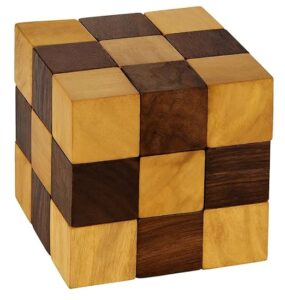
Not every learning tool has scales — the TOSQP27 Wooden Snake Cube Puzzle makes that point well. This hand-crafted, 27-block wooden puzzle, measuring 2.5 × 2.5 × 2.5 inches, challenges you to twist a flexible chain of segments back into a solid 3×3×3 cube.
It sharpens spatial reasoning and problem-solving — skills any serious keeper applies daily.
Compact, portable, and genuinely difficult, it works as a desk object or a gift for the reptile enthusiast who thinks systematically.
| Best For | Puzzle lovers and analytical thinkers who enjoy a hands-on mental challenge — or anyone looking for a thoughtful, low-tech gift. |
|---|---|
| Target Audience | Adults |
| Primary Material | Natural Wood |
| Snake Theme | Snake Cube Puzzle |
| Price Range | Not listed |
| Educational Value | Spatial reasoning |
| Skill Developed | Problem-solving |
| Additional Features |
|
- Builds real spatial reasoning skills in a small, satisfying package
- Compact enough to sit on a desk or toss in a bag
- Genuinely challenging — it’ll keep you busy longer than you expect
- The elastic string can feel stiff at first and may loosen over time
- Some units arrive with minor surface dust or small scratches
- Can get frustrating fast if you’re new to this style of puzzle
5. Wooden Jointed Wiggly Snake Toy
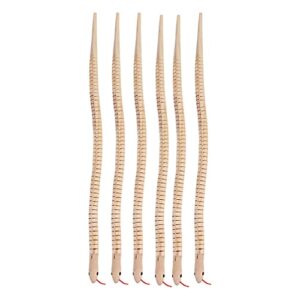
The Wooden Jointed Wiggly Snake Toy — measuring 11.81 inches and crafted from lightweight, burr-free hardwood — mimics the segmented, sinuous movement of live snakes. Weighing just 148 g, it’s designed for easy handling by younger enthusiasts.
Its untreated surface invites customization with acrylics or markers, doubling as a practical art project that enhances fine-motor control.
Priced affordably, it serves as a versatile party favor or prank prop. However, reviewers note that it’s fragile under rough handling.
| Best For | Kids who love art projects, parents looking for cheap party favors, or anyone who wants a fun little prank prop for birthdays or Halloween. |
|---|---|
| Target Audience | Children |
| Primary Material | Wood |
| Snake Theme | Snake Toy/Prop |
| Price Range | Not listed |
| Educational Value | Creative arts |
| Skill Developed | Hand-eye coordination |
| Additional Features |
|
- The untreated wood is a blank canvas — kids can paint or decorate it however they want, which is great for creativity and fine-motor skills.
- At 148 g, it’s light and easy for little hands to pick up and play with.
- Affordable enough to buy in bulk as party favors without breaking the bank.
- It’s fragile — a few rough play sessions and it might snap, so it’s not built for rowdy kids.
- The finish and overall build quality feel cheap, even compared to other budget toys in the same price range.
- Younger children or heavy-handed players will likely break it faster than expected.
6. Everything You Need To Know Snakes For Kids
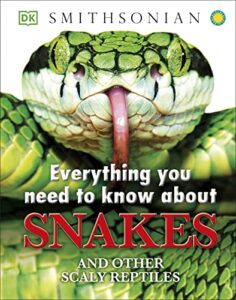
Everything You Need to Know: Snakes for Kids by DK Children bridges that gap cleanly, offering an 80-page exploration of anatomy, behavior, habitats, and quirky comparisons like Python vs. Alligator.
Interactive quizzes and hands-on activities make it genuinely useful for ages 4–11, whether reading aloud or exploring independently.
Priced at $15.10, it’s a low-cost way to build a young keeper’s foundational knowledge before they handle their first boa.
| Best For | Kids ages 4–11 who are obsessed with snakes and want a colorful, activity-packed book they can actually learn from. |
|---|---|
| Target Audience | Children 4-11 |
| Primary Material | Paper |
| Snake Theme | Snake Biology |
| Price Range | $15.10 |
| Educational Value | Snake biology |
| Skill Developed | Scientific literacy |
| Additional Features |
|
- 80 pages of vivid photos and illustrations that make snake biology click for visual learners
- Interactive quizzes, games, and hands-on activities give it real staying power beyond a one-time read
- Fun comparisons like Python vs. Alligator and "Snake or Fake" keep curious kids genuinely entertained
- Doesn’t go deep — serious young enthusiasts will outgrow it fast
- Some feeding and defense illustrations might unsettle more sensitive kids
- Vocabulary can run ahead of early readers, so younger kids may need an adult nearby
7. Junior Learning Sequencing Snake Cards
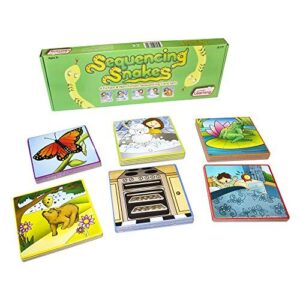
Junior Learning Sequencing Snake Cards ($14.99, Model JL177) offer a hands-on alternative for young readers needing a break. The set includes 50 self-correcting cards spanning fiction and nonfiction stories, each measuring approximately 4 by 6 inches.
Designed for durability, the cards feature a laminated finish built for repeated use. Children sequence illustrated story events independently, then flip the cards to verify order using the printed snake-pattern backing—no adult intervention required.
This activity reinforces logical thinking and narrative comprehension while providing a screen-free learning experience.
| Best For | Preschool and kindergarten kids who are building number sense and sequencing skills, especially those with autism or language delays who benefit from hands-on, tactile learning. |
|---|---|
| Target Audience | Preschool/Kindergarten |
| Primary Material | Cardstock |
| Snake Theme | Sequencing Snake Cards |
| Price Range | $14.99 |
| Educational Value | Number sequencing |
| Skill Developed | Oral language skills |
| Additional Features |
|
- Self-correcting cards let kids check their own answers, so they can practice independently without needing an adult hovering over them.
- The 3-D number track makes abstract number patterns feel concrete and easier to visualize.
- Supports more than just math—oral language, storytelling, and analytical thinking all get a workout too.
- No info on card or board dimensions, so it’s hard to know if it’ll fit in a bag or on a small table.
- Only 50 cards, which might not keep more advanced kids challenged for long.
- No digital resources or instruction guide included, so adults may need to step in to get the most out of it.
8. Wacky Wiggly Fidget Snake
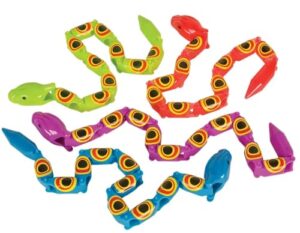
The Wacky Wiggly Fidget Snake is a 15-inch, 12-segment articulated plastic snake designed for bending, coiling, and twisting through 360 degrees of motion. Its hinged joints produce soft clacking feedback, engaging both tactile and auditory senses simultaneously.
This desk tool serves as a low-distraction focus aid, ideal for hands needing activity during reading or study sessions. Suitable for ages 5 and up, it is available in assorted colors and supports concentrated tasks without disrupting surroundings.
| Best For | Kids and adults who need something to keep their hands busy — great for classrooms, study sessions, or anyone who fidgets. |
|---|---|
| Target Audience | Ages 3+ |
| Primary Material | Plastic |
| Snake Theme | Articulated Snake Toys |
| Price Range | Not listed |
| Educational Value | Sensory/motor skills |
| Skill Developed | Tactile dexterity |
| Additional Features |
|
- 12 snakes in the pack, so there’s plenty to share as party favors or classroom rewards
- Bends and twists along the full 15 inches, giving your hands a lot to work with
- Comes in fun, vibrant colors that kids actually want to play with
- Not safe for kids under 3 — small parts are a choking risk
- The plastic segments can crack if you push them too hard
- Keep them away from water — they’re not washable or dishwasher-safe
9. Acrylic Snake Climbing Rings
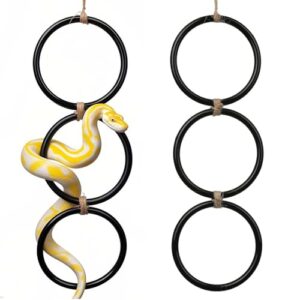
From fidget tools to functional enrichment — the Acrylic Snake Climbing Rings offer something your live boa actually benefits from.
Made from high-toughness acrylic with smooth, rounded edges, each 11 cm ring won’t abrade scales during contact. You can configure them horizontally or vertically, no tools required.
They support up to 5 lb per ring and double as basking platforms.
One real limitation: the 4.33-inch diameter works well for juveniles, but growing boas will outgrow them within a year.
| Best For | Snake owners with juveniles or smaller species like corn snakes and kingsnakes who want an easy, tool-free way to add climbing enrichment to their setup. |
|---|---|
| Target Audience | Reptile Owners |
| Primary Material | Acrylic |
| Snake Theme | Reptile Enclosure Rings |
| Price Range | Not listed |
| Educational Value | Reptile enrichment |
| Skill Developed | Reptile husbandry |
| Additional Features |
|
- Smooth, rounded acrylic edges are gentle on scales — no abrasion risk during climbing or basking
- Super flexible setup: go vertical, horizontal, or link rings together, no tools needed
- Pulls double duty as a basking platform, so snakes can thermoregulate without touching the enclosure floor
- The 4.33-inch diameter is a hard limit — larger or fast-growing snakes will outgrow these within a year
- The included twine can be a pain to secure in mesh or glass tanks; expect to grab zip ties or hooks separately
- Acrylic scratches and cracks if you’re rough with it during setup or cleaning, so handle with care
10. Safari Corn Snake Figurine
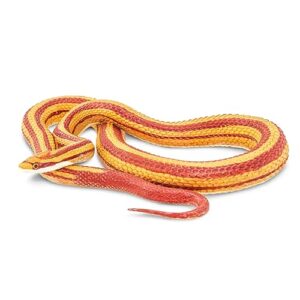
For educators, parents, and collectors, the Safari Corn Snake Figurine (model 100073) delivers accurate morphological detail in a compact, durable format. Hand-painted to represent the striped corn snake morph, it measures 5.25 inches in length — proportionally realistic and crafted from non-toxic BPA-free PVC throughout.
At $13.99, it serves as a low-cost introduction to reptile identification for ages 3 and up. The figurine’s design prioritizes educational accuracy and safety, making it suitable for hands-on learning environments.
However, users should note the fixed coiled pose cannot be repositioned, and some report fragility with rough handling. This limitation underscores the need for supervised use, particularly with younger children.
| Best For | Parents, teachers, and reptile fans looking for a safe, affordable, and realistic snake figurine for kids aged 3 and up. |
|---|---|
| Target Audience | Ages 3+ |
| Primary Material | PVC Plastic |
| Snake Theme | Corn Snake Figurine |
| Price Range | $13.99 |
| Educational Value | Wildlife learning |
| Skill Developed | Imaginative play |
| Additional Features |
|
- Hand-painted detail makes it genuinely useful for learning about corn snakes and reptile identification
- Non-toxic, BPA-free PVC means it’s safe for little hands
- At $13.99, it’s an easy buy as a gift, classroom prop, or starter collectible
- The fixed coiled pose can’t be changed, so don’t expect any poseable fun
- Some buyers report fragile parts that don’t hold up well to rough play or curious mouths
- At just 5.25 inches, it feels small for something marketed as "XL," which may disappoint buyers expecting something bigger
Frequently Asked Questions (FAQs)
What are the 5 stages of a snakes life cycle?
A snake’s life cycle moves through five stages: egg or live birth, neonate, juvenile, subadult, and adult. Each phase brings distinct size benchmarks, feeding needs, and behavioral shifts.
How long should a 3 year old boa be?
By age three, your boa should measure 6 to 8 feet in length. Females usually land closer to 8 feet; males run shorter, around 6 to 5 feet.
How long do boa constrictors live in captivity?
In captivity, boa constrictors commonly live 20 to 30 years under solid husbandry. With ideal care — stable temperatures, balanced nutrition, and routine vet checks — some individuals reach 35 to 40 years.
What is the lifespan of a wild boa constrictor?
Wild boa constrictors commonly live 20 to 25 years, though individuals in resource-rich habitats with minimal predation pressure have been documented approaching 30 years.
How large do female boas typically grow?
Female boas usually reach 7 to 10 feet in length, with most adults averaging 8 to 9 feet. They’re noticeably heavier-bodied than males, commonly weighing 20 to 30 pounds at maturity.
When does a boas growth rate slow down?
Ever wonder when your boa stops shooting up in size? Growth slows markedly after sexual maturity — around 3 to 5 years — dropping from several inches annually to under 6 inches per year.
How heavy can adult female boa constrictors get?
Adult females commonly reach 40–70 pounds (18–32 kg), with rare individuals exceeding 100 pounds (45 kg). Weight correlates more with length and girth than age alone.
Conclusion
Picture a boa at three meters—coiled, alert, built from thousands of precise decisions made across years of care. Every feeding interval, humidity adjustment, and thermal gradient you maintained shaped that animal from an 80-gram neonate into a physiologically sound adult.
Boa constrictor’s development stages aren’t just milestones to track; they’re intervention points where your knowledge becomes the animal’s biology.
Miss them, and you’re reactive. Master them, and the animal tells you it’s thriving.