This site is supported by our readers. We may earn a commission, at no cost to you, if you purchase through links.
Your boa hatched at 50 cm and 100 grams. Fast forward a few years, and that same snake could stretch past 200 cm and tip the scale at 20 kg! Wild, right?
That’s why a boa constrictor growth rate chart matters. It shows you what’s normal, what’s slow, and what needs a closer look. Females run bigger than males, island boas stay smaller than mainland ones, and a stuck shed can signal a husbandry slip you can fix.
Your boa’s size tells a story about its genetics, its feeding, and its setup. Here’s how to read it, stage by stage, so you can keep your snake growing strong.
Table Of Contents
- Key Takeaways
- Boa Constrictor Growth Rate Chart: Length and Weight by Age
- Boa Constrictor Growth Stages: Hatchling to Adult
- How Sex and Boa Type Affect Growth and Adult Size
- How Feeding and Habitat Affect Boa Constrictor Growth
- How to Track Your Boa’s Growth and Spot Concerns
- Frequently Asked Questions (FAQs)
- How quickly do boa constrictors grow?
- How big should a 3 year old boa be?
- How big is a 1 year old boa constrictor?
- How big is a fully grown boa constrictor?
- How big do boa constrictors get?
- Why does my boa constrictor grow so slow?
- Are boa constrictors bigger than pythons?
- How do you know if a boa constrictor is old?
- How does a boa constrictor’s health affect its growth?
- How long can a boa constrictor live?
- Conclusion
Key Takeaways
- Your boa’s size depends on genetics, with females growing bigger and bulkier than males and island boas finishing smaller than mainland ones, so compare your snake to its own line rather than the whole species.
- Growth is fastest in the first two years, then slows, and adults typically reach 6 to 10 feet and up to 20 kg, though some hit 13 feet.
- You control how close your boa gets to its genetic ceiling through steady feeding with prey about as thick as its widest point, a 75-95°F temperature gradient, and stable humidity.
- Measure length and weight monthly, and call your vet if growth stays flat for over six weeks despite regular meals, or if you see regurgitation, diarrhea, or sudden swelling.
Boa Constrictor Growth Rate Chart: Length and Weight by Age
A boa constrictor growth rate chart is your best friend, so let’s put it to work! Think of it like the pencil marks on a kitchen doorframe. It shows how your snake stacks up as the months roll by.
Once you’ve tracked a few months of growth, check it against this boa constrictor size comparison chart to see how your snake measures up to others of the same age.
Here’s length and weight by age: hatchlings run 40-60 cm and 60-150 g. Juveniles hit 90-150 cm and up to 1 kg. Subadults reach 120-190 cm and 4.5 kg. Near adults measure 150-210 cm and 9 kg. Adults top out at 180-240 cm, often 20 kg.
Your numbers will wobble, and that’s normal. Keep a temperature gradient of 75-95F, follow feeding schedules as they grow, and give adults an enclosure size 4L x 2W x 4H. Happy snake, steady growth, right?
Boa Constrictor Growth Stages: Hatchling to Adult
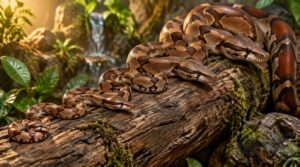
Your growth rate chart shows the big picture, so let’s walk through each stage. Hatchlings start around 20 inches, and they grow fast! Expect a full meter by year one or two. That’s rapid length gain you can see.
After that first-year burst, growth slows considerably, and this corn snake growth timeline shows how long they take to reach adult size.
Juveniles stretch out first, then thicken up. Appetite climbs with size, so your feeding schedule as they grow needs to keep pace. Subadults, at two to four years, run roughly 5 to 8 feet.
Adults slow down in length but fill out through the middle. Sexual maturity usually arrives around three to five years in captivity. By then, you’ll see males usually reaching 5-7 feet and females 6-10 feet by adulthood. Don’t panic if your snake lands somewhere in between, either.
How Sex and Boa Type Affect Growth and Adult Size

Ever wonder why your boa doesn’t match the numbers? Blame genetics! Your growth rate chart shows averages, but sex differences and subspecies variation nudge them up or down.
Adult size by sex usually favors females, who pack on bulk for breeding. Males run leaner, though some lines give them an extra inch or two of length.
Here’s what shapes your snake:
- Sex: Males stay slimmer, females thicken up.
- Subspecies variation: Island or isolated populations usually finish smaller.
- Morph and origin: Lines grow at different tempos, so document your snake’s background.
Compare your snake against its own line, not the whole species. Stick to a steady feeding schedule, and check each measurement against your growth rate chart. Outliers? Just note them!
If you’re unsure what a healthy portion looks like at each stage, this guide to what to feed a pet snake can help you match prey size to your snake’s growth.
How Feeding and Habitat Affect Boa Constrictor Growth
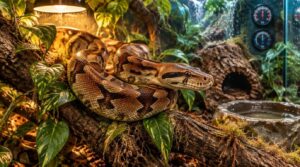
Genetics sets the ceiling, but your care decides how close your snake gets to it. Feeding and habitat are the two levers you actually control!
Hatchlings grow fastest in their first two years, so a corn snake growth timeline helps you spot whether yours is on track.
Genetics sets the ceiling, but feeding and habitat are the levers you control to decide how close your snake gets to it
Start with a steady feeding schedule and the right prey size. Aim for a meal about as thick as the widest part of your boa’s body. Too big, and you’ll get a chunky snake, not a longer one.
Then check the enclosure. A proper temperature gradient keeps digestion humming, and stable humidity levels keep sheds clean.
Here’s what poor care can cost you:
- Watching your growth rate stall while your snake sits hungry.
- Finding a stuck shed that won’t come off.
- Seeing a once-curious boa turn sluggish.
- Realizing months were lost to a fixable setup.
How to Track Your Boa’s Growth and Spot Concerns

Tracking your boa’s growth is easier than you think! Grab a soft tape and a digital scale, then log everything on a growth rate chart. Consistency is your secret sauce.
- Measure length monthly, to the nearest centimeter.
- Weigh hatchlings weekly, then monthly.
- Fast 24 hours before weighing.
- Keep a steady feeding frequency.
- Check your temperature gradient and humidity levels.
Good weight monitoring catches trouble early. Watch for three flat measurements in a row, meaning over six weeks without gain despite regular meals. That could signal parasites or metabolic trouble.
Call your vet if you see daily regurgitation, diarrhea, vomiting with weight loss, or sudden swelling in the belly or joints. Trust your gut, because you truly know your snake best.
Frequently Asked Questions (FAQs)
How quickly do boa constrictors grow?
Picture a hatchling boa, about 45 cm long and light as a pencil. Give it steady meals, and it can triple that length within a year. That’s a fast growth rate!
How big should a 3 year old boa be?
Most 3-year-old boas land between 4 and 6 feet, weighing roughly 1 to 4 kg. Size variations are normal! Males run leaner, females heavier. Steady growth rate, regular feeding schedule, and proper temperature gradient keep your boa on track.
How big is a 1 year old boa constrictor?
Your 1 year old boa constrictor usually measures 3 to 4 feet and weighs 9 to 8 kg. Not bad! Check a growth rate comparison chart, and keep feeding steady every 7 to 14 days.
How big is a fully grown boa constrictor?
Whoa, your boa could outgrow your couch! Size variations are real, but adult boas can reach lengths up to 13 feet. Female redtailed boas and male boa constrictors differ. Feeding frequency and metabolism shape it.
How big do boa constrictors get?
Most adults measure 6 to 10 feet, yet adult boas can reach lengths up to 13 feet.
Females outsize males. Size variations, your feeding schedule and boa constrictor growth rate shape the largest recorded boa.
Why does my boa constrictor grow so slow?
Most hatchlings hit 12 to 24 inches in year one, so a slow growth rate points to growth stunting in captive snakes. Genetics, diet and care matter, so check your feeding schedule and temperature gradient.
Are boa constrictors bigger than pythons?
Think big truck versus massive semi! Pythons usually win the size crown. Boas top out around 13 feet, but reticulated pythons pass Even so, a well-fed boa’s growth rate and size by age still impress.
How do you know if a boa constrictor is old?
Your boa has no birth certificate, but it’s still keeping receipts. Age estimation via size helps, though growth plateaus after year eight. Check coloration assessment for age: dull, faded patterns, sluggish sheds. Ask the breeder for breeder records and pedigree.
How does a boa constrictor’s health affect its growth?
A sick snake just can’t grow well. Fix the temperature gradient, keep humidity high for shedding success, and make feeding schedule adjustments.
Run a monthly body condition assessment to catch trouble early.
How long can a boa constrictor live?
Your boa could outlive your couch, your car, even your career! Boa constrictor lifespan runs 20 to 30 years, sometimes That’s a long-term reptile commitment, so prioritize husbandry and vet checkups for exotic pets.
Conclusion
A hatchling boa starts around 100 grams, yet a healthy adult female can top 20 kg. That’s a 200-fold jump! Keep a boa constrictor growth rate chart handy, and you’ll spot slow growth long before it becomes a problem.
Weigh your snake monthly. Measure it, jot it down, compare. Tweak feeding and heat when numbers lag. You’re not just watching a pet grow, you’re steering it. Do that, and your boa will thrive for decades.