This site is supported by our readers. We may earn a commission, at no cost to you, if you purchase through links.

A ball python sitting in a soaked shed for three weeks isn’t sick. Its enclosure is. Getting the ideal temperature and humidity for pet snakes right matters more than any fancy décor, because a snake can’t sweat, shiver, or ask for a thermostat adjustment. Ten degrees too cold and digestion stalls; humidity too low and toes get stuck in old skin.
The good news? Nailing your snake’s climate is a solved problem once you know the numbers. Below you’ll find exact targets for corn snakes, ball pythons, boas, and desert species, plus how to build gradients that let your snake pick its own comfort zone.
Table Of Contents
- Key Takeaways
- Ideal Temperature and Humidity by Snake Species
- How to Create Temperature and Humidity Gradients
- Safe Heating, Moisture, and Ventilation Methods
- Monitoring and Maintaining Enclosure Conditions
- Preventing Temperature and Humidity Health Problems
- Frequently Asked Questions (FAQs)
- Is 90 degrees too hot for a snake?
- How humid is too humid for a snake?
- Is 72 degrees too cold for a ball python?
- Are snakes out in 100 degree weather?
- Do pet snakes need temperature and humidity control?
- What is the ideal humidity level for temperate snakes?
- Why is humidity important for snakes?
- Do snakes need humidifiers?
- How do I create a perfect humidity level in my snake’s habitat?
- What temperature does a snake need?
- Conclusion
Key Takeaways
- Every snake species has distinct temperature and humidity needs, so matching your enclosure settings to your specific snake — not a generic reptile standard — is the foundation of good husbandry.
- A temperature gradient with a warm basking zone, a mid-range area, and a cool retreat lets your snake self-regulate its body temperature, which directly drives healthy digestion and appetite.
- Most snake health problems stem from slow environmental drift rather than sudden failures, making weekly data logging and calibrated digital gauges more valuable than any instinct or guesswork.
- Humidity must be managed in two modes: a stable baseline for daily health and a temporary spike to 60–70% during shedding, with a damp hide available to prevent stuck skin on toes, tails, and eye caps.
Ideal Temperature and Humidity by Snake Species
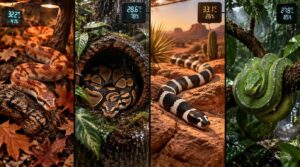
There’s no one-size-fits-all thermostat setting for snakes.
Every species has its own comfort range, so our guide to snake enclosure heating setup walks you through dialing in the right gradient for your particular snake.
A corn snake’s comfort zone would leave a ball python shivering, and desert species would laugh at your misting bottle.
Below, you’ll find the exact temperature and humidity targets for the four most common species groups, so you can dial in your enclosure before your snake ever moves in.
Corn Snakes
are forgiving, but they still need a solid temperature gradient. Aim for 80–85°F on the warm side, 75–85°F across the enclosure, and a cozy basking spot hitting 88–92°F. Let nighttime temps dip to 70–75°F.
Keep humidity levels at 40–50%, bumping to 60–70% during the shedding cycle. Your snake’s thermoregulation will thank you.
Ball Pythons
Now, the ball python. These picky eaters want it warmer: keep ambient temps at 75–80°F, with a basking spot of 88–92°F. Nighttime drops to 70–75°F work fine.
Getting those temperature zones right is much easier with a reliable heat source designed for snake enclosures.
Humidity levels should sit at 50–60%, rising to 60–70% before a shed. Nail this temperature gradient, and your ball python’s thermoregulation (and appetite) will thank you.
Boa Constrictors
If the ball python felt toasty, your boa constrictor runs even warmer. Aim for an ideal temperature range of 80–85°F by day, 78–80°F at night, and a basking spot of 88–92°F. Keep humidity levels at 50–60%, bumping toward 70% during sheds.
Why sweat the details? Because:
- Chronic cold invites respiratory infections.
- Proper thermoregulation fuels digestion.
- Low humidity causes stuck sheds.
- Stability builds trust.
Desert Species
If your boa loves humidity, desert species flip the script. These snakes want it hot and dry.
A proper snake enclosure setup guide walks you through heat gradients, dry substrate, and hides that keep desert species thriving.
| Species | Basking Temp | Humidity |
|---|---|---|
| Horned viper | 35–40°C | 15–25% |
| Coachwhip | 28–34°C | 20–40% |
| Rosy boa | 24–30°C cool end | 30–40% |
| General desert | 32–38°C | 10–30% |
| Night temps | 18–24°C | Low |
Build your temperature gradient with a ceramic heater, keep vents open, and monitor both ends. Dry air, happy snake.
How to Create Temperature and Humidity Gradients
A temperature gradient is your snake’s thermostat, and you build it with layout, not luck. Picture your enclosure as a mini landscape:
- A basking spot at 32–34°C under a focal hide
- A mid-zone hovering at 28°C for casual cruising
- A cool retreat resting at 23–26°C
- A damp hide packed with moist sphagnum on the warm side
- Dry substrate on the cool end to complete the humidity gradient
Space these zones across 20–30 cm bands so your snake slides between microclimates without crossing the whole tank. Aim for 65–80% RH near moist hides and 50–60% on the dry side. Let the warm side cool gradually over 6–8 hours for natural thermal cycling. Then verify everything with probes. Snakes vote with their bodies; watch where they linger.
Safe Heating, Moisture, and Ventilation Methods
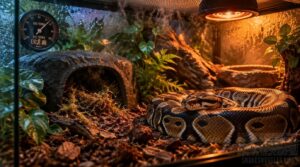
With the right gear, your snake’s climate practically runs itself. Start with heating: a ceramic heat emitter on a thermostat gives you warm light-free heat around the clock. Skip heat rocks entirely; they scorch bellies. If you use heat tape, keep it outside the enclosure, under one-third of the surface, with a wire clip insulator. Because snakes are ectotherms, a proper setup should also offer a thermal gradient for reptiles with distinct warm and cool zones so your snake can self-regulate its body temperature.
For moisture, match substrate to species. Cypress mulch and coconut fiber hold humidity for ball pythons; aspen suits corn snakes; ReptiSand keeps desert dwellers dry. Add a humid hide packed with damp (not dripping) sphagnum moss on the cool side for a shedding-time microclimate.
Monitoring and Maintaining Enclosure Conditions
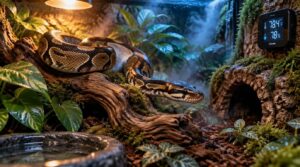
Picture your snake’s enclosure as a tiny weather station, and you’re the meteorologist on duty. Guesswork doesn’t cut it here; environmental monitoring does.
Start with digital hygrometers and thermometers placed at snake height, never on the floor or ceiling where readings lie. Calibrate them yearly with the classic salt test, because cheap plastic units drift and can misreport humidity by 10–15%. Yikes.
For temperature control, grab an infrared thermometer and spot-check basking surfaces. Those readings should hit 85–90°F without you trusting ambient air alone.
Want to level up? Add a data logger recording every 15–30 minutes. Reviewing 24-hour logs reveals overnight dips and humidity spikes you’d never catch. Set thermostat regulation alarms too: alert if temps swing 5°F or humidity leaves the 40–70% band for over two hours.
Preventing Temperature and Humidity Health Problems
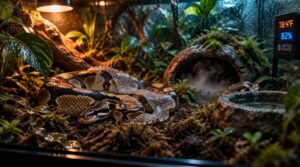
An ounce of prevention beats a vet bill every time. Most snake health troubles trace back to slow environmental drift, not sudden disasters. Watch for these warning signs:
- Wheezing or mouth-breathing, early clues of respiratory infections
- Stuck sheds on toes, eye caps, or tail tips
- Refusal to eat after any sharp temperature fluctuation
- Lethargy or restless glass-surfing from thermal stress
Catch problems early. Fix a failing heat mat, reseal a leaky humidity hide, or swap waterlogged substrate before trouble snowballs. Keep humidity control honest with a calibrated hygrometer, not guesswork. Quarantine new decor, spot-clean daily, and log your readings weekly. Your snake can’t tell you it’s uncomfortable, so let your data do the talking. Steady beats perfect, every single time.
Your snake can’t tell you it’s uncomfortable, so let calibrated data do the talking—steady beats perfect every time
Frequently Asked Questions (FAQs)
Is 90 degrees too hot for a snake?
It depends on your species. For corn snakes, ball pythons, and boas, 90°F ambient is dangerously hot, risking thermal stress. Desert species handle it fine. Always check your snake’s species-specific needs.
How humid is too humid for a snake?
Too humid means sustained readings above your species’ ceiling: roughly 60% for corn snakes, 70% for ball pythons, 80% for boas. Watch for condensation, soggy substrate, and mold. Boost ventilation before respiratory infections or scale rot take hold.
Is 72 degrees too cold for a ball python?
Yes. A ball python kept at 72°F sits below the 75°F cool-side minimum. Digestion slows, appetite drops, and illness risk climbs. Bump your enclosure temperature to 75–80°F on the cool side.
Are snakes out in 100 degree weather?
Short answer: rarely. Wild snakes avoid 100°F heat, hiding in shade, burrows, or water until dusk. Reptile thermoregulation drives them underground. Your pet snake should never face that heat, either.
Heat is only half the story, since proper reptile humidity levels help snakes shed cleanly, and retained shed can cut off blood flow to toes and tails.
Even a short trip can turn dangerous in a parked car, so check this guide to safe temperatures for transporting pet snakes before you pack the container.
Do pet snakes need temperature and humidity control?
Picture your snake stretched across a warm rock at sunrise. That’s thermoregulation in action.
Pet snakes absolutely need temperature and humidity control. Without it, digestion stalls, sheds stick, and respiratory infections creep in.
Smart reptile husbandry creates microclimates, keeping snake health on track.
What is the ideal humidity level for temperate snakes?
Humidity can make or break a snake’s health! For temperate species, keep humidity levels between 40–60%. Too dry means bad sheds; too wet invites respiratory trouble. Use a hygrometer to find that humidity sweet spot.
Why is humidity important for snakes?
Snakes rely on humidity for healthy snake shedding, respiratory health, and hydration. Too dry means stuck eye caps; too wet invites infection. Find your species’ humidity sweet spot and watch substrate moisture closely.
Do snakes need humidifiers?
A ball python in a dry apartment once shed in flakes until its keeper added a humidifier. So, do snakes need one? Only if your humidity levels fall short. Otherwise, humidity hides and misting suffice.
How do I create a perfect humidity level in my snake’s habitat?
That cheap analog gauge on your tank wall isn’t accurate. Grab a digital probe hygrometer, layer in damp coconut fiber substrate, add a water bowl, and partially cover your screen top to trap the moisture.
What temperature does a snake need?
Goldilocks had the right idea: not too hot, not too cold. Build a temperature gradient with a cool side at 75°F, a warm side at 85°F, and a basking spot hitting 90–95°F. Use a thermostat.
Once the temperatures are right, you can plan the rest of the habitat around enrichment ideas for boa constrictors, so every branch and hide earns its place.
If you’re still weighing whether a corn snake fits your lifestyle, this guide on whether a corn snake is right for me covers the daily care commitments in detail.
A steady range between the cool and warm sides lets your snake regulate its own body temperature and digest meals properly, which is why a gradient beats one uniform setting.
Once temperatures are dialed in, your boa will settle faster, and understanding boa constrictor personality traits helps you read its nervous behavior as it adjusts.
Once the enclosure is dialed in, plan the move itself carefully, since how to transport a pet snake safely affects how quickly yours settles into its new setup.
For larger enclosures, a 5 x 5 inch under-tank heating pad for reptile setups draws just 80W and covers plenty of floor space.
Conclusion
Picture a ball python that sheds cleanly every time, eats eagerly every week, and never spends a single day stuck in old skin. That’s what dialed-in husbandry looks like in practice.
Getting the ideal temperature and humidity for pet snakes right isn’t complicated once you know your species, trust your gauges, and respond quickly when numbers drift. Your snake can’t adjust its environment. You can. That’s the whole job.