This site is supported by our readers. We may earn a commission, at no cost to you, if you purchase through links.
Your snake can’t tell you it’s cold. It just stops eating, sits motionless, and slowly shuts down. That’s why understanding how reptile thermometers work matters more than any other piece of equipment in your enclosure.
Here’s the problem: most keepers trust a thermometer that’s measuring the wrong thing. A probe sitting in direct lamp radiation reads hot. An infrared gun pointed at glass reads wrong. Your snake pays the price.
The fix starts with knowing the mechanism. Thermistors, infrared sensors, and bimetallic coils each behave differently, and each demands specific placement, calibration, and pairing with your thermostat.
Table Of Contents
- Key Takeaways
- How Do Reptile Thermometers Work?
- What Temperatures Should Snake Enclosures Have?
- Where Should Thermometer Probes Be Placed?
- How Should Thermometers and Thermostats Work Together?
- How Do You Keep Readings Accurate?
- Frequently Asked Questions (FAQs)
- What temperature should a snake enclosure be at?
- How do reptile thermometers work?
- Is 90 degrees too hot for a snake?
- How to make a snake enclosure hotter?
- Can heat mats alone warm a snake enclosure?
- Why do snakes need a thermal gradient?
- What health problems come from wrong temperatures?
- Which thermostat type suits halogen basking lamps?
- How long should an enclosure run before adding snakes?
- Conclusion
Key Takeaways
- Thermometer type dictates accuracy: probe thermistors read air/microclimate temps, infrared guns read surface temps (never through glass), and analog dials drift ±2–3°C and should only serve as backups.
- Probe placement matters more than the device itself—position the primary probe at the basking spot offset 5–10 cm from radiant lamps, add a second probe on the cool side, and align it with your snake’s body depth.
- Aim for a thermal gradient of at least 10–15°F (cool side 75–80°F, hot side 85–90°F for most species), let nighttime temps drop 5–10°F, and verify both air and surface readings.
- Pair thermometers with a thermostat in proportional mode, enable a high-limit cutoff, calibrate regularly with an ice-water test, and run the enclosure at least two weeks before adding your snake.
How Do Reptile Thermometers Work?
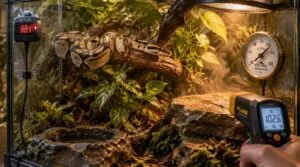
Not all reptile thermometers work the same way, and the differences matter. Each type reads temperature through a distinct mechanism, which determines where it’s useful and where it falls short. There are three main types you’ll encounter when setting up a snake enclosure.
If you’re weighing which type fits your setup, this breakdown of thermostat types for snakes explains how each control style handles heat output differently.
Digital Probe Thermistors
Because the thermistor is a ceramic semiconductor bead, its resistance drops as temperature rises, and your digital probe converts that shift into a reading on the digital display.
Placement matters more than the number itself. The probe tip samples only its immediate microclimate, so where you position it determines what you’re actually measuring.
Regular calibration keeps your temperature monitoring reliable.
Infrared Surface Sensors
Unlike probe thermistors, infrared guns offer noncontact temperature measurement. They read infrared heat radiation naturally emitted from any surface and return a result in well under a second.
For help positioning a probe alongside your infrared gun, this guide to the best placement for a thermometer in a snake enclosure walks through the spots that matter most.
Surface temperature accuracy depends on emissivity, though. Bare reptile skin runs around 0.95, but wet or scaled areas read cooler. Stay within 2–10 cm, aim straight, and don’t take readings through glass.
Analog Dial Mechanisms
Analog dial thermometers trade speed for simplicity. A bimetallic strip inside the housing coils and uncoils with heat, sweeping a needle across the dial. That mechanical action takes 1–5 minutes to settle, so don’t expect instant numbers like your IR gun gives.
Expect ±2–3°C drift over time. Follow these checks:
- Calibrate with an ice bath at 0°C.
- Recheck readings within 30 minutes.
- Recalibrate every 6–12 months.
- Mount away from vibration and basking spotlights.
- Cross-check against a digital probe in your snake enclosure.
Analog sensors work best as backup references, not primary gauges.
Pairing them with a digital hygrometer for boa constrictor enclosures gives you a reliable cross-check whenever readings start to drift.
What Temperatures Should Snake Enclosures Have?
Now that you know how each thermometer reads, the next question is what numbers you’re actually aiming for. Most common pet snakes do well with a cool side of 75–80°F and a hot side of 85–90°F. Diurnal species need a basking spot at 88–92°F, measured as surface temperature, not air temperature.
If your snake’s temperatures are dialed in, a vet visit or road trip gets easier, and these tips for reducing snake stress while traveling help keep them calm in transit.
If you’re monitoring several tanks, digital thermometers and hygrometers for multiple enclosures make it easy to give each one its own calibrated sensor.
Keep a temperature gradient of at least 10–15°F across the enclosure so your snake can thermoregulate freely. Tropical species run warmer: cool side 80–85°F, hot side 90–95°F, with humidity of 60–80%. If the gradient ever collapses—say, both sides drift toward the same reading—it’s worth revisiting why snakes need temperature regulation to understand what’s at stake.
At night, let temps drop 5–10°F below daytime levels. Desert species tolerate hotter, drier conditions, while rainforest snakes demand steady warmth. Verify both air temperature and surface readings before you call the setup done.
Where Should Thermometer Probes Be Placed?
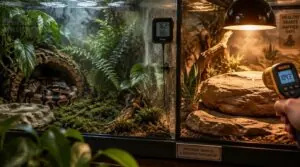
Where you put your probes decides whether your readings mean anything. Sensor placement is everything. Put your primary probe at the basking spot, 2–5 cm from the heat source, but offset it 5–10 cm sideways if you’re using a radiant lamp. Direct radiation skews readings and inflates numbers your snake never actually feels.
Sensor placement is everything—position your probe at the basking spot, offset from radiant lamps so readings reflect what your snake actually feels
Add a second probe on the cool side to verify your gradient. Height matters too: align the probe with your snake’s body depth when basking, roughly 1–2 dorsal skin widths below the surface. Arboreal species? Place one near the perch, not just the floor.
Rotate probes between basking and middle zones weekly to map the full gradient. In drawer systems, keep probes 5–10 cm from glass to avoid heat-loss distortion. Larger snakes need probes matching their coiling diameter, and juveniles need one nearer the warm side to track rapid shifts during shedding.
How Should Thermometers and Thermostats Work Together?

How do you make your thermometer and thermostat a true team? Your thermometer is the eyes; your thermostat is the hands. Digital temperature regulation only works when the probe feeding your thermostat sits exactly where your snake lives, not where you guess it should.
Follow this checklist and you’ll sleep easier at night:
- Place the primary probe at basking level, touching the surface your snake actually contacts.
- Add a second probe in the cool zone to verify your gradient.
- Set your thermostat to proportional mode instead of on/off cycling, so heat ramps smoothly.
- Enable the high-limit cutoff at least 2°C above your setpoint.
- Connect everything to a UPS, because a blackout during winter can kill faster than any predator.
Your thermostat settings mean nothing if the probe reads the wrong spot. Treat temperature monitoring as a loop: sensor, controller, heater, repeat. When each link talks to the next, your enclosure holds steady instead of swinging.
How Do You Keep Readings Accurate?
A thermometer is only as good as its last honest reading. Over time, probes drift, sensors collect grime, and batteries fade, quietly skewing the numbers you rely on. Below, you’ll find how to calibrate and clean your gear and what to do when readings don’t agree.
Calibration and Cleaning
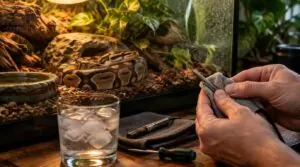
Even a good thermometer lies if you never check it. Run a simple ice water calibration: stir crushed ice and water, wait five minutes, and your probe should read 32°F (0°C). If it’s off by more than a degree or two, adjust or replace it.
Clean IR lenses gently, never with solvents, and always let sensors dry fully before trusting a reading.
Conflicting Temperature Readings
It’s tempting to blame a broken thermometer when readings disagree, but mismatched sensors usually explain it. One probe reads surface temperature; another reads air temperature, so they’ll never match. Shift a probe an inch and hot spots change.
To improve sensor accuracy, compare like with like, verify calibration in ice water, and remember temperature sensors lag during heat-up and cooldown.
Frequently Asked Questions (FAQs)
What temperature should a snake enclosure be at?
Aim for a thermal gradient: 26–32°C (79–90°F) on the warm side, 24–29°C (75–85°F) in the cool zone. Check your species’ needs, since arboreal snakes often want hotter basking spots.
How do reptile thermometers work?
Reptile thermometers rely on temperature sensors to translate heat into readable numbers. Digital sensors use a thermistor probe whose resistance shifts with temperature, while analog sensors use a bimetal coil. Infrared units read surface radiation instead.
Is 90 degrees too hot for a snake?
So is 90°F actually dangerous? Not automatically. Many tropical species tolerate a 90°F basking spot, but sustained 90°F air temperatures cause heat stress, especially for cooler-climate snakes. Your snake temperature control depends on species, humidity, and a proper gradient.
How to make a snake enclosure hotter?
Raise your basking spot wattage, lower the heat lamp closer, or add a ceramic heat emitter. Verify with reptile thermometers that your temperature gradient stays 8–12°C above the cool zone.
Can heat mats alone warm a snake enclosure?
No. Heat mats warm substrate, not air. Your snake enclosure needs an overhead heat source to build a proper thermal gradient. A mat alone leaves the far end and upper air too cool, so pair it with supplemental ambient heat.
Why do snakes need a thermal gradient?
Snakes are ectothermic reptiles, so they can’t make their own body heat. A thermal gradient lets them thermoregulate by moving between a warm basking zone and cool zones, supporting digestion, immunity, and healthy metabolism.
Snakes don’t hibernate like bears do; instead they enter brumation, a cold-weather slowdown where they stay inactive and eat little until temperatures rise again.
Because temperatures below 0°C stop snakes cold, they can’t survive in frozen places, as explained in this guide to snake habitat in Antarctica.
What health problems come from wrong temperatures?
A thermostat is your snake’s silent heartbeat; when it fails, the body falters. Wrong temperatures cause digestive issues, lethargy, dehydration, respiratory health decline, shedding issues, weakened immunity, and elevated reptile stress levels.
Which thermostat type suits halogen basking lamps?
A friend’s halogen lamp spiked 5°C past setpoint on a cheap dial stat. Solid-state digital controllers are the right thermostat type for halogen basking lamps. Their fast cycling controls inrush current, and PID control prevents overheating spikes.
How long should an enclosure run before adding snakes?
Patience wins here. Run your enclosure for at least two weeks before adding snakes. That gives your enclosure microclimate time to settle, confirms thermal gradient management works, and catches thermostat faults during proper temperature monitoring.
Conclusion
Picture a ball python coiled above its heat mat, belly warm, back cold. Your single probe says everything’s fine. It isn’t. That snake needs a thermal gradient, and only correct placement reveals one.
That’s the real lesson in how reptile thermometers work in snake enclosures: the tool matters less than where you put it and how you verify it. Measure surface temps, calibrate often, pair with a thermostat. Your snake can’t speak. Your readings must.