This site is supported by our readers. We may earn a commission, at no cost to you, if you purchase through links.

Your snake’s eyes turn milky blue, and a few days later the whole skin peels away in one clean sheet. That color shift isn’t a flaw. It’s fluid pooling under the spectacle, delivered by a network most keepers never think about.
The snake lymphatic system overview starts there, because this network does far more than manage shedding. It drains leaked fluid from capillaries, carries immune cells, and even speeds venom after a bite. Snakes also lack lymph nodes, and two tiny hearts near the tail push lymph back into the blood.
Here’s how each piece works, and what it means for your animal’s health.
Table Of Contents
- Key Takeaways
- What Does a Snake’s Lymphatic System Do?
- How Snake Lymphatic Vessels Are Organized
- Major Lymphatic Sacs in Snakes
- How Lymph Hearts Return Fluid to Blood
- Snake Immune Defenses Without Lymph Nodes
- How Snake Lymph Supports Healthy Shedding
- Frequently Asked Questions (FAQs)
- What is the lymphatic system summary?
- Does snake venom go into the lymphatic system?
- Which snake is called the silent killer?
- What are the 5 main components of the lymphatic system?
- How does venom spread through a snake bite victim?
- Why does movement speed up venom spread?
- What is the pressure immobilisation technique for snakebites?
- Can fluids be given through the lymphatic sinus?
- How does muscle contraction affect snake lymph flow?
- Conclusion
Key Takeaways
- Your snake’s lymphatic system drains fluid leaking from capillaries and returns it to the blood, with lymph hearts near the tail and muscle movement doing the pumping instead of a diaphragm.
- Because snakes have no lymph nodes, you won’t see swollen glands when yours is sick, so you’ll need to watch for changes in the eyes, skin, and body swelling instead.
- Lymph fluid loosens old skin during shedding and turns the eyes bluish, so raising humidity beforehand helps the skin come off in one piece.
- Venom travels through lymph vessels after a bite, and since muscle activity speeds it up, staying still and using pressure immobilisation slows its spread.
What Does a Snake’s Lymphatic System Do?
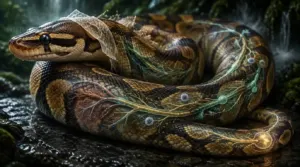
A snake’s lymphatic system does far more than most keepers assume. Its lymphatic vessels collect fluid that leaks from blood capillaries and return it to the veins, which prevents edema and keeps interstitial protein levels stable.
Because the lymphatic and blood systems work as partners, it helps to understand how snakes circulate blood and why that fluid balance matters for healing.
Because snakes lack limbs and a diaphragm, lymph flow depends on lymph heart pumping and on muscle activity as your snake moves.
The same network carries antigens and immune cells for surveillance, speeds venom spread after a bite, and supplies the fluid that loosens old skin during shedding. Unlike mammals, snakes lack swollen lymph nodes when sick, so their lymphatic system is far less conspicuous and harder to observe.
How Snake Lymphatic Vessels Are Organized
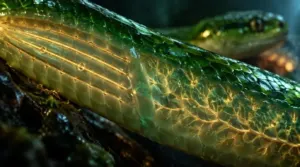
Snake lymphatic vessels follow a pattern you can learn to recognize. Their layout is best understood by looking at two arrangements in turn. Here’s what to expect from each one.
Segmental Networks in Skin and Muscle
Networks of lymphatic vessels in your snake’s skin and body musculature don’t run randomly. They form a segmental network that follows the branching pattern of the hidden arterioles, so each body region drains before lymph converges into larger channels.
Since this fluid layer forms just before the blue eye phase, raising humidity before your snake sheds helps that lymphatic drainage work smoothly and the old skin come off in one piece.
The lymphatic capillaries begin blind-ended in the deep dermis and fascia, measure 35 to 70 μm, and open under interstitial pressure. When your snake moves, muscle contraction compresses them and pushes lymph onward through the valved collecting vessels.
Perivascular Channels and Longitudinal Sinuses
Once lymph leaves the segmental networks, it reaches your snake’s perivascular channels, microscopic spaces wrapped around major arteries and veins. They have no endothelial lining, so interstitial fluid drains freely.
These channels feed the longitudinal sinuses, wide, valveless vessels running beside the vertebral column. Three details matter:
- Aortic and caudal vein channels empty into the abdominal sinus.
- Jugular channels drain forward through anterior sinuses.
- Skin and muscle vessels join at regular intervals.
Movement and arterial pulsation drive lymphatic circulation here.
Major Lymphatic Sacs in Snakes
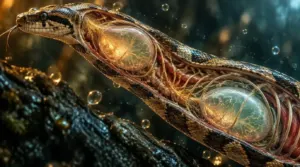
Snake lymph doesn’t just trickle through thin vessels; it also collects in large reservoirs. You’ll find two main lymphatic sacs in the body, and each one has its own location and job. Here’s where to look for them and what each one does.
Aortic and Abdominal Sacs Around Organs
Picture a thin, translucent bladder cradled beneath your snake’s spine, swollen with clear fluid and wrapped around its organs. That’s the abdominal sac.
If that swelling comes with watery or foul-smelling droppings, what to do when your snake has diarrhea can help you work out whether the cause is digestive.
It arises where the aortic lymphatic enlarges, ventrolateral to the abdominal aorta. This lymph sac encloses the liver, spleen, pancreas, and gall bladder, draining them and supporting immune surveillance.
Vascular communication links it to connective tissue sheaths around the viscera and to intestinal vessels. Lymph flows in, then moves onward to the lymph hearts.
Jugular Sac Near The Heart
The jugular lymph sac sits craniad to the heart, ventral to the trachea, and you’ll recognize it as a reddish-pink sphere. The right sac runs larger than the left. Like any lymphatic sac, it collects fluid from anterior vessels and passes it into the jugular and subclavian veins.
If you know body cavity anatomy, you can find it by following the connective tissue sheaths around the vessels. Clinicians use it for cutdown catheter placement and blood sampling.
A well-illustrated reptile veterinary care book walks through these landmarks and cutdown techniques step by step, which helps when practicing on preserved specimens.
How Lymph Hearts Return Fluid to Blood
The paired lymph hearts near your snake’s tail drive fluid return from the lymphatic system into the blood vascular system. Here’s how they work:
- Striated muscle contracts spontaneously, raising pressure inside the chamber.
- Inlet valves close while outlet valves open.
- Lymph enters the femoral or ventral abdominal vein.
- Junction valves block venous backflow.
Beats run 20 to 60 per minute, depending on temperature and hydration. If both lymph hearts fail, lymphatic drainage stalls and fluid pools visibly under the skin.
Snake Immune Defenses Without Lymph Nodes
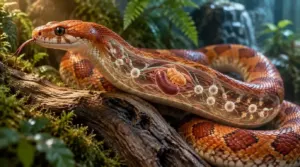
Mammals filter pathogens in lymph nodes, but your snake has none. Its lymphatic system drains fluid through sacs and vessels instead, so immunological function relies on other lymphoid tissue.
The spleen and thymus handle lymphocyte development and maturation. Without germinal centers, the adaptive response runs slower, which delays antibody production and immunological memory.
Innate defenses compensate. Phagocytic B cells and natural cytotoxic mechanisms lead, so you can view reptilian anatomy and serpent morphology as an alternative design, not a deficiency.
Snakes lack lymph nodes, but their innate defenses make them an alternative design, not a deficient one
How Snake Lymph Supports Healthy Shedding
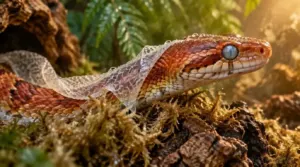
A typical shedding cycle runs roughly 7 to 14 days, and your snake’s cutaneous lymphatics drive it. Lymphatic flow push fluid between old and new epidermis, forming the cleavage zone. Here’s what you’ll notice:
- Eyes turn bluish as fluid pools under the spectacle.
- Skin dulls while enzymes dissolve adhesion.
- Eyes clear as reabsorption finishes.
- Skin and body musculature help your snake crawl free.
Serpent morphology demands smooth shedding, so maintain humidity to protect fluid homeostasis.
Frequently Asked Questions (FAQs)
What is the lymphatic system summary?
Your snake’s lymphatic system controls lymph drainage, pulling excess interstitial fluid from tissues to protect fluid homeostasis. Lymphatic vessels and lymph hearts push that fluid back into venous circulation, while carrying immune cells and antigens along.
Does snake venom go into the lymphatic system?
Yes, it does. Snake venom usually sits in tissue after a snakebite, then drains into lymphatic capillaries and reaches your bloodstream through lymph flow. That’s why pressure immobilisation, which slows lymph flow, matters.
Which snake is called the silent killer?
Ever wondered which snake earns that nickname? It’s the inland taipan, whose venom is potent.
Its snake physiology delivers toxins that exploit your lymphatic system, where lymphatic vessels and lymph flow drive snake venom spread.
What are the 5 main components of the lymphatic system?
Your snake’s lymphatic system rests on five components: lymphatic vessels, lymphatic sinus spaces, lymphatic valves that prevent backflow, lymphatic trunks and sacs that collect lymph, and lymphatic nodules within spleen and thymus tissue.
How does venom spread through a snake bite victim?
Venom can race through you in a heartbeat. Your lymphatic system carries much of it, and muscle activity speeds venom spread toward your bloodstream.
Pressure immobilisation and staying perfectly still will slow that journey considerably.
Why does movement speed up venom spread?
Running for help is the fastest way to deliver the problem to your heart. Muscle activity squeezes lymph vessels, quickening lymph flow and venom spread.
Use the pressure immobilisation technique and limb immobilisation instead.
What is the pressure immobilisation technique for snakebites?
Picture venom as ink drifting through tissue paper, carried along lymph vessels. The pressure immobilisation technique stops that drift after a snakebite.
You’ll start bandage application at the fingers, then splint for firm limb immobilisation.
Can fluids be given through the lymphatic sinus?
Short answer: not directly, and it’s not a good idea. Fluids go in subcutaneously, where interstitial fluid and the lymphatic sinus network absorb them slowly. Intracoelomic delivery bypasses lymph flow behavior. Control volume carefully.
How does muscle contraction affect snake lymph flow?
Your muscles are pumps. Within the muscular lymphatic plexus, this muscle pump drives lymph flow, so movement speeds venom spread.
Pressure immobilisation and keeping still slow lymph flow while you wait for medical help.
Conclusion
Think of your snake’s lymphatic system as a quiet drainage crew working beneath the floorboards, never seen until something goes wrong. This snake lymphatic system overview shows why that crew matters. Sacs collect leaked fluid, lymph hearts push it back into circulation, and immune cells patrol without nodes. At shedding, that same fluid loosens old skin.
Watch the eyes, skin, and swelling closely, because they’ll tell you early. Studying it reveals how reptiles fight infection.