This site is supported by our readers. We may earn a commission, at no cost to you, if you purchase through links.
Your ball python has been wedged under a water bowl for three days, and the $30 cave you bought sits empty. Snakes don’t care what looks pretty to you. They care whether their back and sides touch the walls, because that contact tells their body it’s safe.
Most keepers buy too big, park the hide in the wrong spot, or grab porous material that traps bacteria. Each mistake adds stress, and stress shows up as refused meals and constant escape attempts.
Here’s how to choose a snake cave by size, style, material, and placement, plus four real products worth comparing.
Table Of Contents
- Key Takeaways
- Size Your Snake Cave for a Snug Fit
- Match Cave Styles to Your Snake’s Needs
- Choose Safe, Easy-to-Clean Snake Cave Materials
- Position Warm, Cool, and Humid Snake Hides
- Top 4 Snake Caves to Compare
- Clean, Inspect, and Replace Snake Caves Safely
- Frequently Asked Questions (FAQs)
- What does a good snake enclosure look like?
- What is the friendliest snake to own?
- What wood to avoid for snakes?
- What are the best hides for snakes?
- Do snakes need more than one cave?
- Can I use a coconut shell as a hide?
- Why does my snake ignore its new cave?
- Are hides necessary for baby snakes?
- Should cave colors matter to my snake?
- Conclusion
Key Takeaways
- Size the cave so your snake’s back and sides touch the walls, with an interior about 1.5 times its body width, because that contact is what makes it feel safe and a roomy hide often gets ignored.
- Choose a style that suits your snake’s habits, such as a half-log or dome for ground-dwellers and a mounted sky hide for tree-dwellers, and revisit the fit as your snake grows.
- Pick smooth, non-porous, nontoxic materials like cured resin or plastic that wipe clean easily, and avoid cedar, pine, treated wood and porous cork that trap bacteria.
- Place one matching hide on the warm side (88-92°F) and one on the cool side (74-80°F), add a damp-moss humid hide for shedding, and check all of them regularly for cracks, grime and fit.
Size Your Snake Cave for a Snug Fit
How snug is snug enough? Think of your snake’s cave like a favorite hoodie. It should hug, not squeeze.
If you’re setting up enclosures for a school, these snake hide boxes for classrooms are built to match these fit guidelines and hold up to daily handling.
A snake’s cave should fit like a favorite hoodie: snug enough to hug, never tight enough to squeeze
Snug hiding caves work because snakes crave a thigmotactic fullbody hug, with their back and sides touching the walls. That contact tells your snake it’s safe. Start by measuring the thickest point of your snake’s body while it’s relaxed.
Now size the interior. Make the width about 1.5 times body diameter so turning stays easy. Leave enough length for the full coil plus 20% extra, and enough height for a raised head. Proper sizing for snake species matters, since arboreal snakes want taller space.
Test the snug fit by watching your snake slip freely in and out of the hide box.
Match Cave Styles to Your Snake’s Needs
A snug fit is only half the story. Now match cave styles to your snakes needs, because a perfect size in the wrong shape still gets ignored.
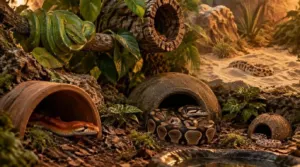
Ground-dwelling corn snakes and ball pythons love a classic half-log or dome. Arboreal species, like green tree pythons, rarely touch ground hides. Mount a sky hide or cork tube high up instead. Burrowers such as Kenyan sand boas barely need a cave at all, since deep, loose, dry substrate does the job.
Babies want tighter spaces than adults, so revisit proper sizing for snake species as yours grows.
Love naturalistic design and aesthetics? Go for it, but choose smooth interiors and safe nontoxic materials so cleanup stays easy. Snug hiding caves look good.
Choose Safe, Easy-to-Clean Snake Cave Materials
Pretty is great, but your snake cares about what the cave is made of. Start with reptile hide material safety, because your snake presses against it every day.
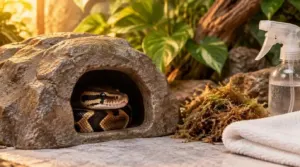
Choose nontoxic materials like fully cured resin, PVC, or smooth plastic. Skip anything splintery or porous. Naturalistic design and aesthetics can still shine here. If your snake needs extra moisture to shed, a closed resin cave packed with damp sphagnum can double as a humid hide, so check the humid hide requirements before you buy.
Picture these when you shop:
- A smooth, rounded entrance with no sharp edges
- A matte, non-porous interior that wipes clean
- Heavy resin that won’t tip when your snake pushes
- A finish that’s cured, with no chemical smell
- Plastic sturdy enough for bleach soaks
That’s ease of cleaning and maintenance in action. A simple snake hide cleaning routine keeps bacteria from settling in. Wipe it down weekly and rinse well.
If you’re still shopping for a replacement, these ball python hides that are easy to clean and built to last are a good place to start.
Position Warm, Cool, and Humid Snake Hides
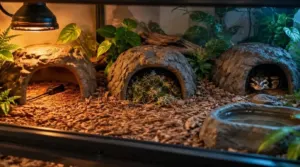
Great caves only work if they’re in the right spot. Start with the warm zone. Set one hide right over or beside your heat source, aiming for a surface temp of 88-92°F. Put the thermostat probe inside that hide, on the substrate, so you read what your snake actually feels.
Next, place an identical hide at the far end for the cool zone, holding 74-80°F. Matching hides keep your snake from picking safety over comfort.
Your humid hide goes on the cool side or mid-gradient, away from heat, so it holds steady humidity for shedding. Pack it with damp sphagnum.
Space all three along the thermal gradient with clear paths between them. Run it for 24-48 hours before your snake moves in.
Top 4 Snake Caves to Compare
Ready to put your snug-fit sizing rules to work? Below are four snake caves that fit the bill, and each one earns its spot for a different reason. Let’s see which one suits your snake best.
1. Leoterra Medium Reptile Hide
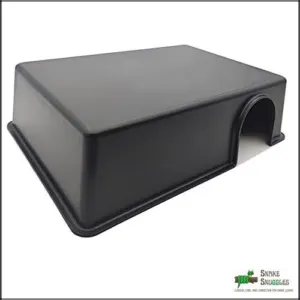
Want a hide that feels safe and snug? The Leoterra Medium is a solid starter pick.
It’s black plastic with rounded edges, so nothing scrapes your snake. The top seal helps hold humidity in the covered space. At 9.45 x 7.09 x 2.36 inches and just 5.11 ounces, it’s easy to move around.
It suits snakes under 150g, like corn, milk, and king snakes. Always check the entrance size first, and inspect it on arrival, since some buyers report cracking.
| Best For | Owners of small to medium snakes under 150g, such as corn, milk, and king snakes, who want a simple, affordable hide that also works for lizards, geckos, and spiders. |
|---|---|
| Material | Black plastic |
| Dimensions | 9.45 x 7.09 x 2.36 in |
| Weight | 5.11 oz |
| Easy Cleaning | N/A |
| Target Species | Small to medium snakes |
| Humidity Use | Top seal improves humidity |
| Additional Features |
|
- Rounded edges on the durable black plastic help prevent injury to your pet
- Top seal design helps hold humidity inside the covered area
- Lightweight at 5.11 ounces and works for many animals, including snakes, lizards, geckos, and small mammals
- Too small for snakes over 200g, who need the L or XL size
- Some customers report it arrives cracked
- You must check that the entrance size fits your snake before buying
2. Reptile Hide Cave Large Size
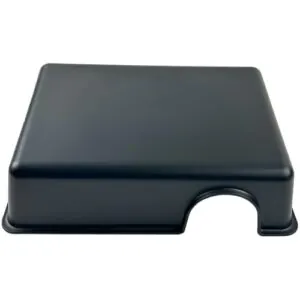
Resin with smooth edges makes the Reptile Hide Cave Large Size a safe pick for your snake. It measures 9.5"L x 6.7"W x 2.2"H and weighs just 0.4 lbs, so it’s easy to place.
The high-density resin holds up to bites and scratches, and it wipes clean fast. It works with any bedding, and suits ball pythons, bearded dragons, and leopard geckos.
Want a humid hide? Add damp moss, sold separately. Skip this cave for very large adult snakes, though.
| Best For | Owners of small to medium reptiles like ball pythons, bearded dragons, and leopard geckos who want a durable, easy-to-clean hide that can also work as a humid hide or basking cave. |
|---|---|
| Material | Non-toxic high-density resin |
| Dimensions | 9.5 x 6.7 x 2.2 in |
| Weight | 0.4 lbs |
| Easy Cleaning | Easy-to-clean surface |
| Target Species | Ball pythons, bearded dragons, leopard geckos |
| Humidity Use | Works as humid hide |
| Additional Features |
|
- Smooth edges and non-toxic, high-density resin hold up to bites and scratches while helping prevent injuries
- Works with all bedding types and wipes clean easily for a hygienic habitat
- Lightweight at 0.4 lbs and flexible enough to serve as a humid hide, basking cave, or shelter
- Not suitable for very large adult reptiles
- Damp moss for humid hide use must be purchased separately
- Available only in Large size (9.5"L x 6.7"W x 2.2"H)
3. Exo Terra Gecko Cave Medium Resin
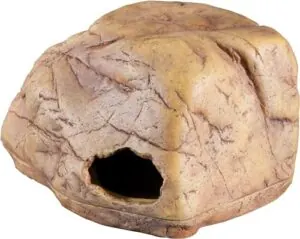
Picture a tiny stone burrow, just big enough for one small creature to tuck into and disappear. That’s the Exo Terra Gecko Cave. Made of resin, it measures 5 x 6 x 3.7 inches, so it’s compact. Add moss inside, and you get a cooler microclimate your pet can retreat to.
Humid hide? It holds moisture for only one day. Customers say it’s too small for adult leopard geckos, so skip it for larger animals. Buy extras for bigger setups.
| Best For | Owners of small reptiles and amphibians, such as Frog Eyed Geckos and Paroedura, who want a secure hiding and nesting spot in a desert or tropical terrarium. |
|---|---|
| Material | Resin |
| Dimensions | 5 x 6 x 3.7 in |
| Weight | N/A |
| Easy Cleaning | Removable top |
| Target Species | Small geckos and amphibians |
| Humidity Use | Humid hide, one day moisture |
| Additional Features |
|
- Gives pets a safe place to rest, which helps ease stress
- Creates a cooler microclimate when moss is added inside
- Has a removable top that makes cleaning and moisture upkeep easy
- May be too small for adult leopard geckos, based on customer feedback
- Holds moisture for only one day when used as a humid hide
- Comes as a single unit, so larger enclosures or multiple animals may need more than one
4. Pangea Reptile Hide Box Large
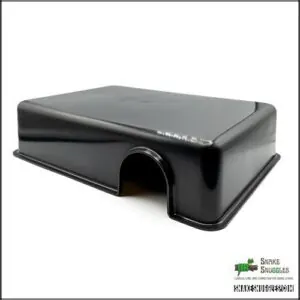
Picture a dark, narrow tunnel where your snake can tuck in and finally exhale. That’s the feel of the Pangea Reptile Hide Box Large.
Its offset door keeps the interior shadowy, and the smooth, non-porous plastic wipes clean in seconds. At 13.25" x 9" x 3.25", it slides into most standard rack units and suits ball pythons and boas.
Here’s the catch. Customer feedback on durability and security is mixed, and some keepers report cracking under stress. Check yours often.
| Best For | Keepers of ball pythons and boas who use standard rack systems and want an easy-to-clean hide box that gives their snake a dark, secluded spot. |
|---|---|
| Material | Heavy 1/8″ black plastic |
| Dimensions | 13.25 x 9 x 3.25 in |
| Weight | N/A |
| Easy Cleaning | Easy-to-clean smooth surface |
| Target Species | Ball pythons and boas |
| Humidity Use | N/A |
| Additional Features |
|
- Smooth, non-porous plastic wipes clean quickly
- Offset door keeps the inside dark and shadowy
- Fits most standard rack units at 13.25" x 9" x 3.25"
- Customers report mixed results on durability
- Feedback on security is also mixed
- Some keepers say it cracks under stress
Clean, Inspect, and Replace Snake Caves Safely
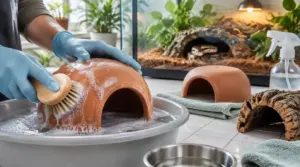
Is your snake’s favorite hideout actually a germ hotel? Let’s fix that.
Clean hides on a schedule. Scrub with soapy water first to lift urates and debris, then disinfect with a reptile-safe product. Rinse well and let everything dry completely, because leftover residue or moisture is no friend to your snake’s lungs. This is where reptile material nonporousness pays off: smooth resin wipes down fast, while cork soaks up trouble.
Next, inspect for damage. Run your fingers over every edge, checking for splinters, cracks, or rough spots. Make sure the hide is stable and won’t tip. Keep reptile hide ventilation openings clear.
Replace any hide that’s too small, cracked, or mite-infested. Snakes grow, so check the fit every few months.
Frequently Asked Questions (FAQs)
What does a good snake enclosure look like?
Think of your snake enclosure as a kingdom, where every corner means something.
A good one has a clear temperature gradient, steady humidity control, and secure hiding spots. Add naturalistic vivarium touches, and you’re set.
What is the friendliest snake to own?
No snake’s truly cuddly, but calm ones exist. The friendliest snake to own is a captive-bred corn snake. Use a snake species habitat guide for your reptile enclosure setup, snake security, and snake stress reduction.
What wood to avoid for snakes?
Picture your snake breathing sharp, resinous fumes in a tiny, sealed den. Skip cedar, pine, and treated wood. Choose nontoxic materials like resin or sealed plastic for each warm zone, cool zone, and steady humidity.
What are the best hides for snakes?
Is bigger always better? Nope. The best hide fits snugly, giving secure hiding spots. Use two matching hides across the temperature gradient, add one for humidity control, and keep your enclosure setup for juveniles small.
Do snakes need more than one cave?
Picture your snake gliding from a sun-warmed den to a cool, shadowy retreat. Yes, hiding caves for pet snakes work best in pairs: one warm side, one cool, so your thermal gradient always stays safe.
Can I use a coconut shell as a hide?
A coconut shell is nature’s cabin, and yes, it works.
Among hiding caves for pet snakes, it offers a natural look and nontoxic materials. Add damp moss on the warm side for a humid hide.
Why does my snake ignore its new cave?
A hide that’s too roomy is like a tent in an open field: covered, but still exposed. Snake hiding behavior depends on touch, so if your snake can’t press against the roof and walls, resize the hide.
Are hides necessary for baby snakes?
Think a bare snake enclosure keeps things simple? Not for baby snakes.
A secure hide is essential to your reptile care routine, supporting temperature regulation, lowering stress, and adding reptile habitat enrichment hatchlings truly need.
Should cave colors matter to my snake?
With limited reptile color perception, your snake cares about darkness and security, not shade. Natural stone suits habitat mimicry, but always run a reptile hide material safety check and make sure solid visual barriers.
Conclusion
Picture your ball python tucked into a snug, shadowed cave, spine and sides pressed against the walls, tongue flicking calmly. That’s what a right-sized hide looks like.
Now you know how to choose a snake cave: match the size to your snake’s body, pick a style that suits its habits, stick with non-porous, washable material, and place one hide on each side of the gradient.
Check it often. A secure snake eats, explores, and thrives.