This site is supported by our readers. We may earn a commission, at no cost to you, if you purchase through links.

A snake can’t generate its own heat, and in November, your spare room is working against it. When the room drops below 75°F, digestion slows, appetite fades, and a healthy animal starts to struggle.
Under tank heaters for winter solve part of that problem by warming the belly the way sun-baked ground would, giving your snake a basking surface between 89 and 95°F. But not every heater earns a spot under glass. RV pads can melt plastic and skip GFCI protection entirely.
Below, you’ll compare five options by wattage, tank fit, and safety, so you can match the right heater to your enclosure.
Table Of Contents
- Key Takeaways
- Winter Heating Needs for Pet Snakes
- Reptile Heat Pads Versus Unsuitable RV Heaters
- 5 Under Tank Heaters and Alternatives Compared
- Choosing Under Tank Heater Size and Wattage
- Safe Under Tank Heater Installation
- When Winter Heating Needs Overhead Support
- Frequently Asked Questions (FAQs)
- Conclusion
Key Takeaways
- Your snake needs a temperature gradient with a 89 to 95°F basking surface, and a reptile-rated under tank heater rebuilds belly warmth when winter chills the room.
- RV tank heaters, bilge heaters, and under-sink water heaters aren’t safe substitutes, since they can melt plastic, lack GFCI protection, and weren’t made for reptile use.
- You’ll match the pad to your tank (8W for 10-20 gallons, 16W for 30-40, 24W for 50-60), run it through a pulse proportional thermostat with the probe above the mat, and confirm the real surface temperature with an infrared thermometer.
- If your room stays below 75°F, a pad alone won’t warm the air, so you’ll add overhead heat like a ceramic heat emitter on its own thermostat.
Winter Heating Needs for Pet Snakes

During winter, your snake loses heat faster than you’d expect. As the room cools, so does the enclosure, and the warm end stops holding the range your snake needs.
A good reptile heating mat for winter snake keeping can help the warm end hold steady even when the room around it gets colder.
Every snake needs a temperature gradient, with a basking surface between 89 and 95°F. That warmth drives digestion and lets your snake thermoregulate by moving between warm and cool zones. Without it, meals can sit undigested and your snake may refuse food.
A tank heating pad solves much of this by delivering belly heat, the same warmth a snake would absorb from sun-heated ground. It’s the simplest way to rebuild the gradient when the room drops. Choosing the right one means matching its output to your enclosure and controlling it carefully. Pairing any heater with a thermostat is essential, since skipping a thermostat risks overheating, dangerous temperature drops, and equipment failure.
Reptile Heat Pads Versus Unsuitable RV Heaters

When the room cools, it’s tempting to grab whatever heater is nearby. Don’t. An RV heater is built to keep water lines from freezing, not to hold a snake’s belly at a safe temperature.
The gap shows up quickly:
- A 300 to 500W unit cycles on and off with no proportional control.
- Its hot spots can melt a plastic enclosure on contact.
- It lacks GFCI protection, a real concern around humid substrate.
- Condensation can short or corrode its parts.
- Its manufacturer never rated it for reptile use, so warranties don’t apply.
A tank heating pad works differently. It uses 4 to 24W, resists spills, and warms the substrate evenly, matching how your snake absorbs heat. Pair it with a thermostat.
5 Under Tank Heaters and Alternatives Compared
The five options below cover RV tank heaters, a bilge heater, and reptile heat pads, so they don’t all suit the same job. Each one is listed with what it’s built for, so you can match the right heater type to your setup. Check the wattage and thermostat control on every entry before you decide.
1. Xtreme Heaters 600W Bilge Heater
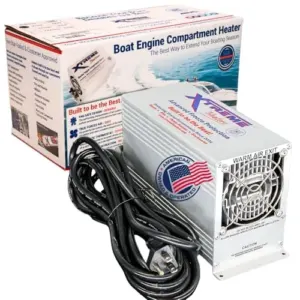
Say you keep snakes in an unheated garage and spot a heater made for boat engines. Will it work? Not as an under tank pad.
The Xtreme Heaters 600W Bilge Heater uses a self-regulating PTC element that switches on at 40°F and off at 55°F. A waterproof 58 CFM fan moves warmed air through its anodized aluminum case, which weighs 5.5 pounds and mounts in any orientation.
It warms air, not glass. Some buyers call it pricey, and it needs power.
| Best For | Boat owners and RV owners who need to keep an enclosed engine compartment or underbelly space above freezing during winter storage. |
|---|---|
| Power | 600 watts |
| Voltage | N/A |
| Dimensions | N/A |
| Weight | 5.5 pounds |
| Temperature Range | On at 40°F, off at 55°F |
| Mounting Method | Any orientation, including upside down |
| Additional Features |
|
- Self-regulating PTC element turns on at 40°F and off at 55°F, so it only heats when needed
- Waterproof 58 CFM fan circulates warm air, and the sealed anodized aluminum case suits marine environments
- Mounts in any orientation, including upside down
- Some users find it expensive compared to alternatives
- Needs an electrical power source and cannot run on flame or fuel
- Limited to 600W output, so other wattages (400W, 800W) must be bought separately
2. RecPro RV Tank Heater Pad Kit
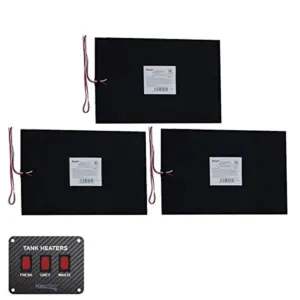
Next up is a pad that actually sticks to a tank, but it’s built for RV water tanks, not reptile enclosures. The RecPro kit measures 18" x 12" per pad and runs on 13.5V DC through an included toggle switch.
It turns on when the water temperature drops below 45°F and holds it at 68°F. That’s far too cool for a snake enclosure, and it suits tanks up to 50 gallons.
Reviews on reliability and quality control are mixed, and some units arrive defective. Wiring diagrams are also missing.
| Best For | RV owners who need to keep fresh water, grey water, or holding tanks of up to 50 gallons from freezing in cold weather. |
|---|---|
| Power | N/A |
| Voltage | 13.5V DC |
| Dimensions | 18″ x 12″ per pad |
| Weight | 1.02 kg kit |
| Temperature Range | On below 45°F, holds 68°F |
| Mounting Method | Peel and stick adhesive |
| Additional Features |
|
- Peel and stick backing makes it easy to attach to a tank
- Turns on automatically when water drops below 45°F and holds the tank at 68°F
- Includes a toggle switch and runs on 13.5V DC, suitable for RV tanks up to 50 gallons
- Customer reports on reliability and quality control are mixed
- Some users received defective units
- No wiring diagrams or detailed installation instructions for the switch panel
3. BISELONG 2.5 Gallon Under-Sink Water Heater
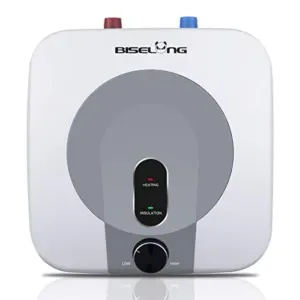
A BISELONG 2.5 gallon under-sink unit heats water, not enclosures, so it doesn’t belong near your snake. It runs a 1.5kW element on 120V AC and heats water up to 149°F, recovering in 8 to 15 minutes. Its 304 stainless steel tank suits RV sinks, food trucks, and cabinets.
Skip it for reptile care. It needs professional installation, carries a 108PSI pressure rating, and some users report leaks at the cold water inlet. Use it for sink hot water only.
| Best For | Homeowners, RV owners, and food truck operators who need a compact source of hot water at a single sink in a kitchen, bathroom, or cabinet. |
|---|---|
| Power | 1.5 kW |
| Voltage | 120V AC |
| Dimensions | 13.0″ L x 11.4″ W x 10.6″ H |
| Weight | N/A |
| Temperature Range | Max 149°F |
| Mounting Method | Wall, floor, or shelf mount |
| Additional Features |
|
- Rapid recovery, bringing water back to temperature in 8 to 15 minutes
- Durable 304 stainless steel tank with laser welding for leak resistance
- Flexible mounting on a wall, floor, or shelf, and a smart chip that holds the set temperature
- Requires professional installation per manufacturer guidelines
- Some users report leaks, particularly at the cold water inlet connections
- Maximum water temperature of 149°F and a 108PSI pressure rating limit its use to sink hot water
4. BN-LINK 6×8 Reptile Heat Pad
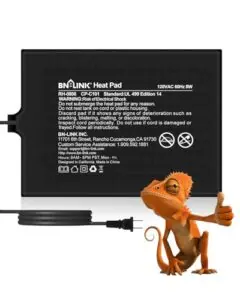
The 6×8 inch pad from BN-LINK draws just 8W on 120V power, so it’s gentle on energy use. It’s waterproof, which makes wiping it down easy, and it sticks to glass terrariums in the 10 to 20 gallon range. The surface runs between 104℉ and 122℉.
Check it closely before you trust it. Customer feedback on heating is mixed, the adhesive may loosen over time, and some units failed within an hour. Pair it with a thermostat and monitor it.
| Best For | Reptile, amphibian, or small animal owners with a glass 10 to 20 gallon terrarium who want a low-power, easy-to-clean heat pad and plan to monitor it closely. |
|---|---|
| Power | 8 watts |
| Voltage | 120V |
| Dimensions | 6″ x 8″ |
| Weight | N/A |
| Temperature Range | 104°F to 122°F |
| Mounting Method | Strong adhesive grip |
| Additional Features |
|
- Uses just 8W on 120V power, so it is gentle on energy use
- Waterproof construction makes it easy to wipe clean
- Strong adhesive sticks it to glass terrariums
- Customer feedback on heating performance is mixed
- The adhesive may not stay secure over time
- Some units failed within an hour of use
5. BN-LINK Reptile Heat Pad 8X12 16W
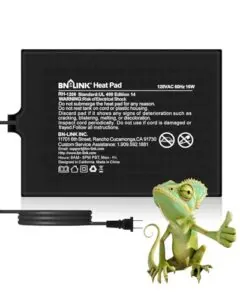
Say your ball python’s 20-gallon tank sits in a spare room that drops to 60°F overnight. A pad that fits the floor and holds a steady warm spot would help, and this 8×12 model is sized for that.
It draws 16 watts at 120 volts and has a waterproof surface and strong adhesive backing. It suits 10 to 20 gallon glass tanks, and it keeps the warm zone between 104°F and 122°F.
Expect a modest 3-4°F ambient rise. Some users report the adhesive failing, so check the bond after setup.
| Best For | Reptile or amphibian keepers with a 10 to 20 gallon glass terrarium who need a simple, waterproof under-tank heat source for a warm spot. |
|---|---|
| Power | 16 watts |
| Voltage | 120V |
| Dimensions | 8″ x 12″ |
| Weight | N/A |
| Temperature Range | 104°F to 122°F |
| Mounting Method | Strong adhesive backing |
| Additional Features |
|
- Waterproof design makes cleaning easy
- Strong adhesive backing is meant to attach securely to the tank
- Flexible, durable construction that keeps the warm zone between 104°F and 122°F
- Mixed feedback on warming, with only a 3-4°F ambient rise reported
- Adhesive may not stick properly to tank surfaces
- Durability reports vary, and some units have fallen off after use
Choosing Under Tank Heater Size and Wattage
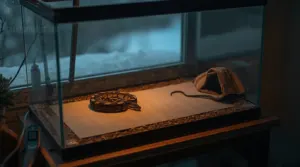
Say you keep a ball python in a 40-gallon tank, and you grab a 6"x8" pad because it was cheap. It won’t cover enough floor to build a real warm side.
Match the pad to your enclosure instead. Under tank heater wattage scales with tank volume, so check the pad’s dimensions before you buy.
- 10-20 gallons: an 8-watt pad, 6"x8".
- 30-40 gallons: a 16-watt pad, 8"x12".
- 50-60 gallons: a 24-watt pad, 8"x18".
- Substrate: keep it under 1.5 inches, or mount the pad on the tank side.
Low wattage density matters most. Pads that hold surface temperatures below 95°F are the safest tank heating solutions for belly warmth. Size up when your tank is larger, not when your room is colder.
Safe Under Tank Heater Installation
A heater is only as safe as the way you install it. Before you power anything on, you’ll want to get thermostat control and surface temperature checks right, since both decide whether the setup protects your snake or puts it at risk. The two points below cover each step in the order you’ll use them.
Thermostat Control and Probe Placement

Where you put the probe decides what your snake actually feels overnight.
| Setting | Guidance |
|---|---|
| Probe spot | Inside enclosure, above mat |
| Cord | Tape or clip down |
| Thermostat | Pulse proportional or dimming |
Place the probe above the mat, never beneath it, so it measures what your snake experiences.
Skip simple on/off models. Rapid cycling shortens heater lifespan, so choose pulse proportional control.
Surface Temperature Checks and Ventilation

A thermostat tells you what the probe senses, not what your snake lies on. Check the real surface with an infrared thermometer.
Your thermostat only reports what its probe feels, so point an infrared thermometer at the substrate to learn how warm your snake’s bed truly is
- Let the heater run for at least 30 minutes first.
- Aim at the substrate directly above the heat source.
- Keep readings within your species’ range, such as 88-92°F for basking.
Leave airflow around the enclosure so heat can’t build up.
When Winter Heating Needs Overhead Support

Once your thermostat and probe are set, check whether the heat pad alone is enough. Under-tank heaters warm the floor of the enclosure, but they don’t raise the air. If your room drops below 75°F, the substrate may reach temperature while the air above it stays cold, and that hurts your snake’s digestion and immune function.
A ceramic heat emitter fixes this. It gives off steady, light-free heat all night, so your snake keeps a normal dark cycle. Run it on its own thermostat with the probe in the basking zone, and use a pulse proportional model to avoid temperature swings.
Mount a radiant heat panel 6 to 12 inches above the enclosure, and use a ceramic socket rated for the wattage. Verify surface temperatures with an infrared gun.
If your room stays cold, add overhead heat to your under-tank setup.
Frequently Asked Questions (FAQs)
How do I tell if my heater is failing?
A failing heater can cook your snake in minutes, so watch for these heater failure symptoms: a thermostat that never cycles, temperatures drifting four degrees past your set point, buzzing, visible cracks, or burn marks.
What backup heat source works during winter blackouts?
Picture a dark house and a snake slowing down. Your best backup heat source is a wrapped chemical pack, not propane heating elements like the Mr Heater Buddy model. 120V units need electrical system compatibility.
How often should I replace an under tank heater?
Think of your heat pad as a sun beneath the glass, and retire it before it dims. No fixed schedule exists. Replace your under tank heater when it warps, cracks, or fails to hold heat.
Conclusion
A heater that costs little can still cost your snake everything, while a modest reptile pad keeps it thriving. Under tank heaters for winter work only when they’re built for reptiles, sized to cover a third of the floor, and run through a thermostat.
Skip the RV and bilge units. Choose a reptile-rated pad, set the probe, and verify the surface with a thermometer. Add overhead heat if the room stays cold. Match, control, verify.