This site is supported by our readers. We may earn a commission, at no cost to you, if you purchase through links.
Winter turns your snake’s cozy enclosure into a cold trap fast. Room temperatures dip, heating elements work harder, and a ball python sitting on a lukewarm substrate stops digesting properly—sometimes for weeks before you notice anything wrong. That subtle sluggishness isn’t personality; it’s a thermoregulation problem.
Reptile heating mats for winter snake keeping solve this by delivering consistent belly heat directly where snakes need it most. But not every mat manages cold-room conditions equally, and a wrong-sized pad without a thermostat is genuinely dangerous. The right setup makes all the difference between a thriving snake and a vet bill.
Table Of Contents
- Key Takeaways
- Top 8 Reptile Heating Mats
- 1. Aiicioo Reptile Heating Pad
- 2. BN-LINK Reptile Under Tank Heat Pad
- 3. Repti Zoo Adjustable Reptile Heat Pad
- 4. Aiicioo Reptile Under Tank Heater Thermostat
- 5. WACOOL TERRA Waterproof Reptile Heat Pad
- 6. Lucky Herp Reptile Heating Pad
- 7. BN-LINK Reptile Heating Pad Digital Thermostat
- 8. iPower Reptile Heat Pad
- Winter Snake Heating Requirements
- Ideal Warm-side Temperatures of 88–92°F
- Mid-zone Temperatures of 80–85°F
- Cool-side Temperatures of 75–80°F
- Safe Nighttime Temperature Drops
- Hatchling Substrate Temperature Needs
- Breeding Snake Winter Heat Requirements
- Ball Python Winter Heating Needs
- Corn Snake and King Snake Heating Needs
- Tropical Versus Temperate Snake Requirements
- Choosing The Right Heat Mat
- Matching Heat Mat Size to Enclosure Size
- Recommended Mat Coverage for Thermal Gradients
- Comparing 8W, 16W, and 24W Heat Pads
- Best Mat Sizes for 10–20 Gallon Tanks
- Best Mat Sizes for 30–40 Gallon Tanks
- Best Mat Sizes for 50–60 Gallon Tanks
- How Substrate Depth Affects Heat Transfer
- When Supplemental Winter Heating is Needed
- Energy-efficient Sizing for Colder Rooms
- Safe Installation and Thermostat Setup
- Why Every Heat Mat Needs a Thermostat
- Proper Floor Placement for Under-tank Heaters
- Avoiding Side-wall Heat Mat Placement
- Installing Heat Mats on Glass Tanks
- Installing Heat Mats on Wooden Vivariums
- Using Protective Barriers to Prevent Burns
- Correct Thermostat Probe Placement
- Keeping Water Dishes Off Heating Elements
- Avoiding Fire Hazards With Certified Devices
- Monitoring Temperature and Energy Costs
- Using Digital Thermometers in Warm Zones
- Using Digital Thermometers in Cool Zones
- Checking Surface Heat With Infrared Thermometers
- Benefits of PID and Proportional Thermostats
- Remote-sensor Thermostats for Winter Alerts
- Monthly Thermometer Calibration Tips
- Calculating Heat Mat Electricity Costs
- Reducing Winter Heating Expenses Safely
- Preventing Overheating, Mold, and Poor Ventilation
- Frequently Asked Questions (FAQs)
- How do I keep my snake warm during the winter?
- Are heating mats safe for snakes?
- Should I leave my snakes heat mat on all night?
- Can heat mats be used with bioactive setups?
- How do power outages affect snake health overnight?
- Do heat mats work inside PVC enclosures?
- How long do reptile heating mats typically last?
- Conclusion
Key Takeaways
- A thermostat isn’t optional — pairing every heat mat with one is the single most important thing you can do to keep your snake safe and warm all winter.
- Match your mat size and wattage to your tank: 8W for 10-gallon setups, 16W for 30–40 gallon tanks, and 24W once you hit 50–60 gallons.
- Cover only 40–60% of the enclosure floor with your heat mat so your snake has a proper warm side and a cool retreat to move between.
- Keep your warm-side substrate temps between 88–92°F and check them weekly — a 5°F drop is all it takes to shut down your snake’s digestion.
Top 8 Reptile Heating Mats
Finding the right heating mat for your snake doesn’t have to feel overwhelming. These eight options cover a solid range of tank sizes, wattages, and budgets — so there’s a good fit no matter your setup.
If you’re still getting your bearings as a new owner, snake owner advice on heating and habitat setup can help you figure out exactly what your specific species needs before you buy.
Let’s take a closer look at each one.
1. Aiicioo Reptile Heating Pad
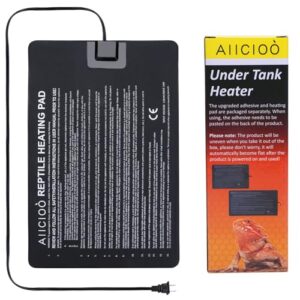
The Aiicioo Reptile Heating Pad is a solid starting point for new snake keepers. Its 16W nichrome element spreads heat evenly across the pad — no annoying hot spots.
At 14 × 8 inches, it fits 30–40 gallon tanks nicely.
The upgraded adhesive sticks well to glass, and rubber feet let you raise it slightly for airflow.
Just remember: it has no built-in temperature controller, so pair it with a thermostat. Without one, you’re flying blind on heat.
| Best For | New reptile keepers with a 30–40 gallon tank who want a simple, affordable heating solution without a lot of setup. |
|---|---|
| Wattage | 16 W |
| Pad Size | 14×8 in |
| Voltage | 120 V AC |
| Adhesive Backing | Yes |
| Waterproof | No |
| Thermostat Included | No |
| Additional Features |
|
- Even heat distribution thanks to the nichrome element — no hot spots to worry about.
- Upgraded adhesive holds well to glass, and rubber feet give you a bottom-mount option with a bit of airflow.
- Energy-efficient at 16W, and built to last — some users have had theirs running for 3 years.
- No built-in thermostat or temp gauge, so you’ll need to buy one separately to avoid overheating.
- Adhesive is meant for one-time use — peel it off and it won’t stick the same way again.
- May not cut it for larger tanks or species that need higher temps.
2. BN-LINK Reptile Under Tank Heat Pad
Next up is the BN-LINK Reptile Under Tank Heat Pad — and it’s a crowd favorite for good reason. This 8 × 12 inch pad runs at 16W, hitting surface temps between 104°F and 122°F pretty quickly.
It’s built for 10–20 gallon tanks, so it’s a great fit for corn snakes or younger ball pythons.
The waterproof surface wipes clean easily, and the peel-and-stick backing makes setup painless. Like the Aiicioo, though, you’ll need a separate thermostat. Non-negotiable.
| Best For | Beginner reptile keepers with 10–20 gallon tanks housing corn snakes, younger ball pythons, or small amphibians. |
|---|---|
| Wattage | 16 W |
| Pad Size | 12×8 in |
| Voltage | 120 V AC |
| Adhesive Backing | Yes |
| Waterproof | Yes |
| Thermostat Included | No |
| Additional Features |
|
- Heats up fast and holds a steady surface temp between 104°F and 122°F — solid range for most small reptiles.
- Waterproof surface makes cleanups quick and easy, no fuss.
- Peel-and-stick setup means you’re done in minutes, no tools needed.
- No built-in thermostat, so you’ll need to buy one separately to keep temps safe.
- Adhesive edges can lift over time and may need extra tape to stay put.
- Some units run hotter at the edges than the center, and a few have failed early.
3. Repti Zoo Adjustable Reptile Heat Pad
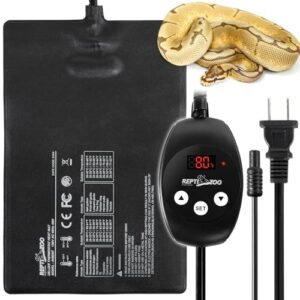
The Repti Zoo Adjustable Reptile Heat Pad steps things up with something neither previous pad offers — built-in thermostat.
You get an adjustable range of 68°F to 122°F right out of the box; no separate controller required.
The 8×12 inch, 24W carbon-fiber element heats up fast and spreads warmth evenly.
That waterproof PVC surface holds up well in humid setups too.
Just keep one eye on temps—some users report occasional overshoot, so a backup thermometer is smart.
| Best For | Reptile owners and hobbyists who want precise temperature control without buying a separate thermostat — great for bearded dragons, leopard geckos, snakes, and even non-reptile uses like fermentation or seed germination. |
|---|---|
| Wattage | 24 W |
| Pad Size | 12×8 in |
| Voltage | 120 V AC |
| Adhesive Backing | Yes |
| Waterproof | Yes |
| Thermostat Included | Yes |
| Additional Features |
|
- Built-in thermostat with a wide 68°F–122°F range means no extra controller to buy
- Carbon-fiber heating element warms up fast and distributes heat evenly across the pad
- Waterproof PVC surface handles humidity well and makes cleanup easy
- Thermostat can overshoot by up to ~10°F, so a backup thermometer is worth having
- Adhesive backing tends to lose grip over time and may peel away from tank glass
- Struggles to hit higher temps in cooler rooms, which could be a problem for baby reptiles
4. Aiicioo Reptile Under Tank Heater Thermostat
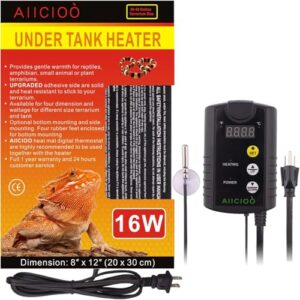
If you liked the Repti Zoo’s built-in control, you’ll appreciate how the Aiicioo Reptile Under Tank Heater Thermostat takes that idea further. This 8×12 inch, 16W pad pairs with a digital thermostat controller right in the box.
Set your target, and the probe does the watching for you. The temperature range spans 32°F to 140°F, so you’ve got plenty of room to dial in that perfect warm side.
Just note that the on/off cycling can swing by 10–15°F in cooler rooms.
| Best For | Reptile owners who want precise temperature control without buying a separate thermostat. |
|---|---|
| Wattage | 8 W |
| Pad Size | 6×8 in |
| Voltage | 120 V AC |
| Adhesive Backing | Yes |
| Waterproof | Yes |
| Thermostat Included | No |
| Additional Features |
|
- Digital thermostat is included right out of the box — no extra purchases needed
- Wide temperature range (32°F–140°F) gives you flexibility for almost any cold-blooded pet
- Works for more than just reptiles — handy for bread proofing or seedling trays too
- On/off cycling can cause 10–15°F swings, which is rough in a cold room
- Adhesive bonds hard to glass, so moving it later is a real pain
- May struggle to hit higher temps if your room is cool and the probe isn’t placed well
5. WACOOL TERRA Waterproof Reptile Heat Pad
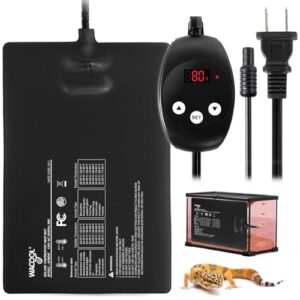
Wet habitats meet their match with the WACOOL TERRA. This 8×12 inch, 24W pad has a waterproof PVC coating, so humidity and accidental splashes won’t short it out.
That’s a real plus for tropical setups or any tank where misting is routine.
It heats fast, covers about one-third of a 30–40 gallon floor, and pairs with an included thermostat controller.
Just keep in mind the display reads Celsius only, so keep a conversion handy.
| Best For | Reptile and amphibian keepers running tropical, humid, or misted setups who need a reliable heat pad that won’t get damaged by moisture. |
|---|---|
| Wattage | 16 W |
| Pad Size | 8×12 in |
| Voltage | 120 V AC |
| Adhesive Backing | Yes |
| Waterproof | No |
| Thermostat Included | Yes |
| Additional Features |
|
- Waterproof PVC coating handles humidity and splashes without issue — great for misted terrariums
- Heats up fast and includes a thermostat controller so you’re not flying blind on temps
- Dual-sided adhesive gives you flexibility to mount it on the bottom or side of the tank
- Real-world max temp caps closer to 93°F, not the advertised 122°F — not ideal for heat-loving species
- Thermostat display is Celsius only on some units, so Fahrenheit users will need to do the math
- Not submersible, so placement needs to stay above water level and you’ll want to monitor it closely in larger enclosures
6. Lucky Herp Reptile Heating Pad
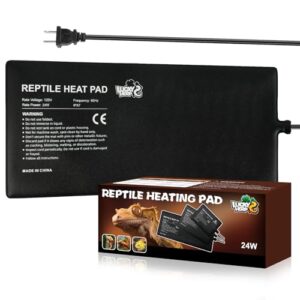
The Lucky Herp Reptile Heating Pad punches well above its price tag. At 8×18 inches and 24W, it covers a solid thermal footprint for 10–20 gallon setups.
The waterproof PVC surface wipes clean in seconds—handy when substrate gets messy.
It heats up fast and holds steady when paired with a thermostat.
Just a heads-up: the adhesive is single-use, so measure twice before sticking it down. One shot is all you get.
| Best For | Reptile and amphibian owners running small 10–20 gallon setups who want an affordable, low-maintenance heat source without a complicated install. |
|---|---|
| Wattage | 24 W |
| Pad Size | 8×12 in |
| Voltage | 120 V AC |
| Adhesive Backing | Yes |
| Waterproof | Yes |
| Thermostat Included | Yes |
| Additional Features |
|
- Heats up fast and holds a steady temp, especially when paired with an external thermostat
- Waterproof PVC wipes clean easily — no fuss when things get messy
- Low 24W draw keeps electricity costs down without sacrificing warmth
- Adhesive is single-use, so a misplaced stick means starting over with a new pad
- Struggles to bond to glass surfaces and may need extra tape to stay put
- Not powerful enough for large enclosures — a 55-gallon tank will leave you wanting more
7. BN-LINK Reptile Heating Pad Digital Thermostat
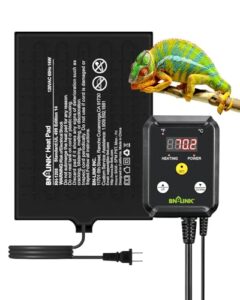
The BN-LINK combo takes the guesswork out of heating. You get an 8×12-inch pad and a digital thermostat built into one package—no separate controller needed.
The three-button interface is dead simple, and the dual °F/°C display keeps readings clear.
A 6-foot probe cord gives you real placement flexibility. One honest caveat: the suction-cup probe mount can be unreliable, so plan on taping it down.
For tanks up to 45 gallons, this setup delivers reliable, steady warmth all winter long.
| Best For | Reptile owners with tanks up to 45 gallons who want an all-in-one heating solution without buying a separate thermostat. |
|---|---|
| Wattage | 24 W |
| Pad Size | 8×18 in |
| Voltage | 120 V AC |
| Adhesive Backing | Yes |
| Waterproof | Yes |
| Thermostat Included | Yes |
| Additional Features |
|
- Thermostat and pad come together in one package—no extra controller to buy or wire up.
- Digital display with °F/°C readout makes it easy to set and check temps at a glance.
- The 6-foot probe cord gives you real flexibility in how you position everything.
- The suction-cup probe mount is unreliable and usually needs tape or an alternative fix.
- The adhesive backing is tough to remove and can damage glass or leave sticky residue behind.
- Some users report thermostat failures after a few months, which can cause dangerous temperature spikes.
8. iPower Reptile Heat Pad
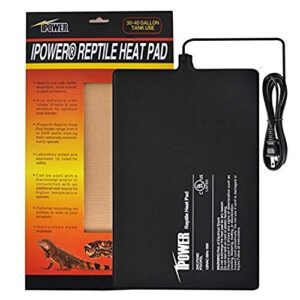
The iPower Heat Pad keeps things refreshingly straightforward. It’s an 8×12-inch, 16W mat built around a PTC heating element—that’s a self-regulating design that resists overheating on its own.
The 3M adhesive backing grips glass cleanly, and rubber feet lift your enclosure for proper airflow underneath.
It suits 30–40 gallon tanks perfectly.
One heads-up: always pair it with a separate thermostat. The mat can run hot without one, and your snake deserves better than a guessing game.
| Best For | Reptile owners with snakes, bearded dragons, or other small ectotherms in 30–40 gallon tanks who want reliable belly heat without a complicated setup. |
|---|---|
| Wattage | 16 W |
| Pad Size | 8×12 in |
| Voltage | 110 V AC |
| Adhesive Backing | Yes |
| Waterproof | Yes |
| Thermostat Included | Yes |
| Additional Features |
|
- PTC heating element self-regulates, so it’s less likely to spike to dangerous temps on its own
- 3M adhesive backing sticks firmly to glass, and the rubber feet keep airflow moving underneath
- Works beyond reptiles too — handy for shrimp tanks, seed germination, or home brewing
- Still needs a separate thermostat to be truly safe; runs too hot on its own for some setups
- Won’t cut it for every enclosure — some users (like praying mantis keepers) saw zero temperature change
- Fire risk if used without proper ventilation underneath, so setup matters a lot
Winter Snake Heating Requirements

Getting your snake’s temperature zones right in winter isn’t complicated, but the numbers do matter. Every setup has a warm side, a middle ground, and a cool retreat—and each one fulfills a specific purpose.
Here’s what those ranges look like and why they matter for your snake’s health.
Ideal Warm-side Temperatures of 88–92°F
Think of 88–92°F as your snake’s sweet spot. Hitting this temperature range on the warm side promotes metabolic rate, digestive efficiency, and stress reduction all at once.
You’ll notice basking behavior increase when thermostat control keeps that heat source placement consistent.
A proper temperature gradient depends on nailing this warm 88–92°F zone first — everything else builds from there.
A reliable maintaining a thermostat is essential for keeping the warm side within the 88–92°F range and preventing overheating.
Mid-zone Temperatures of 80–85°F
The mid-zone is your snake’s living room — where it spends most of its day. Keeping 80–85°F here promotes digestion, activity, and Thermal Gradient Consistency without forcing constant basking trips.
- Target 82°F as your mid-zone anchor
- Use a PID Thermostat Tuning setup for ±1°F stability
- Monitor Substrate Conductivity Impact with a floor-level probe
- Account for Seasonal Ambient Influence when rooms drop to 65–72°F
- Check Heat Transfer Efficiency weekly with an infrared scan
Solid temperature zoning starts here.
Cool-side Temperatures of 75–80°F
Once your mid-zone is dialed in, the cool zone quietly does just as much work. Keep it steady at 75–80°F — that’s your snake’s breathing room.
Good Airflow Optimization, smart Barrier Placement, and Substrate Conductivity all support Humidity Control here.
Whether you’re running a snake rack or a glass tank, Thermostat Accuracy keeps the temperature gradient honest without thermostat-controlled heating creeping into cool-side territory.
Safe Nighttime Temperature Drops
Nights don’t have to stress you out — or your snake. A Gradual Temperature Ramp of 5–10°F keeps things safe. Use Thermostat Programming to automate Species-specific Drop Protocols without guessing.
- Ball pythons: drop to 72–78°F
- Corn snakes: cool to 70–75°F
- Kingsnakes: limit drops to 6–10°F
- Tropical species: stay above 72°F
- Temperate species: allow up to 15°F drops
Thermal Gradient Monitoring and Nighttime Humidity Control protect snake health while thermostat-controlled heating manages the heavy lifting.
Hatchling Substrate Temperature Needs
Baby snakes are delicate. Keep substrate temps steady between 82–90°F using thermostat-controlled heating — no guessing allowed.
| Condition | Target Range |
|---|---|
| Warm-side substrate | 84–90°F |
| Cool-side substrate | 78–82°F |
| Temperature Fluctuation Tolerance | ±1–2°F daily |
| Moisture Balance | Damp, not wet |
Thin Heat Transfer Substrate — about 1–2 inches — facilitates Thermal Gradient Optimization. Watch Hatchling Activity Monitoring signals, like lethargy, to catch drift early.
Breeding Snake Winter Heat Requirements
Breeding snakes need warmer, more consistent heat than adults at rest.
Keep your warm side at 88–92°F with thermostat-controlled heating to support Hormonal Timing and ovulation.
Gradient Consistency matters here — don’t skip the cool zone at 75–80°F.
Pair that with smart Humidity Management around 60–80%, and your heat mat placement becomes a quiet but powerful part of the whole breeding setup.
Ball Python Winter Heating Needs
Ball pythons are surprisingly picky about their thermal environment.
Keep your warm side at 88–92°F using ThermostatControlled Heating Systems, and let that temperature gradient drift naturally toward 75–80°F on the cool side.
Good Heat Distribution Uniformity matters here — your heat mat should cover about half the floor.
Add Substrate Insulation, solid Humidity Management, Seasonal Thermostat Programming, and Power Surge Protection to complete the setup.
Corn Snake and King Snake Heating Needs
Corn snakes and king snakes are forgiving species — but they still need a proper thermal gradient to thrive in winter. Your heat mat setup should deliver 85–90°F on the warm side and 70–75°F on the cool side.
- thermostat-controlled heating to lock in consistent temps
- Snake Behavior Monitoring cues — restlessness signals temperature stress
- Thermal Inertia Effects when adjusting seasonal gradient shifts
- energy efficient controllers to cut winter electricity costs
- Heat Mat Longevity with quality reptile husbandry practices
Tropical Versus Temperate Snake Requirements
Not all snakes want the same thermal environment. Tropical species like ball pythons need a heat mat holding 88–92°F with humidity around 60–80% to support shedding frequency and higher metabolic rate differences.
Temperate species prefer cooler temperature gradients and seasonal temperature shifts down to 65–70°F at night. Match your substrate moisture needs and species-specific temperature requirements to your snake’s actual origin — that’s real temperature control.
Choosing The Right Heat Mat
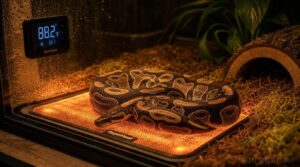
Picking the right heat mat isn’t complicated once you know what to look for. Size, wattage, and coverage all play a role in keeping your snake warm and safe this winter.
Here’s what matches up best for each enclosure type.
Matching Heat Mat Size to Enclosure Size
Getting the volume-to-mat ratio right is honestly half the battle. Think of it like Goldilocks — too small and your snake shivers, too big and you’ve cooked the whole floor.
Match your heat mat to your tank like Goldilocks — too small and your snake shivers, too large and you’ve cooked the floor
Match mat dimensions to your tank:
- 10–20 gal: 6×8 in (8W)
- 30–40 gal: 8×12 in (16W)
- 50–60 gal: 8×18 in (24W)
- Deep substrate (3+ in): bump wattage up slightly
Depth-adjusted heating matters — thicker substrate slows heat distribution, throwing off your thermostat placement and patch size calculation considerably.
Recommended Mat Coverage for Thermal Gradients
Coverage is everything for temperature gradient creation. Aim for 40–60% of the floor — one end only. This keeps a warm band on one side and a natural cool retreat on the other.
| Tank Size | Coverage Target |
|---|---|
| 10–20 gal | ~50% |
| 30–40 gal | 40–60% |
| 50–60 gal | 40–50% |
| Warm room (70°F+) | ~30% |
Ambient Temperature Adjustment matters too — warmer rooms need less coverage for proper Heat Spread Uniformity.
Comparing 8W, 16W, and 24W Heat Pads
Think of wattage like horsepower — more isn’t always better, but it matters.
An 8W heat mat suits tiny 1–5 gallon setups with low Power Consumption Rates. Step up to 16W for reliable Heat Distribution Uniformity in mid-sized tanks.
Cold room? A 24W pad’s Room Temperature Impact is real.
All three need thermostat-controlled heating for safe Wattage Efficiency.
Best Mat Sizes for 10–20 Gallon Tanks
For 10–20 gallon reptile tanks, Width Guidelines matter more than you’d think.
A 12–16 inch mat works well for 10-gallon setups; bump to 14–18 inches for 20-gallon longs.
Here’s your quick-reference list:
- Use a 8W mat for 10-gallon tanks
- Choose 16W for reliable 20-gallon heat source placement
- Cover 40–60% of the floor only
- Always check product dimensions, wattage ratings, and warranty information before buying
- Pair with Thermostat Calibration for accurate Power Consumption Estimates
Best Mat Sizes for 30–40 Gallon Tanks
Stepping up to a 30–40 gallon tank? A 16W mat hits the sweet spot for wattage per gallon here.
Aim for a mat width ratio that covers 40–60% of the floor area ratio—roughly an 8″×12″ pad along one side. This creates a solid edge-to-center gradient without overheating mid-tank.
Thermostat placement stays key. Match customizable width and length to your specific enclosure for energy efficient heating.
Best Mat Sizes for 50–60 Gallon Tanks
Once you hit 50–60 gallons, a 24W mat with the right heat mat shape makes a real difference. Your zone width ratio should cover one-third to one-half of the floor—no more.
- Use customizable width and length strips along the warm side
- Focus wattage distribution across the basking edge, not the center
- Apply an edge placement strategy, keeping the cool side fully clear
Thermostat calibration keeps everything dialed in safely.
How Substrate Depth Affects Heat Transfer
Substrate thickness quietly controls your thermal gradient more than most keepers realize. A 2–3 cm layer warms fast; go 6–8 cm deep, and heat penetration depth slows considerably — thermal diffusion rate drops, and your warm side loses punch.
| Depth | Heat Transfer Speed |
|---|---|
| 2–3 cm | Fast, sharp gradient |
| 4–5 cm | Balanced distribution |
| 6–7 cm | Slower, damped warmth |
| 8+ cm | Significant heat loss prevention needed |
Moisture-driven conductivity and substrate layering effects also matter — damp substrate holds heat longer but unevenly.
When Supplemental Winter Heating is Needed
Once room temps dip below 65°F, your snake’s temperature gradient starts to collapse.
Room Chill Levels and Air Draft Impact hit cold-side readings first — then warm-side temps follow.
Hatchling Heat Needs are most urgent; metabolism stalls fast. Breeding Heat Demand rises too.
A reliable heat mat paired with a digital thermostat is your Cold Snap Response — simple, effective, non-negotiable.
Energy-efficient Sizing for Colder Rooms
Colder rooms demand smarter wattage choices — not just bigger mats. Here’s how to size efficiently:
- Room Load Calculation — Target 60–70% of peak room heat demand for your mat’s output.
- Adjustable Wattage — Choose thermostat-compatible mats for Heat Loss Mitigation in drafty spaces.
- Insulation Impact — Insulating enclosure sides reduces energy use considerably.
- Energy Savings Strategies — An 8–16W mat manages most 10–20 gallon tanks efficiently.
Safe Installation and Thermostat Setup
Getting your heat mat installed correctly makes all the difference between a thriving snake and a trip to the vet.
There are a few key rules that every keeper should follow before plugging anything in.
Here’s what you need to know to set things up safely and confidently.
Why Every Heat Mat Needs a Thermostat

Think of a thermostat as your snake’s safety net. Without one, a heat mat runs full-blast — that’s a real Fire Risk Mitigation concern and a digestion nightmare.
A digital thermostat regulates Temperature Drift Control automatically, keeping warmth steady for Digestion Consistency. It also provides Compliance Documentation if you’re ever audited.
Thermostat-controlled heating simply isn’t optional — it’s essential heat mat safety.
Proper Floor Placement for Under-tank Heaters
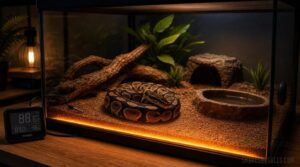
Floor placement sounds simple, but it makes or breaks your setup. Stick your under tank heater flat — Flat Surface Assurance means zero folds, zero air pockets.
Follow the one‑third to one‑half rule for proper heat zone coverage. Clean the glass, apply adhesive firmly for solid Adhesive Application, then route the cord away from water using Cable Routing Safety principles.
Confirm temps with Heat Zone Verification before adding your snake.
Avoiding Side-wall Heat Mat Placement

Side-wall placement is one of the sneakiest mistakes in Heat Mat Installation. Instead of spreading warmth evenly, it creates hot spots right where your snake rests, throwing off Gradient Uniformity and shrinking safe exploration zones.
Burn Risk Prevention starts with proper Heat Source Placement Best Practices — always bottom-only. Do Edge Lifting Checks weekly, too, since lifted edges trap moisture and spike temps fast.
Installing Heat Mats on Glass Tanks
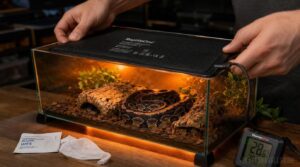
Glass tanks are actually the easiest surface for heat mat installation — no surprises there.
- Start with a Glass Surface Cleaning using isopropyl alcohol; oils kill adhesion fast.
- Edge-to-Edge Pressing removes air bubbles and locks the mat flat.
- Run an Adhesive Compatibility Test before committing.
- Do an Electrical Safety Inspection monthly — check cords for wear.
- Finish with a Temperature Gradient Check across both zones.
Installing Heat Mats on Wooden Vivariums
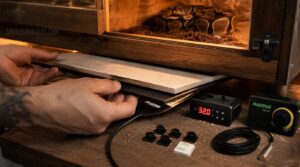
Wood vivariums need a different approach than glass. Never glue the mat directly to wood — fire risk is real. Mount it externally or separate it with a glass or tile layer for proper Moisture Protection and substrate heat conductivity.
| Step | Why It Matters |
|---|---|
| External mount with Barrier Material Types | Prevents scorching |
| Thermostat Wiring + probe placement | Locks temperature gradient |
| Ventilation Integration at back panel | Stops mold buildup |
Choose Adhesive Selection carefully — removable options beat permanent ones every time.
Using Protective Barriers to Prevent Burns
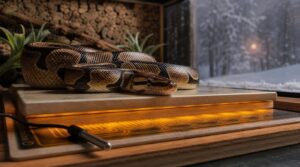
Even with a solid wooden vivarium setup, your work isn’t done yet. Protective barriers are your snake’s last line of defense against burns.
- Material Selection: Choose ceramic or tempered glass rated above 100°C — Compatibility Standards matter here.
- Placement Guidelines: Extend barriers 2–3 inches beyond the mat edge.
- Maintenance Routine: Inspect weekly; replace anything warped or discolored. Safety Testing keeps risks low.
Correct Thermostat Probe Placement
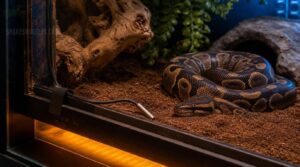
Now that your barriers are set, don’t overlook thermostat probe placement — it quietly makes or breaks your temperature gradient. Rest the probe on the substrate surface above the heat mat, never touching the glass directly.
Avoid Glass Contact; it traps heat and skews readings.
Center Warm Zone placement keeps your thermostat-controlled heating accurate.
Secure Probe Wiring with heat-safe tape, and schedule Periodic Calibration Checks monthly.
Keeping Water Dishes Off Heating Elements
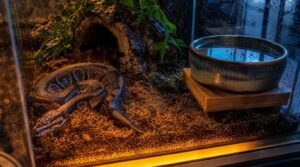
Your thermostat probe is sorted — now check where your water dish sits.
Placing it over the heat mat is a sneaky problem. Warm water speeds evaporation, stresses your snake, and messes with your gradient zone placement.
- Dish Elevation – Use a small riser or platform under the bowl.
- Non-slip Bowls – Ceramic dishes stay put on the cool side.
- Water Temperature Check – Test dish water separately; it shouldn’t feel warm.
- Mat Edge Guard – Keep bowls clear of mat edges entirely.
Avoiding Fire Hazards With Certified Devices
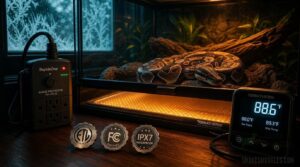
Skipping UL Certification is where fire risks quietly begin. Always use a UL listed heat strip — those labels confirm Fire-Resistant Wiring and Heat Mat Insulation meet real safety standards.
Plug into a Surge Protector and follow heat mat safety guidelines closely.
| Safety Step | Why It Matters |
|---|---|
| UL/ETL certified mat | Meets heat source certification standards |
| Digital thermostat | Prevents dangerous temperature spikes |
| Surge Protector Use | Guards against electrical overloads |
| Emergency Shutoff Testing | Confirms safety considerations for reptile heating devices work |
Monitoring Temperature and Energy Costs
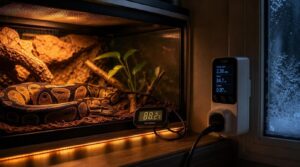
Getting the temperature right is only half the job—knowing it’s right is the other half. few simple tools and some quick math can save you money and keep your snake safe all winter.
what to watch and how to keep costs from creeping up.
Using Digital Thermometers in Warm Zones
Your warm zone is where everything happens — get this wrong and your snake pays the price. A digital thermometer here isn’t optional; it’s your first line of defense for temperature monitoring.
- Place your sensor at the basking spot center for true heat mat readings
- Enable Temperature Drift Detection by logging every 10 minutes
- Use Wireless Thermometer Integration for real-time alerts
- Practice Battery Life Management — swap batteries monthly
Using Digital Thermometers in Cool Zones
Don’t overlook your cool zone — it’s just as important as the warm side for temperature gradient monitoring.
Place water-resistant probes at mid-height, away from water dishes and airflow, for accurate readings.
Set logging intervals to every 15 minutes and enable alert thresholds if readings climb above 82°F.
Monthly calibration keeps your digital thermometer honest.
Probe placement completes your full enclosure temperature picture.
Checking Surface Heat With Infrared Thermometers
An infrared thermometer is your reptile heat mat’s lie detector — point, shoot, and the surface temperature is right there.
- Check spot size consistency by holding the device at the right distance so it reads the exact zone you want.
- Practice surface uniformity mapping to catch hot or cool patches across your temperature gradient.
- Schedule measurement timing in the morning and evening for reliable thermoregulation data.
Watch for device drift and adjust emissivity settings for accurate digital thermometer readings.
Benefits of PID and Proportional Thermostats
Think of a PID thermostat as cruise control for your snake’s enclosure. It delivers Precise Temperature Control by constantly nudging heat output — never just flipping on and off.
That means Stable Humidity Levels, Quiet Operation, and Extended Heater Lifespan. This digital thermostat approach is one of the smartest energy efficient heating options you can choose, cutting reduced energy waste without sacrificing reliable temperature regulation.
Remote-sensor Thermostats for Winter Alerts
Remote-sensor thermostats take your winter monitoring to another level. These temperature monitoring tools for reptile enclosures support Multi-Zone Coordination, tracking warm and cool sides simultaneously.
Freeze Alert Settings notify you via app if temps dip dangerously low — even overnight. Power Management Alerts flag inefficient heating cycles, and Connectivity Options like Wi-Fi keep you informed remotely.
Regular Firmware Updates sharpen alert accuracy, making thermostat integration with reptile heat mats genuinely reliable.
Monthly Thermometer Calibration Tips
Once your remote-sensor thermostat is dialed in, your digital thermometers still need monthly checks. Drift happens quietly.
Keep a calibration logbook and follow these steps:
- Use the ice‑water method — stir, stabilize, then read at 0°C
- Cross‑check with a boiling‑water reference at 100°C
- Test in a draft‑free environment for clean readings
- Flag anything outside tolerance thresholds and replace it fast
Calculating Heat Mat Electricity Costs
Now that thermometers are dialed in, let’s talk money. Running a 16W mat 12 hours daily uses roughly 4.8 kWh monthly—that’s about 1.44 EUR at 0.30 EUR/kWh.
Use this energy usage formula: (watts ÷ 1,000) × daily hours × 30 × your cost per kWh. Wattage to cost math is simple once you check your bill’s rate.
Reducing Winter Heating Expenses Safely
Keeping bills low doesn’t mean cutting corners on your snake’s comfort. A few smart moves go a long way:
- Use thermostat scheduling and timer-controlled mats to run heat only when needed
- Try insulation techniques like foam panels on enclosure sides to retain warmth
- Pick low-power heat pads (8–16W) as cost-effective heating solutions for cold climates
- Choose energy-efficient substrate depths of 1–2 inches for better heat transfer
Thermostat-controlled heating manages the rest automatically.
Preventing Overheating, Mold, and Poor Ventilation
Saving money is great, but poor airflow optimization or skipped humidity management can cost you more—in vet bills. Keep indoor humidity between 30–50% and run an exhaust fan nearby.
temperature spike alerts from remote sensors catch dangerous overheating fast. clean mats regularly, check heat shield positioning, and never block vents.
These safety considerations for reptile heating devices protect your snake all winter.
Frequently Asked Questions (FAQs)
How do I keep my snake warm during the winter?
Your snake basically thinks it’s cold enough to hibernate if winter drops hit.
A heat mat plus adjustable thermostat creates behavioral thermoregulation zones, supporting snake health through seasonal energy savings and proper ambient room heating.
Are heating mats safe for snakes?
Yes — but only when used correctly. Pair your mat with a thermostat, mind your substrate heat transfer, and follow basic user safety guidelines.
Done right, they’re a reliable, reptile-health-friendly heat source.
Should I leave my snakes heat mat on all night?
Funny how snakes and thermostats have one thing in common — both need consistency overnight. Leave the mat on, but only with a thermostat-controlled heating setup to prevent dangerous spikes.
Can heat mats be used with bioactive setups?
Heat mats can work in bioactive setups, but use a thermostat and barrier materials to protect root safety, microfauna health, and moisture retention.
substrate thickness under three inches for decent heat distribution.
How do power outages affect snake health overnight?
A power outage overnight hits harder than you’d think. Digestive slowdown kicks in fast, torpor risk climbs, and stress lethargy follows.
Temperature monitoring every few hours keeps your snake’s recovery timing on track.
Do heat mats work inside PVC enclosures?
Absolutely — heat mats work well in PVC enclosures.
Just place a barrier material between the mat and floor for even PVC heat transfer, use a thermostat, and watch for condensation buildup underneath.
How long do reptile heating mats typically last?
Think of heat mat like a good pair of boots — treat it right, and it’ll go the distance.
They last three to five years, though quality materials and thermostat use can push that further.
Conclusion
snake’s digestion shuts down when substrate temps drop just 5°F below target—that’s how precise this all needs to be.
Getting reptile heating mats for winter snake keeping right isn’t complicated once you match wattage to enclosure size and plug everything into a reliable thermostat.
Check temps weekly, position your probe correctly, and your snake stays warm, active, and healthy all winter.
Cold rooms don’t have to mean cold snakes.