This site is supported by our readers. We may earn a commission, at no cost to you, if you purchase through links.

Traveling with a boa constrictor isn’t like tossing a dog bed in the back seat and hitting the road.
These animals run on temperature gradients, specific humidity windows, and a deep need for security—and none of that pauses because you’re crossing state lines.
Get the enclosure wrong, and you’re not just dealing with a stressed snake; you’re managing a potential escape artist in a moving vehicle.
The good news: boa constrictor enclosures for traveling keepers have come a long way, with smart options for every setup and snake size.
Nail the basics, and your boa arrives calm, healthy, and none the wiser about the trip.
Table Of Contents
Key Takeaways
- Your boa needs a travel enclosure with rigid walls, secure latches, and no tape anywhere near it—spring latches and sticky shortcuts are how escapes happen.
- Keep the basking side at 86–90°F and the cool side at 75–80°F using a thermostat, because temperature swings are the biggest health risk on the road.
- Hit that 45–55% humidity sweet spot with damp sphagnum moss and coco husk substrate, and always pack a calibrated digital hygrometer to catch any shifts early.
- Before you leave, save three emergency contacts—your home vet, a reptile clinic near your destination, and ASPCA Poison Control at (888) 426-4435—because not every ER knows boas.
Choose Travel-Safe Boa Enclosures
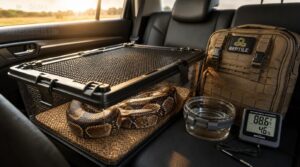
Not every enclosure that works great at home will hold up on the road—and your boa deserves better than a last-minute fix. Picking the right travel setup starts with knowing your options. Here’s what you need to keep in mind before you hit the road.
Brushing up on boa constrictor handling and health basics before you travel can save you a stressful situation far from home.
Temporary Versus Permanent Housing
Think of it this way: your permanent enclosure is home base, while your travel setup is the carry-on bag. Permanent enclosures use laminated plywood or fiberglass — built tough, anchored in place, and designed to last years. Travel crates stay lightweight and compact, fitting easily into a trunk. Same snake, different mission.
Adult Boa Size Minimums
Size matters — especially when your boa is 7 feet of pure muscle. Minimum enclosure dimensions for most adults start at 6×3×3 feet, giving them room to fully stretch out. Females, thanks to sexual dimorphism, regularly hit 7–8 feet and need closer to 8×4×4.
Applying the recommended size formula ensures the enclosure meets length, width, and height requirements.
- Track length every few months to nail enclosure upgrade timing
- Floor area must match or exceed your boa’s total length
- Space for stretching isn’t optional — it directly reduces stress
Juvenile Travel Container Sizes
Young boas are small but sneaky — don’t underestimate their escape instincts. For juveniles under 2 feet, aim for a container 12–16 inches long with 2–3 inches of clearance behind the snake. Around 18–24 inches? Step up to an 18–22 inch container. Keep ventilation holes at 6–10% of surface area and always make sure you can inspect your snake without a full unboxing.
Rigid Boxes and Snake Bags
Once your container sizes are sorted, it’s time to think about what that container is actually made of. Rigid box construction — using greyboard or chipboard cores — gives your boa a secure enclosure that won’t flex or pop open mid-trip.
- Box material choices matter: rigid walls resist deformation
- Insulated travel designs buffer temperature swings
- Bag fabric types like ripstop resist tearing
- Closure mechanisms — drawstrings, zippers, or magnetic latches — prevent accidental openings
Modular Travel-Friendly Setups
If you’re always on the move, a modular enclosure system is worth every penny. These setups use lightweight frames with detachable compartments — each module under 1.2 pounds — so you can reconfigure between car trips and airport carry without breaking a sweat. Think of it as a PVC reptile enclosure that actually fits your lifestyle.
Maintain Heat During Travel
Keeping your boa warm on the road isn’t complicated, but it does require some planning before you pull out of the driveway. Temperature swings are one of the biggest travel risks for these snakes, so getting this right matters. Here’s what you need to know to keep the heat dialed in from start to finish.
Before you hit the road, double-check you’ve got the right temps locked in—this snake basking spot temperature guide breaks down exactly what your boa needs to stay comfortable and healthy.
Safe Basking Temperature Range
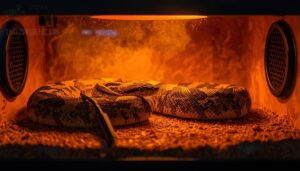
Your boa’s basking spot is basically its personal recharging station — and keeping it dialed in during travel matters more than most keepers realize. Aim for 30–32°C (86–90°F) at the basking surface. Pair a reptile-rated heat lamp or ceramic heater with a calibrated thermostat to hold that range steady, even on the road.
Cool Side Temperature Control

While your boa’s basking side manages warmth, the cool side does the quiet, unglamorous work of keeping thermal regulation on track. Keep it between 75–80°F (24–27°C). A breathable but insulated enclosure cuts outside radiant heat by at least 15%, and reflective interior lining drops surface temps up to 4°C — small details that add up fast on a long drive.
Thermostats for Portable Heating

Think of a thermostat as your heater’s babysitter — it keeps things steady so you don’t have to. Inline thermostats plug right between your outlet and heater, cutting power when the setpoint’s reached. Look for UL or CE certification and precision within 1–2°F. Smart controllers with Wi-Fi let you monitor temperature remotely, which is genuinely reassuring mid-drive.
Heat Pack Safety Tips

Heat packs are like a warm handshake for your boa — reliable when done right, but risky if you skip the basics. Before anything touches the enclosure, test the pack on your inner wrist. It should feel comfortably warm, never hot. That simple check takes two seconds and could save your snake from a burn.
A few non-negotiables to keep in your back pocket:
- Always wrap packs in a thick cloth or sleeve — no direct contact with surfaces
- Limit sessions to 20 minutes to prevent material damage or hot spots
- Inspect every pack for leaks, swelling, or damage before and after use
- Log temperatures at regular intervals so you catch any spikes before they become a problem
Keep packs away from metal components inside the enclosure — metal conducts heat fast and creates exactly the kind of dangerous focal hot spot you’re trying to avoid. Spread warmth with multiple smaller packs rather than one large one. It keeps heat distribution even and your boa calm and comfortable throughout the journey.
Avoiding Overheating Risks

Overheating can sneak up fast — especially when you’re parked in the sun or stuck in traffic. That’s why temperature consistency isn’t optional. Use a digital thermometer on both ends and check readings every 2–3 hours. Your thermostat is the safety net, but you’re the backup.
Good ventilation design and a thin substrate layer act as a natural heat buffer, keeping things stable without babysitting every degree.
Control Humidity on The Road

Humidity is one of those things that sneaks up on you mid-trip if you’re not prepared. Boas need that 50–70% sweet spot to breathe easy and shed properly, even when you’re hours from home. Here’s what to keep in your corner to make it happen.
Ideal Travel Humidity Levels
Keeping humidity dialed in during travel isn’t complicated — it just needs a plan. Target RH zones of 45–55% strike the sweet spot for boas on the road, supporting healthy skin and reducing respiratory irritation without promoting mold growth.
A digital hygrometer is your best travel companion here. Calibrate it before you leave — you want accuracy within ±3% RH.
Damp Moss Humid Hides
A damp sphagnum moss hide is your humidity safety net on the road. Pack the moss moist but not dripping, tuck it into a cozy hide, and place it on the cool side. Swap it out every two to four weeks — sooner if you spot mold or sour smells. A hygrometer nearby keeps your microclimate honest.
Coco Husk Travel Substrate
Moss does the heavy lifting for moisture, but coco husk substrate pulls its weight too. It’s a sustainable substrate option made from coconut husks — renewable, biodegradable, and surprisingly effective at substrate hydration during travel.
Here’s why it works so well on the road:
- Humidity management — its hygroscopic fibers slowly release moisture, keeping levels steady without constant misting.
- Burrowing substrate support — the loose, diggable texture lets your boa settle naturally without compacting under transit bumps.
- Odor control — mix in a little charcoal or moss for fresher air during longer trips.
Its natural airflow optimization also reduces mold risk inside a secure enclosure, making substrate hygiene easier to maintain.
Digital Hygrometer Placement
Your coco husk is holding humidity steady — now you need to actually know what’s happening inside that enclosure. That’s where your digital hygrometer earns its keep.
Place it near the warm basking area inside the enclosure. That’s your most active microclimate, and it’s where humidity monitoring matters most during travel.
| Placement Factor | Recommendation | Why It Matters |
|---|---|---|
| Position | Near basking zone | Reflects active microclimate |
| Calibration | Before every trip | Keeps readings within ±3% |
| Alert System | Set high/low thresholds | Catches dangerous humidity shifts |
Probe positioning away from direct heat sources prevents skewed readings. Use data logging to track trends over the trip, and set alert systems for instant warnings. A quick transit mounting fix — adhesive sleeve or probe clip — keeps everything stable on bumpy roads.
Ventilation Without Drying Out
Good ventilation doesn’t have to mean dry air. Place snake-level ventilation holes on opposite sides of the enclosure to create a gentle cross-flow — enough fresh air without blasting humidity out. A hygroscopic mesh or fine membrane over those openings slows moisture loss greatly. Your substrate does the rest, releasing humidity steadily so the air stays balanced, not stagnant.
Prevent Escapes and Injuries
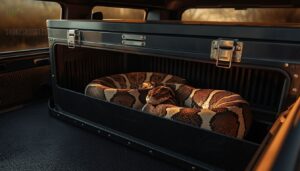
A boa that escapes mid-trip isn’t just stressful — it’s dangerous for both of you. The good news is that a few smart habits before you hit the road can keep everything locked down tight. Here’s what to check before you go.
Secure Latches and Locks
A boa that wants out will find any weak point — so your locks need to mean business.
For an escape-proof enclosure, skip spring latches entirely. They can be forced with enough leverage, and a 30 lb adult boa has plenty. Instead, look for:
- Hardened steel latches with reinforced strike plates
- Anti-tamper mechanisms with tamper-resistant screws
- Keyless security systems for quick, reliable access
Clamp Sliding Glass Lids
Sliding glass lids are only as secure as the clamps holding them. For escape prevention, frameless glass clamps are your best friend — they grip 3/8 to 1/2 inch tempered glass without drilling or adhesives. Look for anti-lift designs that stop a determined boa from nosing the door upward, and always confirm track compatibility before buying.
Inspect Seams Before Leaving
Think of your enclosure seams as the last line of defense between your boa and freedom. Before any trip, run your fingertips along every seam, checking for fraying, pulled threads, or gaps where panels meet. Test each latch — it should click shut with audible positive closure. Spot any corrosion or cracked rubber seals immediately, and keep an emergency seam repair kit packed and ready.
Avoid Tape Near Snakes
Tape seems like a quick fix, but it’s one of the worst things you can bring near a snake enclosure. Adhesive residue transfers directly to scales, causing irritation, microtrauma, and even skin tearing during removal. Train every handler: no tape near snakes, ever. Use purpose-built reptile clips or locking latches instead — your escape-proof enclosure deserves better than a sticky shortcut.
Tape near a snake enclosure isn’t a quick fix — it’s a direct path to scale damage, irritation, and injury
Minimize Stressful Movement
Movement is medicine — or poison — depending on how you handle it. Every jostle, sudden grab, or hasty transfer chips away at your boa’s sense of safety. Calm Handling Drills practiced at home pay off big on travel days. Slow, deliberate lifts with full body support keep stress signals quiet and your snake cooperative when it matters most.
Pack Boa Travel Essentials
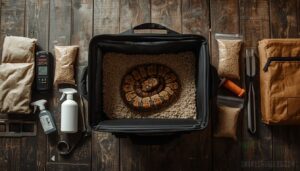
You’ve locked down the enclosure, nailed the temps, and kept humidity right where it needs to be — now it’s time to make sure your bag is just as ready as your boa. A few key supplies can be the difference between a smooth trip and a stressful scramble. Here’s what to pack before you hit the road.
Water and Hydration Supplies
Water is easy to overlook when you’re packing, but your boa needs consistent access to clean hydration on the road. A large water bowl anchored in the enclosure lets your snake soak and drink naturally. Pair that with a hydration bladder holding one to three liters, and you’ve got plenty of reserves without constant refills.
Backup Heat Sources
Hydration sorted — now let’s talk heat. Cold snaps during travel can hit fast, and a single heat source isn’t enough insurance.
Pack at least two backup units: a portable heater module and electric backup heat strips rated 1,000–5,000 watts. Pair them with automatic thermostats to keep warm zones steady without babysitting the temperature all trip.
Cleaning and Waste Supplies
Heat’s covered — now think about the mess. Daily spot cleaning keeps waste from building up fast, so pack heavy-duty trash bags (13–55 gallons work well) and sealed waste bags to trap odors on the road.
Tuck in a reptile-safe disinfectant spray, microfiber cloths, and odor-absorbing charcoal bags to keep things fresh between stops.
Emergency Vet Information
You’ve sorted the mess — now think about the "what if."
Before you hit the road, research reptile-savvy vets along your route. Not every clinic knows boas, so a regular dog-and-cat ER won’t always cut it.
Save three things in your phone:
- Your local vet’s after-hours number
- A reptile emergency clinic near your destination
- The ASPCA Poison Control line: (888) 426-4435
If something goes wrong, call ahead so they can prepare — triage works faster when the clinic knows a boa is incoming.
Quiet Hides for Security
A stressed boa is a quiet boa — but not in a good way. Quiet hide mats use dense closed-cell foam with a soft fabric top to dampen movement noise inside the enclosure. That alone can take the edge off a long drive. Pair one with a Zen Corner Cave for a secure, nonreflective retreat your boa will actually use.
Frequently Asked Questions (FAQs)
How to travel with a boa constrictor?
Traveling with a boa means planning every detail — the right container, stable temps, controlled humidity, and escape-proof security. Get those basics right, and your snake arrives calm, healthy, and stress-free.
Can boas travel safely on long flights?
Yes, boas can handle long flights well — as long as you plan ahead. An escape-proof enclosure, steady temperature monitoring, and proper humidity control make all the difference between a smooth trip and a stressful one.
How do you calm a stressed boa mid-trip?
Think of a hide as your boa’s "off switch." When stress hits mid-trip, stop all handling, keep the carrier dark and still, and let familiar scents do the calming work for you.
Which states require permits to transport boas?
A few states take boa transport seriously. Texas, California, and New York all require permits. Florida is more relaxed but still has interstate rules. Always check before you hit the road.
How often should you feed a boa during travel?
Stick to your normal feeding schedule on the road. Adults eat every 10–14 days; juveniles every 7– If temperatures dip, delay feeding — cool boas digest slowly and a rushed meal causes real problems.
What health signs indicate travel is too stressful?
Your boa’s body doesn’t lie. Restlessness signs like constant repositioning, open-mouth breathing, or a sudden appetite loss after travel are red flags. Abnormal shedding and stress behaviors mean it’s time to reassess your setup.
Conclusion
The hardest part of traveling with a boa isn’t the snake—it’s convincing yourself you’ve got everything covered. But here’s the irony: once you dial in your boa constrictor enclosures for traveling keepers, the snake usually copes with the trip better than you do. Nail the heat, lock down the humidity, double-check those latches, and pack your backup kit. Your boa will arrive calm and unbothered—meanwhile, you’ll be the one who needed the vacation.