This site is supported by our readers. We may earn a commission, at no cost to you, if you purchase through links.

A corn snake that can’t thermoregulate properly will stop eating. One sitting in too-large an enclosure will spend most of its time stressed, hiding, and refusing to thrive. The setup isn’t cosmetic; it’s the difference between a snake that feeds well and one that quietly declines.
What makes a good corn snake home comes down to measurable specifics: the right temperature gradient, secure ventilation, humidity that shifts during shed, and a substrate deep enough for actual burrowing. Every element connects to a biological need.
Get the enclosure right from the start, and you’ll spend far less time troubleshooting problems down the road.
Table Of Contents
- Key Takeaways
- What Makes a Good Corn Snake Home?
- Choose The Right Corn Snake Enclosure Size and Material
- Create Safe Temperature, Humidity, and Lighting
- Add Safe Substrate, Hides, and Enrichment
- Keep The Corn Snake Enclosure Clean and Healthy
- Frequently Asked Questions (FAQs)
- How to make a good corn snake habitat?
- How to tell if a corn snake trusts you?
- What makes a corn snake happy?
- Do cornsnakes like to be held?
- What decor do corn snakes like?
- How often should UVB bulbs be replaced?
- How often should you feed an adult corn snake?
- Should rodents be thawed before feeding your snake?
- How often should I feed my corn snake?
- Can corn snakes be housed together safely?
- Conclusion
Key Takeaways
- Your corn snake’s enclosure size must match its life stage — starting too large causes chronic stress and feeding refusals that are far harder to fix than they are to prevent.
- A reliable temperature gradient (warm side 28–32°C, cool side 22–26°C) is non-negotiable, because a snake that can’t thermoregulate properly will stop eating and quietly decline.
- Humidity between 40–60% (raised to 50–70% during shed) combined with a damp moss hide prevents incomplete sheds, which are the single most common husbandry failure in corn snake keeping.
- Substrate depth, hide placement, and a consistent 12-hour light cycle aren’t cosmetic choices — they directly drive feeding behavior, shed quality, and your snake’s long-term stress levels.
What Makes a Good Corn Snake Home?
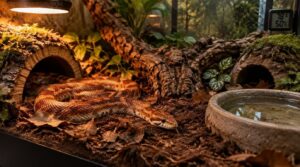
Snakes don’t thrive in minimalist setups with a water bowl and a single heat lamp. A proper corn snake home gives your animal real behavioral choices: somewhere warm to digest, somewhere cool to rest, and a substrate it can burrow into when it needs to feel hidden.
Feeding in the enclosure also removes unnecessary stress — your snake’s corn snake feeding guide can help you build a routine that works with the habitat you’ve already set up.
Think of reptile habitat setup as replicating function, not scenery. Your corn snake needs a reliable temperature gradient, stable humidity, and at least two hides to feel secure. When those essential conditions are met consistently, your snake eats well, sheds cleanly, and stays calm during handling.
Every detail builds on the last. Substrate affects humidity. Enclosure size shapes the thermal gradient. Get the fundamentals right first, and everything else follows naturally from there.
Choose The Right Corn Snake Enclosure Size and Material
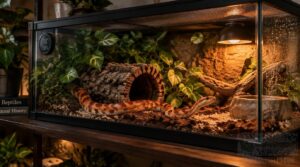
The enclosure you choose affects everything from your snake’s security to its ability to thermoregulate properly. Size, material, and ventilation each play a distinct role at every life stage. Here’s what to look for across all three.
Sizing for Each Life Stage
Every life stage demands a specific enclosure size. Baby corn snakes do best in 10–20 gallon tanks, where tighter quarters reduce stress and build feeding confidence. Plan a 30–40 gallon during the subadult phase, then commit to a 40–60 gallon for adults.
Reptile husbandry done right always means gradual transitions. Sudden jumps compromise habitat security and often trigger feeding refusals.
PVC, Glass, or Wood
Once you’ve locked in the right enclosure size, material determines long-term ease. PVC front-opening designs hold heat better in cooler rooms and resist moisture, making reptile husbandry simpler across seasons.
For a deeper look at sizing and setup options, juvenile boa constrictor enclosure guides cover how PVC builds support bioactive layouts as your snake grows.
Glass offers better visibility and lets you monitor conditions at a glance, but expect higher heating costs.
Wood can work with proper sealing; skip it if humidity control challenges you.
Ventilation and Escape Prevention
Material choice affects ventilation directly. Front-opening designs work best with microclimate vents at multiple levels, preventing stagnant pockets and keeping reptile air quality consistent throughout the enclosure.
For snake escape prevention, inspect every seam. Overlapping mesh frames eliminate gaps above 4 mm, the threshold a corn snake can’t pass. A positive-pressure fan-assisted draft reduces backflow whenever you open the door.
Create Safe Temperature, Humidity, and Lighting
Getting the climate inside your corn snake’s enclosure right is one of the most critical things you’ll do as a keeper. Temperature, humidity, and lighting each play a distinct role in your snake’s health, and small mistakes in any of them compound quickly. Here’s what you need to control and why it matters.
Warm and Cool Zones
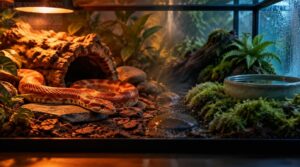
A corn snake can’t self-regulate body heat. Your enclosure’s temperature gradient drives thermoregulation: set the warm zone to 28-32°C and the cool zone to 22-26°C.
- Place a heat mat under the warm end for steady basking temperatures
- Keep thermal zones 6-12°C apart
- Measure each zone with a separate sensor
- Let your snake move freely between both zones for natural thermoregulation
Thermostats and Heating Safety
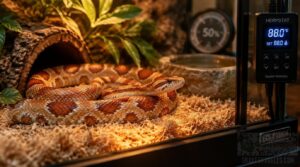
Because runaway heat kills quickly, a pulse-proportional thermostat is the most critical safety device in any setup.
| Feature | Spec |
|---|---|
| Thermostat | Pulse-proportional |
| Heat mat | Insulated, under-tank |
| Substrate | 2-inch minimum |
| Enclosure size | One controller only |
| Heat source placement | Edge-mounted |
Use only one heat source per controller. Recheck your setpoint after adding substrate, since depth changes the surface temperature your snake actually experiences.
Humidity and Shedding Support
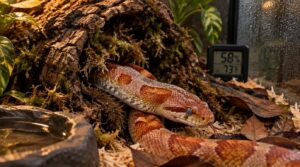
A dry enclosure is the single most common cause of incomplete sheds. Keep humidity between 40 and 60% normally, then raise it to 50-70% once you’ve spotted pre-shed signs.
A humid hide packed with damp sphagnum moss gives targeted shedding assistance without waterlogging your whole setup. That careful habitat humidity balance protects your snake’s eyes and scales every single molt.
UVB and Day-night Cycles

Studies show reptiles kept without a structured lighting schedule develop stress behaviors fast.
- A 12-hour photoperiod cycle prevents appetite loss and irregular shedding
- UVB bulbs at 290-320 nm support bone health and calcium metabolism
- Dim your reptile lighting gradually; a slow dawn shift beats an abrupt switch every time
Set your day-night cycle on a timer and stick to it.
Add Safe Substrate, Hides, and Enrichment
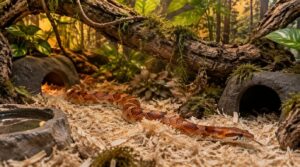
What’s beneath your snake matters more than most keepers expect. For substrate safety, choose aspen shavings over pine or cedar; those aromatic oils are genuinely harmful. Aim for 2 to 4 inches of depth so your snake can burrow comfortably without tail entrapment in substrate folds.
Substrate selection also shapes humidity. Keep it dry enough to prevent fungal growth, and mist only when your readings call for it.
Your hides should fit snugly, roughly 1.5 times your snake’s girth. Place one on the warm side, one on the cool. Opaque, non-porous materials retain heat without warping.
For more guidance on material choices and sizing, setting up a safe snake enclosure and habitat covers what works best across common species.
For habitat enrichment, add climbing branches rated for at least five pounds. Rotate logs and vines every four to six weeks to maintain novelty.
Keep The Corn Snake Enclosure Clean and Healthy
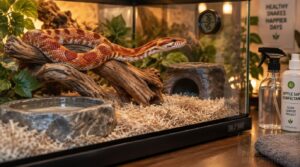
A dirty enclosure is a sick snake waiting to happen. Spot-clean feces and urates daily, and commit to deep cleaning on a regular schedule, because biofilm builds invisibly on glass, hides, and décor long before you can smell it. Use a reptile-safe disinfectant, rinse thoroughly, and let everything dry completely before returning items.
A dirty enclosure is a sick snake waiting to happen — clean it before you can smell it
Substrate safety starts with storage. Keep unused bedding sealed to block contamination before it reaches the enclosure.
Scrub the water bowl every few days. Standing water breeds bacteria faster than most keepers expect.
Follow consistent hygiene protocols: dedicated tools per enclosure, hands washed before and after every session. If you’re introducing a new snake, quarantine it separately for at least 90 days to prevent silent pathogen spread.
Frequently Asked Questions (FAQs)
How to make a good corn snake habitat?
A keeper once lost a healthy corn snake to an overheated enclosure with no cool zone. Build your habitat setup around a temperature gradient, add proper substrate, two solid hiding spots, and maintain steady humidity.
How to tell if a corn snake trusts you?
Corn snakes handled consistently for 8 to 10 weeks show measurably lower stress responses during contact. Your pet snake trusts you when it moves calmly, tracks your presence, and explores near your hand without retreating.
What makes a corn snake happy?
Think of it like a thermostat for behavior. When thermoregulation is dialed in, humidity stays consistent, the enclosure size allows full natural movement, and hiding spots plus climbing branches are readily available, your snake thrives.
Do cornsnakes like to be held?
Some genuinely enjoy being held; others simply prefer minimal contact. Individual temperament drives this more than anything else, but calm, consistent handling two to three times weekly builds lasting tolerance in most snakes over time.
What decor do corn snakes like?
Your corn snake thrives with climbing branches, secure hides, and faux foliage. Always skip cedar and pine shavings. A naturalistic enclosure with rough bark, dark tones, and smooth substrate keeps stress low and shedding easy.
How often should UVB bulbs be replaced?
A UVB bulb can look perfectly bright while emitting absolutely zero usable ultraviolet. Replace T8 tubes every 6 months and T5 tubes every 12 months, then verify the real output with a handheld UV meter.
Understanding UVB output and degradation is essential, as mercury depletion and glass solarization cause invisible drops in UVI that only a Solarmeter 5 UV Index Meter can accurately detect.
How often should you feed an adult corn snake?
Feed adults every 14 to 21 days, adjusting for body condition and season. Leaner snakes often benefit from tighter 10–14-day intervals; overweight ones need more spacing. Always match frozen-thawed prey size to your snake’s girth.
Should rodents be thawed before feeding your snake?
Always thaw frozen-thawed prey fully before feeding. Submerging it in a sealed bag of warm water brings the prey to the right temperature, triggers your snake’s feeding response, and keeps your routine clean and safe.
How often should I feed my corn snake?
Like a clock tied to growth, your snake feeding schedule shifts with every life stage. Hatchlings eat every 5-7 days, juveniles every 7-10 days, and fully grown adults need frozen-thawed prey only every 14-21 days.
Can corn snakes be housed together safely?
Corn snakes are naturally solitary, and cohabitation reliably increases stress, bite risk, and disease transmission. Even without any visible aggression, resource competition over hides and heat gradients makes separate enclosures the only truly safe choice.
If you’re worried about temperament, how male and female corn snakes differ in aggression shows that gentle handling and a calm, well-set-up habitat matter more than sex.
Silent suffering is often the real danger, as explored in this guide on keeping corn snakes together safely—problems don’t announce themselves until real harm is done.
Conclusion
Think of the keeper who built the enclosure right on day one: warm side at 85°F, cool side at 72°F, two snug hides, and a substrate deep enough to actually burrow. Their corn snake fed every single week and shed cleanly, without any issues, every single time. That’s what makes a good corn snake home so important.
Get every setup detail right from the start, and the snake you’re keeping will thrive, not just survive.