This site is supported by our readers. We may earn a commission, at no cost to you, if you purchase through links.

An adult corn snake needs a 40-gallon enclosure. Your dorm contract probably caps tank size well under that. That mismatch trips up more first-time reptile owners than any feeding or shedding issue ever will.
Here’s the thing: corn snake enclosures for college students aren’t just about finding something that fits on a desk — they’re about satisfying RA inspections, roommate nerves, and campus housing codes all at once, without your snake living in a cramped box for four years.
Get the setup right early, and you avoid a mid-semester scramble to rehome your pet.
Table Of Contents
- Key Takeaways
- Check Campus Rules Before Buying
- Choose a Dorm-Sized Corn Snake Enclosure
- Top 3 Corn Snake Enclosures
- Manage Heat, Humidity, and Ventilation
- Create a Secure Roommate-Friendly Setup
- Frequently Asked Questions (FAQs)
- Can I have a snake in my college dorm?
- What is the best enclosure for a corn snake?
- How cold is too cold for a corn snake at night?
- Do corn snakes like vertical or horizontal enclosure?
- How much does a corn snake enclosure setup cost?
- Can corn snakes live with other pets in dorms?
- How long do corn snakes live in captivity?
- What should snakes eat, and how often?
- Can I bring my corn snake home during breaks?
- Conclusion
Key Takeaways
- Check your campus pet policy and register your snake within 14 days of move-in, since most schools ban pets entirely and the rest require paperwork, RA approval, and roommate consent before you buy anything.
- Adult corn snakes need around 40 gallons (36×18×18 inches) to thermoregulate properly, so start juveniles in a smaller 20-30 gallon tank and plan to upgrade as they grow.
- Keep a warm side at 28-32°C and a cool side at 22-26°C using a thermostat-controlled heat mat, and monitor humidity (40-60%) with a digital hygrometer to keep your snake healthy.
- Choose a front-opening enclosure with escape-proof latches (gaps under 1-2mm) and easy-clean substrate like reptile carpet to keep your roommate comfortable and your snake secure.
Check Campus Rules Before Buying

Before you drop a dime on a fancy terrarium, check with your school first — 96% of campuses ban pets outright, and the rest have rules that’ll trip you up if you skip this step. Registration, size caps, and RA sign-off all matter more than which tank looks cool in your dorm. Here’s what to sort out before you buy anything.
Pet Registration Requirements
Before you buy anything, log into your school’s housing portal and fill out the pet registration form within 14 days of move-in. You’ll need your student ID, room number, a snake photo, insurance proof upload, and health certificate renewal — plus microchip ID submission if applicable.
Once the paperwork’s sorted, check out this guide to choosing a snake enclosure for college dorms to set up a safe, space-smart home for your new roommate.
University email notifications track renewal deadlines, so don’t ignore them.
Enclosure Size Restrictions
Once you’re registered, the next hurdle is space. Most campus housing policies cap enclosure footprint at under 20 gallons for shared rooms, even though adult corn snakes need 40 gallons to thermoregulate properly.
- Check dorm room capacity limits before buying
- Confirm minimum tank size in writing
- Ask about weight-rated stands
- Verify escape-proof enclosure requirements
- Note 48-hour removal rules for violations
Roommate and RA Approval
Paper isn’t optional here — your roommate signs a consent form before the tank arrives, covering odor, noise, and allergy concerns. Your RA verifies everything through an inspection checklist: escape-proof latches, clean substrate, proper documentation.
Skip this, and you risk housing relocation. Renewals happen yearly, so keep that paperwork handy — it’s your proof of compliance when questions come up.
Local Reptile Laws
Beyond campus, your city may require a $50 annual permit, plus proof of legal acquisition and liability insurance.
Species restrictions often ban pythons over six feet or venomous reptiles entirely. Enclosures must meet size and lockable-door standards, and health codes require vet certificates.
Skipping wildlife law compliance risks confiscation or fines — stack that atop your roommate agreement, and non-compliance gets expensive fast.
Emergency Removal Planning
When alarms sound, your snake doesn’t get a grace period — so build an evacuation route mapping plan now. Keep a lightweight transport container by the enclosure, note emergency contacts, and set up a roommate alert system.
Line up a temporary housing plan or backup housing plan (friend’s apartment, reptile-savvy RA) before you need it. Quick-release enclosure design saves precious seconds.
Choose a Dorm-Sized Corn Snake Enclosure
Once your paperwork’s sorted, the real question is fit — for your snake and your floor plan. A 40-gallon tank sounds reasonable until you measure the actual space next to your mini fridge. Here’s how to size things right, from juvenile tubs to full-grown setups.
Adult Minimum Enclosure Dimensions
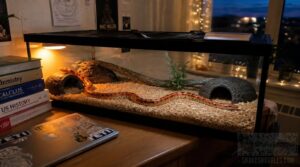
Full-grown corn snakes need real square footage — think 36×18×18 inches minimum, roughly a 40-gallon setup. Length matters more than height here; these snakes stretch out to move and rest, so horizontal space wins.
Whatever enclosure you choose, make sure the lid locks down tight, since even a snug-fitting screen top can be pushed loose by a persistent snake, and this guide to corn snake husbandry and longevity walks through secure setups in more detail.
Aim for 50-75 gallons if your dorm layout allows it. That extra room fits a proper thermal gradient and two hides without crowding your escapeproof enclosure.
Juvenile Starter Enclosure Sizes
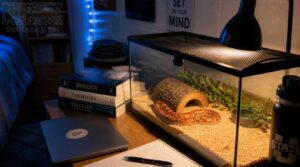
Don’t buy the 40-gallon adult tank on day one — your hatchling will look lost. Start with 20-30 gallons, like a 20-gallon long (30x12x12 inches). Growing fast? Size up to 29-40 gallons.
Aim for 1.5-2x their girth in linear space. A secure lid isn’t optional — juveniles squeeze through gaps adults can’t.
Horizontal Versus Vertical Space
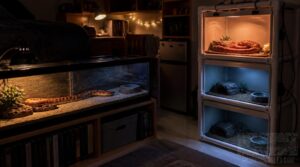
Corn snakes are ground dwellers, so horizontal space usually wins for enclosure footprint efficiency — more floor area means a real gradient, not a cramped guess.
But if your dorm room is tiny, stackable PVC cages save floor space while adding height. Just know vertical setups need careful heat placement, since warm air rises and pools up top.
Front-opening Enclosure Benefits
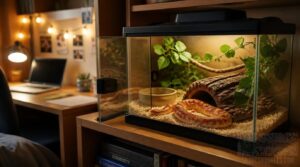
Wrestling a lid off a top-loading tank while your snake makes a break for it? No thanks. Front-opening doors fix that.
- Easy access feeding, no lid removal
- Secure latch design cuts escape risk
- Dual sliding doors reach every corner
- Space-efficient footprint saves dorm space
- Stress-free maintenance, faster cleanups
Modular Upgrade Options
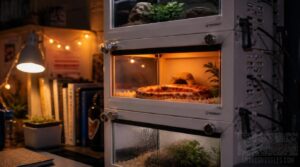
Snakes grow, dorms don’t — so buy a setup that grows with them. Look for modular and expandable stackable PVC cages with slide rails for shelf moves and quick swap doors.
| Upgrade | Function | Dorm Perk |
|---|---|---|
| Power module | 180W output | Daisy-chains 4 devices |
| Misting upgrade | 60–70% humidity | Magnetic locks secure |
| Module stacking | 12×12" footprint | Saves floor space |
Top 3 Corn Snake Enclosures
Now that you know what dimensions and features to look for, let’s talk actual products. These three enclosures hit that sweet spot between dorm-friendly size and snake-approved comfort. Here’s where to start shopping.
1. RepWild PVC Reptile Enclosure 4x2x2

PVC panels win the durability contest here — 0.6 inches thick, built to shrug off humidity swings that warp cheaper materials. At 48x24x24 inches (120 gallons), you’ve got serious room to grow an adult corn snake into.
The sliding glass door locks tight, which matters when roommates get curious. Assembly takes under 30 minutes, tool-free, thanks to predrilled holes.
One catch: the mesh top may need HVAC tape to hold humidity, and deep substrate setups require silicone sealing first.
| Best For | This enclosure is best for reptile keepers housing bearded dragons, ball pythons, geckos, and other terrestrial or semi-arboreal species that need stable humidity and easy front access. |
|---|---|
| Material | PVC |
| Door Type | Sliding glass door with lock |
| Top Ventilation | Rust-proof mesh screen |
| Weight | 63 lbs |
| Dimensions | 48x24x24 in |
| Assembly | Tool-free, under 30 min |
| Additional Features |
|
- Thick, insulating PVC panels hold up well in high-humidity environments and resist warping
- Tempered glass sliding door with a lock offers secure, convenient access
- Tool-free assembly with precision-cut panels means setup in under 30 minutes with minimal sealing needed
- Mesh top may need HVAC tape to retain heat and humidity for certain species
- Deep substrate or bioactive setups require extra silicone sealing along interior edges
- Screw holes can strip if over-tightened during assembly, based on user reports
2. REPTI ZOO 24x18x36 Glass Terrarium
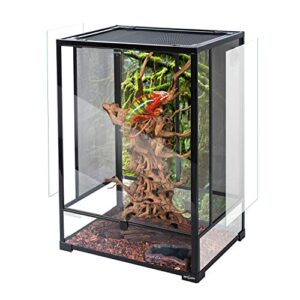
If glass feels more your style than PVC, this one’s worth a look. At 24x18x36 inches (67 gallons), the vertical build suits climbers, while front and top opening doors keep feeding simple without spooking your snake.
Side panels swap between mesh and glass for custom airflow, and the waterproof base copes substrate heaters safely. Just budget extra time — door latches run stiff out of the box, and glass assembly goes smoother with a second set of hands.
| Best For | Keepers of rainforest reptiles and amphibians who need vertical climbing space and want a secure, leak-proof glass enclosure for bioactive or water-feature setups. |
|---|---|
| Material | Glass & Aluminum |
| Door Type | Front & top doors with lock |
| Top Ventilation | Removable mesh top |
| Weight | 60 lbs |
| Dimensions | 24x18x36 in |
| Assembly | Flat-packed, labeled parts |
| Additional Features |
|
- Front and top opening doors make feeding and maintenance easy without stressing your pet
- Interchangeable mesh and glass side panels let you customize ventilation for different species or seasons
- Waterproof base with a raised frame safely supports substrate heaters
- Door latches can be stiff and may need adjusting before they work smoothly
- Glass side panel installation is tricky and often easier with two people
- Structure may wobble slightly under pressure if not placed on a level surface
3. Extra Long All Glass Terrarium
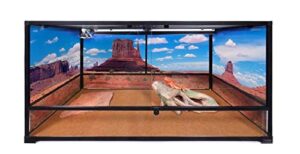
If your snake’s already stretching to full length, give it room to actually stretch. This terrarium runs 60+ inches horizontal, built from 2-3 tempered glass panels with reinforced corners.
Front-opening doors keep feeding tidy, and sealed silicone seams handle humidity without leaking onto your dorm floor. Adjustable top vents balance airflow against escape risk — a fair trade for extra length. Predrilled wiring channels keep heat mat cords hidden, which your RA will appreciate during inspections.
| Best For | This terrarium is best for reptile or amphibian keepers who want a spacious, secure, and easy-to-monitor glass habitat. |
|---|---|
| Material | Glass |
| Door Type | Sliding doors with key-lock |
| Top Ventilation | Steel screen mesh top |
| Weight | 73 lbs |
| Dimensions | 48x24x24 in |
| Assembly | Double-boxed for protection |
| Additional Features |
|
- Sturdy glass construction resists scratches and staining while offering excellent visibility for monitoring your pet
- Key-lock sliding doors and a deep, waterproof base tray keep the habitat secure and debris out of the door tracks
- Sturdy double-box packaging helps protect this large, 73-pound terrarium during shipping
- At 73 pounds, the tank requires careful handling and likely a second person during setup
- Glass surfaces may need specific cleaning products or techniques to keep them looking clear
- Its large 48 x 24 x 24 inch footprint means it needs a solid, spacious surface to sit on
Manage Heat, Humidity, and Ventilation
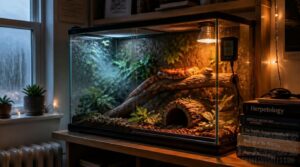
Picking the right tank is only half the job — now you’ve got to make it livable. Corn snakes are picky about temperature and moisture, and dorm rooms don’t exactly help with their drafty windows and cranky radiators. Here’s how to get the climate right without turning your side of the room into a science lab.
Safe Thermal Gradient
Get the gradient wrong, and your snake can’t digest food properly — that’s the whole ballgame here.
Aim for a warm side around 28–32°C and a cool side at 22–26°C, spanning at least 6–10 inches so your corn snake can actually move between zones. Skip guesswork: two thermometers, placed at snake height, confirm the spread is real and stable.
Thermostat-controlled Heating
Plugging in a heat mat without a thermostat is like leaving a stove on and hoping for the best. A thermostat-controlled heating setup uses a probe near the warm side to hold that 28–32°C zone steady, while the cool side settles at 22–26°C.
Dual sensors catch phantom readings, keeping the gradient honest and your dorm circuit safe. For reliable temperature regulation, consider using a smart thermostat option to maintain consistent heat gradients in reptile enclosures.
Nighttime Temperature Limits
When your dorm cools off at night, your snake’s enclosure shouldn’t crash with it.
- Keep warm side steady at 82–90°F (28–32°C)
- Cool side no lower than 72°F (22°C)
- Never drop below 70°F (21°C) anywhere
- Allow max 5°F nightly dip
- Use dual-sensor thermometer for overnight checks
Backup heating with auto-shutoff prevents thermal shock if power blips.
Digital Humidity Monitoring
Eyeballing humidity never works — you need a digital capacitive hygrometer placed at snake level, away from vents. Calibrate it monthly using a 75% salt reference solution.
Good units log readings every few minutes and send phone alerts if levels drift outside 40–60%. Battery-powered models survive dorm power quirks, and bioactive substrate helps retain moisture between checks.
Dorm-friendly Airflow
Stale air stresses snakes just as much as bad heat does. Aim for 3 to 5 air changes per hour using mesh vents placed opposite each other for real cross ventilation.
Skip loud fans — anything under 12 dB keeps things quiet. A small HEPA purifier helps with dust, and front-opening access makes weekly vent checks painless. Keep the tank in a low-traffic corner.
Create a Secure Roommate-Friendly Setup
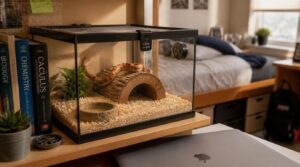
A secure setup isn’t just about keeping your snake in — it’s about keeping your roommate’s trust intact, too. One escaped corn snake under someone’s bed, and you’re not just in trouble with campus housing, you’re in trouble with the person you share a fridge with. Here’s what actually makes an enclosure roommate-proof.
One escaped corn snake under a roommate’s bed breaks more than housing rules — it breaks trust
Escape-proof Locks and Gaps
Corn snakes are escape artists — a gap the width of a pencil is an invitation. Insist on cam locks with stainless bodies (6mm throw) or slam latches with a 90° catch.
Corner and seam gaps must stay under 1-2mm; check monthly with a feeler gauge. Foam gaskets and metal channel reinforcement keep things tight, so surprise roommate encounters stay off the table.
Warm and Cool Hides
Think of hides as your snake’s off switch. Two hides, one per side, let it dial in the right temp without stress — warm side 82–90°F, cool side 72–79°F.
- Warm hide: ceramic or textured plastic
- Cool hide: reinforced, low-mass plastic
- Snug fit, dark interior
- Vented door prevents humidity buildup
- Wipe out weekly with reptile-safe cleaner
Stress-reducing Enclosure Placement
Good hides mean little if the tank sits by a slamming door. Give it a quiet dorm placement — three feet off high-traffic paths, away from roommate sightlines.
Add a vibration-dampening mat under the stand, balance light cycles (12 on, 12 off), and keep airflow steady.
Talk to your roommate early; it saves headaches later.
Easy-clean Substrate Choices
Talking it out early helps — so does picking a substrate your roommate won’t complain about.
Reptile carpet and tile mats wipe clean fast, no mess. Aspen shavings and coconut coir stay low-dust and absorbent. Paper pellets are cheap and beginner-friendly. Skip loose, scattering bedding in shared spaces — spot-clean daily, full swap every 3–4 weeks.
Power Outage Backup Plan
Substrate’s sorted — now plan for the day the power just quits.
Keep a UPS or power bank for thermometers and hygrometers. Insulate the tank, avoid opening it, and use non-heated hides for backup thermal regulation. List roommate and campus safety contacts. Track your equipment inventory, and set a max outage time before calling it — relocation beats a dead snake.
Frequently Asked Questions (FAQs)
Can I have a snake in my college dorm?
Picture explaining to your RA why there’s a "cat" hissing under your bed. Legal, sort of—check your pet policy first. Most campuses require approval, registration, and proof it won’t nuke your housing deposit or spark a noise complaint.
What is the best enclosure for a corn snake?
A front-opening terrarium with escape-proof latches, solid PVC or tempered glass sides, and room for a proper thermal gradient. For dorms, compact starter habitats that scale up as your snake grows offer the best space-saving design.
How cold is too cold for a corn snake at night?
Once the sun goes down, comfort gets trickier. Below 65°F, your snake gets sluggish and stressed. Keep nights between 65-75°F using a thermostat-controlled mat — anything colder risks slowed digestion and brumation-like lethargy.
Do corn snakes like vertical or horizontal enclosure?
Honestly, both — corn snakes enjoy climbing behavior on branches but still need floor space for stretching out. A space-saving design with vertical hides and horizontal stretch room, plus solid substrate depth, covers all their natural instincts.
How much does a corn snake enclosure setup cost?
Like Noah’s ark, budget for two of everything upfront. Your initial purchase budget runs $130–$300 for a 40-gallon tank, heating, and hides. Add substrate replacement, humidity tools, and monthly upkeep — roughly $15–$30 ongoing.
Can corn snakes live with other pets in dorms?
Solo living usually works best — corn snakes don’t interact with other pets and roaming cats or dogs can trigger stress. Get a roommate consent check first, plus escape-proof latches, since dorm pet policy compliance usually bans mixed-species setups anyway.
How long do corn snakes live in captivity?
Think decades, not years: with good genetics, solid diet, and low stress, corn snakes often live 15 to 20 years—sometimes Smart enclosure design and routine vet care make that goal realistic, even in a dorm room.
What should snakes eat, and how often?
Feed frozen-thawed rodents, not live — safer and easier to portion with feeding tongs. Juveniles eat pinky or fuzzy mice weekly; adults take weaned mice every 7–14 days. Match prey width to your snake’s thickest point.
Can I bring my corn snake home during breaks?
Usually, yes — but check break transport policies first. Use a labeled, ventilated travel carrier, keep temps stable in transit, and have a vet contact and backup power plan ready in case your home setup needs adjusting.
Conclusion
The smallest enclosures demand the biggest planning — that’s the paradox every dorm-bound keeper faces.
Done right, corn snake enclosures for college students stop feeling like a compromise and start feeling like a smart, contained habitat you built yourself. Check the rules, measure twice, buy the right glass or PVC box once. Your snake gets a stable home.
You get fewer headaches, happier roommates, and one less thing to explain to your RA. That’s a trade worth making.