This site is supported by our readers. We may earn a commission, at no cost to you, if you purchase through links.
Your furnace dries the air to 20% in January. Your ball python needs 80% in the same house. That gap is why one humidity setting never works for everything under your roof.
Keep your home between 30-50% in winter and below 60% year-round, or mold and dust mites move in. Sustained readings above 70% invite mildew and structural damage. Your snake’s enclosure runs 60-80%, and even higher during a shed.
Humidity control systems for home use range from $30 plug-in controllers to whole-house steam units on dedicated 240-volt circuits. Here’s how nine of them compare.
Table Of Contents
- Key Takeaways
- Home and Snake Enclosure Humidity Targets
- Home Humidity Systems and How They Work
- 9 Home Humidity Control Systems Compared
- 1. Inkbird IHC200 Humidity Controller
- 2. Inkbird IHC-200 Wi-Fi Humidity Controller
- 3. Inkbird ITC-608T Dual Stage Thermostat
- 4. Inkbird ITC-308 and IHC-200 Controller Set
- 5. Trafibal 600M Whole House Humidifier
- 6. Moiswell WD160 Whole House Dehumidifier
- 7. Honeywell H6062A1000 HumidiPro Control
- 8. YOUENKITY Automatic Humidity Mister
- 9. Levoit Superior 6000S Evaporative Humidifier
- Choosing Systems by Climate, Capacity, and Compatibility
- Humidity Control System Costs and Energy Use
- Safe Installation, Sensor Placement, and Maintenance
- Frequently Asked Questions (FAQs)
- Conclusion
Key Takeaways
- Keep your home at 30-50% humidity in winter and under 60% year-round to block mold and dust mites, while your ball python’s enclosure needs its own 60-80% (70-80% during a shed), so you have to plan for both numbers.
- Handle the two spaces separately: use whole-house tools like bypass, fan-powered, or steam humidifiers and ducted dehumidifiers for the room air, and a small mister or plug-in controller like the Inkbird IHC200 or YOUENKITY for the enclosure.
- Pick equipment by your climate, your moisture load, your HVAC compatibility, and the voltage and amp rating of each device, because a mismatched or undersized unit wastes power, with a dehumidifier running nonstop costing about $35 a month.
- Install it safely and check it often by using a licensed electrician for 240V steam units, mounting sensors at 4-5 feet away from kitchens and bathrooms, verifying readings against a calibrated hygrometer, and replacing pads and flushing drains on schedule.
Home and Snake Enclosure Humidity Targets

Two humidity numbers matter here: the one your family lives in and the one your snake needs. They don’t match, so plan for both.
Once you know your snake’s target range, a DIY humidity control setup for snake enclosures can help you hold that number steady without changing your home’s own comfort level.
Your household and your reptile each need their own humidity level, so set up your space to serve both
Your home should sit at 30-50% in winter and 40-60% in summer. Stay under 60% to hold off mold and dust mites. Anything above 70% for long stretches invites mildew and structural damage.
A ball python wants 60-80% inside its snake enclosure, and 70-80% during shedding. Some keepers run 50-60% normally and still get clean sheds. Aim for a gradient, with the cool side at 70-85% and the warm side at 60% or higher. Humidity can climb even higher after dark, since nighttime humidity targets of 80-100% mirror the snake’s native African habitat.
That gap is your real task. Control room air for comfort, then handle moisture management inside the enclosure with substrate, a water bowl, and a humid hide.
Home Humidity Systems and How They Work
Every humidity fix starts with knowing how each system works, so you can match it to your home or your snake’s enclosure. Below, you’ll find six types, each with a clear job, a typical output range, and a tradeoff you should weigh. Read them in order, and you’ll see which ones fit your space, your budget, and your level of control.
Bypass and Fan-Powered Humidifiers

Furnace-mounted humidifiers come in two forms, and the difference comes down to airflow. A bypass unit pulls warm air from the supply plenum, runs it through a wet panel, and returns it through a 6-inch duct. It uses your blower, so it adds no fan power. It also drains about 50% of its water.
A fan-powered unit has its own fan. It works when the furnace is idle, outputs 15-22 GPD, and wastes only 20-30% of its water. Expect it to draw 20-40 watts.
Steam Humidifiers
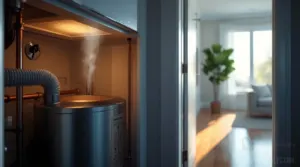
Bypass and fan-powered units rely on air to move moisture. Steam skips that step. It boils water in a sealed canister, so you get sterile, mineral-free vapor with no white dust.
Output runs 11.5 to 34.6 GPD, enough for homes up to 5,000 sq. ft. Control stays within ±1% of setpoint, and it works even when the blower’s off.
Plan on a dedicated 240-volt circuit.
Ducted and Portable Dehumidifiers
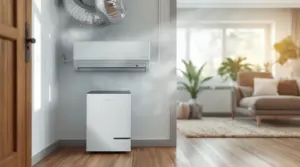
Steam adds moisture. Ducted dehumidifiers take it out, and they do it for the whole house.
A unit tied into your HVAC ductwork pulls humid air from the return, dries it, and sends it back through the supply. Size it for the latent load. For 1,500 to 3,500 sq. ft., start at 70 to 120 pints per day. Installation takes a few hours and needs a drain line and wiring.
Portable Humidifiers and Enclosure Misters

How much humidity do you actually need? In a ball python enclosure, 50-60% RH, and 65-70% during a shed. Your room needs 30-50%. Those goals conflict.
Don’t raise the whole room. Use an enclosure mister instead. The YOUENKITY runs 1-120 second intervals and suits tanks up to 40 gallons. Clean the nozzles weekly with vinegar.
Whole-House Fans, HRVs, and ERVs

A whole house fan, an HRV, and an ERV all swap indoor air for outdoor air, but they do very different jobs. Fans move 1,500 to 7,000 CFM, while HRV and ERV ventilation systems handle just 100 to 150 CFM.
- A fan pulling a cool evening breeze through open windows
- An HRV recovering 70% to 80% of heat
- An ERV balancing moisture year-round
Neither one dehumidifies.
Plug-in and Smart Humidity Controllers

Plug-in controllers keep things simple, but smart ones give you more. A plug-in humidistat controller switches power at your humidity setting. Smart plugs add remote scheduling, but they need WiFi-enabled humidity sensors for closed-loop control.
| Type | Strength |
|---|---|
| Plug-in | Simple on/off |
| Smart plug | Remote scheduling |
| Sensor pair | Real-time readings |
Set the appliance to continuous operation, or the controller can’t switch it.
9 Home Humidity Control Systems Compared
Here are nine humidity control options, from plug-in controllers to whole-house units. Each one is checked for load compatibility, capacity, and how well it fits your setup. Use the list to find the one that matches your space and your goals.
1. Inkbird IHC200 Humidity Controller
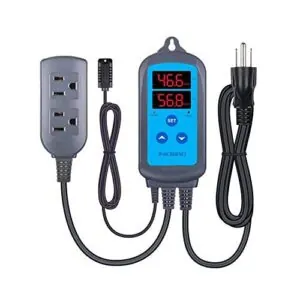
Think of this controller as a humidity thermostat you plug in and forget. It’s pre-wired, so no electrical work is needed for a standard US outlet.
The probe sits on a 6.56 ft (2 m) cable and reads 5–99.99% RH with ±3% accuracy. You can control from 5–99% RH, and the dual outputs run a humidifier and dehumidifier, each up to 10A at 100–240V AC.
Don’t exceed that load. The sensor cable is fixed at 6.56 ft, with no extension options.
Check the "<3W" power figure with the manufacturer, since the listing contains a typo.
| Best For | Mushroom growers, reptile keepers, and grow tent hobbyists who want simple, plug-and-play humidity control without any electrical work. |
|---|---|
| Product Type | Humidity controller |
| Humidity Range | 5–99% RH control |
| Humidity Control | Dual-stage automatic |
| Dimensions | N/A |
| Power Rating | 10A, 100–240V AC |
| Ideal Use | Grow tents, reptile enclosures |
| Additional Features |
|
- Pre-wired outlet works with standard US plugs, so setup needs no wiring.
- Dual-stage control runs both a humidifier and a dehumidifier, with a 5–99% RH control range.
- Digital display shows humidity in 1% steps, with ±3% accuracy and a 6.56 ft probe cable.
- Each output is limited to 10A at 100–240V AC, so higher-powered equipment can’t be used.
- The probe cable is fixed at 6.56 ft, with no extension options listed.
- The listed power draw ("<3W") contains a typo and needs to be checked with the manufacturer.
2. Inkbird IHC-200 Wi-Fi Humidity Controller
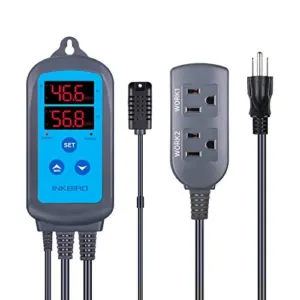
Your snake’s enclosure and your living room don’t need the same air, and this controller lets you manage both from your phone.
It runs on 2.4GHz Wi-Fi only, so a 5GHz-only network won’t work. Through the INKBIRD app, you can monitor and adjust humidity from anywhere.
Two relay outputs let you run a humidifier and a dehumidifier together. Each controls 10A, up to 2200W at 220Vac or 1200W at 120Vac.
Alarms for high and low humidity sound off until you silence them with a button or the app. They won’t reset themselves.
| Best For | Hobbyists who grow mushrooms, cure foods, or keep reptiles and want to monitor and control humidity from their phone. |
|---|---|
| Product Type | Wi-Fi humidity controller |
| Humidity Range | 10–99% RH measuring |
| Humidity Control | Automatic via dual relays |
| Dimensions | 3.3 x 1.7 x 1 in |
| Power Rating | 10A, 1200W at 120V |
| Ideal Use | Mushrooms, reptiles, greenhouses |
| Additional Features |
|
- Dual relay outputs let you run a humidifier and a dehumidifier automatically
- Remote monitoring and control through the INKBIRD app
- High and low humidity alarms warn you when conditions drift
- Works only with 2.4GHz Wi-Fi, so 5GHz-only networks won’t connect
- Alarms don’t reset on their own and must be silenced by button or app
- Humidity accuracy of ±3% to ±5% may not suit very precise needs
3. Inkbird ITC-608T Dual Stage Thermostat
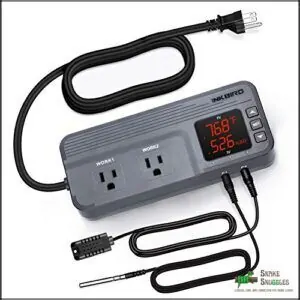
Need one controller that controls both temperature and humidity? This one does. It runs on 120VAC and carries a max load of 15A and 1800W, so check your gear’s draw first.
WORK1 controls heating or cooling devices. WORK2 regulates your humidifier or dehumidifier. It reads from -40°F to 212°F and 5% to 99% RH, and you can calibrate both readings and switch between Fahrenheit and Centigrade. It’s ETL listed, too.
The drawback is the learning curve. Some users find the instructions unclear, and durability reports are inconsistent.
| Best For | Hobbyists such as grow tent gardeners, greenhouse owners, home brewers, and reptile keepers who want one controller to manage both temperature and humidity and are willing to spend some time learning to set it up. |
|---|---|
| Product Type | Temp/humidity controller |
| Humidity Range | 5–99% RH |
| Humidity Control | Dual-stage via WORK2 |
| Dimensions | N/A |
| Power Rating | 15A, 1800W at 120V |
| Ideal Use | Grow tents, brewing, terrariums |
| Additional Features |
|
- Controls both temperature and humidity through separate WORK1 and WORK2 outlets, so one unit can run a heater or cooler and a humidifier or dehumidifier.
- Wide sensing range, from -40°F to 212°F and 5% to 99% RH, with calibration for both readings and a choice of Fahrenheit or Centigrade.
- ETL listed for safety, with a max load of 120VAC, 15A, and 1800W.
- Customer feedback is mixed on how easy it is to program, so there is a learning curve.
- Some users find the instructions unclear or difficult to follow.
- Reports on long-term durability are inconsistent.
4. Inkbird ITC-308 and IHC-200 Controller Set
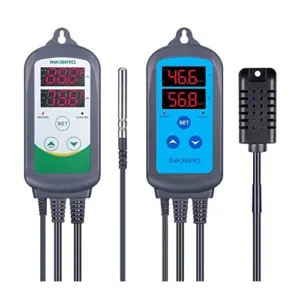
Want separate controllers for each job? This set splits the work. The ITC-308 controls temperature, and the IHC-200 controls humidity. Each comes with a 2m sensor.
Temperature reads from -58°F to 248°F, and humidity measures 5 to 99.99% RH. Both take 100 to 240VAC and switch up to 10A per output. Dual relays cover heating and cooling, plus humidifying and dehumidifying. Buzzer alarms warn you when readings drift.
Mind the downsides. Some owners report the humidity unit failing in week one, and the instructions confuse people.
| Best For | Hobbyists who ferment, cure salami, grow in tents, or run incubators and want separate, dedicated controllers for temperature and humidity. |
|---|---|
| Product Type | Temp/humidity controller set |
| Humidity Range | 5–99% RH control |
| Humidity Control | Automatic via relay |
| Dimensions | N/A |
| Power Rating | 10A, 100–240V AC |
| Ideal Use | Fermentation, grow tents, incubation |
| Additional Features |
|
- Two separate controllers (ITC-308 for temperature, IHC-200 for humidity) each include a 2m sensor.
- Dual relays handle heating and cooling plus humidifying and dehumidifying, with up to 10A per output on 100 to 240VAC.
- Adjustable high and low buzzer alarms warn you when temperature or humidity drifts out of range.
- Some owners report the humidity unit failing within the first week.
- Feedback on the long-term durability of the humidity controller is mixed.
- Customers describe the instructions as confusing.
5. Trafibal 600M Whole House Humidifier
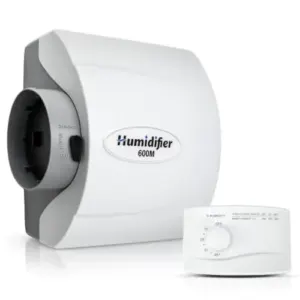
Want one system for the whole house? This bypass humidifier uses your furnace airflow to push moisture through existing ducts. It delivers 17 gallons per day and suits homes up to 5,000 sq ft.
Control is manual. You set the dial and adjust it as weather changes. The unit measures 18.9"D x 13"W x 16.9"H, so check duct space.
Expect upkeep. You’ll replace the water panel yearly, more often with hard water. Hire a pro for water and drain lines.
| Best For | Homeowners with a home up to 5,000 sq ft and existing ductwork who want one system to humidify the whole house and are fine adjusting the humidity dial by hand. |
|---|---|
| Product Type | Whole-house humidifier |
| Humidity Range | N/A |
| Humidity Control | Manual adjustment |
| Dimensions | 18.9 x 13 x 16.9 in |
| Power Rating | N/A |
| Ideal Use | Homes up to 5000 sq ft |
| Additional Features |
|
- Delivers 17 gallons per day, enough for homes up to 5,000 sq ft
- Uses furnace airflow to spread even moisture through existing ductwork
- Helps relieve dry air and protect hardwood floors and furniture
- Manual humidity control means you must adjust it as the weather changes
- Needs a yearly water panel replacement, and more often in hard water areas
- Requires professional installation for the water and drain lines
6. Moiswell WD160 Whole House Dehumidifier
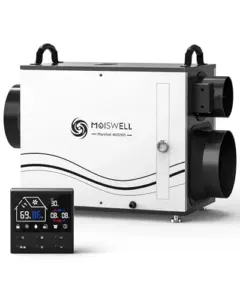
Humidifiers add moisture, but some homes need the opposite. This ducted unit pulls up to 160 pints per day under saturation conditions. Under AHAM conditions, it removes 65 pints.
It moves 330 CFM and covers up to 2,500 sq ft, so basements and crawl spaces are fair game. Point the outlet horizontally or vertically.
Plan for ductwork, since whole-home distribution needs it. The fresh air function also requires opening a damper. At 24.72"W x 21.46"H, it needs space.
| Best For | Homeowners dealing with excess moisture in a basement, crawlspace, or larger home who are ready to install ductwork. |
|---|---|
| Product Type | Dehumidifier |
| Humidity Range | N/A |
| Humidity Control | N/A |
| Dimensions | 14.88 x 24.72 x 21.46 in |
| Power Rating | N/A |
| Ideal Use | Whole homes, basements, crawlspaces |
| Additional Features |
|
- Removes up to 160 pints of moisture per day under saturation conditions.
- Moves 330 CFM and covers up to 2,500 sq ft, and it can be ducted to multiple rooms or tied into an HVAC system.
- Has an adjustable horizontal or vertical outlet and a cycle timer for automatic on/off operation.
- Needs ductwork to distribute air through the whole home.
- The fresh air function only works if a damper is opened for outdoor air intake.
- At 14.88"D x 24.72"W x 21.46"H, it takes up a good amount of space, and removal drops to 65 pints per day under AHAM conditions.
7. Honeywell H6062A1000 HumidiPro Control
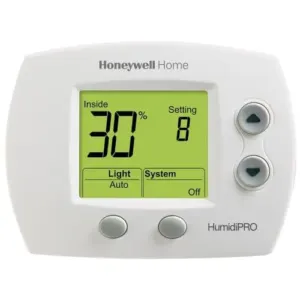
That last unit experiences too much moisture. This one experiences the balance. The Honeywell control works as a humidistat or dehumidistat, depending on what you connect.
It adjusts to outdoor temperature, which helps prevent window condensation. Manual mode runs 10% to 90% RH. It weighs 10.24 ounces, so it’s easy to mount.
Know the drawbacks. Some users report humidity climbing past their setpoint. Others see inconsistent results from the temperature-based adjustments.
Check your readings against a separate hygrometer before you trust it.
| Best For | Homeowners who want a digital control that automatically manages indoor humidity and helps stop window condensation with a humidifier or dehumidifier system. |
|---|---|
| Product Type | Humidistat/dehumidistat |
| Humidity Range | N/A |
| Humidity Control | Automatic digital |
| Dimensions | N/A |
| Power Rating | N/A |
| Ideal Use | Home humidity, window condensation |
| Additional Features |
|
- Adjusts automatically based on outdoor temperature, so you don’t need to change settings by hand.
- Helps prevent condensation on windows.
- Works with both home humidification and dehumidification systems.
- Customers give mixed feedback on how accurate its humidity control is.
- Some users report that humidity rises above the level they set.
- The temperature-based adjustments can lead to inconsistent performance, according to users.
8. YOUENKITY Automatic Humidity Mister
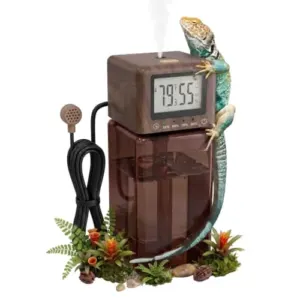
A compact mister like this one works for small spaces, not rooms. It’s built for snake enclosures and plant shelves, and it measures just 2.7" x 2.7" x 6.6" and weighs 6.56 ounces.
The built-in sensor does the work. Pick a preset of 35%, 50%, 70%, or 85%, or type in a custom value. The unit holds that target on its own.
Let the wick soak for five minutes before first use. Unplug the charging cable once it’s full. Reviews on long-term durability are mixed, so check it often.
| Best For | Reptile keepers and plant owners who need steady humidity in a small enclosure or on a shelf, rather than in a whole room. |
|---|---|
| Product Type | Portable humidifier |
| Humidity Range | 35–85% presets |
| Humidity Control | Automatic with presets |
| Dimensions | 2.7 x 2.7 x 6.6 in |
| Power Rating | N/A |
| Ideal Use | Reptile terrariums, plants |
| Additional Features |
|
- Built-in sensor holds your target humidity automatically
- Four presets (35%, 50%, 70%, 85%) plus a custom setting for precise control
- Compact and light at 2.7" x 2.7" x 6.6" and 6.56 ounces, so it saves space
- Wick must soak for five minutes before first use
- Charging cable must be unplugged once it’s fully charged
- Customer reviews on long-term durability are mixed
9. Levoit Superior 6000S Evaporative Humidifier
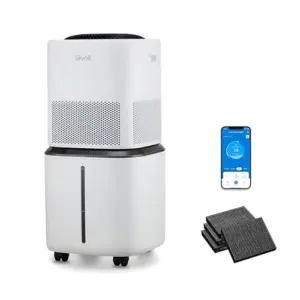
The Levoit’s evaporative design covers up to 3,000 ft² and puts out 1,500 mL/h without visible mist or white dust.
The 23 L tank runs up to 72 hours on low speed. At 12.72" x 12.72" x 26.7" and 13.2 lbs, it’s easy to move and fold away for storage. Voice assistants work through the VeSync app, but expect ±5% sensor accuracy.
Plan for filter replacement every 3 to 6 months. Reservoirs may crack after extended use, and walls hurt range.
| Best For | Homeowners who want to humidify a large open space or several connected rooms without dealing with white dust or constant refilling. |
|---|---|
| Product Type | Evaporative humidifier |
| Humidity Range | N/A |
| Humidity Control | Built-in sensor automatic |
| Dimensions | 12.72 x 12.72 x 26.7 in |
| Power Rating | N/A |
| Ideal Use | Homes up to 3000 sq ft |
| Additional Features |
|
- Covers up to 3,000 ft² with 1,500 mL/h output and no visible mist or white dust
- The 23 L tank runs up to 72 hours on low speed and works with tap water
- Voice assistant compatibility through the VeSync app and a foldable design for compact storage
- Filter may need replacing every 3 to 6 months
- Reservoir may crack after extended use, according to customer reports
- Humidity sensor is accurate only to ±5%, and walls, obstructions, or multi-floor placement can reduce performance
Choosing Systems by Climate, Capacity, and Compatibility

Your climate sets the problem. Your house decides how big it gets. A tight home in a dry, cold region needs humidifying, while a leaky one in a muggy region needs drying, and neither fix works if the equipment doesn’t match.
Start with these four checks:
- Match your climate zones. Cold winters mean humidification and lower targets as temperatures drop. Humid summers mean dehumidification.
- Size by moisture load. Count occupants, cooking, bathing, basements and air leaks, not floor area alone.
- Confirm HVAC compatibility. Bypass units need a compatible furnace and duct path. Fan-powered and steam units are more flexible.
- Check control ratings. A plug-in controller must handle your device’s voltage and load.
Snake enclosures are different. Room-level systems won’t guarantee the enclosure hits its species target, so give it local control.
Humidity Control System Costs and Energy Use
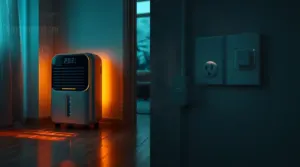
A 600-watt dehumidifier running 10 hours a day uses about 180 kWh a month. That’s roughly $35 at $0.19/kWh, about what a refrigerator costs you.
Most of your other options run cheaper. Plug-in controllers like the Inkbird units draw only a few watts, so they add pennies to your bill. They still switch bigger loads, so their cost depends on what you plug in. Humidifiers and mistersfall in the middle, and a typical home unit adds $5 to $30 a month.
Your local rate matters. It runs from about $0.11/kWh in Louisiana to $0.39/kWh in Hawaii.
Size each unit correctly. An undersized dehumidifier runs nonstop and wastes power. A 550W unit uses 13.2 kWh daily nonstop but only 5.28 kWh at a 40% duty cycle. Pick Energy Star models and save about 13%.
Safe Installation, Sensor Placement, and Maintenance

One loose duct joint can undo a good system. Get the basics right and your setup runs cleaner, safer, and longer.
Before you touch anything, kill HVAC power at the breaker. Then seal every duct opening with approved HVAC tape or mastic, and follow the maker’s mounting and orientation specs.
- Hire a licensed electrician for any 120V, 208V, or 240V steam unit.
- Mount sensors at 4-5 feet, 6 inches upstream of moisture sources.
- Add shut-off valves and solid drain connections.
Keep sensors out of kitchens, bathrooms, and laundry rooms. Short spikes there will make your system behave erratically.
Test before you trust. Run the fan 15 minutes without the humidifier to find leaks, then check the humidistat against a calibrated hygrometer. Confirm overflow switches and low-water cutoffs work.
Replace pads yearly, clean steam tanks quarterly, and flush drain lines twice a year.
Frequently Asked Questions (FAQs)
What causes condensation on windows during winter?
Your windows are the one spot in the house that’s honest about your humidity. Warm, moist air hits cold glass, drops below its dew point, and turns to water. Colder weather and more indoor moisture make it worse.
How do I know my hygrometer is accurate?
Run a salt test. Seal a salt-and-water slurry in a container, keep your hygrometer above it, and wait 6 to 8 hours. A reading near 75% means it’s accurate there.
Can high humidity damage electronics or furniture?
Think your gear and furniture can shrug off damp air? They can’t. Humidity above 60% corrodes contacts and circuit traces, even in unpowered devices, and swells solid wood until it warps, cracks, or loosens joints.
How can I reduce humidity without any equipment?
Start with ventilation. Open windows for 10 to 15 minutes when outdoor air is drier, and run exhaust fans during showers and cooking. Cover pots, fix leaks, and dry laundry outdoors.
Does humidity affect how warm my home feels?
Picture a damp towel on a hot day: it never dries, and you never cool off. Humid air works the same way on your skin. Sweat evaporates slowly, so the same thermostat setting feels warmer.
Conclusion
Measure the air, match the tool, and place the sensor where it counts. That’s the whole job. The right humidity control systems for home use start with your climate, your square footage, and your voltage, not the price tag.
Keep your living space between 30-50% in winter. Give your snake its 60-80%. When both numbers hold, mold stays out, scales shed clean, and your furnace stops running the show. Then verify both monthly, and relax.