This site is supported by our readers. We may earn a commission, at no cost to you, if you purchase through links.

Mold doesn’t need much of an invitation—just air sitting above 60% relative humidity for a few days, and it starts moving in.
Most people reach for an electric dehumidifier without realizing their home already holds the tools to fight back: strategic airflow, certain plants, and a handful of materials that pull moisture from the air without drawing a single watt of power.
These natural humidity control techniques won’t just lower your numbers on a hygrometer—they’ll change how your home breathes.
The sections ahead cover ventilation methods, moisture-absorbing plants, desiccant materials, and daily habits that work together to keep indoor air consistently dry and clean.
Table Of Contents
- Key Takeaways
- Ventilation Techniques That Remove Moisture
- Natural Absorbers for Indoor Humidity
- Moisture-absorbing Plants for Bathrooms and Kitchens
- Peperomia for Low-light Humidity Control
- Golden Pothos for Easy Indoor Moisture Reduction
- Aloe Vera for Low-water Dehumidifying Support
- Bamboo Palm for Larger Damp Spaces
- Tillandsia Clusters for Small-room Moisture Capture
- Rock Salt Bowls for Low-cost Humidity Control
- Baking Soda Containers for Closets and Cabinets
- Activated Charcoal Bags for Moisture and Odors
- Silica Gel Packets for Targeted Dry Storage
- Calcium-chloride Pellets for Stronger Moisture Absorption
- Moisture-Smart Habits and Materials
- Keeping Indoor Relative Humidity Between 30% and 50%
- Taking Shorter Showers to Reduce Steam Buildup
- Covering Pots While Cooking to Limit Excess Moisture
- Drying Clothes Outdoors Instead of Indoors
- Fixing Leaks Quickly to Stop Hidden Humidity Sources
- Wiping Condensation From Windows and Cold Surfaces
- Clay Plaster and Lime Mortar for Passive Moisture Buffering
- Cork Wall Coatings for Breathable Humidity Control
- Magnesium-oxide Boards in Damp-prone Rooms
- French Drains and Grading to Reduce Basement Moisture
- Knowing When Natural Methods Are Enough
- Knowing When Mechanical Dehumidification is Needed
- Top 4 Plants for Humidity Control
- Frequently Asked Questions (FAQs)
- How can natural ventilation improve indoor humidity?
- How to reduce indoor humidity?
- How do you increase indoor humidity?
- How do you naturally cool a home in a humid climate?
- What is the best humidity for dry sinuses?
- What health risks does excess indoor humidity cause?
- How does humidity affect wood floors and walls?
- Can humidity damage electronics and metal fixtures?
- What humidity level is too low for comfort?
- How do smart vents help regulate indoor moisture?
- Conclusion
Key Takeaways
- Mold takes hold once indoor humidity climbs above 60%, so keeping your home between 30% and 50% relative humidity is the single most important target to hit.
- Ventilation is your first line of defense — pairing cross-ventilation through opposite windows with stack-effect airflow through low and high openings moves moisture out without any equipment.
- Plants like Boston Fern, Peace Lily, and Snake Plant actively pull moisture from the air, while desiccants like rock salt activated charcoal, and silica gel packets handle the spaces that plants can’t reach.
- Daily habits — covering pots while cooking, drying clothes outdoors, wiping window condensation, and fixing leaks within 24 hours — quietly do as much work as any material or device you install.
Ventilation Techniques That Remove Moisture
Ventilation is your first line of defense against indoor moisture — move the air, and you move the problem. The good news is you don’t need expensive equipment to get results; smart airflow design can do most of the work.
Pairing smart airflow with the right enclosure setup — like those covered in this guide to best ball python enclosure design — shows how placement and circulation work together to keep humidity dialed in.
Here are six ventilation techniques that naturally pull humid air out of your home.
Cross-ventilation With Opposite Windows and Doors

When windows face opposite walls, your home becomes its own air exchange system — no equipment required. Align openings with prevailing wind direction and clear the airflow path between them. Proper opening size ratio keeps pressure balance steady and the breeze moving. Seasonal timing matters most:
- Open windward windows wider than leeward ones
- Remove furniture blocking the natural ventilation path
- Use cross ventilation during cooler evening hours
- Apply these ventilation techniques and ventilation strategies consistently for real humidity reduction
Implementing cross ventilation reduces moisture helps prevent corrosion and mold.
Stack Effect Airflow Using Low and High Openings

Cross-ventilation moves air horizontally, but stack effect ventilation works vertically — and that changes everything. Warm air rises and escapes through high openings, while cooler air enters at floor level.
thermal buoyancy optimization creates a steady pressure differential design that doesn’t need wind to function.
Opening Height Ratio by placing low inlets near the floor and high outlets several feet above eye level, and the airflow path symmetry manages the rest.
Wind Towers for Passive Air Exchange

Stack effect pulls air vertically — wind towers push it deliberately. A properly sized shaft uses Vertical Pressure Gradient to direct outdoor air downward without fans.
- Quadrant Head Configuration captures wind from every direction
- Shaft Diameter Optimization controls flow rate and noise
- Passive Noise Dampening comes from smooth interior passages
- Material Choice Impact affects thermal mass and durability
- Wind tower integration for cooling pairs well with solar chimneys
Natural ventilation strategies for humid climates rely on stack effect utilization in homes alongside passive cooling systems like these.
Earth Tubes for Cooler, Drier Incoming Air

Earth tubes take a different approach entirely — burying the work underground.
You route incoming air through HDPE pipe selection rated for long-term soil contact, usually 30 to 50 meters long and sloped 1 to 3 percent, for pipe slope design that drains condensation automatically.
Soil thermal buffer stabilizes temperatures around 13°C, cooling and drying summer air before it enters.
Add moisture barrier integration and bypass damper control, and you’ve built reliable passive humidity control into the foundation itself.
Solar Chimneys That Exhaust Humid Indoor Air

Solar chimneys flip the stack effect into an exhaust engine — sunlight does the heavy lifting, so you don’t have to.
A dark absorber panel heats the air inside a vertical shaft, and buoyancy pulls humid indoor air upward and out. Pair smart Absorber Material Choice with correct Chimney Height Design, and you get hours of reliable natural ventilation daily.
Key design decisions that determine performance:
- Solar Alignment Optimization orients the shaft face toward peak sun hours for maximum thermal gain
- Thermal Insulation Techniques wrap the channel to retain heat when cloud cover interrupts direct sunlight
- Performance Monitoring Sensors track exhaust temperature and airflow, so you catch efficiency drops early
- Ventilation shafts routed vertically without bends minimize resistance, and keep passive cooling techniques effective
- Stack effect ventilation strengthens as chimney height increases, so sizing the shaft correctly is non‑negotiable
Hybrid Airflow With Window and Ceiling Fans

When passive ventilation isn’t enough, Fan Speed Coordination between a window exhaust fan and your ceiling fan closes the gap.
Set the window fan to exhaust mode, run the ceiling fan at low speed for Directional Airflow Mapping, and you’ve built a quiet cross-ventilation loop.
Seasonal Fan Settings, Noise Level Management, and Energy Consumption Optimization all improve when portable fan systems work together rather than independently.
Natural Absorbers for Indoor Humidity

Once ventilation gets the air moving, the next step is giving moisture somewhere to go.
Plants, desiccants, and household staples can all pull humidity out of the air without a single plug or switch.
Here are the natural absorbers worth placing in your home.
Moisture-absorbing Plants for Bathrooms and Kitchens
Some plants do more than look good — they actively pull moisture from the air through leaf surface transpiration. Your placement strategy matters as much as the species you choose.
Here are five that thrive in humid bathrooms and kitchens:
- Boston Fern — loves high humidity and indirect light
- Peace Lily — stabilizes moisture through large glossy leaves
- Spider Plant — pet-friendly options don’t get easier than this
- Snake Plant — low water uptake needs, high tolerance for steam
- English Ivy — trailing habit suits shelves with strong light needs
Peperomia for Low-light Humidity Control
Few indoor plants earn their place like Peperomia. This light tolerant Peperomia absorbs atmospheric moisture through thick, glossy leaves — making it one of the quietest plant-based dehumidifiers you can place in a dim corner. Pair it with cross ventilation for a stronger humidity control system.
| Care Factor | Recommendation | Why It Matters |
|---|---|---|
| Soil Drainage Mix | 1 part potting soil, 1 part perlite | Prevents root rot in low light |
| Pot Rotation Frequency | Every 2–3 weeks | Ensures even growth and airflow |
| Pest Monitoring Routine | Weekly leaf inspection | Catches mealybugs early |
Watch for leaf curl — that’s your signal that ambient humidity has dropped below comfortable levels, not a watering cue. This low-energy dehumidification strategy works best when you keep indoor plants grouped near a north-facing window.
Golden Pothos for Easy Indoor Moisture Reduction
Golden Pothos might be the most forgiving moisture manager on your windowsill. Through plant transpiration and broad leaf surface area, it absorbs indoor moisture while also filtering VOCs like formaldehyde — solid air purification without any effort.
Its low light tolerance makes placement strategies simple: hang baskets near kitchens or bathrooms.
Use propagation tips to multiply cuttings, spreading these houseplants across rooms for wider ventilation technique support.
Aloe Vera for Low-water Dehumidifying Support
Aloe vera pulls double duty as both a low-maintenance succulent and one of the more practical plant-based dehumidifiers you can keep near a window.
Its CAM water regulation slows daytime transpiration while its leaf transpiration rate peaks at night, quietly stabilizing moisture.
Use an optimized potting mix with perlite, apply the plant grouping effect near humid zones, and enhance results through strategic window placement for natural ventilation support.
Bamboo Palm for Larger Damp Spaces
Where aloe vera manages tight spots quietly, Bamboo Palm brings real presence to larger damp spaces. Growing 6 to 12 feet tall, it pulls moisture from the air across a wide footprint.
Smart Pot Size Selection and Root Zone Management keep it vigorous.
Apply basic Pruning Techniques, use Light Optimization near windows, and combine it with ventilation techniques for serious indoor humidity control.
Tillandsia Clusters for Small-room Moisture Capture
Where bamboo palm claims a corner, Tillandsia clusters handle the spaces in between. These soil‑free plant‑based dehumidifiers absorb moisture directly through leaf trichomes, making them ideal for small‑room humidity mitigation.
- Group several T. kolbii or T. ionantha for Surface Area Optimization
- Hang clusters 30–60 cm below the ceiling for Airflow Positioning
- Keep Temperature Range between 20–25°C for peak uptake
- Follow a Misting Schedule of every 1–2 weeks, drying completely after
Each cluster creates a subtle Microclimate Creation effect, quietly exchanging moisture with surrounding air.
Rock Salt Bowls for Low-cost Humidity Control
Rock salt bowls are among the simplest DIY desiccant solutions using household items you’ll find. Fill a ceramic or glass bowl with 1–2 kg of rock salt and set it in a corner — Placement Optimization matters here.
| Factor | Guideline | Why It Matters |
|---|---|---|
| Absorption Efficiency | Replace monthly | Brine saturation slows uptake |
| Maintenance Routine | Check weekly for clumping | Restores absorptive surface area |
| Safety Guidelines | Keep away from pets/children | Salt ingestion is harmful |
Cost Effectiveness makes this low-cost humidity control for basements and bathrooms hard to beat for humidity regulation.
Baking Soda Containers for Closets and Cabinets
Baking soda works on the same principle as rock salt — it pulls moisture from surrounding air — but it fits neatly inside closets and cabinets where bowls won’t.
For best results as part of your DIY humidity reduction strategies:
- Choose airtight storage with silicone seals to control release rate
- Match capacity choices to space size — 8 oz for small cabinets
- Use labeling organization with dated stickers to track replacement every 3–6 weeks
- Follow placement tips: eye level, away from steam sources
These natural desiccants cost almost nothing.
Activated Charcoal Bags for Moisture and Odors
Unlike baking soda, activated charcoal bags tackle both moisture and odors at once — making them one of the most adaptable natural desiccants for indoor moisture issues and mold prevention.
| Feature | Details |
|---|---|
| Bag Capacity | 100–500 grams per bag |
| Placement Strategies | Closets, shoe racks, laundry rooms |
| Rejuvenation Methods | 1–2 hours of direct sunlight monthly |
| Safety Precautions | Keep sealed; non‑toxic but avoid crushing |
Rotate placements every few weeks for even coverage.
Silica Gel Packets for Targeted Dry Storage
Silica gel packets punch well above their weight for targeted dry storage. Their adsorption capacity reaches up to 40% of their own weight in moisture — outperforming many DIY desiccant solutions using household items like rock salt or baking soda.
Use them this way:
- Tuck 1–10g packets into electronics cases or camera bags
- Distribute larger 100g packets in wardrobe or tool storage bins
- Watch the indicator types — blue-to-pink or orange-to-green signals saturation
- Reactivate at 120°C for one to two hours; avoid exceeding 150°C to protect pore structure
food-grade polypropylene materials make safety handling straightforward. The reactivation process restores full performance across 20-plus cycles.
Calcium-chloride Pellets for Stronger Moisture Absorption
When humidity climbs past 60%, calcium chloride pellets outperform most natural desiccants for excess moisture — absorbing several times their own weight as RH rises.
Absorption rate factors include enclosure size and airflow; small closets see the fastest results.
Watch pellet saturation indicators like visible dampening or brine pooling, replace every two to three weeks, and follow safety handling guidelines by wearing gloves and keeping pellets away from children.
Moisture-Smart Habits and Materials
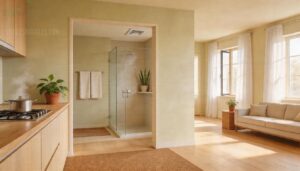
Good ventilation and smart plant choices go a long way, but your daily habits and building materials do just as much heavy lifting.
Small decisions — how you cook, how you shower, what’s on your walls — quietly shape the moisture level in every room.
Here’s what actually moves the needle.
Keeping Indoor Relative Humidity Between 30% and 50%
Think of your home’s air as a living system — and 30% to 50% relative humidity is its healthy range. Drift outside that band, and you’re either cracking lips or feeding mold.
Keep your home’s air between 30% and 50% humidity — drift past either edge and you’re either cracking lips or feeding mold
Keep it dialed in with these daily habits:
- Place a humidity sensor in central living areas, not near vents
- Use smart thermostat integration to trigger ventilation automatically
- Apply building envelope sealing to block humid outdoor air during peak seasons
- Make seasonal RH adjustments — target 30%–35% in winter, up to 50% in summer
Taking Shorter Showers to Reduce Steam Buildup
Your shower is a steam engine — and every extra minute adds fuel.
A 10-minute shower floods a small bathroom with far more moisture than a 5-minute one. Cut that time with a shower timer, switch to cool water showers, and install low-flow fixtures rated 6–9 L/min.
| Habit | Humidity Impact |
|---|---|
| Turn off lathering | Cuts steam mid-shower |
| Run exhaust fans | Clears residual moisture fast |
Pair these with a humidity sensor for real-time steam monitoring.
Covering Pots While Cooking to Limit Excess Moisture
Every uncovered pot is a small fog machine running in your kitchen. Matching your cooking method to the right lid seal type keeps steam where it belongs — inside the pot.
Use vented lid strategies for simmering sauces, and tight-fitting lids for braising.
Good steam condensation management, combined with ventilation, protects your humidity levels without changing how you cook.
Drying Clothes Outdoors Instead of Indoors
Cooking outdoors isn’t always an option, but drying clothes outside always is. Wet laundry hung indoors raises humidity levels quickly — a single load can release over a pint of moisture into your air.
- Energy savings add up quickly with zero tumble‑dry cycles
- Wind‑driven drying in a 20 km/h breeze cuts drying time by 40%
- Sunlight benefits whites naturally through UV exposure
Space garments 2 inches apart on an outdoor rack, position lines in sun‑exposed areas, and let natural ventilation handle the rest.
Fixing Leaks Quickly to Stop Hidden Humidity Sources
A dripping pipe under the sink does more damage than you’d think — slow leaks are silent humidity machines. Fix leaks promptly before they soak into walls.
| Step | Action | Timeframe |
|---|---|---|
| Immediate Shutoff | Stop water at the source valve | Within minutes |
| Rapid Drying | Shop-vac standing water, run fans | First 24 hours |
| Moisture Metering | Check RH with a moisture meter | Every 24–48 hours |
Seal cracks in walls and foundations, document damage, and confirm dryness before closing up materials. Source identification — checking supply lines, flashing, and ceiling stains — keeps hidden leaks from quietly feeding your indoor humidity for weeks.
Wiping Condensation From Windows and Cold Surfaces
Leaks handled; your next target is the glass itself.
Sweating windows signal that surface temperatures have dropped below the dew point.
Wipe them down with a microfiber wiping method — cloth first, then polish after wiping with a dry cloth to prevent streaks.
Install edge insulation strips to reduce cold spots, and set condensation drip trays beneath sills to catch runoff.
Pair this with cross ventilation and daily habits like brief twice-daily airings to shift moist air out before it resettles.
Clay Plaster and Lime Mortar for Passive Moisture Buffering
Your walls can work for you. Clay plaster and tadelakt lime plaster are hygroscopic, meaning their capillary sorption pulls excess moisture in when humidity spikes, then releases it when the air dries out.
A hybrid mortar blend pushes moisture buffering performance further by combining both materials’ porosity.
Keep surfaces unsealed for passive moisture regulation with clay and lime, and schedule maintenance reapplication whenever cracks appear.
Cork Wall Coatings for Breathable Humidity Control
Cork-based wall coatings offer vapor permeability that keeps moisture moving rather than trapping it inside your walls.
The natural thermal buffering effect reduces condensation spikes during cooking or showering, lowering relative humidity by several percentage points at peak times.
These breathable building materials also provide acoustic dampening and come from eco-friendly sourcing, with installation flexibility across plaster and lime substrates — no major structural changes needed.
Magnesium-oxide Boards in Damp-prone Rooms
When bathrooms and laundry rooms push humidity into your walls, magnesium oxide boards hold the line.
These moisture-resistant building materials offer dimensional stability through repeated humidity cycling without warping or degrading.
Pair them with corrosion resistant fasteners, a continuous moisture barrier integration behind each panel, and alkali-resistant joint tape.
Their fire resistance and dense, low-absorption matrix make them a reliable long-term upgrade in any damp-prone room.
French Drains and Grading to Reduce Basement Moisture
Basement humidity often starts outside, not inside. When groundwater pools against your foundation, it seeps through — and no interior fix fully solves an exterior problem. Here’s what actually works:
- Perforated Pipe Installation in a gravel trench design intercepts seepage before it reaches your walls.
- Slope Calculation Methods require a quarter-inch drop per foot toward your outlet.
- Drainage Fabric Selection keeps soil from clogging the gravel bed over time.
- Sump Pump Integration ejects collected water safely away from the building envelope.
Pair French drains with proper landscaping for moisture control — grade soil at least 1 inch per foot away from the foundation for the first 6 feet.
Knowing When Natural Methods Are Enough
Natural methods genuinely work — when conditions are right. If outdoor air runs drier than inside and your RH stays between 30–50%, natural ventilation, plant-based dehumidifiers, and desiccants are doing their job.
| Condition | Natural Methods Sufficient? |
|---|---|
| RH below 50%, good airflow | Yes |
| Dry season, cross-ventilation active | Yes |
| RH 50–60%, mild condensation | Monitor closely |
| Peak summer, humid climate | Rarely |
Track humidity level monitoring weekly to confirm you’re within the ideal indoor relative humidity range.
Knowing When Mechanical Dehumidification is Needed
When RH stays above 60% despite your best efforts, natural methods have hit their limit.
Visible mold growth, dew point thresholds above 12°C, or latent load indicators like persistent condensation all signal it’s time for a dehumidifier.
Humidity sensors with sensor trigger levels automate the response, and code compliance requirements in humid climates often mandate mechanical systems during seasonal humidity peaks to protect indoor air quality.
Top 4 Plants for Humidity Control
Some plants don’t just look good — they actually pull moisture from the air around them. If you’re dealing with a stuffy bathroom, a damp corner, or just want to take the edge off indoor humidity naturally, the right plant can do real work.
Here are four worth considering.
1. Costa Farms Boston Fern Plant
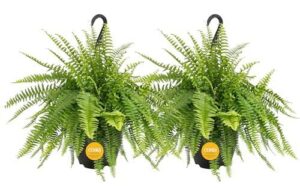
Boston Fern (Nephrolepis exaltata) is one of the hardest-working plants you can add to a humid room. Costa Farms ships two 16-inch ferns in 10-inch grower pots for around $37 — a practical starting point for kitchens or bathrooms.
Ferns thrive between 65–75°F with consistent moisture, pulling water vapor through their arching fronds to lower ambient humidity. Keep them in bright, indirect light, water with 2–3 cups weekly, and check that drainage holes stay clear to prevent root rot.
| Best For | Anyone who wants low-maintenance greenery that actually does something — cleans the air, adds life to a shelf or bathroom, and ships ready to go. |
|---|---|
| Plant Type | Boston Fern |
| Light Requirement | Bright indirect sunlight |
| Indoor Suitable | Yes |
| Outdoor Suitable | Yes, patio or garden |
| Pot Included | 10-inch black plastic grower pot |
| Drainage Holes | Yes, included |
| Additional Features |
|
- You get two solid-sized ferns for under $37, which is a pretty good deal for plants this established
- They’re genuinely easy to keep alive — bright indirect light, a couple cups of water a week, done
- Great gift option for housewarmings or birthdays since they arrive packaged and ready to hand off
- The grower pots can hold onto too much moisture, so root rot is a real risk if you’re not watching drainage
- Boston ferns are slow growers, so don’t expect them to fill a big space quickly
- Only suited for outdoor living in USDA zones 9–10 — anywhere colder and they’re strictly an indoor plant
2. Costa Farms Peace Lily Decorative Pot
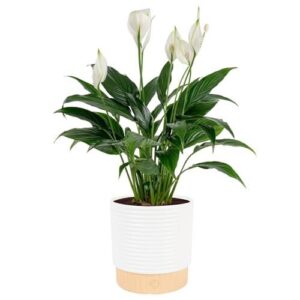
Where the fern works hard, the Peace Lily works quietly.
Costa Farms ships this Spathiphyllum in a 6-inch bamboo decorative pot — roughly 15 inches tall and under a pound, so it fits comfortably on a desk or shelf.
It filters airborne VOCs while pulling moisture from the surrounding air, and it only needs about a cup of water per week.
One important note: the decorative pot has no drainage holes, so always empty standing water to prevent root rot.
| Best For | Anyone looking for a low-maintenance indoor plant that doubles as a decorative piece — great for beginners, gift-givers, or anyone wanting cleaner air at home or the office. |
|---|---|
| Plant Type | Peace Lily |
| Light Requirement | Bright indirect light |
| Indoor Suitable | Yes |
| Outdoor Suitable | Limited, zones 10b-11 |
| Pot Included | 6-inch bamboo decorative pot |
| Drainage Holes | No, must manage manually |
| Additional Features |
|
- Easy to care for — just indirect light and about a cup of water a week, and it’s pretty forgiving if you miss a watering
- Looks great on a desk or shelf, and those white blooms add a nice touch without taking up much space
- Actually does something useful — filters common indoor air pollutants while it sits there looking pretty
- The bamboo pot has no drainage holes, so you have to be careful about emptying out excess water or you’ll end up with root rot
- Shipping can be rough on it — some plants arrive stressed or damaged, especially in colder weather
- Toxic to pets and kids if eaten, so placement matters if you’ve got curious animals or little ones around
3. Gold Child English Ivy Plant
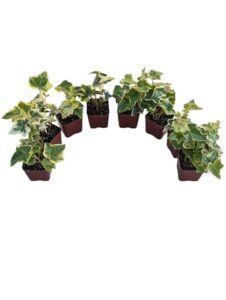
If the Peace Lily is your quiet worker, Gold Child Ivy is the overachiever trailing beautifully from a shelf while pulling moisture from the air.
Its variegated green-and-gold leaves absorb ambient humidity — and in brighter indirect light, that variegation intensifies, so you get better performance and better looks together.
Keep the top inch of soil dry between waterings, prune leggy stems every few weeks, and wipe leaves with a damp cloth to prevent dust buildup and spider mites.
| Best For | Beginner gardeners and plant lovers who want easy, eye-catching greenery for shelves, hanging baskets, or bare garden patches. |
|---|---|
| Plant Type | English Ivy |
| Light Requirement | Full sun to shade |
| Indoor Suitable | Yes |
| Outdoor Suitable | Yes, groundcover or containers |
| Pot Included | 2.25-inch plastic pots |
| Drainage Holes | Not specified, transplant recommended |
- Eight plants for $23.99 is a solid deal — great coverage without breaking the bank.
- Variegated green, white, and brown leaves look beautiful trailing from containers or spreading across a garden bed.
- Grows in almost any light condition, from full shade to full sun, so placement is flexible.
- Can turn invasive fast in mild climates if you’re not keeping up with regular trimming.
- A few buyers have reported missing plants in their order, so fulfillment can be hit or miss.
- Sensitive to heat during shipping — plants may arrive stressed or dried out in warmer months.
4. Costa Farms Snake Plant Decorative Pot
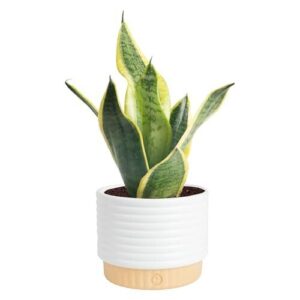
Where the Ivy trails, the Snake Plant stands — literally. Costa Farms’ Snake Plant arrives in a 10-inch decorative pot, already styled and ready to work.
Its rigid, upright leaves filter formaldehyde and xylene while tolerating the low light and dry air that defeat most plants.
Water it only when the top inch of soil is dry, and it’ll quietly manage ambient humidity year-round.
At $18.42, it’s one of the most low-maintenance investments your indoor air quality will thank you for.
| Best For | Anyone who wants a low-fuss houseplant that looks good, cleans the air, and basically takes care of itself — great for beginners, busy people, or anyone shopping for a practical gift. |
|---|---|
| Additional Features |
|
- Thrives in low light and needs watering only every week or two, so it’s almost impossible to kill
- Filters indoor air pollutants like formaldehyde and xylene, making it a smart pick for bedrooms and offices
- Arrives in a decorative ceramic pot at $18.42 — ready to display or gift with zero extra setup
- Plant size can be smaller than photos suggest, so don’t expect a showstopper right out of the box
- Mildly toxic to pets and kids if ingested, so placement matters in households with curious animals or little ones
- Can’t ship to AK, AZ, CA, HI, or GU, which cuts out a big chunk of potential buyers
Frequently Asked Questions (FAQs)
How can natural ventilation improve indoor humidity?
Natural ventilation can single-handedly transform a stuffy, moisture-logged room into a comfortable space.
Opening opposite windows creates a direct airflow path that can cut indoor humidity by up to 20 percent quickly.
How to reduce indoor humidity?
Reducing indoor humidity starts with airflow, smart habits, and the right absorbers. Open opposite windows, add moisture-loving plants, and keep indoor relative humidity between 30% and 50% for comfort and health.
How do you increase indoor humidity?
Most people are busy fighting high humidity — but sometimes your home is too dry.
Open a simmering pot, group leafy plants together, or leave the bathroom door open after a shower.
How do you naturally cool a home in a humid climate?
Cooling a humid home naturally starts with moving air smartly. Open opposite windows at dusk, use ceiling fans, and shade south-facing glass. Ventilation and airflow together make a real difference.
What is the best humidity for dry sinuses?
For dry sinuses, aim for indoor relative humidity between 40% and 50%. That range keeps nasal membranes moist without encouraging mold or dust mites that can make sinus symptoms worse.
Allow your digital hygrometer to stabilize for 2 to 5 minutes before adjusting your humidifier.
What health risks does excess indoor humidity cause?
Imagine waking up wheezing because your walls are quietly growing mold overnight.
Excess indoor humidity above 60% fuels dust mites, mold spores, and respiratory infections — putting your lungs, skin, and home structure at serious risk.
How does humidity affect wood floors and walls?
Wood absorbs moisture like a sponge. High humidity makes floors cup and swell, doors stick, and paint blister. Keeping indoor RH between 30–50% protects both your floors and walls long-term.
Can humidity damage electronics and metal fixtures?
Yes, it can. Humidity corrodes metal contacts, shorts circuits, and degrades solder joints. Keeping indoor RH between 30% and 50% protects both electronics and metal fixtures from moisture-driven damage.
What humidity level is too low for comfort?
Once indoor relative humidity drops below 30%, you’ll likely notice dry skin, irritated sinuses, and a scratchy throat. That 30%–50% range is your comfort sweet spot.
How do smart vents help regulate indoor moisture?
Smart vents use built-in humidity sensors to automatically adjust airflow room by room, targeting damp zones instantly.
They coordinate with your HVAC to pull moisture out before it ever becomes a problem.
Conclusion
Some may worry that natural methods can’t keep up with severe humidity issues, but they are often an essential first line of defense. By combining strategic airflow, moisture-absorbing plants, and smart habits, you create a balanced approach to indoor air quality.
Embracing natural humidity control techniques, as well as reducing your reliance on electric dehumidifiers, also fosters a healthier, more resilient home environment, better equipped to handle life’s unexpected moisture challenges, naturally and effectively.