This site is supported by our readers. We may earn a commission, at no cost to you, if you purchase through links.

A ball python curled inside a snug hide isn’t hiding from you—it’s doing exactly what 4,000 years of evolution designed it to do. In the wild, these snakes spend most of their lives wedged inside termite mounds or buried beneath leaf litter, rarely exposed.
Strip that security away in a classroom enclosure, and chronic stress follows: refused meals, erratic sheds, glass-surfing that never stops.
The right ball python hides for classroom pets don’t just complete the setup—they’re what separates a thriving snake from a perpetually stressed one. Warm-side, cool-side, humid hide for shedding—each fulfills a distinct purpose, and picking the wrong size or material undermines all of it.
Table Of Contents
- Key Takeaways
- Why Classroom Ball Pythons Need Hides
- What Makes a Good Hide
- Choosing The Right Hide Size
- Hide Placement in Classroom Enclosures
- Top 9 Ball Python Hides
- 1. Exo Terra Large Snake Cave
- 2. Exo Terra Extra Large Reptile Cave
- 3. Zilla Reptile Bark Bends Terrarium Hideout
- 4. Zilla Vertical Rock Cave Decor
- 5. Zilla X Large Terrarium Rock Den
- 6. Zilla Rock Lair Reptile Hide
- 7. Pangea Black Medium Reptile Hide Box
- 8. Zoo Med Large Reptile Shelter
- 9. Leoterra XL Plastic Ball Python Hide
- Cleaning and Replacing Classroom Hides
- Frequently Asked Questions (FAQs)
- Can ball pythons hide?
- How do you keep a ball python from shedding?
- Do ball pythons like roomier hides?
- How many hides do you need for a ball python?
- What is the best hideout for a ball python?
- Are ball pythons good classroom pets?
- Is 70 degrees too cold for a ball python at night?
- Can students safely handle the ball python daily?
- How long do ball pythons typically live in captivity?
- What substrate works best under classroom hides?
- Conclusion
Key Takeaways
- A ball python needs at least two hides — one on the warm side (86–90°F) and one on the cool side (76–80°F) — to thermoregulate naturally and stay stress‑free in a busy classroom.
- Hide size should match your snake’s coil diameter, not just its weight — too roomy, it feels exposed, too tight, it’ll avoid the hide altogether.
- Humid hide packed with damp sphagnum moss, placed on the warm side, handles shedding cleanly without spiking enclosure‑wide humidity above 60%.
- Non‑porous materials like polypropylene or resin are non‑negotiable for classroom setups — they clean fast, resist bacteria, and hold up through regular bleach or peroxide disinfection cycles.
Why Classroom Ball Pythons Need Hides
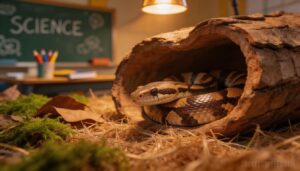
A hide isn’t optional for a ball python — it’s the difference between a stressed, hiding-in-the-corner snake and one that actually thrives. In a busy classroom, that matters even more.
Picking the right one comes down to a few key details — this guide to the best hide types for ball pythons breaks down exactly what to look for.
Here’s why getting this right sets everything else up for success.
Stress Reduction in Busy Classrooms
Classrooms are busy — loud voices, movement breaks, shifting energy. That constant activity hits a ball python hard without a secure hide to retreat into.
Think of it like your own need for a quiet corner after a hectic day. A snug, single-entrance hide with nonporous material works like white noise and calming color schemes do for students — it signals safety, lowers chronic stress, and keeps glass-surfing behavior away.
A snug, single-entrance hide signals safety to a ball python the way a quiet corner restores a person after a hectic day
Better Feeding and Digestion Support
A secure hide does more than calm nerves — it directly aids digestive health monitoring and consistent feeding behavior.
Ball pythons fed on proper feeding frequency timing, every 7–14 days for adults, digest better when post-feed rest isn’t interrupted.
Prey size matching and hydration management round out the equation.
Without a reliable retreat, stress undermines all of it.
Warm- and Cool-side Security
Your ball python needs two hides — a warm hide near the heat source at 86–90°F and a cool hide at 76–80°F. Heat Source Proximity and Draft-Free Placement keep each microclimate stable.
A single entrance with a weighted base manages Escape Prevention Measures and Anti-Tip Stability.
Microclimate Consistency between both sides is what keeps stress-triggered behaviors from surfacing mid-class.
Humid Hide Help During Shedding
Shedding is where a humid hide earns its place. Placing the hide on the warm side creates a localized high humidity microclimate for the pre‑shed snake. Tuck damp sphagnum moss inside and it manages moisture retention quietly — no need to spike enclosure-wide humidity above 60%.
Three things it directly provides:
- Shedding Efficiency — skin peels cleanly in one pass
- Eye Cap Release — retained caps become far less common
- Mold Prevention — moss replacement every 2–4 weeks keeps buildup away
Check humidity inside with a hygrometer. That’s humidity monitoring done right.
Natural Hiding Behavior in Captivity
In the wild, ball pythons rely on burrowing behavior and predator avoidance to survive — captivity doesn’t erase those instincts.
A naturalistic hide satisfies burrowing instincts, facilitates circadian activity patterns, and delivers sensory enrichment through scent and texture. It also functions as territory marking space, anchoring the snake’s sense of security.
That microclimate inside the hide is where stress reduction actually happens — quietly, naturally, every day.
What Makes a Good Hide

Not every hide belongs in a classroom — some stress snaps out, and others just fall apart after the first cleaning. A few specific features separate a reliable hide from one you’ll regret buying.
what to look for before you add anything to your cart.
Snug Fit Matters Most
Think of it like a snug sleeping bag — the fit itself is part of what keeps your snake calm. A proper snug fit means the interior matches coil diameter precisely, leaving no drafts along the body.
That edge flush design prevents cold air from sneaking in, supporting body heat conservation throughout the day. Follow weight-based hide sizing guidelines — appropriate hide size for ball pythons directly reduces restless movement.
Single Entrance for Better Security
single entrance isn’t just a design choice — it’s the difference between a secure hide and an escape route. One offset opening means your snake enters and settles without tailgating risks or anxiety from multiple access points.
controlled entry facilitates visitor flow management inside the enclosure, keeps the snake from bolting during emergency lockdown drills, and gives you clear surveillance redundancy when observing behavior daily.
Strong, Tip-resistant Construction
A wobbly hide is a stressed snake waiting to happen. In a busy classroom, bumps and brushes are inevitable — so the hide needs to hold its ground.
Look for these three construction qualities:
- Low Center Gravity and weighted base designs to prevent tipover during accidental contact
- Reinforced Corner Bracing with Anti-Wobble Feet that grip smooth floors
- Base Weight Distribution confirmed through Impact Load Testing — solid hides handle 50 kg without buckling
Smooth, Non-porous Safe Materials
Material choice is where safety starts. A plastic hide or resin hide made from nonporous plastic keeps bacteria from settling into surface cracks — critical in classrooms where cleaning happens on a schedule, not on demand.
| Material | Key Benefit |
|---|---|
| Polypropylene durability | Resists moisture absorption |
| Silicone coating | Blocks bacterial adhesion |
| Ceramic glaze | Hard, impermeable surface |
| Epoxy sealant | Seals any micro-gaps |
Stainless steel hygiene standards inspired nontoxic material formulations now used in reptile hides — BPA-free, easy to clean, and genuinely safe for students handling them daily.
Easy Cleaning for Classroom Setups
Classroom cleaning shouldn’t be complicated.
Nonporous plastic hides wipe down fast — no scrubbing, no guesswork.
Non-porous Surface Choices pair perfectly with Color-coded Cleaning Supplies from your Hygiene Station Design, keeping everything organized and student-safe.
- Bleach solutions (1:30 ratio) disinfect without damaging material durability
- Routine Monitoring Checklists track your maintenance schedule weekly
- Student Clean-up Days make easy to clean, hides a hands-on lesson
Choosing The Right Hide Size
Getting the size right is honestly one of the most overlooked parts of setting up a ball python’s hide. A hide that’s too big leaves your snake feeling exposed — too small, and they’ll avoid it altogether.
Here’s a quick breakdown by age and weight to help you match the right hide to your classroom snake.
Hatchlings Under 150 G
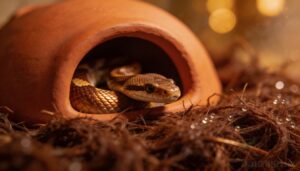
For hatchlings under 150 g, snug fit isn’t optional — it’s everything. A hide sized around 4 in × 3 in mimics the tight burrows they instinctively seek, lowering stress and supporting their high metabolic rate.
Choosing appropriate hide size for ball pythons at this stage directly impacts feeding schedule consistency, molt management, and scale condition.
| Care Factor | Hatchling Guideline |
|---|---|
| Hide Size | 4 in × 3 in |
| Weight Tracking | Weekly weigh-ins |
| Warm Side Temp | 88–90 °F |
| Humid Hide Benefits | 70–90% RH for shedding |
| Single Entrance | Reduces escape anxiety |
A secure hide with a single entrance keeps these tiny snakes calm between feedings.
Juveniles From 150–500 G
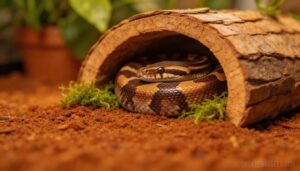
Once your ball python crosses 150 g, a 5 in × 4 in hide becomes the right call. Choosing appropriate hide size for ball pythons at this stage helps weight-based temperature regulation and reduces shedding stress.
Keep these three priorities consistent:
- Growth Rate Monitoring through weekly weigh-ins
- Prey Size Selection — 8 to 12 cm prey items
- Calcium Supplementation with 1–2 dusted meals weekly
A secure hide with humid hide benefits for shedding keeps juveniles thriving.
Sub-adults From 500–1,500 G
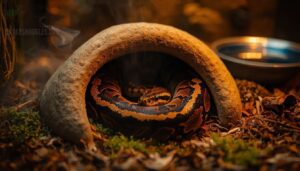
Once your snake hits 500 g, bump up to a 6 in × 5 in secure hide — and stick with that size through 1,500 g. Growth velocity picks up fast here, so weight tracking every two weeks keeps your sizing accurate. A single entrance hide design keeps them calm, and a humid hide aids shedding through this stretch.
| Weight Range | Hide Size | Feeding Schedule |
|---|---|---|
| 500–900 g | 6 in × 5 in | Every 7 days |
| 900–1,200 g | 6 in × 5 in | Every 7 days |
| 1,200–1,500 g | 6 in × 5 in | Every 5–7 days |
Weight-based hide sizing guidelines and a stable temperature gradient — 86–90 °F warm side, 76–80 °F cool — support digestion and reduce stress.
Adult Male Hide Sizing
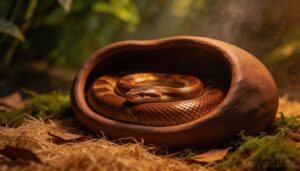
Adult males usually land between 600–900 g — a range where weight based hide sizing starts to matter more precisely. Standard dimensions here sit around 6 in × 5 in, but a proper size accounts for coil diameter ratio, not just weight scaling.
Here’s what proper fit looks like:
- Interior snugness — snug fit versus oversized hides reduces stress.
- Growth buffer size for males approaching 900 g.
- Fit margin guidelines: 1–1.5× coil diameter.
- Size grading of hides for growth stages prevents premature upsizing.
- Hide size selection should factor individual girth, not weight alone.
Adult Female Hide Sizing
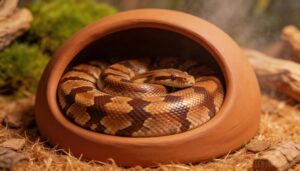
Females are a different beast — they can push past 1,500 g and need hides sized around 9–12 in long and 5–7 in wide.
Girth Based Dimensions matter more than weight here, following a Coil Diameter Ratio of 1–1.5×. Draft Free Sealing keeps airflow controlled without cold spots.
| Weight Range | Length | Width |
|---|---|---|
| 500–1,000 g | 9 in | 5 in |
| 1,000–1,500 g | 10 in | 6 in |
| 1,500 g+ | 12 in | 7 in |
Signs a Hide is Too Small
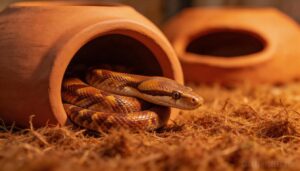
When a hide’s too tight, your snake tells you — just not with words. Watch for tail squeezing at the entrance, limited coil space forcing awkward postures, or frequent escape attempts right after entering.
Visible skin irritation and increased respiratory rate signal chronic stress.
Proper size and weight-based hide sizing prevent these issues before they start.
Hide Placement in Classroom Enclosures
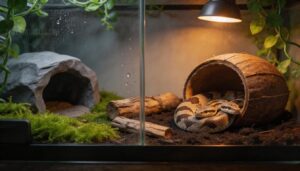
Where you place your hides matters just as much as which ones you buy. A ball python that can’t reach both a warm retreat and a cool one will show it — through stress, refused meals, or bad sheds.
Here’s what proper hide placement looks like inside a classroom enclosure.
Two Hides Minimum Per Enclosure
Think of your ball python’s enclosure as having two safe rooms — one warm, one cool. That’s the Dual Hide Strategy, and it’s non‑negotiable for smart enclosure design.
Two hides minimum create Temperature Zoning and Enclosure Balance that facilitate natural behavior without student interaction pressure.
Place a secure hide on each end, clean hides weekly, and your ball python stays genuinely stress‑free.
Warm-side Hide at 86–90 °F
Your warm hide sits directly over the heat mat — set your thermostat to hold that 86–90 °F temperature range consistently. Material heat retention matters here: a nonporous material transfers heat evenly without hot spots. Temperature stability reduces stress and helps digestion after feeding.
Student monitoring is straightforward — one quick thermometer check confirms everything’s running right without disturbing the snake.
Cool-side Hide at 76–80 °F
The cool hide anchors the far end of your thermal gradient — placed away from any heat source, it should read 76–80 °F inside, not at the enclosure wall. Use Temperature Monitoring inside the hide for accuracy.
Color Coding the cool side helps students with Thermal Gradient Calibration quickly.
Your ball python retreats here after digestion, so consistent temperature range and Ventilation Management matter.
Humid Hide Placement Basics
Your humid hide belongs on the warm side — near Basking Lamp, ideally 86–90 °F, where evaporation keeps that interior microclimate consistently moist.
Elevated Positioning above direct substrate contact helps airflow.
Keep it Away from Fans, which dry the moss out fast.
Side-by-side Pairing with your warm-side dry hide gives your snake options.
Microclimate Monitoring every 2–3 days tells you when moss replacement is due.
When to Add a Third Hide
Once your warm- and cool-side hides are placed, most ball pythons settle quickly.
But watch for Shelter Saturation Indicators — signs that the snake is constantly pressed against one side.
Add a third humid hide when you notice:
- Temperature Zone Imbalance despite proper gradients
- Crowding Stress Signs like glass-surfing
- Incomplete sheds signaling poor microclimate creation using humid hides
- Activity Pattern Monitoring showing zero cool-side use
Wait until the Shedding Cycle Completion before introducing it.
Observation Without Handling Stress
Once the third hide is placed, shift your focus to watching rather than touching. Quiet Observation Windows and a Predictable Viewing Schedule let students study real Behavioral cues for hide usage — coiling patterns, breathing pace, exit timing — without triggering stress.
Non-Intrusive Enclosure Design with Student Observation Protocols keeps Stress Indicator Monitoring consistent.
Stress reduction through proper hiding spots works best when the snake stays undisturbed.
Top 9 Ball Python Hides
Finding the right hide doesn’t have to feel like a guessing game. Each option below was chosen with classroom setups in mind — balancing easy cleaning, solid construction, and the right fit for your snake’s size.
Here are nine hides worth a close look.
1. Exo Terra Large Snake Cave
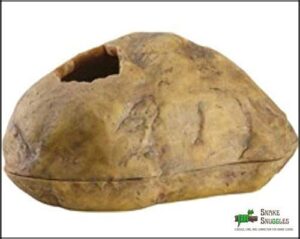
The Exo Terra Large Snake Cave (model PT2847) is a reliable choice for classroom enclosures. It’s molded from rigid, UV-stable resin — smooth inside, easy to disinfect, and heavy enough at 3.15 lb to stay put when your ball python coils inside.
The removable top lets you do quick health checks without stressing the animal.
Toss in the included dried moss, dampen it slightly, and it converts into a humid hide for shedding.
Fits juveniles to sub-adults well.
| Best For | Reptile keepers housing juvenile to sub-adult snakes or lizards who want a stable, easy-to-clean hide that doubles as a humid spot for shedding. |
|---|---|
| Material | Rigid plastic |
| Color | Brown |
| Weight | 3.15 lb |
| Humidity Support | Yes, with included moss |
| Cleanability | Smooth interior, easy to clean |
| Removable Lid | Yes |
| Additional Features |
|
- The removable top makes health checks and cleaning quick without stressing your animal out
- Heavy enough at 3.15 lb to stay put even with an active snake inside — no tipping on heat pads
- Drop in the included moss, add a little water, and you’ve got a solid humid hide for shedding season
- The entry hole is on the smaller side, so bigger or bulkier snakes may struggle to get in or out comfortably
- Some owners notice a plastic smell that sticks around even after a good cleaning
- Only comes in one size, so if you need something larger than "large," you’ll have to look elsewhere
2. Exo Terra Extra Large Reptile Cave
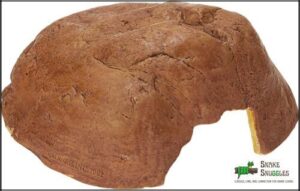
Need more room? The Extra Large Reptile Cave (model PT2854) steps up where the PT2847 leaves off — at 10.23 × 11.02 × 4.33 in, it comfortably fits adult females and larger sub-adults.
Same natural rock finish; same easy-clean resin interior.
One entrance keeps your snake feeling secure rather than exposed.
Worth noting: check the interior edges before first use and sand down any rough molding seams.
At 2.09 lb, it stays stable without dominating a mid-size enclosure.
| Best For | Owners of large snakes or medium reptiles who need a roomy hide that fits naturally into a mid-size to large enclosure. |
|---|---|
| Material | Resin |
| Color | Black |
| Weight | 2.09 lb |
| Humidity Support | Yes, with added moss |
| Cleanability | Flat surfaces, easy to clean |
| Removable Lid | No |
| Additional Features |
|
- Plenty of space for adult ball pythons, corn snakes, and similar-sized reptiles
- Natural rock look blends right into most terrarium setups
- Easy to clean and can double as a humid hide with a little moss or damp paper towel
- Interior molding edges can be sharp and may need sanding before use
- Thin resin walls can degrade over time with heavy washing or high humidity
- Large footprint eats up tank real estate, so it’s not a great fit for smaller enclosures
3. Zilla Reptile Bark Bends Terrarium Hideout
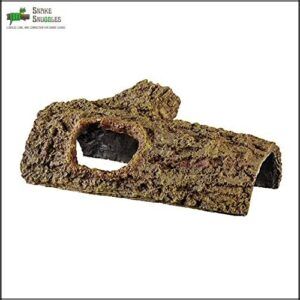
The Zilla Bark Bends Terrarium Hideout brings something different to the lineup — a faux-log design that actually looks at home in a classroom terrarium.
The medium size (8.38″ × 3.63″ × 3″) fits hatchlings and small juveniles well.
Its non-porous plastic resists bacteria and wipes clean fast, which matters when students are involved in weekly care routines.
The wide, stable base won’t tip during enclosure checks.
One thing to verify first: inspect edges out of the box and sand any rough spots before use.
| Best For | Reptile and amphibian owners with medium to large enclosures who want a natural-looking hide that lets them observe their animals without constant disturbance. |
|---|---|
| Material | Plastic resin |
| Color | Brown |
| Weight | 0.92 lb |
| Humidity Support | Limited |
| Cleanability | Standard plastic cleaning |
| Removable Lid | No |
| Additional Features |
|
- The open "Bark Bend" design lets you watch your animal burrow, shed, or nest without lifting the hide or stressing them out.
- Non-porous resin won’t rot, harbor bacteria, or stain — easy to wipe down and keep clean.
- Heavy and stable enough to stay put in both terrestrial setups and aquariums used as a sunken décor piece.
- Some units arrive with sharp or jagged edges that need sanding before they’re safe to use.
- Shipping damage like cracks or broken pieces has been reported, so inspect it carefully right out of the box.
- It’s on the larger, heavier side — not a great fit for small tanks or setups with delicate inhabitants.
4. Zilla Vertical Rock Cave Decor
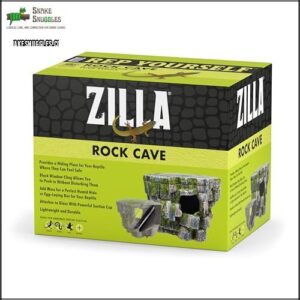
This one mounts directly to the glass. The Zilla Vertical Rock Cave uses suction cups with a lever mechanism — easy to reposition without tools, which classroom setups need constantly.
Dimensions run roughly 8.75″ × 5.875″ × 7.25″, making it a solid fit for sub-adults.
The non-porous polyurethane foam resists bacteria and withstands regular disinfection without degrading.
Rounded edges reduce snag risk. One caution: suction cups lose grip on dirty glass, so wipe the mounting surface clean before attaching.
| Best For | Arboreal reptiles and amphibians like geckos, frogs, and chameleons that need an elevated hide and basking spot in a glass terrarium. |
|---|---|
| Material | Rigid plastic |
| Color | Grey |
| Weight | 1.09 lb |
| Humidity Support | Limited |
| Cleanability | Easy to reposition and clean |
| Removable Lid | Yes, removable top |
| Additional Features |
|
- Mounts directly to the glass with suction cups and a lever — no tools needed, easy to move around
- Built-in cavity works as both a hideout and a feeding station when you drop a dish inside
- Lightweight but tough enough for daily climbing and regular cleaning
- Suction cups can lose grip on dirty or textured glass, so the surface needs to be clean before mounting
- Takes up a noticeable amount of space, which could feel cramped in a smaller tank
- Dimensions vary across listings, so double-check measurements before buying to make sure it fits
5. Zilla X Large Terrarium Rock Den
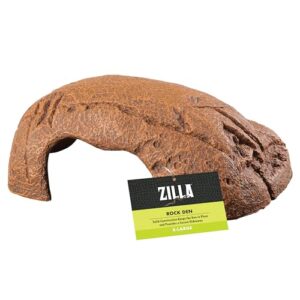
Three things make this hide classroom-ready: stability, easy cleaning, and the right size for growing ball pythons. Zilla X-Large Rock Den measures 6″ × 5″ × 7″ — snug enough for adult females without crowding the enclosure.
Its flat, wide base won’t tip when your snake coils inside. The non-porous plastic surface wipes down fast with soapy water and dries quickly, fitting neatly into weekly cleaning routines.
The textured rock finish also keeps students visually engaged during observation periods.
| Best For | Teachers and reptile owners who need a stable, easy-to-clean hide for medium to large ball pythons or similar-sized reptiles. |
|---|---|
| Material | Injection-molded plastic |
| Color | Orange |
| Weight | Not specified |
| Humidity Support | Limited |
| Cleanability | Soap and water compatible |
| Removable Lid | No |
| Additional Features |
|
- Non-porous plastic wipes clean fast — soap, water, done
- Heavy base stays put even when a snake pushes in or out
- X-large size gives adult females room to coil comfortably
- Interior edges can be sharp right out of the box and may need light sanding
- Tight corners and nooks trap shed skin and waste, making deep cleans trickier
- Some units arrive with cracks or manufacturing debris that need attention before first use
6. Zilla Rock Lair Reptile Hide
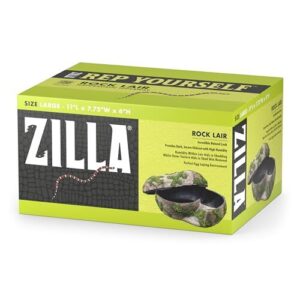
If your classroom snake stresses during busy periods, the Zilla Rock Lair quietly solves that. Its side entrance blocks ambient light, creating that burrow-like darkness that pythons instinctively seek.
The heavy resin construction stays put — no tipping when your snake coils inside.
Pack damp sphagnum moss underneath the removable lid and it doubles as a humid hide during shedding cycles.
The rough exterior texture also helps loosen old skin naturally.
Dimensions run 11″ L × 7.75″ W × 6″ H — a solid fit for sub-adults and adult females.
| Best For | Teachers, hobbyists, or reptile owners who need a reliable hide that handles shedding support and stress relief in one enclosure-ready piece. |
|---|---|
| Material | High-density plastic |
| Color | Grey |
| Weight | Not specified |
| Humidity Support | Yes, primary feature |
| Cleanability | Easy to clean |
| Removable Lid | Yes |
| Additional Features |
|
- Dark interior and side entrance mimic a natural burrow, which helps snakes and lizards feel secure and calm down during high-traffic moments
- Works great as a humid hide — just pack damp moss under the lid and you’ve got a solid shedding station
- Heavy, sturdy build means it stays in place even when a snake is actively moving around inside
- Edges can chip in shipping, so inspect it carefully when it arrives
- The interior runs on the smaller side, so larger snakes or multiple adults will likely outgrow it fast
- Plastic construction can look out of place in a bioactive setup without some extra décor around it
7. Pangea Black Medium Reptile Hide Box
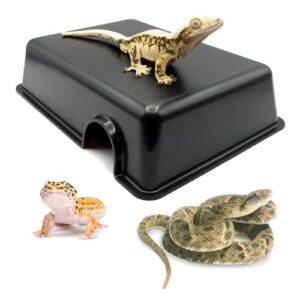
The Pangea Black Medium Reptile Hide Box is pure function — no decorative extras, just solid 1/8-inch thick black plastic built to last through weekly disinfection cycles.
Measuring 10 × 7 × 2.25 inches, it fits adult colubrids and juvenile-to-sub-adult ball pythons snugly inside standard 28–32 quart tubs.
The offset entrance gives your snake that secure, enclosed feeling without restricting movement.
Smooth, non-porous surfaces clean up fast with peroxide or diluted bleach — exactly what busy classroom schedules demand. Budget-friendly and durable.
| Best For | Teachers, hobbyists, and reptile keepers who need a no-fuss, easy-to-clean hide for medium-sized snakes, geckos, skinks, or bearded dragons. |
|---|---|
| Material | Rigid black plastic |
| Color | Black |
| Weight | 0.31 lb |
| Humidity Support | Yes, with moss or water |
| Cleanability | Hot water or sanitizer safe |
| Removable Lid | No |
| Additional Features |
|
- Thick 1/8-inch plastic holds up through repeated disinfection with hot water, peroxide, or bleach — no degrading, no staining.
- Offset entrance gives reptiles that snug, secure feeling they actually want in a hide.
- Works as a humid hide too — just toss in some damp moss and you’re done.
- Too roomy for hatchlings or tiny species that need a tighter fit to feel safe.
- Lightweight enough that bigger, active snakes can shift or lift it — may need a rock on top.
- Flat black plastic gets the job done but looks pretty plain next to stone or wood hides.
8. Zoo Med Large Reptile Shelter
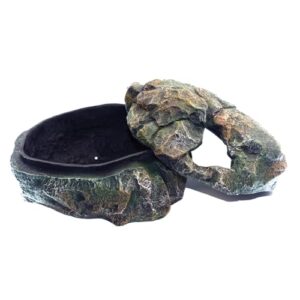
Zoo Med’s Large Reptile Shelter earns its place in classroom setups by doing three jobs at once — hide, humidity shelter, and egg‑laying site. The removable lid makes weekly inspections and cleaning fast, with no enclosure disruption needed.
Resin construction manages disinfection without degrading, and the single‑entrance cave design keeps your ball python calm during busy class periods.
It’s weighted enough to stay put when the snake coils inside. A reliable pick for hatchlings through small adults.
| Best For | Small-to-medium reptile owners who want a hide that doubles as a humidity and nesting box — especially great for leopard geckos, corn snakes, and baby pythons. |
|---|---|
| Material | High-impact plastic |
| Color | Black |
| Weight | 7.35 lb |
| Humidity Support | Yes, retains moisture |
| Cleanability | Removable lid for cleaning |
| Removable Lid | Yes |
| Additional Features |
|
- Three functions in one — works as a hide, humid shedding box, and egg-laying site, so you’re not cluttering the enclosure with multiple accessories.
- The removable lid makes cleaning and egg checks quick and easy without tearing apart the whole setup.
- Weighted design keeps it stable, so active reptiles can’t knock the lid loose during their midnight adventures.
- The lid fit isn’t always snug — some owners find it needs a little adjusting to stay properly in place.
- Plastic can crack if it ends up too close to a heat source, so placement matters.
- Faster-growing reptiles may outgrow it sooner than expected, meaning you might need to size up within a year.
9. Leoterra XL Plastic Ball Python Hide
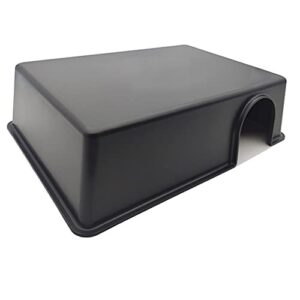
If you need something bigger and simpler, the Leoterra XL is worth a look. At 16.54" × 10.63" × 4.33" with a 4.4" × 3.54" entrance, it fits adult ball pythons comfortably — including larger females over 1,500 g.
Single-piece rigid plastic means no seams to trap bacteria.
The top-seal design holds localized humidity well, supporting cleaner sheds.
Lightweight enough for easy repositioning, though larger snakes may tip it without anchoring.
Clean with diluted bleach or hydrogen peroxide — quick and straightforward for weekly classroom routines.
| Best For | Adult ball python owners who want a spacious, no-fuss hide that’s easy to clean and holds humidity well. |
|---|---|
| Material | Impact-resistant plastic |
| Color | Black |
| Weight | 0.88 lb |
| Humidity Support | Yes, sealed top |
| Cleanability | Water or disinfectant safe |
| Removable Lid | No |
| Additional Features |
|
- XL size comfortably fits large adult ball pythons, including bigger females
- Single-piece plastic with no seams means bacteria has nowhere to hide
- Top-seal design helps lock in humidity for healthier sheds
- Bigger snakes can tip it over without extra anchoring
- Plastic look won’t blend well if you’re going for a natural enclosure aesthetic
- Pricier than similar plastic hides on the market
Cleaning and Replacing Classroom Hides
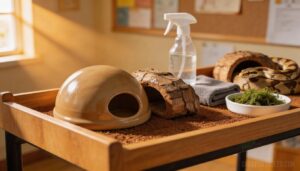
Keeping classroom hides clean isn’t complicated, but it does need to happen on a regular schedule.
A few simple habits — weekly washing, moss swaps, and quick damage checks — go a long way toward keeping your snake healthy and your setup running smoothly.
Here’s what to stay on top of.
Weekly Washing and Disinfection
A consistent cleaning routine keeps your snake healthy and your classroom safe. Before disinfecting, wash each hide with soap and water to clear debris. Then apply your chosen disinfectant — and don’t skip Contact Time Management; let it sit per the label.
Follow this weekly sequence:
- Wipe surfaces daily using a microfiber cloth
- Wear gloves — Glove Protocols protect students and staff
- Log the date, product, and any damage noted
Surface Drying Techniques matter too — always air-dry completely before returning hides. Rotate disinfectants periodically to support Disinfectant Rotation and reduce resistant organisms. Quarterly Microbial Swab Testing confirms your cleaning and maintenance of reptile hides is actually working.
Safe Peroxide or Bleach Cleaning
Once the soap wash is done, you have two solid options: 3% hydrogen peroxide or a 1:30 bleach solution. Both handle cleaning hides with bleach solutions and peroxide effectively—but never mix them.
Chemical Mixing Rules matter here; combined, they create fumes nobody wants near students.
Follow Contact Time Guidelines per the label, rinse thoroughly for complete Residue Rinsing, and always clean under Ventilation Requirements—open a window.
Moss Replacement Every 2–4 Weeks
After disinfecting, shift your attention to the humid hide’s sphagnum moss. Moss Moisture Retention degrades quickly in a warm enclosure — mold prevention and moss replacement schedules every 2–4 weeks keep things clean and safe.
- Replace sphagnum moss every 2–4 weeks
- Pre-moisten fresh moss before placing it
- Follow a Mold Prevention Schedule consistently
- Use Humidity Monitoring via hygrometer after each swap
- Apply Moss Storage Protocol — store extras in a sealed, clean container
Checking for Cracks and Sharp Edges
Once the hide is clean and dry, run a slow Light Inspection under bright, even lighting — cracks hide surprisingly well in shadows. Follow up with Magnifier Use for hairline fractures under 0.5 mm.
Check Edge Rounding carefully; any burr you feel is a sharp edge risk worth flagging. Use Crack Marking to track problem spots.
These are your core Replacement Criteria signals.
Replacing Worn-out or Damaged Hides
When a crack shows up or the entrance edges start snagging, that’s your Replacement Timing Plan trigger — don’t wait. Run a quick Odor Inspection Protocol and Seal Integrity Review each cleaning cycle.
Nonporous, BPA-free materials score best for Disinfection Compatibility.
Use Fit Adjustment Guidelines to confirm the new hide still fits snugly.
Mold or musty smell? Pull it immediately.
Upsizing Hides as The Snake Grows
As your ball python gains weight, track each Growth checkpoint tracking point by measuring Coil Diameter Measurement rather than length — girth tells you more.
Follow a Size Upgrade Schedule every 2–4 months during juvenile growth, and keep an Inventory Buffer Strategy ready with one size up on hand.
Use Student Observation Logs and weight-based sizing to document each growth stage scaling step accurately.
Frequently Asked Questions (FAQs)
Can ball pythons hide?
Yes, they absolutely can — and they must. Ball pythons are instinctive hiders, using Behavioral Indicators like reduced movement and coiling to signal Hide Preference.
Hiding isn’t optional; it’s core to their health.
How do you keep a ball python from shedding?
You can’t stop shedding — and shouldn’t try.
Molt Management means supporting the process: maintain humidity control with a humid hide, moss humidity monitoring, and Gentle Enclosure Design to guarantee clean, stress‑free molt timing every time.
Do ball pythons like roomier hides?
Not exactly.
Ball pythons prefer snug hides—tight curling space and breathing freedom matter more than room to roam. A hide that matches their coil diameter reduces stress and reinforces natural hide preference instincts.
How many hides do you need for a ball python?
You need at least two hides — one on the warm side, one on the cool side. That simple hide distribution strategy covers your bases and follows ball python husbandry best practices.
What is the best hideout for a ball python?
The Exo Terra Snake Cave leads the pack — resin build, nonporous materials for easy disinfection, snug single entrance hide design, and budget-friendly pricing make it the most dependable choice for your ball python.
Are ball pythons good classroom pets?
Yes — with the right setup.
Ball pythons are calm, low-allergen, and surprisingly effective teaching tools for Educational Value and Curriculum Integration.
Student Engagement stays high when Safety Protocols and Ethical Considerations guide every interaction.
Is 70 degrees too cold for a ball python at night?
At 70°F, your ball python sits right at the edge.
It’s not immediately dangerous, but nighttime thermoregulation suffers — metabolic rate impact is real, digestion slows, and the snake may avoid its warm hide altogether.
Can students safely handle the ball python daily?
Daily handling isn’t safe. Stick to short, occasional sessions — skip contact right after feeding and during shedding.
Always supervise with a two-handed grip and enforce hand hygiene protocols before and after every interaction.
How long do ball pythons typically live in captivity?
Ball pythons commonly live 20 to 30 years in captivity, with some reaching 40+. Average lifespan lands around 25 years when temperature stability, veterinary care, and proper diet stay consistent throughout their life.
Since you’ll be caring for your ball python across multiple decades, learning to read its species-specific behavior cues early on makes it much easier to spot stress or health issues as it ages.
Compared to other popular pet snake species like corn snakes and kingsnakes, ball pythons sit at the longer end of the captive lifespan spectrum — a commitment worth considering before bringing one home.
Pairing that longevity with an understanding of ball python body language and cuddling behavior helps owners recognize stress early and build a calmer, healthier bond over the decades.
Before bringing one home, check the enclosure conditions and ask breeders about lineage and care history, since a ball python’s early husbandry often shapes how long and healthily it lives.
What substrate works best under classroom hides?
Coconut coir is your best bet — it balances humidity retention and comfort without molding fast. Aspen chips work too, staying clean and low-dust. For simplicity, paper towel wins every time.
Conclusion
Like a puzzle piece falling into place, the right ball python hide can transform a stressful classroom pet into a thriving one. By choosing the perfect hide—considering size, material, and placement—you’ll create a sanctuary that meets your snake’s instinctual needs.
With the ball python hides for classroom pets listed here, you’ll be well on your way to a harmonious and healthy environment. Your snake will thank you; now go build that hide—and nurture a happy, stress-free pet.