This site is supported by our readers. We may earn a commission, at no cost to you, if you purchase through links.

A snake that can’t shed properly is telling you something. That crinkled, stuck skin around the eyes or tail isn’t bad luck—it’s low humidity, and it’s completely fixable.
Most keepers don’t realize their enclosure is running too dry until they’re already soaking their ball python in a warm bath at midnight, peeling off retained eye caps with a damp cotton swab.
The fix rarely requires expensive equipment. A properly sized water bowl, the right substrate, and some smart placement can increase humidity and hold it steady—keeping your snake comfortable, healthy, and shedding cleanly every single time.
Table Of Contents
- Key Takeaways
- Measure Humidity Before Changing Anything
- Set Your Snake’s Target Range
- Increase Water Bowl Evaporation
- Choose Moisture-Holding Substrate
- Mist The Enclosure Safely
- Add a Proper Humid Hide
- Adjust Ventilation and Heat
- Support Room Humidity Naturally
- Top 9 Humidity Tools
- 1. Indoor Digital Hygrometer LCD
- 2. AcuRite Indoor Hygrometer Thermometer
- 3. Pelonis Champagne Oil Filled Heater
- 4. HumiCare Gel Bead Humidifier
- 5. Honeywell Top Fill Tower Humidifier
- 6. Raydrop 2.2L Cool Mist Humidifier
- 7. AprilAire Model 10 Water Panel
- 8. Levoit Quiet Cool Mist Humidifier
- 9. Pure Lavender Essential Oil
- Prevent Mold, Mites, and Stress
- Frequently Asked Questions (FAQs)
- How do you increase humidity in a room?
- How to humidify your home?
- How can I increase humidity without a humidifier?
- Should you add humidity to your home?
- How can I make my humidity higher?
- How can I raise the humidity without a humidifier?
- Does putting a bucket of water in a room increase humidity?
- Does outdoor humidity affect indoor moisture levels?
- Can humidity levels impact sleep quality?
- How does air conditioning change indoor humidity?
- Conclusion
Key Takeaways
- Before tweaking anything in your snake’s enclosure, grab a digital hygrometer and check both the warm and cool sides — you can’t fix what you haven’t measured.
- Wider water bowls placed near your heat source and moisture-holding substrates like cypress mulch or coconut fiber are the easiest passive ways to keep humidity steady without constant effort.
- During a shed cycle, bump humidity 5–10% above your snake’s baseline, mist the enclosure walls (not the snake), and add damp sphagnum moss in a warm-side hide to help skin slip off cleanly.
- Too much moisture is just as harmful as too little — soggy substrate, wall condensation, and stagnant air invite mold and mites fast, so pair any humidity boost with steady airflow.
Measure Humidity Before Changing Anything
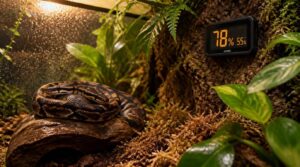
Before you touch a single thing in your snake’s enclosure, get a baseline reading — otherwise you’re just guessing. Knowing your actual humidity levels tells you exactly how much adjustment is needed and keeps you from overcorrecting. Here’s what to check before making any changes.
A quick look at ideal humidity ranges for ball pythons gives you a solid target to measure against before you start tweaking anything.
Use a Digital Hygrometer
Before you adjust a single thing, grab a digital hygrometer — it’s your starting point. These small devices give you real-time humidity levels in percent relative humidity, often alongside temperature. Most run $10–$30 and offer solid sensor accuracy of ±2%–5% RH. Some include Bluetooth monitoring features to track hygrometric readings remotely from your phone. The device’s compact hand‑held design makes it ideal for quick spot checks in terrarium setups.
- Look for LCD display with backlight
- Choose models with min/max memory
- Avoid analog dial gauges — they drift
- Confirm humidity sensor calibration on setup
Check Warm and Cool Sides
Now that your hygrometer is in hand, don’t just plop it in one spot and call it a day. Your snake’s enclosure runs two distinct zones — warm side (85–90°F) and cool side (75–82°F) — and humidity behaves differently across each.
Check both ends separately for accurate thermal gradient accuracy and a complete picture of your enclosure’s microclimate.
Avoid Vent-side Readings
Where you place your moisture sensors matters more than most keepers realize. Readings taken near vent openings get skewed by active airflow, creating artificial spikes that don’t reflect what your snake actually experiences. Move sensors away from vents and toward interior zones for honest, representative air sampling.
- Skip vent-adjacent spots
- Sample enclosure mid-height
- Position away from water bowls
- Use two sensors minimum
Track Daily Humidity Changes
Once your moisture sensors are positioned correctly, the next step is watching what those readings do over time.
Humidity levels shift constantly — indoor RH usually fluctuates 5–15% within a single day. Morning readings often run lower than afternoon.
Log hourly if you can, noting temperature alongside humidity to catch dew point changes and spot patterns before they become problems.
Record Shed-cycle Spikes
During a shed cycle, humidity spike duration matters as much as peak value. Log the time your hygrometer climbs above baseline and when it drops back down. Useful data points include:
- Spike timing relative to misting events
- Peak relative humidity reached per microclimate zone
- Substrate moisture levels before and after each spray
This reveals your misting cadence optimization window clearly.
Set Your Snake’s Target Range

Not every snake needs the same humidity level — a ball python and a corn snake have pretty different comfort zones. Getting this dialed in before you start tweaking anything saves you a lot of guesswork. Here’s what each common species actually needs, plus how to adjust during shed cycles.
Match Species Humidity Needs
Not every snake thrives at the same humidity — species-specific ranges matter more than most keepers realize. Getting it wrong long-term raises the risk of respiratory infections, stuck sheds, and sluggish metabolic cycles.
Think of humidity control like a thermostat: set it right for your specific snake, and everything else falls into place naturally.
Set your snake’s humidity like a thermostat — dial it in once for your species, and everything else follows
Ball Python Humidity Range
Ball pythons need 55–70% relative humidity as their daily baseline — drop below that, and you’re looking at stuck sheds and irritated airways. During a shedding cycle, nudge levels toward 70–80% to help the skin slip off cleanly.
- Daily range: 55–70% general enclosure humidity
- Humid hide target: 75–85%
- Shedding window: 70–80%
- Use two hygrometers for warm and cool sides
- Avoid sudden humidity swings to prevent respiratory stress
Corn Snake Humidity Range
Corn snakes are more forgiving than ball pythons, but don’t let that fool you into ignoring humidity altogether.
Your target baseline is 65–75%, with 40–60% tolerated in drier rooms — though that lower range risks dysecdysis (stuck shed) if left unchecked.
During shedding windows, push toward the upper end to help skin slip off cleanly.
Boa Constrictor Humidity Range
Boas are the high-maintenance clients of the snake world — and their humidity baseline reflects that. Aim for 60–75% relative humidity under normal conditions, bumping to 75–85% during shedding. True Amazonian boas need the upper end consistently.
Use a hygrometer to monitor microhabitat humidity zones on both warm and cool sides, and adjust moisture control as seasons shift.
Raise Humidity During Shedding
Shedding is the moment humidity control matters most. When your snake enters the blue eye phase — eyes turn cloudy and bluish — it’s time to act.
- Raise humidity 5–10% above baseline
- Mist substrate to boost substrate moisture levels
- Add damp moss for microclimate creation
- Watch for shedding stress signs like rubbing or hiding
Increase Water Bowl Evaporation
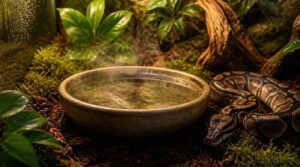
Your water bowl does more than quench your snake’s thirst — it’s one of the easiest passive humidity tools you already have. A few small adjustments to how you use it can make a real difference in your enclosure’s moisture levels. Here’s what to focus on.
Use a Wider Water Bowl
One of the easiest wins for raising humidity levels is swapping out a small bowl for a wider one. A 6- to 8-inch diameter bowl dramatically increases the water surface exposed to air, which speeds up moisture evaporation naturally.
| Feature | Recommendation |
|---|---|
| Ideal diameter | 6–8 inches |
| Minimum water volume | 250 ml |
| Material | Smooth, non-porous |
| Lip height | Shallow but stable |
| Cleaning frequency | Weekly minimum |
Choose a smooth, non-porous bowl — ceramic or heavy plastic works well — since rough surfaces trap bacteria and make scrubbing a chore. Wider bowls also sit more securely, so your snake won’t flip them mid-cruise across the enclosure.
Move Bowl Near Warmth
Now that you’ve got the right bowl, placement does the heavy lifting. Position the bowl 4–8 inches from your warm side — close enough for heat to drive evaporation, but not so close it overheats. A ceramic bowl absorbs and holds that warmth longer, sustaining moisture release steadily throughout the day.
Refill With Clean Water
Water placement helps, but what’s inside the bowl matters just as much. Refill daily with fresh, dechlorinated water — either filtered or left to sit out for 30 minutes so chlorine dissipates.
Keep it room temperature; cold water stresses snakes. A quick rinse with hot water and mild soap between refills prevents biofilm buildup before it starts.
Prevent Spills and Flooding
A spill sounds minor until soggy substrate starts wicking moisture straight into your bedding — and suddenly you’ve got a humidity imbalance instead of control.
- Use a waterproof tray under the bowl
- Choose a non-skid, wide base dish
- Keep water container placement away from substrate edges
- Seal enclosure base seams to stop seepage
Good stable bowl placement keeps your moisture balance where it belongs.
Clean Bowl Regularly
Neglecting your water bowl is like leaving dirty dishes in the sink — bacteria move in fast.
Wash daily with hot water and unscented soap, then rinse completely; soap residue can stress your snake. Dry the bowl fully before refilling to stop biofilm and mold.
Consistent cleaning keeps evaporation steady and your humidity monitoring accurate.
Choose Moisture-Holding Substrate
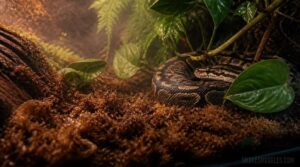
What’s under your snake actually matters more than most people realize in terms of holding moisture.
The right substrate acts like a sponge — keeping humidity steady between mistings instead of letting it drop the moment you close the lid.
Here are your best options for keeping things consistently damp without turning the enclosure into a swamp.
Use Cypress Mulch
Cypress mulch is one of the best substrates you can use for humidity-loving snakes. It retains moisture naturally, releasing it slowly into the enclosure air — no electricity needed. Its natural resins also deter some insects and resist mold.
Spread it 2–3 inches deep, mist lightly, and it’ll hold humidity steadily for days.
Try Coconut Fiber
Coconut fiber — or coir — is cypress mulch’s closest rival for moisture retention. It’s a natural byproduct of coconut processing, so it’s eco-friendly and biodegrades cleanly over time.
Coir holds water steadily and releases it slowly, keeping humidity levels stable between mistings. It also gives your enclosure a naturalistic forest-floor look, your snake will actually appreciate.
Avoid Dusty Dry Bedding
Dry, dusty bedding is a quiet troublemaker in any snake enclosure. Substrate dust irritates your snake’s respiratory tract and can derail shedding — neither of which you want.
Watch for these warning signs:
- Visible particles floating during handling
- Dry, flaky substrate surface
- More frequent incomplete sheds
- Snake rubbing its nose repeatedly
Replace bedding every one to three weeks and keep it slightly damp to bind particles and cut airborne dust entirely.
Mix Substrate Moisture Evenly
Think of your substrate like a concrete mix — too dry or too wet, and the whole thing fails. Work water in gradually while turning the material, aiming for uniform 5–7 cm depth throughout.
The squeeze test confirms you’re there: a small handful releases a few drops, nothing more.
Warmer spots evaporate faster, so mix those areas more thoroughly to prevent localized dry pockets.
Replace Moldy Substrate Fast
Mold doesn’t wait — and neither should you. If you spot fuzzy green or black patches, or catch that musty odor, replace substrate within 24 hours.
Double‑bag the old material, wear gloves and a mask to contain spores, then scrub the enclosure with a warm water‑vinegar solution. Dry it completely before adding fresh substrate.
Mist The Enclosure Safely
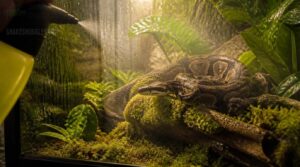
Misting is one of the easiest ways to give your snake’s enclosure a quick humidity boost — but technique matters more than you’d think. Done right, it keeps conditions comfortable without creating the soggy mess that leads to mold and respiratory problems. Here’s how to do it safely, step by step.
Mist Lightly, Not Soaking
Less is more regarding misting. You want light, even coverage — not a soaking.
Short bursts work best; a fine mist should visibly hang in the air, then dry within 30 to 90 seconds. That tells you the water vapor is evaporating, not pooling.
Saturated substrate breeds mold fast, so always check moisture levels after each session.
Spray Enclosure Walls
Once you’ve nailed your misting technique, aim your spray bottle at the enclosure walls, not the substrate. Nonporous surfaces like acrylic or polycarbonate panels absorb no moisture, so water evaporates cleanly into the air — exactly where you want it.
- Mist walls in short sweeping passes
- Target side panels and back wall evenly
- Check silicone-sealed corners for pooling
- Wipe excess droplets with a clean cloth
Avoid Spraying The Snake
Spraying directly on your snake is one of those habits that seems harmless but quietly causes real problems. Direct contact with water can irritate skin, disrupt natural oils, and create conditions where fungal infections take hold around scales and the vent area. It can also throw off shedding cycles and trigger noticeable behavioral stress responses.
| What Happens | Why It Matters |
|---|---|
| Skin oils get diluted | Increases dehydration risk |
| Uneven drying occurs | Disrupts normal shedding cycle |
| Fungal growth starts | Threatens long-term scale health |
| Startle response triggered | Raises enclosure stress levels |
Keep your spray aimed at walls only. That protects microclimate stability and maintains steady, healthy indoor humidity without putting your snake in the crossfire.
Mist More During Shed
Once you’ve got wall-misting down, shed season is your cue to step things up. When your snake enters a shed cycle, mist more frequently — once or twice daily keeps skin pliable and loosens the old layer cleanly. This targeted increase in humidity makes moisture-driven shedding success far more achievable:
- Mist enclosure walls, not the snake
- Focus moisture on the warm side
- Maintain steady humidity levels throughout
Monitor After Each Misting
After misting, grab your hygrometer and note the baseline humidity reading within 60 seconds. Check both sides — warm and cool — then watch for a brief humidity spike that settles within a few minutes. Log the readings at 1, 3, 5, and 10 minutes post-misting to track patterns and fine-tune your routine.
| Checkpoint | Target |
|---|---|
| 1-minute reading | Humidity rise confirmed |
| 5-minute check | Within target range |
| 10-minute check | Stable, no sharp drop |
Add a Proper Humid Hide
A humid hide is one of the most effective things you can add to your snake’s enclosure — and it’s simpler to set up than most people expect. Getting the details right makes all the difference between a hide that works and one that causes more problems than it solves. Here’s what you need to know to do it properly.
Monitoring moisture levels accurately matters just as much as the setup itself, so it’s worth understanding why your hygrometer might be giving inaccurate humidity readings before trusting it to guide your adjustments.
Use Sphagnum Moss
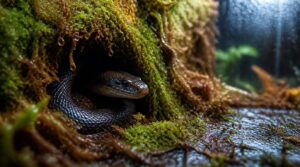
Sphagnum moss is one of the best tools in your humidity toolkit. It acts like a natural moisture reservoir — holding many times its weight in water and releasing it slowly as the air dries out.
Pack a loose handful inside your humid hide, and it creates a stable microclimate—your snake can retreat to anytime, especially during shedding.
Keep Moss Slightly Damp
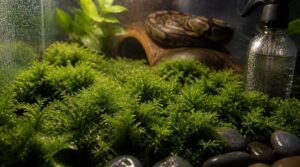
Getting the dampness level right is the real trick here. Press the moss lightly — it should feel cool and springy, never soggy.
Too much water breeds mold fast. Aim to mist only when the surface starts drying out, using room-temperature water.
Tap water with high minerals leaves residue, so filtered is better when you can manage it.
Place on Warm Side
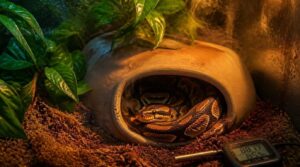
The humid hide belongs on the warm side, full stop. That’s where radiant heat drives active evaporation, creating a stable microclimate your snake actually wants to rest in.
Keep a 4–6 inch gap from any heat mat edge to avoid hotspots. Use a thermometer nearby — the warm side should hold 28–32°C for reliable temperature-humidity balance.
Size Hide Correctly
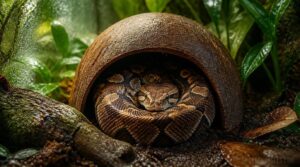
The hide should fit like a snug burrow — not a cage. Ideal snugness levels mean your snake can fully coil with its head tucked, but can’t stretch out comfortably. That’s your sweet spot.
- Proper coiling space — room to curl, nothing more
- Hide entry width — body-width access, no wider
- Avoiding pinching risks — no tight squeezes at the entrance
- Evaluating stress markings — dark patches signal a poor fit
Check for Mold Often
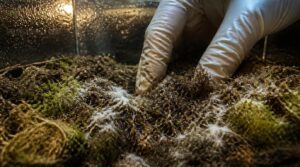
Mold doesn’t announce itself — it creeps in quietly.
Check your humid hide’s sphagnum moss within 24 hours after misting, scanning for gray fuzzy growth. Run your fingers across the substrate; boggy or spongy texture signals excess moisture.
If you spot white cottony patches, brown spore deposits, or slime rings near the water bowl, act immediately — remove and replace.
Adjust Ventilation and Heat
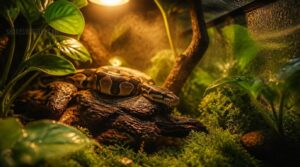
Ventilation and heat have more influence over your enclosure’s humidity than most keepers realize. Too much airflow pulls moisture out fast, and the wrong heat source can dry things out just as quickly. Here’s how to dial in both so your snake stays in its target range.
Cover Part of Screen Tops
Sliding a partial acrylic sheet across your screen top is one of the simplest humidity fixes you can make. Cut it to cover roughly half the surface, leaving the opposite end open. This slows evaporation without trapping heat.
Breathable mesh patches work well too — they reduce moisture loss while keeping enough airflow to prevent condensation buildup underneath.
Preserve Safe Airflow
Reducing evaporation matters, but you still need steady air exchange to keep things healthy. Stale, stagnant air invites mold fast.
- Keep intake vents unobstructed at the lower front
- Position exhaust openings high to encourage vertical airflow
- Check vents weekly for dust or blockage
A digital hygrometer near both intake and exhaust tells you exactly what’s happening inside.
Avoid Overheating The Enclosure
Too much heat is the enemy of stable humidity. When your enclosure runs hot, moisture evaporates faster than you can replace it.
Set your thermostat to a tight 1–2°F control range, and aim to keep the warm side at or below 88–89°F. A heat gradient, cool on one side, warm on the other, gives your snake room to self-regulate.
Use Radiant Heat Carefully
Radiant heat is gentler on moisture than forced-air, but it still needs managing.
Keep heat sources at least three feet from flammable materials and maintain 12 inches of clearance around any unit.
Use an infrared thermometer to check wall surfaces — if you’re seeing hotspots above 90°F near the enclosure, reposition the heater to spread warmth evenly.
Reduce Excessive Drying
Forced-air heat is the quiet culprit behind most humidity crashes. When it runs too long, substrate moisture retention drops fast and your snake’s skin pays the price.
- Shorten heating cycles on mild days
- Switch to radiant heat where possible
- Seal drafty gaps near windows
- Monitor humidity levels after each cycle
- Adjust gradually in 5% increments
Support Room Humidity Naturally
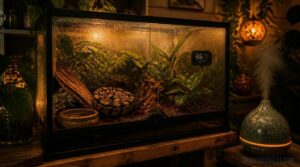
Your snake’s enclosure doesn’t exist in a vacuum — the air in the room around it matters more than most keepers realize. If the room itself is bone dry, even a well-sealed enclosure will fight a losing battle. A few simple habits can raise ambient humidity and take some pressure off your setup.
Place Water Near Heat
The room itself can quietly work in your favor. Place a shallow dish of water near a warm radiator or heat vent — warmth doubles evaporation rate, creating a small humid zone around your snake’s enclosure.
A wide, ceramic bowl maximizes surface area for faster moisture release. Refill it daily to keep evaporation steady.
Add Safe Houseplants Nearby
Tucking a few houseplants near your snake’s enclosure is genuinely one of the easiest humidity wins you’ll find. Plants release moisture through transpiration — a constant, passive process that quietly raises ambient humidity without any electricity.
For best results, focus on three key principles:
- Choose high-transpiration tropical plants — Peace Lily, Boston Fern, and Pothos release steady moisture and tolerate indoor conditions well.
- Group plants together within 2–3 meters of the enclosure to create a localized humid microclimate rather than spreading them around the room.
- Use humidity trays beneath each pot — a shallow tray filled with water and pebbles adds a continuous micro-evaporation layer right where you need it.
Keep plants away from direct heat sources that could overheat the enclosure, and avoid toxic species like pothos if your snake is a known escape artist — safety first.
Air-dry Laundry Away From Enclosure
Here’s a trick most people overlook: air-drying laundry indoors naturally raises room humidity while saving on the dryer. Position your drying rack several feet away from the enclosure, near a vent or open window.
Good laundry airflow speeds drying and keeps excess moisture from pooling near your snake’s habitat — clean humidity control without the guesswork.
Limit Harsh Forced-air Heat
Central forced-air heating is one of the biggest culprits behind dry enclosures. It moves large volumes of air fast, and that high airflow speed strips moisture from the room before it can settle. Wherever possible, lower the fan output or switch to a radiant heat source — oil-filled radiators, for instance — which warms without blasting air around.
- Reduce blower speed on milder days to slow evaporation rate naturally
- Avoid dry drafts near the enclosure by repositioning vents or using diffusers
- Gentle air exchange preserves indoor humidity far better than aggressive cycling
This kind of thoughtful moisture management keeps thermal zones stable and gives your humidity control methods a real chance to work.
Keep Room Humidity Balanced
Think of your enclosure as a small ecosystem inside a larger one. Room humidity levels directly influence what’s happening inside the tank, so keeping indoor relative humidity between 40–50% gives you a stable baseline to work from. Use a calibrated hygrometer to spot seasonal humidity shifts — winter heating dries air fast, while summer often brings excess moisture.
| Condition | Action |
|---|---|
| Below 40% humidity | Add passive evaporation source |
| Above 55% humidity | Improve indoor air circulation |
| Winter heating season | Lower forced-air output |
| Mold signs present | Reduce moisture, increase airflow |
Humidity management isn’t about chasing a perfect number daily — it’s about keeping swings small and consistent.
Top 9 Humidity Tools
Getting the right tools makes humidity management a whole lot easier than guessing and hoping for the best. Whether you’re monitoring levels, adding moisture, or keeping the room balanced, there’s something on this list for every setup. Here are nine tools worth keeping on your radar.
1. Indoor Digital Hygrometer LCD
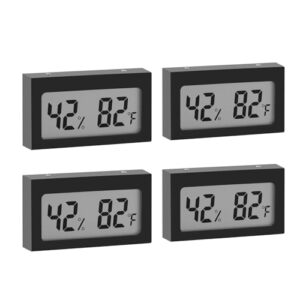
If you only buy one tool for your snake’s setup, make it a digital hygrometer. This small LCD device updates every 10 seconds, so you’re always looking at current conditions — not yesterday’s guess.
It displays temperature, humidity, and time on one screen, and runs on two AA batteries for roughly a year. You can prop it up with the angled stand or mount it to the wall, making placement easy anywhere in the enclosure.
| Best For | Snake owners and reptile keepers who want real-time, reliable monitoring of temperature and humidity inside their enclosure without constant manual checking. |
|---|---|
| Power Source | 2× AA Batteries |
| Primary Function | Humidity & Temp Monitoring |
| Noise Level | Silent (display only) |
| Maintenance Required | Battery replacement (~1 yr) |
| Coverage / Capacity | Room-wide monitoring |
| Humidity Role | Measures & displays only |
| Additional Features |
|
- Updates every 10 seconds, so you’re always seeing live conditions rather than stale readings
- Displays temperature, humidity, and time all on one screen — no need for multiple devices
- Flexible placement options (angled tabletop stand or wall-mountable) with about a year of battery life
- The display can be difficult to read from a distance, which isn’t ideal for larger rooms or enclosures set back from view
- Accuracy can vary slightly (±2% RH, ±1°F), so occasional calibration checks are a good idea
- Not built for outdoor or high-exposure environments, and battery life isn’t precisely guaranteed
2. AcuRite Indoor Hygrometer Thermometer
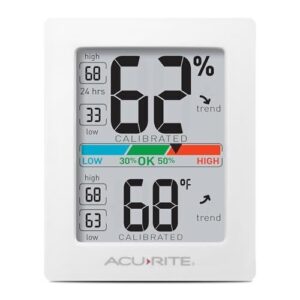
The AcuRite takes a step up from bare-bones models with a comfort-zone indicator — a color-coded arrow that shifts between low, OK, and high, so you don’t have to do the math. It reads humidity with ±2% accuracy across the normal range, updates every 10 seconds, and logs daily highs and lows.
Mount it magnetically or on a wall slot.
One note: no backlight, so nighttime checks mean grabbing a flashlight.
| Best For | Anyone who wants a quick, at-a-glance humidity and temperature reading for spaces like nurseries, wine cellars, or cigar humidors without needing a complex setup. |
|---|---|
| Power Source | 2× AAA Batteries |
| Primary Function | Humidity & Temp Monitoring |
| Noise Level | Silent (display only) |
| Maintenance Required | Battery replacement (multi-year) |
| Coverage / Capacity | Room-wide monitoring |
| Humidity Role | Measures & displays only |
| Additional Features |
|
- Color-coded comfort-zone arrow makes it instantly clear whether humidity is too low, just right, or too high — no guesswork needed
- Updates every 10 seconds and tracks 24-hour highs and lows, so you can spot trends and adjust your humidifier or dehumidifier accordingly
- Flexible mounting options (magnetic back or wall slots) make it easy to move between rooms or surfaces
- No backlight means the display is tough to read in dim or dark conditions
- Temperature only shows in whole numbers, so you lose a bit of precision
- Readings can lag when moving the unit between environments with very different temperatures
3. Pelonis Champagne Oil Filled Heater
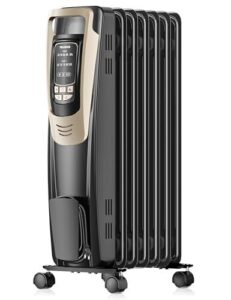
Once you’ve nailed your readings, you need a heat source that won’t dry out your enclosure. The Pelonis Oil Filled Heater warms the surrounding room gently using radiant heat — no fan blasting dry air around. That matters for snakes.
It runs whisper-quiet, covers up to 164 sq ft, and offers three power levels (600–1500 W) so you’re not cooking the room.
Just keep it a safe distance from the enclosure itself.
| Best For | Snake and reptile owners who want to warm the room around their enclosure without drying out the air or disturbing sensitive animals with fan noise. |
|---|---|
| Power Source | AC (1500W) |
| Primary Function | Room Heating |
| Noise Level | Whisper-Quiet (no fan) |
| Maintenance Required | None noted |
| Coverage / Capacity | Up to 164 sq ft |
| Humidity Role | Indirect (reduces moisture) |
| Additional Features |
|
- Completely silent operation — no fan means no dry air blasting around your enclosure
- Three power levels (600–1500 W) give you flexibility to heat the room without overdoing it
- Built-in safety features (tip-over switch, overheat protection) make it a low-worry option to leave running
- Thermostat can be inconsistent, so you may need to manually tweak settings to hold a stable temperature
- First use may come with an off-gassing smell from the paint or coating
- Running it at full power continuously will add up on your electricity bill
4. HumiCare Gel Bead Humidifier
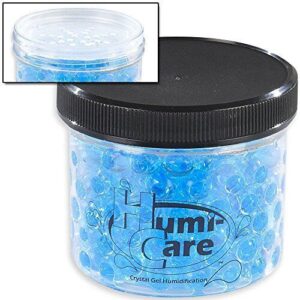
The Pelonis manages ambient room warmth — but inside the enclosure, you need moisture control that works on its own. That’s where the HumiCare Gel Bead Humidifier earns its spot.
Drop it inside your humidor-style enclosure, add distilled water, and the beads slowly release moisture without any power cord. The beads even tell you when they’re dry: clear means recharge time, cloudy means they’re working. Simple, reusable, and surprisingly reliable for maintaining steady humidity between misting sessions.
| Best For | Cigar enthusiasts of any experience level who want a low-maintenance, set-it-and-forget-it humidity solution for a medium-size humidor. |
|---|---|
| Power Source | Passive (None) |
| Primary Function | Passive Cigar Humidification |
| Noise Level | Silent (passive) |
| Maintenance Required | Refill with distilled water |
| Coverage / Capacity | 40–150 cigars |
| Humidity Role | Maintains 65–70% RH |
| Additional Features |
|
- Passive humidification means no cords, no batteries, and no complicated setup — just add distilled water and you’re done
- Reusable beads last up to a year, making it a cost-effective alternative to constantly buying disposable humidity packs
- Maintains a steady 65–70% RH for 40–150 cigars, which covers most home humidor setups comfortably
- The jar’s height can be a tight fit in smaller humidors or on packed shelves, so check your clearance before buying
- After a refill, the passive system takes longer to bounce back to target humidity compared to active solutions
- You’ll need to keep distilled water on hand and check bead saturation periodically — tap water won’t cut it
5. Honeywell Top Fill Tower Humidifier
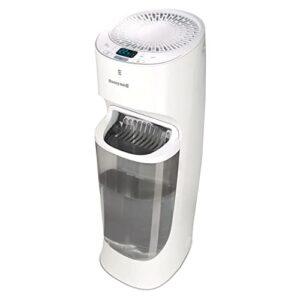
When your snake’s room air is bone dry, no amount of in-tank misting will keep up.
The Honeywell Top Fill Tower Humidifier covers that ambient gap — just pour water in from the top, set your target, and let it run. Its built-in humidistat automatically cuts off when the room hits your setpoint, so you’re not accidentally over-humidifying. At roughly 1,000 square feet of coverage, one unit can stabilize an entire reptile room quietly overnight.
| Best For | Reptile keepers managing large rooms or dedicated reptile spaces who need hands-off, automated humidity control without constant monitoring. |
|---|---|
| Power Source | AC |
| Primary Function | Evaporative Humidification |
| Noise Level | Whisper-Quiet |
| Maintenance Required | Filter replacement & tank cleaning |
| Coverage / Capacity | Up to 800 sq ft |
| Humidity Role | Raises to 40–60% RH |
| Additional Features |
|
- Top-fill design makes refilling quick and mess-free — no need to remove or flip the tank
- Built-in humidistat automatically shuts off at your target humidity, preventing over-humidification
- Quiet enough for overnight use, with up to 24 hours of runtime on a single fill
- Filter requires regular replacement, and mishandling it can hurt performance
- Some units have reported tank seal issues that can cause leaks on uneven surfaces
- The built-in hygrometer may not perfectly match external sensors, which can lead to inconsistent cycling around your target setpoint
6. Raydrop 2.2L Cool Mist Humidifier
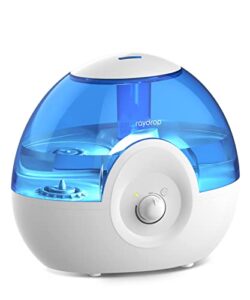
At around 28–30 dB, the Raydrop 2.2L Cool Mist Humidifier runs whisper-quiet — barely louder than a soft breath. That makes it a smart pick for a bedroom setup where your snake rests nearby.
The 2.2L tank lasts up to 30 hours on the lowest mist setting, and the wide 3.74-inch opening keeps cleaning straightforward.
One heads-up: skip the essential oils and use distilled water to avoid mineral buildup on the transducer over time.
| Best For | Light sleepers, nursery setups, or anyone who needs quiet, consistent humidity overnight without fuss. |
|---|---|
| Power Source | AC (110–240V) |
| Primary Function | Ultrasonic Humidification |
| Noise Level | 28–30 dB |
| Maintenance Required | Regular tank cleaning |
| Coverage / Capacity | Small–medium rooms |
| Humidity Role | Raises indoor humidity |
| Additional Features |
|
- Whisper-quiet at 28–30 dB — genuinely unnoticeable in a bedroom or nursery
- Up to 30 hours of runtime on low means you can run it all night without refilling
- Wide 3.74-inch tank opening makes refilling and regular cleaning easy
- No single-color night light option — it’s either cycling colors or off
- The non-removable nozzle and mist tube make deep cleaning a hassle
- Mist can settle on nearby surfaces, so placement near electronics or wood furniture needs some thought
7. AprilAire Model 10 Water Panel
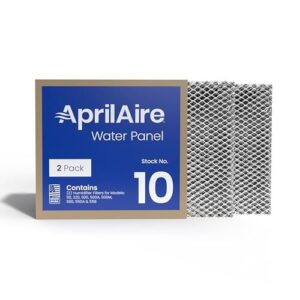
If your home runs on a whole-house humidifier, the AprilAire Model 10 Water Panel is the replacement pad that keeps it working. It fits models 110, 220, 500, 550, and 558 — and the aluminum mesh with ceramic coating absorbs water steadily, pushing moisture into your furnace airflow all season.
Replace it annually, or sooner if you have hard water. A clogged panel won’t hit the 40–60% humidity your snake actually needs.
| Best For | Homeowners with an AprilAire whole-house humidifier (models 110, 220, 500, 550, or 558) who want an easy, reliable way to maintain healthy indoor humidity levels year-round. |
|---|---|
| Power Source | Passive (None) |
| Primary Function | Whole-Home Humidifier Panel |
| Noise Level | Silent (passive) |
| Maintenance Required | Annual panel replacement |
| Coverage / Capacity | Whole-home system |
| Humidity Role | Maintains 40–60% RH |
| Additional Features |
|
- Comes in a 2-pack, so you’ve got a full year (or two seasons) covered right out of the box
- The ceramic-coated aluminum mesh does a solid job absorbing and evaporating water consistently throughout the heating season
- Works with the AprilAire Healthy Air App, which takes the guesswork out of knowing when it’s time to swap the panel
- Hard water can clog the panel before the season’s even over, meaning you might need to replace it more often than once a year
- Only fits specific AprilAire models — won’t work with any other humidifier brand
- You can’t clean and reuse it; washing damages the ceramic coating, so it’s a one-and-done replacement each time
8. Levoit Quiet Cool Mist Humidifier
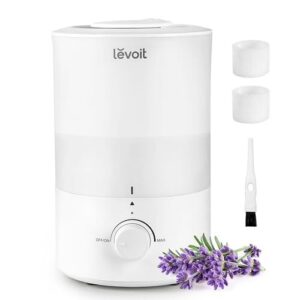
The Levoit Quiet Cool Mist Humidifier covers small to medium rooms up to 290 square feet — solid coverage for most reptile rooms. Its 3-liter top-fill tank runs up to 25 hours continuously, so you’re not constantly refilling.
At just 28 dB, it won’t disturb your snake overnight. The 360° rotating nozzle lets you direct mist exactly where humidity is dropping.
No built-in sensor, though — pair it with your hygrometer to stay in control.
| Best For | Snake and reptile keepers who need quiet, reliable humidity in small to medium-sized rooms without a lot of fuss. |
|---|---|
| Power Source | AC (25W) |
| Primary Function | Ultrasonic Humidification & Diffusion |
| Noise Level | ≤28 dB |
| Maintenance Required | Regular tank cleaning |
| Coverage / Capacity | 107–290 sq ft |
| Humidity Role | Raises indoor humidity |
| Additional Features |
|
- 3-liter top-fill tank runs up to 25 hours, so you’re not constantly stopping to refill
- Ultra-quiet at 28 dB — won’t disturb sleeping animals (or you) overnight
- 360° rotating nozzle lets you aim mist exactly where your enclosure needs it
- No built-in humidity sensor, so you’ll need a separate hygrometer to monitor levels
- Requires regular cleaning to keep mold and mildew from building up in the base
- Only comes with a two-pin plug, which may not work with all outlets without an adapter
9. Pure Lavender Essential Oil
This one’s a curveball on a humidity list — but hear it out. Pure lavender essential oil isn’t a humidifier, but a few drops in your diffuser can make the room environment noticeably calmer for you during enclosure maintenance.
Keep it well away from your snake’s enclosure, though. Essential oils are toxic to reptiles when inhaled directly. Think of it as a keeper’s comfort tool — not a humidity fix.
| Best For | Snake keepers and reptile hobbyists who want a calming, aromatic boost to their own environment during enclosure maintenance sessions. |
|---|---|
| Power Source | None |
| Primary Function | Essential Oil Aromatherapy |
| Noise Level | Silent |
| Maintenance Required | Track freshness; reorder as needed |
| Coverage / Capacity | 10 mL bottle |
| Humidity Role | No direct humidity effect |
| Additional Features |
|
- 100% pure therapeutic-grade oil with batch-specific GC/MS reports, so you know exactly what you’re getting
- Versatile beyond the diffuser — works great diluted in a carrier oil for skincare or mixed into a hair care routine
- Small, compact 10 mL bottle is easy to store and the labeled dropper cap makes it simple to use without overdoing it
- Toxic to reptiles if inhaled directly, so it has to be kept completely away from your snake’s enclosure
- No printed expiration or batch date on the bottle, meaning you’ll need to track freshness yourself
- The scent leans more herbaceous than floral, which might not match what you’d expect from a classic lavender oil
Prevent Mold, Mites, and Stress
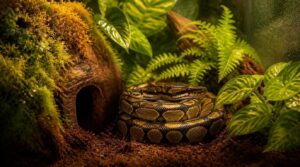
Getting humidity right is only half the battle — keeping it stable without turning your enclosure into a swamp is where most keepers trip up. Too much moisture, left unchecked, invites mold, mites, and a stressed-out snake fast. Here’s what to watch and do to keep things clean and balanced.
Avoid Constant Wet Conditions
Too much moisture is just as harmful as too little. Constant wet conditions invite mold, bacterial growth, and mite infestations that stress your snake fast. If your substrate clumps together and sticks to your fingers rather than crumbling lightly, it’s too wet. Aim for healthy moisture balance — damp enough to hold humidity, dry enough to breathe.
Use a reliable digital humidity gauge to catch excess moisture before it creates unhealthy enclosure conditions.
- Swap soaked substrate within 24–48 hours
- Let enclosure surfaces dry between mistings
- Refill water bowls without overflowing the base
- Rotate substrate layers to expose drier material underneath
Watch for Condensation
Wet conditions and condensation go hand in hand. If you spot water droplets on enclosure walls or glass, your humidity is likely too high — surfaces are hitting their dew point.
Wipe them down, improve airflow slightly, and recheck with your hygrometer. Persistent fogging means mold risk is climbing fast.
Remove Spoiled Substrate Promptly
Spoiled substrate doesn’t just smell bad — it actively wrecks your humidity control by releasing ammonia and trapping excess moisture. Watch for sour or ammonia odors, dark damp patches, or fuzzy mold growth. Spot any of these? Act fast.
- Scoop it out with gloves into a sealed disposal bag
- Wipe down enclosure surfaces before replacing
- Add fresh substrate within 12 hours to restore stable moisture
Maintain Clean Hides
Clean hides are your first defense against mold and mites. Every week, pull hides out and shake off debris, then vacuum crevices with a soft brush attachment on low suction.
For grime, blot with a mild eco-cleaner tested on a hidden spot first.
Keeping hides clean directly enhances stable humidity regulation inside the enclosure.
Balance Humidity With Ventilation
Getting hides spotless helps, but ventilation is where humidity regulation really comes together. Airflow stagnation lets mold take hold fast. Aim for 0.2–0.5 air changes per hour using partial screen coverage.
- Adjust screen coverage to slow evaporation
- Check vents weekly for vent obstruction
- Use convection patterns to distribute moisture evenly
- Target 40–60% RH for microclimate stability
Frequently Asked Questions (FAQs)
How do you increase humidity in a room?
Raise room humidity by boiling water, air-drying laundry indoors, placing a water bowl near heat, using a humidifier, misting with a spray bottle, or adding transpiring houseplants to stabilize humidity levels naturally.
How to humidify your home?
Boil a pot of water, air-dry laundry indoors, or group houseplants together. A portable humidifier or misting with a spray bottle works too — all raise humidity levels quickly.
How can I increase humidity without a humidifier?
You don’t need a humidifier at all. Passive water placement, substrate moisture retention, and natural transpiration from nearby plants can raise enclosure humidity effectively — no plug required.
Should you add humidity to your home?
Yes — but carefully. Keeping indoor relative humidity between 30–50% protects your health, prevents mold, and shields wood floors. Go too high and you’ll invite condensation on windows and mildew.
How can I make my humidity higher?
Getting your humidity levels right starts with knowing your snake’s needs. Wider water bowls, moisture-holding substrate, and smart water bowl placement near heat sources all work together to raise enclosure moisture efficiently.
How can I raise the humidity without a humidifier?
You don’t need a humidifier at all. Wider water bowls, damp substrate, light misting, a humid hide with sphagnum moss, and nearby houseplants all raise enclosure humidity naturally and effectively.
Does putting a bucket of water in a room increase humidity?
A bucket of water does raise humidity, but slowly. Evaporation surface area matters most — wider bowls work better than deep buckets. Temperature and airflow speed things up, while stagnant water risks mold over time.
Does outdoor humidity affect indoor moisture levels?
Outdoor air absolutely affects your indoor moisture levels. Building envelope leakage lets outdoor air sneak in, shifting your relative humidity seasonally — drier winters drop it, humid summers push it up — which directly impacts your snake’s enclosure climate.
Can humidity levels impact sleep quality?
Funny enough, humidity levels hit your sleep just as hard as your snake’s. Poor indoor moisture balance disrupts sleep continuity, triggers nighttime awakenings, and wrecks thermoregulation — your body can’t cool properly.
How does air conditioning change indoor humidity?
Air conditioning pulls moisture out of the air as warm air passes over cold evaporator coils, causing condensation. That collected water drains away, steadily dropping your indoor relative humidity.
Conclusion
Think of humidity like airflow in a duct system—get the balance right, and everything runs smoothly. Once you know how to increase humidity with the right substrate, a well‑placed water bowl, and a damp humid hide, your snake’s enclosure practically self‑regulates itself.
You won’t be soaking a stressed reptile at midnight anymore. Nail these fundamentals, and every shed will come off clean, in one piece, exactly the way it should.