This site is supported by our readers. We may earn a commission, at no cost to you, if you purchase through links.

A ball python sitting exposed in an open enclosure isn’t resting—it’s waiting for something to kill it. That’s not dramatic; that’s the behavioral reality of an animal whose ancestors spent millions of years traversing West African rainforests as both predator and prey. Without a place to disappear, the threat assessment never stops.
Do ball pythons need hides to feel secure? The answer is non‑negotiable. A hide isn’t enrichment or a decorative touch—it’s the difference between a snake that eats, sheds, and behaves normally and one locked in a low‑grade survival loop that quietly degrades its health over months.
Getting hides right means more than dropping a plastic dome in the corner. Placement, temperature, size, and material all determine whether your snake actually uses them—and whether the security they provide is real.
Table Of Contents
Key Takeaways
- A ball python without a hide isn’t just uncomfortable — it’s running chronic stress hormones that silently tank its appetite, immune system, and long-term health.
- two hides minimum, one at 86–90°F on the warm side and one at 76–80°F on the cool side, both available simultaneously so your snake can thermoregulate without ever being exposed.
- Hide size is non‑negotiable: the interior should contact your snake’s body on all sides — if your hand fits in beside it, the hide is too big.
- Add a humid hide at 70–90% internal humidity during shed cycles to prevent retained skin, which can cut off circulation to the tail tip or eyes if left unchecked.
Yes, Ball Pythons Need Hides
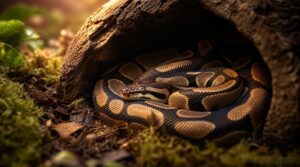
Ball pythons aren’t being dramatic — they genuinely need hides to function well in captivity. Without one, you’ll see stress behaviors that tank appetite, spike defensiveness, and wear down their immune system over time. Here’s what a proper hide setup actually does for them.
For bioactive keepers especially, getting hides right matters even more — ball python hides for bioactive setups break down exactly how to integrate secure, functional hides without disrupting your living enclosure.
Security Reduces Daily Stress
A ball python without a hide isn’t just uncomfortable — it’s running on stress hormones all day.
A hideless ball python isn’t just stressed — it’s drowning in stress hormones around the clock
Consistent retreat access gives your snake environmental predictability, so it doesn’t have to stay alert every waking moment. That reduced vigilance translates directly into calmer, more settled behavior.
A proper secure hide is the single fastest way to lower chronic stress and restore behavioral calmness.
Hides Support Normal Behavior
In the wild, ball pythons spend most daylight hours tucked into burrows or tight ground cover. That same instinct doesn’t switch off in captivity. Normal daytime behavior centers on concealment, not exploration. When a hide is available, your snake retreats into it, settles, and stays — exactly what it’s supposed to do.
Concealment Improves Confidence
A snake that can retreat on demand isn’t just comfortable — it’s confident. Concealment boosts confidence by giving your ball python control over its own exposure. When it can hide and choose when to emerge, stress drops noticeably:
- Less glass-surfing and roaming
- Stronger feeding response
- Calmer posture during digestion
Concealment aids digestion too — a settled snake processes meals more efficiently than one still searching for cover.
No Hide Causes Anxiety
Remove the hides, and anxiety sets in fast. Without cover, your ball python faces increased visibility stress — it can’t retreat, can’t reset, and can’t choose when to be exposed.
That constant openness triggers roaming, defensive behavior, and handling reluctance.
Temperature choice loss, shedding difficulty risk, and limited resting options compound quickly.
Hides aren’t optional enrichment — they’re baseline survival logic.
Why Hides Help Them Feel Secure
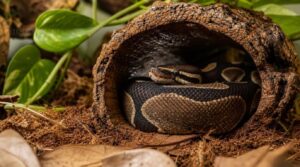
Ball pythons don’t hide because they’re shy — they hide because their instincts demand it. In the wild, a concealed burrow isn’t a luxury; it’s survival. Here’s what makes a hide actually work for them.
Natural Burrow Instincts
Every ball python carries millions of years of burrow instinct wired into its biology.
In the wild, these snakes don’t just stumble into holes — they rely on complex tunnel networks that block predator access, trap familiar scent, and stabilize temperature. That scent barrier effect inside a burrow actively lowers perceived threat levels, keeping the snake calm at rest.
In their natural habitats, they often select soft soils for burrowers, which allow easier excavation and stable burrow conditions.
Body Contact Comfort
Think of thigmotaxis as a built-in pressure switch. When a hide’s interior walls make consistent contact with the body on all sides, the snake’s nervous system registers safety.
Smooth-walled options like those featured in this guide to snake hides for bioactive enclosures maintain that all-around contact without harboring the bacteria that undermine a safe, stress-free environment.
That’s why the snug-fit rule matters — secure wall contact keeps resting posture stable, prevents restless shifting, and signals shelter rather than exposure.
A hide that’s too large breaks that contact, and the snake knows it immediately.
Darkness Lowers Exposure
Opaque hides block ambient light, and that matters more than most keepers realize. Ball pythons rely on darkness for stress reduction — lower light exposure slows the constant sensory input that their nervous system processes.
A dark interior mimics the buried, lightless conditions of a natural burrow, keeping perceived exposure minimal and resting behavior stable.
Single Entrance Protection
A hide with a single entrance works like a single entry door — one way in, one way out. That geometry is the whole point. Ball pythons can monitor the opening from inside without exposing themselves, which keeps their stress response quiet.
- One controlled opening means no surprises from a second direction
- A snug-fit, tight hide removes the feeling of open, vulnerable space
- Physical barrier strength — solid walls on all sides — replaces constant vigilance with genuine rest
Less Defensive Behavior
A ball python with proper hides simply has less to react to. Defensive posturing — tight balling, hissing, striking — drops noticeably when secure cover is consistently available.
The snake isn’t scanning for threats; it’s resting.
Stress signal reduction happens because concealment replaces vigilance, and behavioral calm gains follow naturally from that shift.
Provide Two Hides Minimum
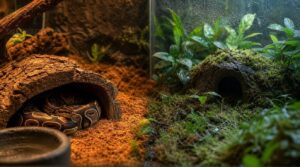
One hide isn’t enough — your ball python needs two, and that’s non-negotiable. Each hide fulfills a different purpose depending on where it sits in the enclosure. Here’s what you need to set up both correctly.
Warm-side Hide
The warm-side hide sits directly over or beside your heat source, targeting an interior temperature of 86–90°F. Ceramic or dense plastic works best here — both materials retain heat well and clean easily.
The entrance should be offset and snug-fit, so your ball python presses against all sides. A tip-resistant base keeps it stable when your snake shifts inside.
Cool-side Hide
The cool-side hide mirrors that same snug‑fit rule — just positioned at the opposite end of the enclosure. Target 76–80°F inside, verified with a thermometer placed directly within the hide.
Keep it fully opaque, tip‑resistant, and sized to your ball python’s girth.
A single offset entrance maintains entrance concealment, completing your thermal gradient without forcing your snake to choose between comfort and security.
Both Available Always
Both hides need to be in the enclosure at all times — not rotated out, not removed for cleaning and left out overnight, not swapped one at a time. Your snake needs that dual hide setup available continuously so it can move between the warm and cool ends while staying covered throughout.
Remove one, and you’ve broken the system.
Avoid Forced Temperature Choices
When only one hide is available, your snake doesn’t get to choose — it is forced. Remove the cool side hide, and it either overheats or stays exposed. Lose the warm side hide, and digestion suffers.
A proper thermal gradient only works when both temperature zones stay accessible, stable, and covered simultaneously.
Fix Unused Hides
If a snake ignores its hide, don’t remove it — fix the problem. Start by checking temperature: a warm side hide reading below 86°F won’t attract a thermoregulating snake.
Then apply the snug-fit rule. Too much interior space breaks the sense of security.
Reposition the hide, add a visual barrier nearby, or introduce a novel hide to reset the snake’s interest.
Place Hides Correctly
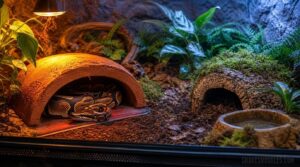
Getting the temperature right in each hide isn’t optional — it’s the whole point. Your ball python can only thermoregulate if the hides are actually sitting in the correct zones. Here’s what each placement needs to hit.
Warm Hide: 86–90°F
The warm hide needs to sit in the 86–90°F range — not approximate, not "close enough." Place it directly over or beside your heat source, then verify with a thermometer at floor level inside the hide.
That’s where your ball python actually rests.
If your thermostat probe isn’t measuring that exact zone, the temperature will drift without you knowing.
Cool Hide: 76–80°F
The cool hide targets 76–80°F — the opposite end of the enclosure from your heat source. Ball pythons need this zone to offload heat after basking or digesting.
Check it with a thermometer probe placed inside the hide itself, not at glass level. Radiant heat drift is real; the warm side can creep over without regular inspection.
Keep Ends Separate
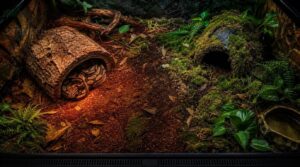
Treating both ends of the enclosure as Two Hide Zones is non-negotiable. Your warm hide and cool hide must stay on opposite sides — always. Don’t let them drift toward the middle.
- Warm hide sits over the heat source
- Cool hide anchors the far end
- Separate Access Points keep thermoregulation clean
- Both hides available simultaneously, no exceptions
Near Safe Heat Source
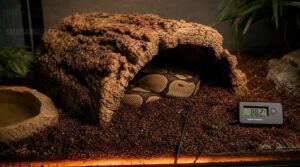
Your warm hide only works if the heat beneath its controlled.
Use a thermostat to regulate your under-tank heater or heat mat — it cycles the heat source on and off to hold the warm zone at 86–90°F without spiking.
Add a secondary safety cutoff as backup. If the thermostat fails, that second layer prevents dangerous surface temperatures from making your warm hide a hazard instead of a refuge.
Check With Thermometers
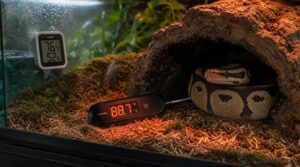
Your thermostat holds the temperature — your thermometer confirms it. Don’t trust the dial alone.
Place a digital probe directly inside the warm hide and check that the surface reads 86–90°F, not just nearby air.
Run an ice-water calibration check periodically to catch sensor drift.
One misread thermometer quietly ruins your entire thermal gradient.
Choose Snug, Safe Hides
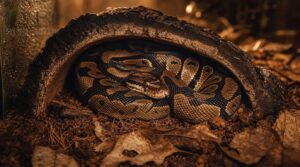
The right hide isn’t just about size — it’s about making your ball python feel genuinely secure, not just technically housed. A few key factors determine whether a hide actually works or just takes up space in the enclosure. Here’s what to look for when choosing one.
Snug Fit Matters Most
Size is the first thing to get right. The snug-fit rule is simple: the hide’s interior should be 70–85% of your ball python’s girth.
Use the hand test method — if your hand slides beside the coiled snake with no resistance, the hide is too large.
Resize every 4–6 months as your snake grows.
Body Touches Sides
When the snug fit rule is working, your ball python’s body will press against the hide walls on multiple sides. That’s wall contact, and it’s the whole point.
A tight fitting hide forces the snake into thigmotaxis — natural, instinct-driven contact that signals safety. Too much space around the body breaks that contact and raises stress.
Opaque Materials Preferred
Wall contact matters — so does what’s surrounding it. The material your hide is made from directly affects how secure your ball python feels inside.
Dark, opaque materials are the right call. Here’s why they outperform clear or semi-transparent options:
- Block all visible light, creating a dark interior that signals safety
- Non-reflective surfaces reduce glare and visual disturbance during handling
- Nonporous plastic and glazed ceramic resist bacteria and clean easily
- Durable construction means commercial molded hides and plastic tubs hold up long-term
- Heat retention on the warm side stays consistent without warping
Skip anything see-through. Transparency undermines the purpose.
Tip-resistant Construction
Material quality means nothing if the hide flips. A weighted or reinforced base keeps the structure planted when your snake pushes against it — and they’ll push.
Wide, stable footprints distribute load evenly, preventing tipping on loose substrate. The Exo Terra Large Snake Cave adapts this well with its low-profile, anchored base design.
Easy-to-clean Surfaces
A stable hide that won’t tip is only half the battle — it also has to stay clean.
Nonporous materials like smooth plastic, resin, or glazed ceramic don’t absorb waste or bacteria. Continuous designs leave nowhere for grime to hide.
Weekly cleaning with dilute hydrogen peroxide takes seconds on these surfaces. The Exo Terra Large Snake Cave checks both boxes.
Add Humid Hides When Needed
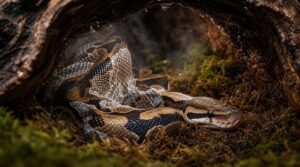
Most ball pythons do fine with two standard hides — until shed time hits. That’s when a humid hide earns its place in the setup. Here’s what you need to know to do it right.
Helps Difficult Sheds
A bad shed isn’t just unsightly — retained skin can cut off circulation to the tail tip or eyes. That’s where a humid hide earns its place.
During an active shed cycle, the elevated moisture inside helps loosen the skin evenly, reducing the risk of incomplete sheds. Proper hide size and moisture retention work together here — a snug fit keeps humid air concentrated around the snake’s body.
Damp Moss or Towels
Both damp sphagnum moss and paper towels work well inside a humid hide. Sphagnum moss holds moisture longer and provides natural texture that facilitates the shedding process.
Paper towels are easier to swap out but dry unevenly. Replace moss every 2–4 weeks; launder towels weekly.
Use a hygrometer to confirm conditions inside the hide stay consistent.
70–90% Hide Humidity
That 70–90% range isn’t arbitrary — it’s the exact window where shed skin separates cleanly without drying out mid-process. Too low, and retained eye caps become a real risk.
Humid hide design matters here: a near‑sealed lid traps vapor, while a small vent prevents the condensation buildup that leaves standing water on surfaces.
Use a humidity probe placed inside the hide itself — not near the enclosure wall — to confirm you’re hitting the target consistently.
Replace Substrate Regularly
The sphagnum moss inside your humid hide works hard — but it doesn’t last forever. Replace it every 2–4 weeks to prevent bacterial buildup and keep moisture levels accurate. Old, compacted moss loses its absorption capacity and traps waste.
When swapping it out, rinse the hide with a reptile-safe disinfectant before adding fresh, pre‑moistened substrate.
Prevent Mold Buildup
Mold doesn’t announce itself — it builds quietly when moisture goes unchecked. Keep enclosure humidity at 40–60% ambient while your humid hide manages the rest. Good airflow optimization around the hide prevents stagnant pockets where mold thrives.
Watch for these warning signs:
- Discoloration or fuzzy growth on moss
- Sour or musty odor from the hide
- Condensation pooling inside without evaporating
Monitor humidity with a digital hygrometer and adjust ventilation if readings spike consistently above range.
Frequently Asked Questions (FAQs)
How often should ball python hides be replaced?
Replace hides every 1–2 years under heavy use. Swap them out sooner if you spot cracks, mold, or worn edges — any of those become injury or hygiene risks fast.
Can ball pythons share hides with other snakes?
Technically, no. Ball pythons are solitary — shared hides create competition, stress, and feeding disruption. Each snake needs its own two snug hides. Cohabitation rarely ends well.
Do hatchlings need different hides than adult pythons?
Yes — hatchlings need smaller, snugger hides than adults. A hatchling under 150 g fits a 4″ × 3″ hide. Adults need up to 8″ × 6″. Resize every 4–6 months as your ball python grows.
What enrichment items pair well with python hides?
Hardwood climbing branches like oak or manzanita, artificial plants, and varied substrate depth pair well with hides. Rotate their locations monthly and vary feeding spots to keep your python mentally engaged.
Conclusion
A ball python without proper hides will spend every waking hour wound tighter than a spring—stress that compounds silently until feeding stops and health follows.
Completely and without exception.
Two snug hides, placed at opposite thermal ends, with a humid option during shed cycles—that’s the entire framework.
Get those details right, and your snake stops surviving its enclosure and starts actually living in it.