This site is supported by our readers. We may earn a commission, at no cost to you, if you purchase through links.

Your new ball python just spent three days wedged against the glass, tongue flicking like a metronome. Looks like a snake with a plan. It isn’t. It’s a snake that doesn’t feel safe.
Ball pythons evolved as prey as much as predator, so every unfamiliar shadow and sudden grab registers as danger. Wrong temperatures, bare enclosures, and too much handling too soon stack that stress fast. Skip the guesswork. Learning how to make a ball python feel safe starts with a few concrete choices: snug hides, a steady heat gradient, and a feeding schedule your snake can predict. Here’s how to build all three.
Table Of Contents
- Key Takeaways
- Set Up an Enclosure That Makes Your Ball Python Feel Safe
- Keep Your Ball Python’s Temperature and Humidity Stable
- Recognize When Your Ball Python Feels Safe or Stressed
- Handle Your Ball Python Gently and at Its Own Pace
- Build Your Ball Python’s Trust Through Predictable Routines
- Frequently Asked Questions (FAQs)
- Do ball pythons enjoy being held?
- How to tell if a ball python will bite you?
- What are the signs that a ball python is happy?
- Do ball pythons get attached to their owners?
- How do you keep a ball python healthy?
- How do you handle a ball python?
- Can a ball python be injured?
- What happens if a ball python is handled too much?
- How to tell if a snake is bored?
- How can I safely transport my ball python?
- Conclusion
Key Takeaways
- Give your ball python a snug-fitting enclosure with two hides, one warm and one cool, plus clutter for cover, so it never has to choose between feeling safe and staying warm.
- Keep a steady heat gradient of 88–92°F on the warm side and 76–80°F on the cool side, with humidity at 50–60% (70–80% during shed), and use a thermostat so the heat stays safe.
- Learn to read your snake’s body language: loose, stretched-out posture and slow tongue flicks mean it feels secure, while tight coiling, hissing, and glass surfing mean you should fix the setup or back off.
- Build trust slowly by leaving a new snake alone for 7–14 days, then feeding on a set schedule and handling it gently, with full support, in short sessions that follow its pace.
Set Up an Enclosure That Makes Your Ball Python Feel Safe
Security starts with the enclosure. Choose a size that lets your hatchling stretch out while still touching the walls.
A tub that’s too roomy can leave a nervous hatchling feeling exposed, so check this guide to the best enclosure size for hatchlings before you buy.
Add two snug hides, one warm and one cool. Smart hide placement means your snake never trades comfort for steady heat. Link them with cork bark for covered travel. Clutter like fake plants and branches also creates visual barriers and cover that mimic the shelter ball pythons rely on in the wild.
Pick a front-opening tank with secure locks, ventilation balance, and stable humidity.
Keep Your Ball Python’s Temperature and Humidity Stable

Your hides are in place. Now let’s make sure they sit in the right temperatures.
Pairing each hide with a reliable thermometer reading helps you spot cold or hot zones early, and this guide to the best placement for snake hides in the tank shows how to balance it all.
Build a thermal gradient. Aim for a warm-side basking surface of 88–92°F and a cool side of 76–80°F. Your snake moves between them and picks what feels right. Nights stay above 75°F, since colder stretches can hurt digestion and immunity.
Heat mats alone rarely warm the air enough. Use a thermostat matched to your heater, so steady heat never turns into a burn risk. Skip bright lamps after dark. A non-light-emitting heater keeps things warm without disturbing sleep.
Keep stable humidity at 50–60%, then raise it to 70–80% during shedding. Measure at snake level with a digital hygrometer. Check an infrared thermometer on the basking spot too. Recheck after any change.
Recognize When Your Ball Python Feels Safe or Stressed

Temps dialed in? Good. Now watch how your snake responds.
Body language tells you everything. A relaxed posture looks loose and stretched out, with the head resting on the coils. Slow, steady tongueflicking is a good sign too. Long, drawn-out flicks usually mean the coast is clear. Add a calm feeding response and evening exploring, and you’ve got a secure snake.
If you’re still unsure what you’re seeing, this guide on how to tell if your snake is happy shows how smooth, unhurried movement differs from stress.
Now the flip side. Tight coiling, sudden hissing, constant escape attempts. Head pulling and rapid tongueflicking. Those are stress indicators.
A defensive posture, like balling up during every handling session, means your python needs more time.
Glass surfing or hiding all night? Recheck your hides and gradient. Skipped meals point there too. Fix the setup first, then watch again.
Handle Your Ball Python Gently and at Its Own Pace

Handling your ball python goes best when you let your snake set the pace. Two steps will keep you both calm: giving it time to settle in and holding it with full, steady support. Here’s how each one works.
Allow Time for Acclimation
Think of your new snake as a houseguest who just landed after a long flight. Give it a bed, not a tour.
Treat a new snake like a jet-lagged houseguest: give it a quiet bed to rest in, not a tour
The acclimation period lasts at least 7-14 days. Practice no-contact acclimation: keep the enclosure in a calm environment, skip handling, and only do essential care. Once it’s eaten and relaxed, use a side approach. Rushing resets the clock.
Practice Safe, Fully Supported Handling
You start with clean hands. Follow your hand washing protocol every time, so food scents don’t cause a strike.
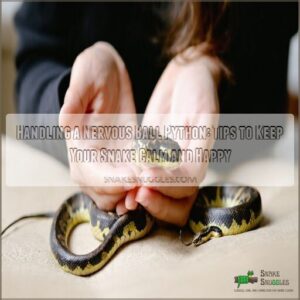
Approach from the side. Slide one hand under the middle of the body, the other behind the head. That’s proper body support.
Feel it gripping? That’s insecurity, not aggression. Fully supported handling fixes it. Safe handling always relies on stress reduction techniques.
Build Your Ball Python’s Trust Through Predictable Routines

Pick one feeding day and stick to it. For a juvenile, that means every 7 days, same weekday, same evening hour. Your snake can’t read a calendar, but it learns patterns fast.
Build a predictable interaction routine around it. Thaw prey completely, warm it to 98–100°F, and use tongs every time. Keep handling sessions to 10–15 minutes, a few evenings a week. Skip them right after meals and during shed.
Trust building with reptiles takes patience. Does your snake explore and tongue-flick gently? Good. Extend sessions a little. Balling up, hissing, or rapid breathing? Return it to its enclosure and try again later. That’s solid body language interpretation in action.
Keep habitat setup steady too: same lighting, same cleaning schedule.
Frequently Asked Questions (FAQs)
Do ball pythons enjoy being held?
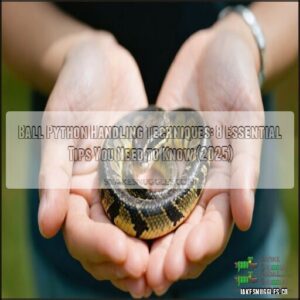
Picture a ball python gliding slowly across your palms, muscles loose, tongue flicking. Calm? Yes. Thrilled? Not quite. Most tolerate handling, but they don’t crave cuddles. Watch for tension, and keep sessions short.
How to tell if a ball python will bite you?
Your snake’s body talks before its teeth do. Watch for a tight ball, puffed hissing, an S-curve neck, or a hard stare. Skip handling after meals and wash your hands to keep a defensive bite away.
What are the signs that a ball python is happy?
Look for signs of a relaxed ball python. Loose, stretched body. Slow, steady tongue flicks. Calm evening exploring. Eats on schedule. Hides by day, roams at night. That’s body language you can trust. No stress indicators.
Do ball pythons get attached to their owners?
Not the way a dog would. Your ball python won’t miss you, but it can learn your scent means safety. That’s trust building through calm, predictable handling. Expect comfort, not affection.
How do you keep a ball python healthy?
Picture Mia, who weighs her python monthly and catches a dip early. That’s healthy care. Nail temperature regulation (88–92°F warm, 76–80°F cool), humidity control, a feeding schedule, shedding cycle care, clean water, and gentle handling.
How do you handle a ball python?
Hands from above look like hawks to a ball python.
Wash your hands, let your snake sniff you, approach from the side. Support mid-body and tail. Move slowly. Start with 3-5 minutes, never after feeding.
Can a ball python be injured?
Yes, your ball python can absolutely get hurt. Weak enclosure security, damp substrate, and rough handling cause injuries. Cold temperatures trigger regurgitation. Watch early stress indicators and defensive behavior, then use proper body support technique.
What happens if a ball python is handled too much?
A coiled ball python is a closed door. Push too hard, and stress indicators pile up: musking, striking, refused meals. Ease off. Cut your handling frequency, shorten handling sessions, and your trust development timeline resets.
How to tell if a snake is bored?
Is your snake bored, or just being a snake? Ball pythons don’t get bored like dogs do. Hiding, exploring, and calm tongue-flicking are normal body language. Watch for glass surfing or constant pacing. Those are real stress indicators. Add habitat complexity and enrichment.
How can I safely transport my ball python?
Nervous about the drive? Use a rigid, ventilated carrier with a dark cloth bag, and keep it 72-80°F with heat packs outside the bag.
Afterward, wait 24-48 hours before gentle handling, so your python settles.
Conclusion
Trust is a slow tide. It doesn’t crash in, it creeps up the shore while you aren’t watching.
Knowing how to make a ball python feel safe comes down to three habits: a snug hide, steady warmth, and a routine your snake can predict. Keep those solid, handle gently, and let your snake set the pace.
One day, the glass-hugging stranger will drape across your hands, calm and curious. That’s trust, and you earned it.