This site is supported by our readers. We may earn a commission, at no cost to you, if you purchase through links.

Your boa’s heat lamp can look perfectly fine while it fails. Incandescent basking bulbs lose 40% of their output after just 200 hours, and the glow never changes. Some ceramic emitters rated for 10,000 hours quit within a month.
That’s the problem with choosing reptile heat lamps for boa constrictors. Your snake needs a basking zone near 90°F, a cool side in the high 70s, and nights that never climb past 90°F. A weak bulb leaves him sluggish. A bad one burns him.
You control all of it, starting with the right lamp. Here are ten worth buying.
Table Of Contents
- Key Takeaways
- Boa Constrictor Heating Needs and Temperature Gradients
- Top 10 Reptile Heat Lamps for Boas
- 1. REPTI ZOO 2 Pack 100W Heat Lamp
- 2. Lucky Herp 100W Ceramic Heat Emitter
- 3. Flukers Basking Spotlight Bulb for Reptiles
- 4. REPTI ZOO 100W Ceramic Heat Emitter
- 5. LUCKY HERP Reptile Heat Lamp Bulbs
- 6. ReptiKing 100W Basking Spot Bulb
- 7. Flukers Repta-Sun 100W Basking Bulb
- 8. REPTI ZOO 75W Reptile Heat Lamp Combo
- 9. LUCKY HERP 150W Ceramic Heat Emitter
- 10. REPTI ZOO 2 Pack 100W Infrared Heat Lamp
- Choosing Heat Lamp Types, Wattage, and Thermostats
- Installing Boa Heat Lamps Safely
- Monitoring Boa Temperatures Throughout Day and Night
- Troubleshooting Boa Heat Lamps and Temperature Problems
- Frequently Asked Questions (FAQs)
- Do boa constrictors need heat lamps?
- Do snakes like heat lamps?
- What is the ideal temperature range for a boa constrictor?
- Do snakes need a heat lamp 24-7?
- How long can boas go without heat?
- Do boas need UVB lighting too?
- Can heat lamps cause burns on boas?
- Should heat lamps stay on at night?
- How often should heat bulbs be replaced?
- Conclusion
Key Takeaways
- You’re in charge of your boa’s body temperature, so build a gradient with a basking zone around 88-92°F, a warm side in the mid-80s, and a cool side in the high 70s to low 80s.
- A thermostat isn’t optional, because every heat source can overheat, and a guard over any lamp inside the enclosure prevents burns.
- Bulbs often fail quietly, since incandescents lose about 40% of their output after 200 hours while still glowing and some ceramic emitters die within months, so keep spares and replace bulbs on a schedule.
- Use a basking bulb by day, switch it off at night, and add a lightless ceramic emitter only if the room drops below about 68°F, then check temperatures daily with a probe and an infrared gun.
Boa Constrictor Heating Needs and Temperature Gradients
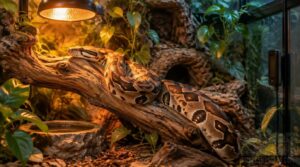
Because boas are ectotherms, you’re the one in charge of their body temperature. Heat isn’t a bonus; it’s the engine behind digestion, shedding, and activity. So what does your boa actually need?
Once your temperatures are dialed in, you can match meal size and timing to your snake’s growth with this boa constrictor feeding schedule and prey size guide.
Because boas are ectotherms, their body temperature is in your hands, and heat is the engine behind digestion, shedding, and activity
A proper temperature gradient. Set your warm side at 85-88°F, with a basking zone of 86-90°F. Keep the cool side between 75-80°F. That roughly ten-degree spread lets your boa choose.
Nights can dip to 70°F safely, as long as a thermostat runs your heat lamp. Surface temperatures can hit 95°F, but ambient air above 90°F is risky. Good temperature control isn’t guesswork; it’s measurement.
Place probe thermometers at the basking zone and the cool end. Spot-check surfaces with an infrared gun. Wild boas roam widely, so mimic that. Heat sources should always be paired with a reliable thermostat to prevent overheating and keep temperatures consistent.
Top 10 Reptile Heat Lamps for Boas
You’ve got the gradient basics down, so now it’s time to pick your gear. The ten picks below cover Heat Lamp bulbs and ceramic emitters, and each one can help you build a safe, stable Basking Zone. Here’s what you need to know to match the right heat source to your boa’s enclosure.
1. REPTI ZOO 2 Pack 100W Heat Lamp
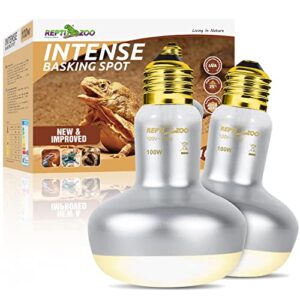
The REPTI ZOO 2 Pack 100W Heat Lamp isn’t a gimmick, it’s a Workhorse. Each 100W bulb fits a standard E26 socket and lasts over 2,000 hours. The flat bottom focuses 35% more heat in the beam, so your Basking Zone stays strong. It runs quietly, with no buzzing or flickering.
Watch one thing. The metal cap can separate from the glass before burnout. Replace each bulb every 5 months. Want control and safety? Then never skip that replacement schedule.
| Best For | Reptile keepers, such as owners of bearded dragons, geckos, and turtles, who need a quiet, reliable basking heat source and don’t mind replacing bulbs on a regular schedule. |
|---|---|
| Power Rating | 100W |
| Base Type | E26 |
| Rated Lifespan | 2000-3000 hours |
| Heat Type | Light-emitting basking |
| Visible Light | Yes |
| Durability Complaints | Cap separation |
| Additional Features |
|
- Simulates a natural sunrise and sunset for even heating
- Flat bottom focuses 35% more light and heat in the beam, keeping the basking zone strong
- Runs quietly with no buzzing or flickering
- The metal cap may separate from the glass bulb before burnout
- The cap can get stuck in the fixture while the bulb dangles on thin wires
- Needs replacing every 5 months to avoid overheating risks
2. Lucky Herp 100W Ceramic Heat Emitter
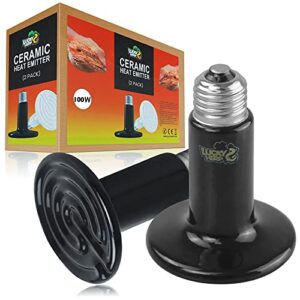
Need heat at night? The Lucky Herp 100W Ceramic Heat Emitter isn’t a light, it’s a Night Heat Source. It gives off heat with no visible glow, so your boa’s sleep cycle stays intact.
It reaches rated temperature within 4 minutes. The thick ceramic body is built to last, and the standard E26 base fits common lamp fixtures at 120V.
Mount it at least 30cm away from your snake. Don’t switch it on and off constantly. Some fail within months.
| Best For | Reptile and amphibian keepers who need a steady, light-free heat source for nighttime use in enclosures with a standard E26 lamp fixture. |
|---|---|
| Power Rating | 100W |
| Base Type | E26 |
| Rated Lifespan | N/A |
| Heat Type | Ceramic infrared |
| Visible Light | No |
| Durability Complaints | Early failure |
| Additional Features |
|
- Gives off heat with no visible glow, so it won’t disrupt your animal’s sleep cycle at night
- Reaches its rated temperature within 4 minutes of being turned on
- Thick ceramic construction and a standard E26 base make it durable and easy to install in common lamp fixtures
- Must be mounted at least 30cm from your animal to prevent overheating
- Shouldn’t be switched on and off frequently, or it may get damaged
- Some units lose heat output or fail within months of use
3. Flukers Basking Spotlight Bulb for Reptiles
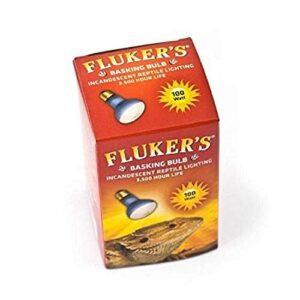
Daytime is different. The Flukers Basking Spotlight Bulb isn’t a night heater, it’s a Basking Heat Source for daylight hours. This 75-watt incandescent (model 22602) gives off infrared heat and a yellowish glow your boa can bask under.
Since a gradient matters more than a single hot spot, pairing the lamp with the temperature guidance in this hognose snake care sheet helps you set up a warm side and a cool side.
The ceramic base screws into standard reptile lamp fixtures. It measures 2.5 x 2.5 x 5.5 inches and weighs 1.6 ounces.
Heat is concentrated, not evenly spread, so aim it deliberately. Lifespan varies. Some units fail within weeks, so keep a spare.
| Best For | Reptile owners, especially boa keepers, who need a simple, affordable daytime basking heat source that fits a standard lamp fixture. |
|---|---|
| Power Rating | 75W |
| Base Type | Screw-in |
| Rated Lifespan | N/A |
| Heat Type | Infrared basking |
| Visible Light | Yes |
| Durability Complaints | Weeks-long failures |
| Additional Features |
|
- Gives off infrared heat that lets reptiles bask and regulate their core body temperature
- Ceramic base screws into standard reptile lamp fixtures
- Compact and lightweight at 2.5 x 2.5 x 5.5 inches and 1.6 ounces
- Heat is concentrated in one spot rather than evenly spread, so it must be aimed carefully
- Gives off a yellowish light that looks less natural to human eyes
- Lifespan varies, and some units fail within weeks, so a spare is a good idea
4. REPTI ZOO 100W Ceramic Heat Emitter
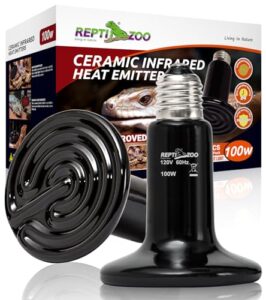
The REPTI ZOO 100W Ceramic Heat Emitter gives you steady, 24-hour warmth without a single flash of light. That matters. It isn’t a lamp, it’s a non-light emitting heat source, so your boa’s sleep patterns stay intact.
The ceramic build is crack-resistant and safe in high humidity. It’s CE-certified, RoHS-compliant, and rated for 10,000 hours. Want to hold 95 to 100 degrees Fahrenheit? You can.
Be careful, though. Some users report failures within a month. Use a thermostat and gloves.
| Best For | Reptile keepers with turtles, bearded dragons, geckos, lizards, or snakes who want steady, light-free heat around the clock and are willing to use a thermostat. |
|---|---|
| Power Rating | 100W |
| Base Type | E26 |
| Rated Lifespan | 10,000 hours |
| Heat Type | Ceramic infrared |
| Visible Light | No |
| Durability Complaints | Failure within month |
| Additional Features |
|
- Gives consistent 24-hour warmth without emitting light, so it won’t disrupt your reptile’s sleep.
- Can hold terrarium temperatures between 95 and 100 degrees Fahrenheit, and its infrared heat promotes blood circulation.
- Has a crack-resistant ceramic build that is safe in high humidity, with a 10,000-hour rating and CE and RoHS certifications.
- Some users report the bulb failing within a month of use.
- The bulb can get extremely hot, so a thermostat is recommended.
- Skin oils can damage the ceramic surface, so you need to wear gloves when installing it.
5. LUCKY HERP Reptile Heat Lamp Bulbs
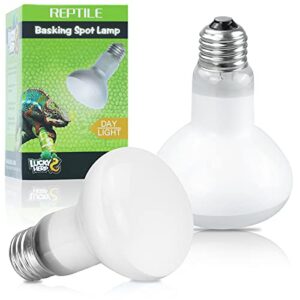
A 2-pack of these 100W bulbs gives you daytime Basking Heat and UVA in one setup. They fit any standard E26 fixture and run on 120V. Rated life? Up to 2,000 hours.
But this isn’t a full-spectrum solution, it’s a daytime heat source. It emits no UVB, so you’ll need a separate UVB lamp. Don’t run it overnight, either.
Watch for early burnout. Some owners report inconsistent lifespan. Keep the spare bulb ready, and your boa’s basking spot stays steady.
| Best For | Owners of bearded dragons, leopard geckos, tortoises, and other reptiles who want an affordable daytime basking heat source and already have, or plan to add, a separate UVB lamp. |
|---|---|
| Power Rating | 100W |
| Base Type | E26 |
| Rated Lifespan | 2000 hours |
| Heat Type | Incandescent basking |
| Visible Light | Yes |
| Durability Complaints | Early burnout |
| Additional Features |
|
- Provides daylight-style warmth and UVA to support natural basking behavior
- Fits standard E26 ceramic fixtures and runs on 120V, so setup is simple
- Comes as a 2-pack, so you have a spare ready, with a rated life of up to 2,000 hours
- Emits no UVB, so a separate UVB lamp is required for full-spectrum needs
- Meant for daytime use only and can’t be used for nighttime heating
- Some owners report inconsistent lifespan and early burnout
6. ReptiKing 100W Basking Spot Bulb
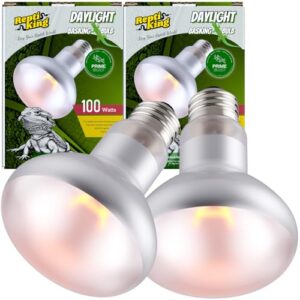
Picture a golden pool of light spilling across a branch, your boa draped through it, soaking up warmth. That’s what the ReptiKing 100W Basking Spot Bulb aims to create.
It’s a 100W basking bulb with a US E26 base, built for 120V, 60Hz sockets. It helps you hold basking temperatures between 88°F and 90°F. Its light skews more yellow than halogen.
Is it perfect? No. Rated for 2000 hours, some bulbs failed within a month. Always keep a spare bulb.
| Best For | Owners of bearded dragons, turtles, geckos, iguanas, and similar reptiles or amphibians who want an affordable-style 100W basking bulb for a warm basking spot and don’t mind keeping a spare on hand. |
|---|---|
| Power Rating | 100W |
| Base Type | E26 |
| Rated Lifespan | 2000 hours |
| Heat Type | Daylight basking |
| Visible Light | Yes |
| Durability Complaints | Failure within month |
| Additional Features |
|
- Helps maintain basking temperatures between 88°F and 90°F in enclosures
- Produces a daylight spectrum to support a daytime light cycle
- Works with night heat lamps or ceramic heat emitters for 24-hour cycles
- Some bulbs reportedly fail within a month, despite the 2000-hour rating
- Feedback on long-term reliability and build quality is mixed
- Light output looks more yellow than standard halogen bulbs
7. Flukers Repta-Sun 100W Basking Bulb
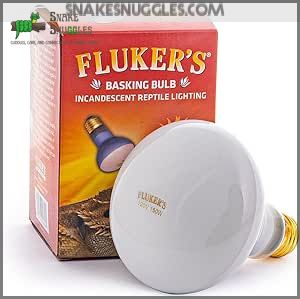
A warm amber glow settles over one end of the enclosure while the other stays cool and shadowed. That’s what the Flukers Repta-Sun 100W Basking Bulb does for your boa.
It’s a 100-watt incandescent bulb. It throws focused infrared heat and visible light at one spot, so your boa gets a real basking zone to thermoregulate. Aim for a surface around 90°F.
Here’s the catch. Some owners report burnout in under a month, and a few units arrive defective. Keep a spare on hand.
| Best For | Reptile owners with bearded dragons, turtles, geckos, or ball pythons who want an affordable 100-watt bulb that creates a focused basking spot of around 90°F. |
|---|---|
| Power Rating | 100W |
| Base Type | N/A |
| Rated Lifespan | N/A |
| Heat Type | Radiant infrared |
| Visible Light | Yes |
| Durability Complaints | Burnout under month |
| Additional Features |
|
- Directs heat and light to one spot, giving your reptile a clear basking area
- Provides radiant infrared heat that supports thermoregulation in ectothermic reptiles
- Fits standard reptile lamp fixtures and works in both reptile tank and aquarium setups
- Multiple owners report the bulb burning out in less than a month
- Reliability is mixed, and some units arrive used or defective
- Doesn’t last as long as bulbs from other brands
8. REPTI ZOO 75W Reptile Heat Lamp Combo
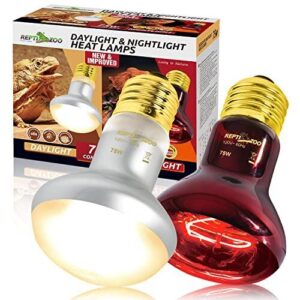
Want one setup that covers day and night? This combo gets you there.
You get two 75W bulbs: a UVA basking lamp for daytime and an infrared emitter for after dark. The infrared heat emitter gives off soft red light, so your boa’s day/night cycle stays intact. The UVA lamp encourages appetite and natural behavior.
Both bulbs are rated for 2000-3000 hours. Reality is different. Some owners report the red bulb dying in three months and the daytime bulb in two. Keep spares handy.
Pair them with a thermostat. Always.
| Best For | Reptile owners with medium to larger enclosures, such as a boa keeper, who want one combo covering daytime UVA and nighttime heat without disrupting the day/night cycle. |
|---|---|
| Power Rating | 75W each |
| Base Type | N/A |
| Rated Lifespan | 2000-3000 hours |
| Heat Type | Infrared plus UVA |
| Visible Light | Both types |
| Durability Complaints | Burns out in months |
| Additional Features |
|
- Includes both a UVA basking lamp and an infrared heat emitter, so one set covers day and night.
- The infrared bulb gives off soft red light, which keeps your pet’s day/night cycle intact.
- The UVA lamp encourages appetite and natural growth and behavior.
- Customers report the red bulb dying in about three months with nightly use.
- The daytime bulb has been reported to burn out after only two months of continuous use.
- Real-world lifespan can fall well short of the advertised 2000-3000 hours, so you’ll need spares and a thermostat.
9. LUCKY HERP 150W Ceramic Heat Emitter
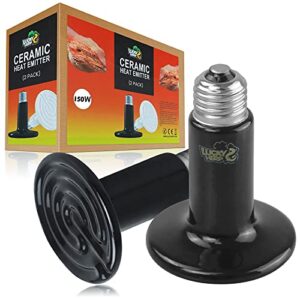
Need heat without light? The Lucky Herp 150W Ceramic Heat Emitter delivers it. It’s a Ceramic Heat Emitter, not a bulb, so your boa’s night stays dark.
It reaches rated temperature in 4 minutes, runs on standard 120V, and screws into an E26 base. The thick ceramic body is rated for up to 10,000 hours.
Safety comes first. Pair it with a compatible ceramic lamp holder. Mount it more than 30cm from your boa. Avoid frequent on/off cycling at all.
| Best For | Reptile and amphibian keepers who need steady, light-free heat in a terrarium, including those who also warm chicks, dogs, or cats in controlled setups. |
|---|---|
| Power Rating | N/A |
| Base Type | E26 |
| Rated Lifespan | 10,000 hours |
| Heat Type | Ceramic infrared |
| Visible Light | No |
| Durability Complaints | N/A |
| Additional Features |
|
- Gives off heat without visible light, so animals’ night cycles stay undisturbed
- Reaches rated temperature in just 4 minutes
- Thick ceramic build is rated for up to 10,000 hours
- Needs a compatible ceramic lamp holder to be used safely
- Must be mounted more than 30cm from animals to avoid overheating
- Frequent on/off cycling should be avoided, and it isn’t meant for immediate reuse after being turned off
10. REPTI ZOO 2 Pack 100W Infrared Heat Lamp
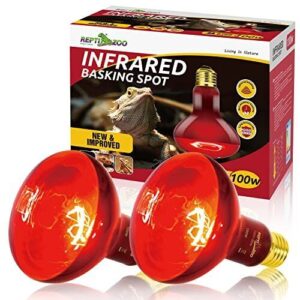
Your last pick was a ceramic emitter. This one isn’t. The REPTI ZOO 2 Pack 100W Infrared Heat Lamp gives you two bulbs.
It screws into a standard E26 socket and emits red Infrared Heat with no visible light. Your boa keeps its day and night cycle. The updated vacuum aluminizing process boosts efficiency.
Be realistic about lifespan. It’s rated for 2000 to 3000 hours, but some owners report 2 to 12 weeks. Defective? Replacement is covered within 3 months.
| Best For | Reptile, amphibian, or chicken keepers who want a simple, screw-in heat source that works day and night without lighting up the enclosure. |
|---|---|
| Power Rating | 100W |
| Base Type | E26 |
| Rated Lifespan | 2000-3000 hours |
| Heat Type | Infrared emitter |
| Visible Light | No |
| Durability Complaints | 2-12 week lifespan |
| Additional Features |
|
- Gives off infrared heat with no visible light, so animals keep their natural day and night cycles
- Fits a standard E26 socket, so it works in ordinary fixtures
- Suits bearded dragons, geckos, tortoises, and chicken brooders or coops
- Rated for 2000 to 3000 hours, but some owners report it lasting only 2 to 12 weeks
- Aluminum construction and a 100W rating may not suit every setup, so check your enclosure before buying
- Replacement is only offered for defects within 3 months, so a bulb that fails later is on you
Choosing Heat Lamp Types, Wattage, and Thermostats
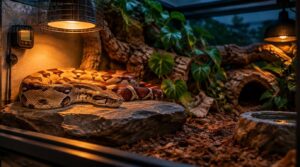
Picking a heat lamp isn’t about the biggest bulb, it’s about the right match. Your boa needs a Basking Zone of 88-92°F, and your setup decides how you get there.
Start with four decisions:
- Heat source type: Ceramic heat emitters give lightless heat and run 24 hours. Basking bulbs need a 12-hour cycle.
- Wattage requirements: CHEs come in 60W, 100W, and 150W. Pick the lowest wattage that works.
- Thermostat pairing: Use on/off or pulse proportional with CHEs. Use dimming with bulbs.
- Night plan: If your room drops below 68°F, add a thermostat-controlled CHE.
Why does this matter? Thermostat-driven temperature control keeps your gradient stable. Guard every heat lamp, too. Burns happen fast. Let your thermostat do the work for you.
Installing Boa Heat Lamps Safely
Your heat lamp is only as safe as its setup. Start with proper placement. Mount the lamp outside a mesh top when you can, and keep it 9 inches above the highest basking point.
Inside the enclosure? Fit a heat lamp guard with mesh of 0.5 inch or less. Clamp every fixture firmly. Use a ceramic socket rated for your wattage.
| Skipped step | Your boa risks |
|---|---|
| No guard | Painful burns |
| Untested thermostat | Overheating |
Protect the wiring. Plug into a surge protector, clip cords along the exterior, and keep them away from water. That’s electrical safety. Set thermostat control with the probe in the basking area. Complete temperature calibration before your boa moves in: simulate swings and watch the lamp cycle.
Monitoring Boa Temperatures Throughout Day and Night
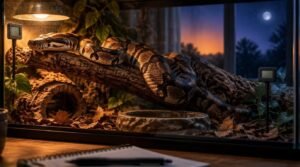
Setup is done. Now you keep it honest. Temperature monitoring isn’t a one-time task, it’s a daily habit.
Here’s your routine:
- Check the basking spot in the morning, afternoon, and evening. Aim for 88-92°F.
- Measure the cool zone at the same times. Target 78-82°F.
- Record nighttime readings before lights out and upon waking. Stay between 75-80°F.
- Use a digital probe at each end. Skip stick-on dials.
- Log every reading.
Why log? Because a written record exposes failing equipment fast. Note any spike above 95°F or drop below 70°F immediately. Review weekly, then adjust your thermostat control. A steady temperature gradient isn’t luck, it’s your data at work. That’s how you stay in control, every day.
Troubleshooting Boa Heat Lamps and Temperature Problems
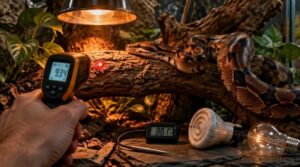
When your boa’s hot spot drifts, don’t guess. Measure first.
Start with the probe. Air-placed sensors overestimate the basking surface by up to 10°F, so aim an infrared gun at the surface itself. Still too cool? Check the bulb. Incandescent filaments lose 40% of output after 200 hours while looking fine. Ceramic emitters crack inside after 3 to 6 months, causing 15 to 25°F drops.
Glass and acrylic absorb roughly 20% of infrared, so heat source placement matters.
Wild temperature fluctuations? A new proportional thermostat needs 24 to 48 hours to settle. That isn’t a defect, it’s calibration. Poor temperature control and uneven heat distribution are fixable. Is your wiring undersized? Voltage drops can hide a 10 to 15°F deficit.
Frequently Asked Questions (FAQs)
Do boa constrictors need heat lamps?
Yes, you need a heat source. Your boa can’t warm itself, so it needs a basking spot of 86-90°F and a temperature gradient. Use thermostat control, and add CHEs for nocturnal reptile heat without light.
Do snakes like heat lamps?
Think your boa loves that glowing bulb? It doesn’t. Reptile thermoregulation drives basking behavior, so your snake wants warmth, not light. Use thermostat control, smart heat source placement, and a steady temperature gradient every day.
What is the ideal temperature range for a boa constrictor?
Your boa needs a temperature gradient, not one number. Hold these temperature ranges: basking spot 88-92°F, warm side 85-88°F, cool side 78-82°F. Nights may drop to 68-75°F.
Run a thermostat and keep temperature logging daily.
Do snakes need a heat lamp 24-7?
Worried darkness chills your snake? Don’t be. Switch the basking spot off at night, keep the temperature gradient intact, add nocturnal heating only below 68°F. Heat source reliability and reptile enclosure temperature management need thermostats.
How long can boas go without heat?
How long is too long? Healthy adults handle 24 to 48 hours without a basking spot if the enclosure stays above 60°F.
Beyond that, intervene right away. Restore a temperature gradient and start temperature logging.
Do boas need UVB lighting too?
Boas don’t strictly need UVB lighting, but it helps. Safe UVB exposure aids vitamin D3 synthesis and natural basking behavior.
Always offer a shaded retreat, so thermoregulation stays in your snake’s hands, not the lamp’s.
Can heat lamps cause burns on boas?
Can a heat lamp really burn your boa? Yes. Contact with an unguarded bulb does it, and so does a basking spot set too close. Use a snake-proof guard, check the temperature gradient, and prevent burns.
Should heat lamps stay on at night?
Nights as cool as 68°F won’t hurt your boa. Turn the heat lamp off after dark. Nighttime cooling keeps your temperature gradient natural.
Need warmth? Use a ceramic heat emitter. Basking behavior stimulation stays intact.
How often should heat bulbs be replaced?
A fading bulb is a candle burning low. Heat bulb lifespan and durability set your schedule: halogen every 3-6 months, ceramic heat emitter yearly. Temperature monitoring daily. Enclosure temperature management starts with reptile equipment maintenance.
Conclusion
A bulb that loses 40% of its output in 200 hours isn’t dead, it’s quietly failing. Your boa pays for that. The right reptile heat lamps for boa constrictors hold a steady 90°F basking spot without surprises, but only when you pair them with a thermostat.
Check your temperatures weekly. Replace bulbs before they fade. Your boa can’t tell you when the heat slips, so you must. Control the warmth, and you control his health.