This site is supported by our readers. We may earn a commission, at no cost to you, if you purchase through links.

A ball python needs 50% to 60% humidity. Your cheap analog gauge says 70%. Your snake sheds in pieces anyway, and you spend a week blaming the substrate.
Multiply that error across six enclosures and the guesswork gets expensive. A ±5% gap on one tank is a nuisance. On a rack, it hides a dry shelf and a damp one behind identical readings.
The right digital thermometers hygrometers for multiple enclosures change that. You get readable displays, steady power, and sensors that hold calibration. Here are five that earn a spot on your tank walls.
Table Of Contents
- Key Takeaways
- Top 5 Thermometer-Hygrometers for Multiple Snake Enclosures
- Compare Accuracy, Response Times, and Sensor Types
- Evaluate Displays, Battery Life, and Moisture Resistance
- Choose Multi-Enclosure Connectivity, Alerts, and Data Logging
- Position Sensors Across Warm and Cool Zones
- Verify Calibration and Long-Term Sensor Reliability
- Frequently Asked Questions (FAQs)
- What is the best hygrometer for a terrarium?
- Which digital hygrometer is the most accurate?
- What is the best indoor/outdoor thermometer with multiple sensors?
- Which digital thermo hygrometer is the best?
- How often should I replace thermometer batteries?
- Can one hygrometer monitor several enclosures at once?
- What temperature range suits most snake species?
- How do I clean sensors without damaging them?
- Are wireless sensors safe near heat lamps?
- Conclusion
Key Takeaways
- You can’t trust a single analog gauge across a rack, so give every enclosure its own digital sensor and cross-check each one against a trusted reference, like a salt test, before you mount it.
- You’ll get the most useful picture by placing one sensor at the warm end and another at the cool end, at the height your snake actually rests, rather than a single probe in the middle.
- You should match features to how you’ll use them: LED displays stay readable under lamps, USB power suits permanent racks, and Bluetooth apps with alerts and data logging show you which tub drifted.
- You’ll still need to check calibration regularly and watch for common weak spots in the five reviewed models, such as mixed humidity accuracy, weak adhesion, small screens, and dead batteries on arrival.
Top 5 Thermometer-Hygrometers for Multiple Snake Enclosures
Running several snake enclosures means you can’t trust one reading and hope for the best. The five units below are built to give you steady temperature and humidity readings across a whole rack. Check each one against your setup, then pick the model that fits.
Before you mount anything, it helps to see how a snake enclosure heating setup pairs a thermostat with probe placement, so every reading you log reflects real conditions.
1. PAIZOO Reptile Thermo-Hygrometer LED Display
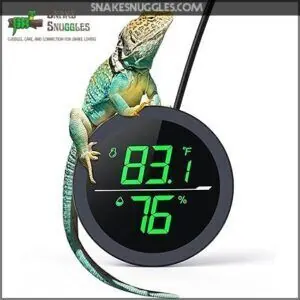
Readability sets the PAIZOO apart. Its 3-inch LED screen shows temperature and humidity in real time, bright enough to read from across the room. A high-precision chip controls measurement, and the 140 cm USB cable keeps it powered continuously.
That accuracy matters in a classroom, where cheap analog dials can drift ±10% or more, so this guide to humidity gauges for classroom reptile habitats explains what to look for.
Mounting is simple. Press the adhesive onto the tank wall, and use the extra 3M sticker as a backup.
Know the trade-offs. Humidity accuracy gets mixed reviews, adhesion can slip in damp enclosures, and some units failed early or smelled burnt.
| Best For | Reptile keepers who want an easy-to-read, always-on display of terrarium temperature and humidity and don’t need laboratory-level humidity accuracy. |
|---|---|
| Measurement Type | Temperature and humidity |
| Display Type | 3-inch LED |
| Power Source | USB plug-in |
| Temperature Accuracy | N/A |
| Humidity Accuracy | N/A |
| Mounting Method | 3M adhesive sticker |
| Additional Features |
|
- Bright 3-inch LED screen shows temperature and humidity in real time and is easy to read from across the room
- Plugs in with a 140 cm USB cable for continuous power, and a high-precision chip handles measurement
- Adhesive backing makes tank mounting simple, with an extra 3M sticker included as a backup
- Customers report mixed results on humidity accuracy
- Adhesive can slip in damp, high-humidity enclosures
- Some units failed early or gave off a burning smell from the vents
2. QZQ Digital Reptile Thermometer Humidity Gauge
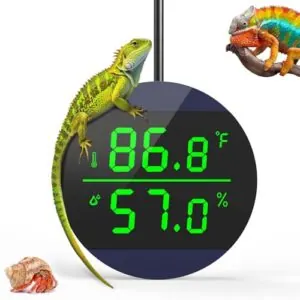
If the PAIZOO’s adhesion worries you, the QZQ offers a simpler setup. It reads temperature from 32°F to 140°F with ±1.8°F accuracy, and humidity from 5% to 99% with ±5% accuracy. The bright LED HD display stays readable in any lighting.
Since a digital hygrometer like this beats an analog dial, our guide to reptile humidity gauges for beginners shows what accuracy to look for.
You plug it in with the 150 cm USB cable, so you never swap batteries. Double-sided adhesive holds it inside the tank.
Watch the numbers, though. Some users report readings 10–15°F low, and feedback on accuracy is mixed. Cross-check each unit against a trusted probe.
| Best For | Reptile owners with chameleons, turtles, snakes, leopard geckos, or bearded dragons who want a bright, easy-to-read, USB-powered display for monitoring temperature and humidity, and who are willing to double-check its readings against a trusted probe. |
|---|---|
| Measurement Type | Temperature and humidity |
| Display Type | Bright LED HD |
| Power Source | USB plug-in |
| Temperature Accuracy | ±1.8°F |
| Humidity Accuracy | ±5% |
| Mounting Method | Double-sided adhesive |
| Additional Features |
|
- Bright LED HD display that stays easy to read in both low and bright light
- USB-powered with a 150 cm cable, so there are no batteries to replace
- Double-sided adhesive backing makes mounting inside the tank simple
- Some users report temperature readings 10–15°F lower than the actual temperature
- Customer feedback on accuracy is mixed from unit to unit
- Needs a USB power source or adapter to work
3. TempPro TempAir Digital Hygrometer
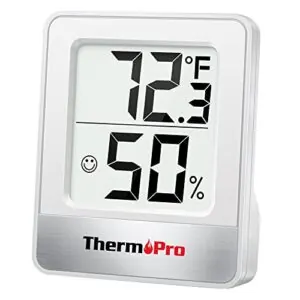
If you’d rather skip the cable, the TempPro TempAir runs on a battery. It weighs just 35 g and measures 0.7" W x 2.6" H, so it slips between enclosures easily.
Since the right enclosure also depends on size, ventilation, and heat, this snake cage and habitat guide helps you match the setup to your species.
Sensors are accurate to about ±1°F and ±2-3% RH, and readings refresh every 10 seconds. A face icon flags dry, comfort, or wet conditions, though the small screen can make it hard to read.
Batteries are the catch. Some buyers report dead cells on arrival, so test yours first.
| Best For | Plant growers, parents of newborns, and RV or workshop owners who want a small, battery-powered gauge that shows temperature and humidity at a glance. |
|---|---|
| Measurement Type | Temperature and humidity |
| Display Type | Face icon display |
| Power Source | Battery powered |
| Temperature Accuracy | ±1°F/°C |
| Humidity Accuracy | ±2-3%RH |
| Mounting Method | N/A |
| Additional Features |
|
- Accurate sensors, within about ±1°F/°C for temperature and ±2-3% for humidity
- Face icon quickly shows whether conditions are dry, comfortable, or wet
- Compact and light at 0.7" W x 2.6" H and 35 g, so it fits into tight spaces
- Some buyers report dead batteries on arrival, and battery life reviews are mixed
- The small screen can make the face icon hard to see clearly
- No waterproof rating is listed, so it may not suit damp spots
4. Reptile Thermometer Hygrometer 2-Pack
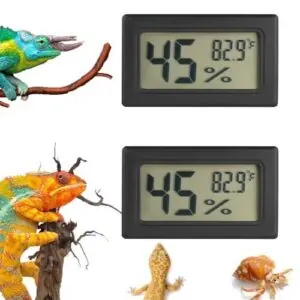
Dead batteries on arrival are a hassle, so a built-in battery looks appealing. This 2-Pack gives you two units that track temperature and humidity together, with ±1°F and ±5% accuracy and a 10-second response time.
Pair the sensors with a humidity hide box for snakes placed beside the warm corner, so you can confirm it stays damp enough for shedding.
The battery lasts about four months, which suits a rack of snake tubs. Double-sided tape keeps setup wire-free.
Mind the downsides. Adhesion varies, so press firmly and watch for slipping. The screen can be hard to read, and the ABS plastic gets mixed durability reviews.
| Best For | Reptile keepers who want a simple, wire-free way to monitor temperature and humidity in enclosures like leopard gecko, bearded dragon, or ball python habitats. |
|---|---|
| Measurement Type | Temperature and humidity |
| Display Type | LCD, 1.42 × 0.6 in |
| Power Source | Built-in battery |
| Temperature Accuracy | ±1°F |
| Humidity Accuracy | ±5% |
| Mounting Method | Double-sided tape |
| Additional Features |
|
- Tracks temperature and humidity at the same time, with ±1°F and ±5% accuracy and a 10-second response time
- Built-in battery lasts about four months, and two spare batteries come with each unit
- Double-sided tape makes setup wire-free, and it works indoors, outdoors, and in greenhouses
- Adhesive performance varies, and some users report poor tape adhesion
- The small LCD display (1.42 × 0.6 inches) can be hard to read for some users
- The ABS plastic casing has mixed durability feedback
5. AQUANEAT Digital Reptile Thermometer Hygrometer
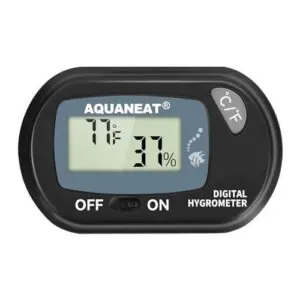
A small, no-frills unit like the AQUANEAT gives you a temperature and humidity reading in one glance. It’s powered by a single LR44 battery, which is included, and the polycarbonate case keeps things light. You can track conditions from -58°F to +158°F, with humidity from 20% to 99% RH.
Stick it to the glass with the suction cup, but test the grip first. Some units arrive without one, and adhesion can be weak on certain surfaces.
The 2.3 x 1.5 inch screen is compact, so expect to lean in for a clear look.
| Best For | Reptile keepers, hatchery users, and humidor owners who want a simple, low-cost gauge for reading temperature and humidity in a small enclosure. |
|---|---|
| Measurement Type | Temperature and humidity |
| Display Type | LCD, 2.3 × 1.5 in |
| Power Source | LR44 button cell |
| Temperature Accuracy | N/A |
| Humidity Accuracy | N/A |
| Mounting Method | Suction cup |
| Additional Features |
|
- Covers a wide range, from -58°F to 158°F for temperature and 20% to 99% RH for humidity
- Comes with an LR44 battery included, and the polycarbonate case keeps it light
- Works in vivariums, hatchers, brooders, propagators, and humidors, with a suction cup for mounting
- The suction cup may grip weakly or inconsistently on some surfaces
- The 2.3 x 1.5 inch screen is small and may be hard to read for some people
- Some units arrive without the suction cup
Compare Accuracy, Response Times, and Sensor Types
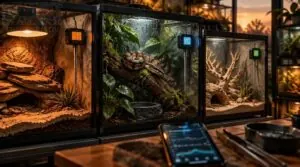
Because every snake enclosure runs its own microclimate, you’ll want to compare specs before you buy anything.
Start with sensor types. Capacitive humidity sensors hold ±2-5% RH accuracy and respond faster than resistive ones, which drift over time. Typical digital units claim ±1°C and ±5% RH, but that’s only under lab conditions at 25°C and 50% RH.
Response time matters next. Temperature probes react in 1 to 30 seconds, while humidity sensors lag at 30 to 90. For basking zones, pick a probe under 5 seconds so you don’t overshoot.
Accuracy slips above 80% RH, and don’t trust a reading after misting. Bluetooth connectivity and data logging help you spot trends across racks, but they can’t fix a bad sensor. Consistent monitoring also matters because proper humidity helps successful reptile shedding and healthy respiratory function.
Evaluate Displays, Battery Life, and Moisture Resistance
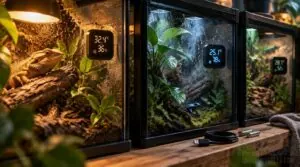
Think of the display as a windowpane: if it fogs or glares, you’re guessing at what’s behind it.
An LCD digital screen sips power and reads well in steady room light, but it can wash out under a bright basking lamp. LED panels stay legible in both glare and darkness. Judge display readability from where you’ll actually stand when you check.
Battery life varies widely. Rechargeable units run one to three months per USB-C charge, while AAA models last 18 to 24 months. Pick AAA for hands-off racks, and don’t leave a charging cable plugged in unless you want the screen lit constantly.
For moisture resistance, choose IP-rated water resistance like IPX5, which survives mist and splashes but not submersion.
Choose Multi-Enclosure Connectivity, Alerts, and Data Logging

A rack of snake enclosures is a row of quiet rooms, and your sensors are the hallway cameras that tell you which door to open first. Without them, you’re guessing.
Pick wireless units that name each tub separately, so a Bluetooth app history shows you exactly which enclosure drifted. Remote monitoring matters most when you’re at work and a heat mat sticks on.
Here’s what good multi-enclosure racks give you:
- A phone buzzing at 2 a.m. because Tub 4 hit 92°F.
- A graph showing humidity sagging each night after lights out.
- A CSV export you can line up against your misting schedule.
Set high and low alerts per snake, and use data logging to catch slow trends. Choose USB power for permanent racks.
Position Sensors Across Warm and Cool Zones
One probe in the middle of the tank tells you almost nothing. Your snake doesn’t live in the middle, so your sensors shouldn’t either.
A single sensor in the middle of the tank reveals almost nothing, because your snake never lives there
Build a clear thermal gradient by mounting one unit at the warm end and another at the cool end, both at the height your snake actually rests. For basking spot monitoring, set the probe beside the warm hide, not touching it and not under the lamp’s beam. Hide entrance sensing works the same way: sample the air where your snake pauses, not the heated surface.
Cool retreat monitoring matters just as much. Place that second probe near the cool hide, at matching height.
Then leave them alone. Sensor placement accuracy depends entirely on consistent, repeatable locations.
Verify Calibration and Long-Term Sensor Reliability
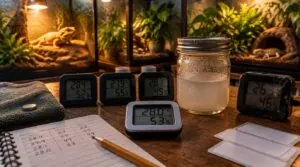
Can you trust a number just because it’s glowing on a display? Don’t. Even the best unit drifts, so you need a routine.
Start with user calibration. Compare each gauge against a trusted reference under stable conditions, and record temperature and humidity offsets separately. Check your calibration options for sensors too, since some units allow manual humidity offsets and others don’t.
- Test humidity near 75% RH with a sealed sodium chloride slurry.
- Remember that one test point doesn’t prove sensor accuracy across the full range.
- Log reference and device readings to separate drift from enclosure changes.
- Label each gauge with its enclosure and installation date.
- Note battery life and response time beside any odd reading.
Replace frozen or divergent gauges.
Frequently Asked Questions (FAQs)
What is the best hygrometer for a terrarium?
Accuracy is your compass here. The best hygrometer for a reptile terrarium pairs a Sensirion sensor with an integrated digital thermometer and user calibration offsets. Choose TempPro if you run multiple enclosures and recalibrate yearly.
Which digital hygrometer is the most accurate?
Think of your hygrometer as a lighthouse: a false beam wrecks ships. Choose professional-grade capacitive sensors with ±1–2% RH humidity accuracy.
Then add user calibration, Bluetooth app connectivity, data logging, and strong temperature accuracy too.
What is the best indoor/outdoor thermometer with multiple sensors?
Funny how the priciest gadget rarely wins. Your best pick is the TempPro TP220B: three bundled sensors, solid temperature accuracy, wireless connectivity and realtime monitoring across four spots. Bluetooth app connectivity? You won’t need it.
Which digital thermo hygrometer is the best?
Does a pricier sensor win? No. The Govee H5075 is the best digital thermometer hygrometer for multi-enclosure monitoring, pairing ±54°F accuracy with realtime data. Use it for temperature and humidity control with accurate terrarium sensors.
How often should I replace thermometer batteries?
Battery life depends on the model. TempPro’s replaceable batteries last 18 to 24 months; PAIZOO recharges every 1 to 3 months. Watch lowbattery alert systems, keep spare batteries included or a CR2032 battery handy.
Can one hygrometer monitor several enclosures at once?
Most keepers learn this the hard way: one probe reads one spot. A single hygrometer can’t cover several enclosures, so give each its own sensor and let a gateway collect everything.
What temperature range suits most snake species?
Most snakes thrive with a cool side near 75–80°F and a warm side near 80–85°F. Your thermal gradient drives temperature regulation, so choose a wide temp range 58–158°F meter with temperature accuracy and max/min records.
How do I clean sensors without damaging them?
Ironically, your cleaning hurts sensors more than grime does. Use manufacturer spec sheet validation first, then wipe the condensation-resistant sensor housing with a dry cloth, never the element. Dry fully, run user calibration for drift.
Are wireless sensors safe near heat lamps?
Infrared lamps can top 200°C, well past a sensor’s 60-85°C limit. Keep wireless thermometer placement 40-60 cm away, use external probe temperature monitoring, and choose IPrated water resistance for temperature accuracy across the thermal gradient.
Conclusion
Yes, five sensors cost more than one analog dial. But a dial that’s off by 10% costs you shed cycles, vet visits, and weeks of chasing the wrong problem.
Pick digital thermometers hygrometers for multiple enclosures based on your rack, not the reviews alone. Check calibration against a salt test before you mount anything, then place probes on both the warm and cool sides. Do that once, and you’ll stop guessing. Your rack talks straight.