This site is supported by our readers. We may earn a commission, at no cost to you, if you purchase through links.
A hygrometer that reads 10% in a tank that should sit at 60% isn’t measuring anything. It’s guessing, and your ball python pays for the guess.
Classroom reptiles can’t tell you when the air is wrong. Bearded dragons develop infections above 60% humidity. Crested geckos struggle when it drops below 45%. A cheap analog dial can drift ±10% or more, and students trust the number on it.
The right humidity gauges for classroom reptile habitats give you readings you can verify. Here are two worth buying, plus the placement and calibration steps that keep them honest.
Table Of Contents
- Key Takeaways
- 2 Humidity Gauges for Classroom Reptile Habitats
- Choosing Accurate, Classroom-Friendly Reptile Humidity Gauges
- Matching Classroom Humidity Monitoring to Reptile Species
- Placing Classroom Reptile Gauges for Accurate Readings
- Calibrating Classroom Humidity Gauges and Tracking Trends
- Frequently Asked Questions (FAQs)
- What is the best humidity gauge for reptiles?
- What is the best humidity checker for reptiles?
- What is the ideal humidity level for reptiles?
- Do cheap humidity meters work?
- Can one gauge monitor multiple stacked enclosures?
- What should teachers do during weekend absences?
- Are wireless humidity gauges safe around students?
- How long do reptile hygrometer sensors usually last?
- Are replacement probes available for damaged units?
- How do students safely handle gauges during habitat cleaning?
- Conclusion
Key Takeaways
- Choose a digital hygrometer over an analog dial, since cheap dials can drift ±10% or more while digital units usually hold within 3 to 5%, and a reading you can’t trust can put your reptiles at risk.
- Match your humidity target to each species, because bearded dragons and leopard geckos need 30–40%, ball pythons 50–60%, and crested geckos 60–80%, with spikes during shedding for some.
- Place each sensor at the animal’s mid-level, at least 6 inches from heat lamps, and away from water bowls, misters and vents, with one gauge in the warm end and one in the cool end.
- Check your gauge with the salt test, where it should settle near 75% RH, and log readings daily so you catch drift early and replace any unit that keeps missing tolerance.
2 Humidity Gauges for Classroom Reptile Habitats
Your classroom reptile habitat needs a reliable humidity gauge, and these two options are built for the job. Both pair a hygrometer with a thermometer, so you can track moisture and heat from one display. Check each one against your species’ needs before you buy.
For a closer look at dependable models and what to watch for, see this guide to reptile thermometers for classroom reptile habitats.
JEDEW Digital Hygrometer Thermometer
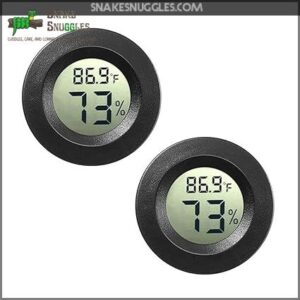
The JEDEW Digital Hygrometer Thermometer gives you fast, readable data for your classroom terrarium. Its sensor updates every 10 seconds through 24 vents, so you’ll catch humidity swings fast. It reads 0°C–70°C and 10%–99% RH, with ±3%RH humidity accuracy. Switch between Fahrenheit and Celsius anytime.
At 1.78"W × 0.6"H and 40 g, it fits small enclosures easily. Use the hanging elastic for placement.
There’s no backlight, so check dim rooms. Readings may stick at 10% when humidity drops lower.
- Updates every 10 seconds through 24 vents, so you catch humidity swings quickly.
- Small and light at 1.78"W × 0.6"H and 40 g, with a hanging elastic for flexible placement.
- Switches between Fahrenheit and Celsius, with ±1°F temperature accuracy and ±3%RH humidity accuracy.
- Humidity readings may stay at 10% even when the actual level is lower, so it can’t detect very dry conditions.
- There’s no backlight, so the display can be hard to read in dim rooms.
- It needs periodic battery replacement, and the adhesive tape’s durability varies.
PAIZOO LED Digital Reptile Thermometer Hygrometer
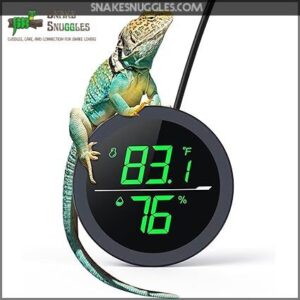
If the JEDEW’s missing backlight bugs you, the PAIZOO LED Digital Reptile Thermometer Hygrometer fixes that. Its 3-inch LED display shows temperature and humidity at once, so you can read it from across the room without opening the enclosure.
The 31.5-inch cable also lets you run a probe in each tank, and these reptile humidity gauges for multiple tanks show how to monitor several enclosures at once.
Dual vents and an electronic sensor keep readings accurate. The 140 cm cable plugs in, so you skip batteries and can place it in larger terrariums.
Caveats: humidity may cap near 81%, adhesive can fail when damp, and it auto-shuts off.
- The 3-inch LED display shows temperature and humidity at the same time and is easy to read from a distance.
- Dual vents and an electronic sensor are designed to give accurate readings.
- The 140 cm power cable means no batteries and lets you place it in large terrariums.
- Humidity readings may cap at around 81%, so they may not be accurate in very humid setups.
- The adhesive tape can lose its grip in high humidity, which may cause the unit to fall off.
- The display turns off automatically after a few seconds, so you have to reactivate it each time you want a reading.
Choosing Accurate, Classroom-Friendly Reptile Humidity Gauges
Both gauges above clear the first bar, but humidity gauge selection still comes down to a few checks. A classroom humidity management plan fails fast when the tool can’t be trusted.
If you’re weighing options, this guide to humidity gauges for guitar storage compares accuracy, size, and calibration needs so you can pick one that holds up.
Start with humidity gauge accuracy. A digital hygrometer usually holds ±3 to 5% RH. Analog dials often drift ±10% or more. Pick digital.
Then run three checks before you buy:
- Min/max memory. It catches overnight and weekend extremes you’ll never see in person.
- Probe design. Your sensor placement stays at animal height while the display sits dry outside the enclosure.
- Durable housing. Students drop things. Cracked plastic and loose suction cups end readings fast.
Plan to compare your unit against a trusted reference now and then. Consumer sensors drift. Proper humidity also helps with respiratory function and shedding, so a reliable reading protects the health of your classroom reptiles.
Matching Classroom Humidity Monitoring to Reptile Species

A reliable reading only helps if you know what to aim for. Species specific care sets your humidity targets, and classroom reptile habitats rarely share one number.
For tropical species that need steady moisture, it helps to understand how foggers work in reptile habitats before choosing one for your enclosure.
Bearded dragons and leopard geckos want 30–40% humidity. Keep bearded dragons under 60%, since sustained dampness invites respiratory and skin infections. Give leopard geckos a humid hide at 70–80% during shedding.
Corn snakes sit at 40–60%, rising to about 70% when they shed. Ball pythons need 50–60%, climbing to 65–70% during shedding.
Crested geckos run wetter. Hold 60–80%, spike to 80–100% at night, and let the enclosure dry to 45–50% by day.
Set your digital hygrometer alerts to match each animal, and label each humidity gauge with its species range for your students.
Placing Classroom Reptile Gauges for Accurate Readings
The best humidity gauge still lies when you put it in the wrong spot. Humidity gauge placement shapes your humidity accuracy more than the price tag does.
Even the best humidity gauge gives false readings in the wrong spot, so where you place it matters more than what it costs
Start with distance. Keep every sensor at least 6 inches from heat lamps, and stay out of the basking beam. Move it away from water bowls, misters, and classroom vents too. Splashes and drafts skew humidity gauge accuracy fast.
Next, think height. Set sensor placement at mid-level where your reptile actually lives, not at the substrate or lid. Use one gauge in the warm end and one in the cool end. Large tank? Add a third.
For humidity gauge mounting, stick units to the outside glass at eye level. Secure all probe wires.
Calibrating Classroom Humidity Gauges and Tracking Trends

Test your gauge before you trust it. Humidity calibration with the salt method takes little effort. Seal the gauge and a saturated sodium chloride solution in an airtight container for 8 to 12 hours. The reading should settle near 75% relative humidity. If it doesn’t, record the offset and adjust.
Don’t skip this step. A consumer digital hygrometer can be off by 3 to 5% RH, and sensors drift over months of classroom use.
Start humidity tracking. Log readings at the same time every day. Compare two gauges in one enclosure, and you’ll catch drift fast. Chart your humidity trends against your species’ needs. Check humidity gauge placement, since vents and sunlight skew readings. Replace gauges that keep missing tolerance.
Frequently Asked Questions (FAQs)
What is the best humidity gauge for reptiles?
Why trust a guess when a digital hygrometer gives you numbers? For classroom reptile habitats, pick a humidity gauge with ±5% humidity accuracy, like JEDEW. Mount it mid-enclosure for solid sensor placement, away from water.
What is the best humidity checker for reptiles?
For classroom reptile habitats, pick the JEDEW digital hygrometer. Its ±3% humidity accuracy beats PAIZOO’s ±5%. You get a two-pack, so cross-check readings. Choose PAIZOO only if you need a remote probe.
What is the ideal humidity level for reptiles?
A bearded dragon at 70% humidity can develop respiratory trouble within weeks. Target humidity depends on species. Desert reptiles need 20-40%, temperate snakes 40-60%, tropical species 60-80%. Species-specific care protects reptile health.
Do cheap humidity meters work?
A budget hygrometer rated ±5% RH can still drift 2-3% every year. So yes, cheap meters work, with limits.
Trust humidity gauge accuracy only between 20% and 80%. Run a salt test for humidity gauge calibration in classroom reptile habitats.
Can one gauge monitor multiple stacked enclosures?
One thermometer on a hallway wall tells you nothing about the rooms behind it. Same goes for stacked tanks. Heat rises, so your top enclosure runs drier. Use dual sensor placement, one probe per tank.
What should teachers do during weekend absences?
Before you leave Friday, fill every water dish and add a humid hide. Check fogger reservoirs and hygrostat setpoints. Log baseline readings for data logging. Use sensor redundancy, and set up remote monitoring with humidity alerts for classroom reptile care.
Are wireless humidity gauges safe around students?
Wireless gauges raise a concern. A Bluetooth sensor or WiFi sensor emits RF radiation, and kids absorb more. For student safety in classroom reptile habitats, pick wired-free units. You’ll keep humidity gauge reliability without transmitters.
How long do reptile hygrometer sensors usually last?
Most reptile hygrometer sensors last 1 to 2 years, so plan on that for humidity gauge durability. Tropical setups run closer to one year. Sensor drift builds, so recalibrate every 6 to 12 months.
Are replacement probes available for damaged units?
Think a spare humidity probe exists? It doesn’t. JEDEW and PAIZOO sell none, so humidity gauge durability matters. Use this humidity gauge buying guide, keep humidity sensor maintenance simple, and buy a cheap spare unit.
How do students safely handle gauges during habitat cleaning?
Remove your humidity gauge before cleaning. Set it on a dry, non-porous surface at least 10 inches from chemicals. Wear gloves and goggles, keep spray away from the gauge sensor, and wash your hands afterward.
Conclusion
A ±10% drift is enough to turn a safe tank into a risky one. That’s why the humidity gauges for classroom reptile habitats you choose matter less than how you treat them. Place the probe at animal level, away from heat and spray. Test it against a salt check every few months.
Log readings weekly so your students spot trends before the animals show symptoms. Trust verified numbers, and your reptiles will thrive all year.