This site is supported by our readers. We may earn a commission, at no cost to you, if you purchase through links.

Your ball python’s tank reads 62% humidity. The tank beside it reads 78%. Same room, same substrate, same misting schedule. One of those gauges is lying to you, and a stuck shed or a respiratory infection could be the price of guessing wrong.
Most reptile humidity gauges for multiple tanks carry an error margin of ±5% RH, and that error stacks across every enclosure you run. Cheap sensors also drift within months, so a reading you trusted in spring may mislead you by fall.
Below, you’ll find ten gauges tested against the demands of rack and shelf setups.
Table Of Contents
- Key Takeaways
- Top 10 Reptile Humidity Gauges for Multi-Tank Setups
- 1. Repti Zoo Reptile Thermometer Hygrometer Gauge
- 2. Reptile Thermometer Humidity Gauge
- 3. Paizoo Reptile Thermometer Hygrometer
- 4. Jedew Digital Hygrometer Thermometer
- 5. QZQ Reptile Thermometer Hygrometer
- 6. Reptile Thermometer And Humidity Gauge
- 7. Flukers Digital Thermometer Hygrometer
- 8. Zoo Med Dual Thermometer Humidity Gauge
- 9. Repti Zoo Digital Thermometer Hygrometer
- 10. ThermoPro Digital Hygrometer Thermometer
- Choosing Standalone Gauges or Wireless Systems for Multiple Tanks
- Key Features to Compare in Multi-Tank Reptile Humidity Gauges
- Installing and Positioning Humidity Gauges in Snake Enclosures
- Calibrating Gauges and Troubleshooting Multi-Tank Humidity Readings
- Frequently Asked Questions (FAQs)
- What is the best humidity gauge for a reptile tank?
- What is the most accurate hygrometer for reptiles?
- What is the best humidity gauge for gecko tanks?
- Which humidity meter is the most accurate?
- How often should I calibrate my humidity gauges?
- Can I use one gauge for different species?
- What causes sudden humidity spikes in tanks?
- Are wireless gauges more accurate than wired ones?
- Do humidity gauges work in screen-top enclosures?
- How often should reptile tank humidity be checked?
- Conclusion
Key Takeaways
- Don’t trust any gauge out of the box, because even matching units carry about ±5% error and drift within months, so run a salt test on each one before it goes in a tank and recalibrate every three months.
- Pick standalone gauges if you keep three or four tanks and want to save money, but move to wireless systems with logging and alerts once you pass four enclosures, since standalone units only catch problems when you happen to look.
- Compare accuracy, humidity range, display, power source, and mounting before you buy, and match the gauge’s range to your species, since analog units need no battery but some budget models fail within months.
- Mount each sensor at animal height in the lower third of the enclosure, away from substrate, water bowls, and direct spray, so you read the air your animal actually breathes, and check every tank twice a day.
Top 10 Reptile Humidity Gauges for Multi-Tank Setups
One bad reading in one tank can cost you a shed, a respiratory infection, or an animal. The ten gauges below earned their spots because they help you keep tight humidity control across every enclosure you run. Check each pick against your own rack, your species’ needs, and your budget before you buy.
If you’re running a full rack, this guide to humidity gauges for multiple enclosures compares multi-pack options so you can monitor every tank without overspending.
1. Repti Zoo Reptile Thermometer Hygrometer Gauge
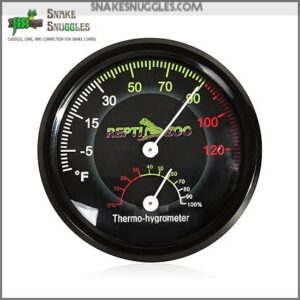
The REPTI ZOO Reptile Terrarium Thermometer Hygrometer Gauge comes in two versions, analog and digital, and both give you dependable readings for multitank monitoring.
The analog unit covers -5 to 120°F and 0 to 100% relative humidity. Its color-coded segments let you confirm safe zones at a glance, and it runs without a battery, so there’s nothing to replace across a rack of tanks. A sticky pad holds it to the enclosure, and the 12-month warranty adds peace of mind.
The digital version reads 14 to 122°F with ±2°F accuracy and ±5% humidity precision. Two LR1130 button cells power it for over twelve months, so battery swaps stay rare. For flexible placement, the digital model also offers 4-sides mounting options with a front screw hole, so you can secure it on any side of the terrarium.
Choose analog if you want an affordable humidity gauge for vivariums that never needs power. Either way, this gauge belongs in reptile enclosure climate control for multitank setups where quick visual checks keep you in command.
| Display Type | Digital |
|---|---|
| Measurements | Temperature and humidity |
| Weight | 1.45 ounces |
| Dimensions | 4.5 x 0.5 x 6 inches |
| Build Material | Plastic |
| Accuracy | Mixed user feedback |
| Additional Features |
|
2. Reptile Thermometer Humidity Gauge
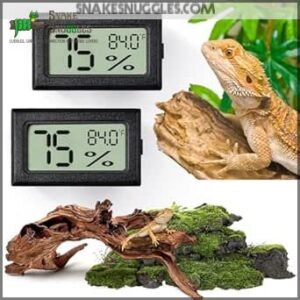
If you’re running a multitank setup, the Vodolo Reptile Thermometer Humidity Gauge gives you a cheap, no-fuss way to keep every enclosure in check. Its high-precision chip holds ±0.9°F accuracy across -4 to 176°F, and the easy-read LED screen shows temperature and humidity at the same time.
A single replaceable battery lasts months, and the cordless design means double-sided adhesive mounting works on glass or plastic, so compatibility with enclosure types is rarely a problem. The package includes 2 thermometers, so probe counts stay simple: one unit per tank, two tanks covered right out of the box. Switch between ℉ and ℃ to match your species’ care sheet.
No humidity accuracy listed, and there’s no data logging or wireless monitoring, so you’ll read each tank by eye. Direct spray throws off readings, so mist away from it.
| Display Type | N/A |
|---|---|
| Measurements | N/A |
| Weight | N/A |
| Dimensions | N/A |
| Build Material | N/A |
| Accuracy | N/A |
3. Paizoo Reptile Thermometer Hygrometer
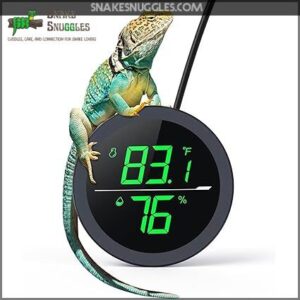
Tired of opening every lid just to check a reading? The Paizoo Reptile Thermometer Humidity Gauge puts the sensor on a 31.5 inch cable, so you can park the display where you can see it while the probe sits at the spot inside the enclosure.
You get dual readouts for temperature and humidity on a backlit LED display, covering 32 to 140°F and 0 to 99% RH. Both refresh every 10 seconds, so a misting or a heat lamp swing shows up fast. Accuracy is ±1°F and ±5% humidity, which is plenty for desert and tropical setups, though you can’t adjust calibration.
Unlike the battery-swap models before it, this one recharges. Expect one to three months per charge, and the included Type-C cable gives you a USB powered option for always-on display. The slim acrylic body mounts with 3M tape, which keeps multitank setups tidy.
| Display Type | N/A |
|---|---|
| Measurements | N/A |
| Weight | N/A |
| Dimensions | N/A |
| Build Material | N/A |
| Accuracy | N/A |
4. Jedew Digital Hygrometer Thermometer
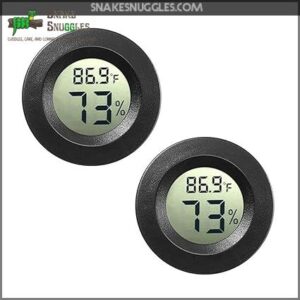
Not every tank needs a cable and a charger. The JEDEW 2 Pack Hygrometer Thermometer Digital gives you two small round gauges for multitank monitoring without the fuss.
Each unit reads 10 to 99% humidity within ±3% and measures temperature within ±1.5°F, updating every 10 seconds through 24 sensor vents. Misting shows up fast, so you can correct before your animal feels it.
A single LR44 battery lasts about 10 months, and two spares ship in the box. At 1.77 inches wide and 0.6 inches high, it tucks into a corner, held by the included adhesive mounting solutions, or it stands free.
Know the limits: there are no data logging capabilities and no mobile alert systems, so you check it by eye. For dependable readings, that’s enough.
5. QZQ Reptile Thermometer Hygrometer
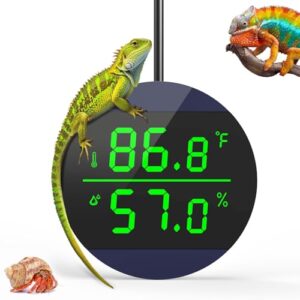
The QZQ Reptile Thermometer Hygrometer swaps batteries for USB power, and that changes how you monitor. Its 59-inch cable keeps readings running around the clock, so you never find a dead display on the one morning you needed it.
You get 32 to 140°F and 5 to 99% RH on a bright blue LED display, with accuracy of ±1.8°F and ±5% RH. That’s solid for a single enclosure, but it won’t replace multizone systems, and it lacks data logging capabilities, wireless monitoring, and mobile alert systems.
Mounting is where it gets tricky. The 2.28-inch unit sticks to glass with double-sided tape, but the probe tubing is stiff and the clips can fail under constant enclosure heat.
- Route the cable before you place the unit.
- Press the tape firmly and let it cure.
- Recheck the probe position every week.
6. Reptile Thermometer And Humidity Gauge
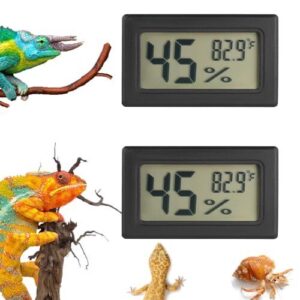
A two-unit pack gives you parallel reptile habitat monitoring without paying twice. Serundo Auto’s HT01 pairs battery-powered LCD modules that read temperature to ±1°F and humidity to ±5 percent, which suits bearded dragons and leopard geckos that don’t demand lab-grade precision.
You’ll cover roughly -4 to 176°F and 10 to 95 percent humidity, and the 10-second response time catches shifts fast, which helps your terrarium temperature regulation and microclimate management for reptiles.
Know the limits. Calibration is factory-locked, the display has no backlight, and batteries are your only power. Spare batteries come included.
| Spec | Detail |
|---|---|
| Display | Digital LCD |
| Mounting | Double-sided tape |
| Housing | ABS plastic |
| Pack size | Two units with spare batteries |
Mount one module per enclosure, check the warm and cool ends, and treat this reptile enclosure climate control setup as an affordable first line of defense.
7. Flukers Digital Thermometer Hygrometer
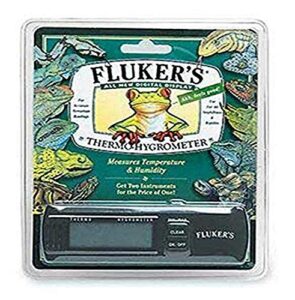
Think of the Flukers Digital Thermometer Hygrometer (Model 34134) as a rookie night-watch guard: alert, but you can’t take its word as gospel.
It shows temperature and humidity on an easy-to-read digital display and suits all life stages of amphibians and reptiles. At 1.45 ounces and 4.5 x 0.5 x 6 inches, it’s easy to deploy across several tanks.
Here’s the catch. Users give mixed accuracy feedback and report limited longevity, and the plastic build won’t help. Verify readings yourself.
| Best For | Amphibian and reptile keepers who want an inexpensive, easy-to-read digital display for monitoring temperature and humidity across one or several enclosures, and who don’t mind double-checking its readings. |
|---|
- Shows temperature and humidity digitally on an easy-to-read display
- Helps establish consistent temperature and humidity levels for a safe, comfortable pet environment
- Lightweight (1.45 ounces) and slim (4.5 x 0.5 x 6 inches), so it’s easy to use in multiple tanks
- Users give mixed feedback on its accuracy
- Reports of limited longevity make its durability uncertain
- The plastic construction may affect long-term use
8. Zoo Med Dual Thermometer Humidity Gauge
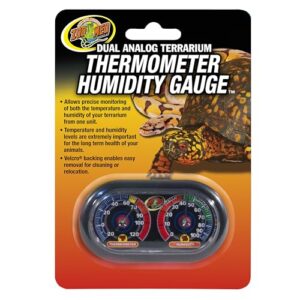
A dead battery can leave you staring at a blank screen while your enclosure drifts out of range. This black Zoo Med gauge (model TH-27) never goes dark, because its analog dials need no power at all.
You get temperature and humidity on one dual analog display, so you can check both with a single glance. The plastic body measures 6 x 1 x 4 inches and weighs just 0.32 ounces, which keeps it compact inside tight enclosures.
Velcro backing lets you pull the unit out during deep cleaning and reposition it in seconds. Don’t trust it blindly, though. The adhesive may loosen over time, so test the grip often.
Verify its readings against a trusted reference, because some owners report inaccurate humidity, and a few saw failure after roughly two months. Budget for replacements, and keep a backup gauge handy.
| Best For | Reptile and amphibian keepers who want one compact, easy-to-move gauge for tracking terrarium temperature and humidity and who don’t mind double-checking its readings. |
|---|
- Tracks both temperature and humidity from a single unit
- Velcro backing lets you remove and reposition it during cleaning
- Compact and lightweight at 6 x 1 x 4 inches and 0.32 ounces
- The adhesive backing may not hold securely over time
- Some users report inaccurate humidity readings
- Some units may fail after about two months of use
9. Repti Zoo Digital Thermometer Hygrometer
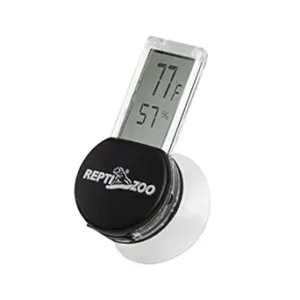
Running five tanks on a shoestring? You need one gauge you can duplicate across every enclosure.
The Repti Zoo digital thermometer hygrometer reads 20% to 99% humidity and 14°F to 122°F, so it covers arid leopard gecko setups and rainforest chameleon enclosures alike. Accuracy sits at ±2°F and ±5% RH, with 0.1°F resolution and a five-second refresh on a digital LCD, so you’ll catch swings fast.
Suction cups give you two mounting modes, front glass or side glass. The package includes two LR1130 batteries, good for over a year of use, so you won’t be swapping cells every few months.
Some keepers find the display hard to read, the suction cup can lose its grip on tank sides, and battery life reports are mixed. Press it firmly onto clean, dry glass and verify readings against a trusted reference.
| Best For | Budget-minded reptile keepers running several tanks who want one affordable gauge that works in both dry setups and humid enclosures. |
|---|
- Wide range of 20% to 99% humidity and 14°F to 122°F, suited to both arid and rainforest setups
- Two mounting modes with dual suction cups, for front or side glass
- Comes with two batteries that are meant to last over a year, plus a 12-month quality assurance
- Some users find the display hard to read
- The suction cup can lose its grip on tank sides
- Battery life reports are mixed
10. ThermoPro Digital Hygrometer Thermometer
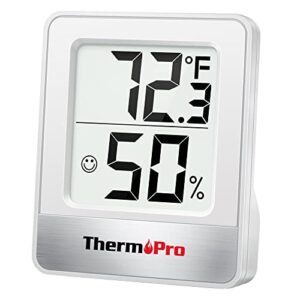
Can you trust a gauge you never have to second-guess? With the ThermoPro Digital Hygrometer Thermometer, you get close. It reads temperature within ±1°F between 32 and 140°F and humidity within ±2% from 30 to 80% RH, so your readings stay reliable across every tank on the rack.
Updates arrive every 10 seconds, and the large LCD stays readable from across the room. A Dry, Comfort, Wet face icon gives you a quick verdict before you read a number.
Mount it on the magnetic back, a tabletop stand, or the hanging slot. One AAA battery is included, and some keepers report years before a swap.
Know the limit, though. There’s no data logging and remote access, no appconnected monitoring, no cloud data storage, and no CSV export for analysis. Each unit is a standalone gauge, so you check every tank by eye.
Choosing Standalone Gauges or Wireless Systems for Multiple Tanks
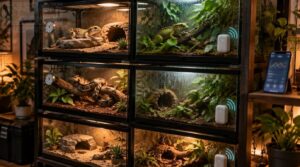
Your rack size decides this call. Standalone gauges cost less per unit, so they suit three or four tanks. Past that, cable clutter and manual checks become your weak point.
Ask yourself these five questions:
- Do you run more than four enclosures? Wireless wins on multitank monitoring.
- Is your rack stacked? Check wireless signal range through glass and wood.
- Want alerts on your phone? Choose appconnected monitoring.
- Keep several species? Pick multizone terrarium sensing.
- Need logs for winter and summer swings? Seasonal variation accommodation needs data history.
Standalone gauges can’t log or alert, so you’ll catch problems only when you look. Wireless systems cost more upfront, but they catch drifts early. If budget is tight, start standalone, then upgrade later.
Key Features to Compare in Multi-Tank Reptile Humidity Gauges

One bad reading can cost you a shed, a clutch, or a healthy animal, so you can’t treat gauges as an afterthought.
Before you buy, compare six key features, because each one decides whether your setup stays tight across every tank. Check them in order below, and you’ll know exactly what to demand from any gauge on your shortlist.
Accuracy and Calibration
decide whether your numbers mean anything. A ±3% RH rating is an error bound, not a promise, so two gauges can disagree and both pass. Sensor precision doesn’t prove correctness either.
Run the 75% salt test method: seal gauges for 8 to 12 hours, log each offset. Recheck calibration every 3-6 months. Data synchronization won’t verify accuracy.
Temperature and Humidity Ranges
Calibrated gauges still fail if the range is wrong. Many compact units cover only 20–99% RH, so arid readings can fall outside what they display. Check each unit’s humidity range and temperature measurement limits before buying.
- Match species specific humidity needs to the gauge’s span.
- Plan your number of probes: one per zone, at least two.
- Catch microclimates, not averages.
Display and Visibility
Once your range is right, you still have to read it. Display readability decides whether you catch a drop at 6 a.m. or miss it. Pick large LCD digits, around.75" tall.
Backlit display benefits matter in dim reptile rooms. Clear LEDs for day or night viewing, with high-contrast LED readability and color-coded sections for quick assessment, flag trouble fast.
Power Sources
A dead battery turns your gauge into a liar, so know what powers each unit. A CR2032 coin cell suits compact digital models, while AAA battery performance holds up better in backlit displays. Cold enclosures drain cells faster.
For battery life optimization, skip the backlight. USBpowered operation gives continuous readings, but you’ll need an outlet within reach.
Mounting and Installation
Match your mounting method to your enclosure material, because Mounting and Installation protects your readings. Suction cup installation suits glass and acrylic, but clean the surface with isopropyl alcohol first. Magnetic mounting options work through thin glass, so test the pull first.
For adhesive mounting for glass enclosures, wait 24 hours before moisture. PVC enclosure mounting needs adhesive, never magnets.
Multi-Tank Monitoring Options
Think of one gateway as a watchtower: it sees every enclosure at once.
Pick your setup by scale:
- Reptile Guardian: five sensors, multizone monitoring.
- Slither Sense: 200 sensors per gateway.
- MOCREO: Wi-Fi alerts, no hub.
Demand multitank simultaneous monitoring, dualunit measurement, and 10s updates, then secure each probe with sticky pad mounting. Control starts with seeing everything.
Installing and Positioning Humidity Gauges in Snake Enclosures
Picture a probe buried under damp aspen, reporting a fantasy of 90% while your ball python breathes dry air an inch above. That’s how bad data starts.
A probe buried in damp substrate can report a fantasy of 90% humidity while your snake breathes dry air just above
Installing and Positioning Humidity Gauges in Snake Enclosures starts with where your snake actually lives. Set the sensor at activity height: substrate level for terrestrial species, mid-enclosure for arboreal ones. Mount it in the lower third of the wall, beside a hide, never up top where heat drags readings low.
In multitank habitats, mounting and placement should be repeatable. Use suction cups, clips, or Velcro so you can remove the unit for cleaning, and zip ties or hot glue for climbing setups.
Avoid substrate contact issues. Sensor obstruction prevention means keeping decor clear.
Calibrating Gauges and Troubleshooting Multi-Tank Humidity Readings
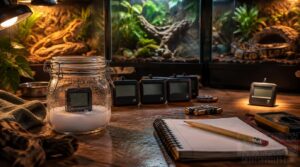
Would you trust a single witness who changes their story every hour? That’s your uncalibrated humidity gauge.
Start with a salt test. Seal each unit above a saturated sodium chloride slurry for 8 to 24 hours, note its deviation from 75%. Apply that offset later. Plan on calibration every 36 months, since aging sensors drift.
When troubleshooting inconsistent readings, work in this order:
- Swap batteries and check sensor contacts first.
- Compare timestamps, since wireless delays mimic disagreement.
- Co-locate suspect units in one sealed space for hours.
A shift in one tank points to a local change or fault. Shifts everywhere mean the room. Aim for synchronized accuracy, within 3 points across all sensors, and flag any erratic humidity gauge.
Frequently Asked Questions (FAQs)
What is the best humidity gauge for a reptile tank?
Your best humidity gauge is a digital hygrometer accurate within ±3-5% and verified with a salt test. Mount it inside each reptile enclosure, and choose wireless sensors for multitank monitoring and reliable terrarium environmental monitoring.
What is the most accurate hygrometer for reptiles?
Your ball python’s tank reads 60% while the next one reads 72%? That’s sensor calibration spread, and it wrecks reptile enclosure management.
Choose Sensirion-based digital units: ±2% RH hygrometer accuracy, relative humidity monitoring, temperature measurement.
What is the best humidity gauge for gecko tanks?
Choose a humidity gauge with a 10 to 99 RH range, so your Leopard Gecko’s tank never surprises you. Pick a compact size that fits beside dual vents, and verify accuracy with a salt test.
Which humidity meter is the most accurate?
Picture a gauge baking beside heat lamps.
Your most accurate pick is a digital hygrometer with an external probe, holding ±3%. Weigh accuracy and response time, display readability, mounting options, power source, terrarium temperature regulation.
How often should I calibrate my humidity gauges?
Run a salt calibration before first use, then monthly. Factory tolerance drift creeps in, so retest after drops, battery swaps, or odd readings.
Log each device calibration, run quarterly battery checks, and catch calibration errors.
Can I use one gauge for different species?
A desert gecko at 35% humidity thrives; a tropical frog needs 80%. You can share one gauge, but species humidity mismatch hides swings while it’s elsewhere.
Dedicated sensors give you multitank monitoring and environmental control.
What causes sudden humidity spikes in tanks?
Why does your hygrometer suddenly jump to 95%? Misting, water bowls, and soaked substrate dump vapor, while temperature swings release more.
Poor water source avoidance makes sensors record a local spike, not true tank humidity.
Are wireless gauges more accurate than wired ones?
A radio link is a messenger; it can’t sharpen the probe’s readings.
In accuracy comparison, wireless gauges and wired gauges rely on sensor quality and calibration. Multisensor support and data logging add convenience, not precision.
Do humidity gauges work in screen-top enclosures?
Gauges work in screen-top enclosures, but mesh bleeds moisture. Cover half the screen with acrylic or foil tape.
Follow placement tips: mount sensors at mid-tank height. For humidity monitoring, choose multisensor support and battery life.
How often should reptile tank humidity be checked?
A ball python’s humidity can swing 20% in a day. Check twice daily, morning and evening, for enclosure management.
For multitank monitoring, give each tank a sensor. Humidity monitoring protects respiratory health and shedding support.
Conclusion
Think buying ten identical gauges means ten identical readings? It doesn’t. Even matching units drift apart, so test each one in a sealed bag with salt before it touches a tank.
Once you’ve chosen reptile humidity gauges for multiple tanks, recalibrate every three months and log the numbers. Trust the data you’ve verified, not the display you’ve inherited. Your snakes can’t tell you a gauge is lying, but a steady, honest reading speaks for them.