This site is supported by our readers. We may earn a commission, at no cost to you, if you purchase through links.

You pinch a black speck off your ball python’s chin, and it pops between your fingers. That’s a snake mite, and where there’s one, hundreds more are hiding in the belly folds, vent, and eye scales.
Sprays and baths can stress your snake and miss eggs in the substrate. Predatory mites for snake mites work differently. These tiny hunters live in the enclosure, eat the pests at every life stage, and leave your snake unharmed.
You can order them online and release them within days. First, make sure you’re dealing with mites and not shed skin or dust.
Table Of Contents
Key Takeaways
- Confirm you’re dealing with mites first: look for tiny black or dark red specks that crawl and pop when pinched, especially around the chin, belly, vent, and eyes.
- Pick the predator that fits your setup, since Cheyletus eruditus (Taurrus) hunts on your snake and in the enclosure, while Stratiolaelaps scimitus works only in the top inch of substrate and targets eggs and young mites.
- Clean the enclosure and wait at least two weeks before releasing predatory mites, because any insecticide, disinfectant, or diatomaceous earth residue will kill them on contact.
- Call a vet right away if your snake is a hatchling, gravid, weak, anemic, or struggling to breathe, and otherwise keep checking for four to six weeks, topping up the mites every two to four weeks if snake mites persist.
How to Spot Snake Mites
How do you know it’s mites and not dust? Look for tiny black or dark red specks, about the size of a pinhead. Pick one up. A live mite crawls across your fingers, and a pinch makes it audibly pop. Debris and shed skin won’t do either.
Once you’ve confirmed they’re mites, understanding what causes snake mite infestations can help you trace how they got in.
Dust sits still, but a real mite moves, scurrying over your skin and bursting with a tiny snap when squeezed
Check the chin crease, belly, vent folds and the scales around the eyes. Sunken eyes are an early warning. On dark snakes, white specks like dandruff are mite waste. Excessive soaking and messy shedding are also red flags. Another simple check is pressing tape onto suspected hot spots and sticking it to white paper, where moving black bugs confirm an infestation.
Which Predatory Mites Eat Snake Mites?
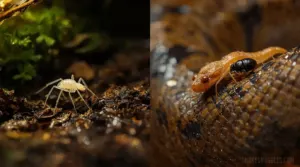
Two predatory mites are commonly used against snake mites, and they work in different parts of your enclosure. Knowing where each one hunts helps you pick the right option for your setup. Here’s how the two main species compare.
Cheyletus Eruditus (Taurrus)
The predator behind Taurrus is Cheyletus eruditus, a tiny mite that hunts snake mites on your snake and in its enclosure. Adults measure under 1 mm and look orange to brown. Don’t worry about size. They attack and kill prey three to four times bigger than themselves.
Taurrus arrives as live predatory mites mixed with sawdust. They work best at 20°C to 30°C and 70 to 90% humidity, which suits most setups. Fed mites turn dark red quickly. In trials on ball pythons, snake mite survival dropped to 6% in treated enclosures.
Stratiolaelaps Scimitus (Entomite-M)
Stratiolaelaps scimitus works differently. It hunts the top inch of substrate, so it targets eggs and young mites that drop off your snake. Sold as Entomite-M, it’s among the most common biological control agents for snake mite problems.
Pairing these predatory mites with a few natural ways to remove snake mites gives you a chemical-free plan that protects your snake while the colony builds.
Know these four things first:
- Adult females eat up to 4.5 prey a day.
- Keep substrate moist, never soggy, between 59°F and 86°F.
- Use the mites within 18 hours of delivery.
- They don’t climb walls or feed on your snake.
Treat them as a substrate fix, not a snake treatment.
When Snake Mites Need Veterinary Care
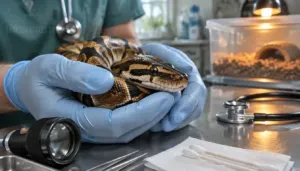
Predatory mites won’t fix everything. Some snakes need a vet first, and treating at home can make things worse.
Choosing a dust-free substrate from these best substrates for milk snakes also helps keep the enclosure clean while you deal with mites.
| Situation | What you may see | What to do |
|---|---|---|
| Hatchlings, gravid, or unwell snakes | Weakness, weight loss | Same-day vet visit |
| Anemia | Pale gums, lethargy | Get supportive care first |
| Breathing trouble | Open-mouth breathing | Go immediately |
| Skin infection | Raised, weeping lesions | Needs topical therapy |
| Garter or hognose snakes | Any heavy infestation | Skip chemical treatments |
Isolate new arrivals right away.
Where to Buy Live Predatory Mites
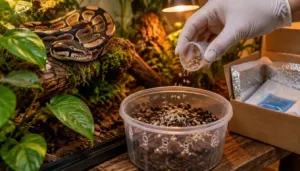
Where you live decides which species you can order.
In the US, Stratiolaelaps scimitus is easy to find. NaturesGoodGuys sells 12,500 mites on Amazon and markets them for snake mites, while Sound Horticulture ships 15,000 to 20,000 per quart. Evergreen Growers Supply is cheaper, around $16.
In the UK, look for Cheyletus eruditus under the name Taurrus. Reptiles By Post and Charterhouse Aquatics list a Medium pack at £30.99, and Dragonfli starts at £22.99.
Choose sellers that guarantee live delivery.
How to Apply Predatory Mites Safely
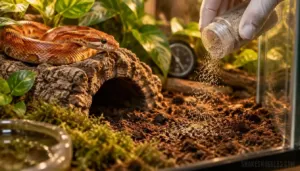
Clean the enclosure first, then wait at least two weeks before you release anything. Insecticide, disinfectant, or diatomaceous earth residue will kill predatory mites on contact.
For Stratiolaelaps, scatter 1,000 to 2,000 mites over a 40-gallon enclosure’s substrate, favoring corners, hides, and damp spots. Keep humidity near 50 to 70%. Release Taurrus the day it arrives, and wear gloves if you’re allergic to shellfish or dust mites.
- Your snake stays calm in its own space.
- You stop scrubbing at 2 a.m.
- Your home feels safe again.
How Soon to Check for Remaining Mites
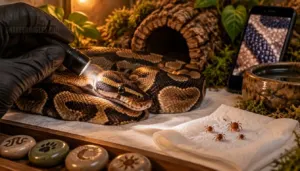
Seeing nothing after a week doesn’t mean you’re done. Eggs hatch fast, so new adults can appear within two to three weeks.
Check on this schedule:
- Inspect the snake and enclosure daily on white paper or tissue.
- Do a flashlight check weekly and photograph the skin.
- Add predatory mites every 2 to 4 weeks if snake mites persist.
- Call a vet if mites stay on the snake.
- Count 30 days without any mites or feces.
Expect four to six weeks.
Frequently Asked Questions (FAQs)
Can I use predatory mites with a bioactive enclosure?
Funny how the bugs you want in your tank can save it from the bugs you don’t. Yes, you can. Stratiolaelaps scimitus stays in the soil, so it won’t climb your snake, and it only thins your cleanup crew.
Will predatory mites survive if there are no snake mites?
Don’t worry that they’ll linger forever. Taurrus mites die almost immediately once snake mites are gone, since they have no other food source.
Scimitus mites last three to four weeks by scavenging algae and debris.
Do predatory mites bite or bother humans?
Think of them as tiny bouncers with no interest in you. Their mouthparts are built to pierce arthropod exoskeletons, not human skin, so they can’t bite. If you feel itching, blame snake mites or allergens.
Conclusion
Two weeks after Dana released Stratiolaelaps scimitus into her corn snake’s enclosure, her nightly checks turned up nothing but clean scales. No chemicals, no stressful soaks.
That’s the appeal of predatory mites for snake mites: they work where you can’t reach. Confirm the pest first, keep the enclosure slightly humid, and recheck weekly. If your snake looks sick, call a vet.
Your snake’s enclosure can defend itself. You just need to add the right crew.
- https://www.theveterinarynurse.com/content/clinical/ectoparasites-in-captive-reptiles
- https://soundhorticulture.com/blogs/news/biological-control-for-snake-mites
- https://www.researchgate.net/publication/257029016_Cheyletus_Eruditus_TaurrusR_An_effective_candidate_for_the_biological_control_of_the_snake_mite_Ophionyssus_Natricis