This site is supported by our readers. We may earn a commission, at no cost to you, if you purchase through links.
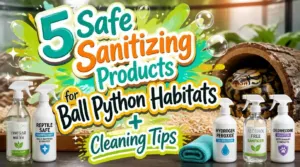
That "fresh lemon" scent on your cleaner? It can poison your ball python. Citrus extracts, quats, ammonia, and phenols all rank as toxic to reptiles, and your snake breathes and soaks in that enclosure around the clock.
Cleaning a tank feels like a simple chore, but the wrong spray leaves residue on glass, wood, and hides that your python absorbs for days. The right one wipes out bacteria, viruses, and fungi without a single harmful trace.
Here are safe sanitizing products for ball python habitats, plus household swaps and the deep-cleaning steps that make them work. Your snake deserves a spotless home!
Table Of Contents
- Key Takeaways
- Choosing Safe Sanitizers for Ball Python Habitats
- 5 Ball Python Habitat Cleaners and Disinfectants
- Household Cleaner Alternatives and Ingredients to Avoid
- Safe Disinfectant Application During Habitat Deep Cleaning
- Sanitizing Substrates, Hides, and Porous Décor
- Ball Python Habitat Cleaning and Disinfection Frequency
- Frequently Asked Questions (FAQs)
- Conclusion
Key Takeaways
- Skip citrus, quats, ammonia, phenols, pine oil, and heavily scented cleaners, because your snake breathes and absorbs whatever residue is left in its enclosure.
- Choose a reptile-safe disinfectant like F10SC or chlorhexidine for real germ-killing, and use enzyme cleaners or wipes for everyday messes, since they clean but don’t disinfect.
- Always scrub away debris and soap first, follow the label’s dilution and contact time, then rinse thoroughly and air dry fully before your snake goes back in.
- Spot clean daily, deep clean monthly, and bake porous hides and bark at 200°F (93°C) for an hour rather than soaking them in liquids.
Choosing Safe Sanitizers for Ball Python Habitats
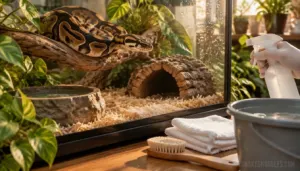
You want your ball python’s home spotless, but the wrong spray can do more harm than a little dirt. Reptiles breathe and absorb things differently than we do, so what smells fresh to you can irritate your snake’s lungs and skin.
A simple routine helps too, and this ball python enclosure cleaning schedule shows when to spot clean and when to fully disinfect.
Start with a reptile-appropriate disinfectant. Look for products labeled for reptile use, with no phenols, formaldehyde, ammonia, or heavy fragrance. Veterinary-grade options like F10SC are popular because they’re safe and effective when used at the right strength.
Here’s the catch: disinfectants only work on clean surfaces. Soap residue and debris can neutralize them, so scrub and rinse well first. Reptile veterinarians stress that physically cleaning before disinfecting is essential, since leftover organic debris reduces how well germ-killing agents work. Then follow the proper dilution and contact time every single time. Your ball python tank will thank you for it!
5 Ball Python Habitat Cleaners and Disinfectants
Ready to find the right cleaner for your ball python’s home? Below are five reptile-safe options that cover everything from daily spot cleaning to full deep cleans. Let’s see which one fits your routine!
1. F10 Veterinary Disinfectant Spray 1L
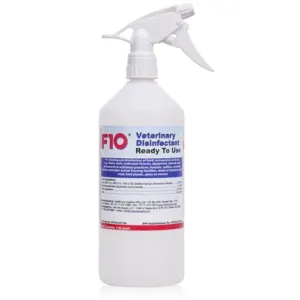
The F10 spray is a smart pick when you want zero guesswork. It’s pre-diluted, so you skip the measuring and mixing entirely.
This EPA registered formula fights bacteria, viruses, fungi, and spores, and it’s unscented and biodegradable. It’s also non-rinsing, so it keeps working after it air dries. The 1-liter bottle suits terrariums, cages, and water bowls.
Pro tip: stick to compatible hard surfaces and follow the label. At $25.99, some folks find it pricey, but the convenience is real.
| Best For | Veterinary clinics, animal shelters, breeders, zoos, and pet owners who need a ready-to-use disinfectant for cages, kennels, terrariums, bird habitats, and water bowls. |
|---|---|
| Product Type | Spray disinfectant |
| Price | $25.99 |
| Dimensions | 9.17 x 4.8 x 4.61 in |
| Weight | N/A |
| Rinse Required | No, non-rinsing |
| Target Animals | Exotics, birds, reptiles |
| Additional Features |
|
- Comes pre-diluted, so there is no measuring or mixing before you spray.
- EPA registered to work against bacteria, viruses, fungi, and spores.
- Non-rinsing and unscented, and it keeps working on surfaces after air drying.
- Priced at $25.99, which some customers find high for the value.
- Works only on compatible hard surfaces listed on the product label.
- Needs careful use of the label directions to get effective surface protection.
2. Absolutely Clean Reptile Terrarium Enzyme Cleaner
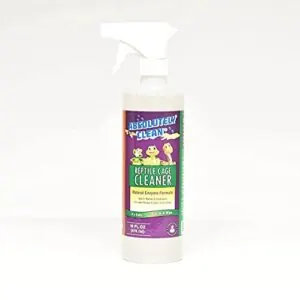
If you’d rather clean with enzymes than chemical fumes, this one’s worth a look. It uses natural enzymes to break down odors and tough messes on contact, and it’s made in the USA by a Colorado-based family company.
For more family-friendly picks that skip the fumes, see this roundup of reptile cleaning sprays for families with kids.
It works on metal, wood, glass, vinyl, and plastic, and it’s safe around pets with a delicate sense of smell. Plus, it leaves no greasy or filmy residue.
Pro tip: let it sit 3-5 minutes before scrubbing. Then rinse with hot water until the sudsing stops, and dry everything fully. It’s $16.99.
| Best For | Reptile, amphibian, small mammal, and fish keepers who want an enzyme-based cleaner that tackles odors and tough messes without harsh chemicals or fumes. |
|---|---|
| Product Type | Enzyme cleaner |
| Price | $16.99 |
| Dimensions | 9.8 x 7.83 x 3.46 in |
| Weight | 1.15 |
| Rinse Required | Yes, rinse with hot water |
| Target Animals | Reptiles, amphibians, small mammals, fish |
| Additional Features |
|
- Uses natural enzymes to break down odors and tough messes on contact.
- Leaves no greasy, sticky, or filmy residue after application and rinsing.
- Works on metal, wood, glass, vinyl, and plastic, and is safe around pets with a delicate sense of smell.
- Needs a 3-5 minute dwell time before you can scrub with a brush or cloth.
- Must be rinsed completely with hot water until the sudsing stops.
- The habitat has to be fully dried before the animal goes back in, which adds time to cleaning.
3. CAROLINACUSTOMCAGES Chlorhexidine Reptile Spray Kit
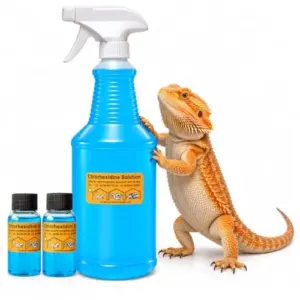
Prefer a classic disinfectant? This kit has you covered. It comes with a 32 oz sprayer bottle and 2% chlorhexidine concentrate refills, so you can mix a fresh batch whenever you need one.
Fill the bottle with distilled or tap water up to the marked levels, then add the concentrate. Spray surfaces directly or wipe them down, whichever suits your setup.
Pro tip: use the diluted solution for soaking cage accessories, and keep a brush handy. It isn’t included!
| Best For | Reptile owners who want a dependable, ready-to-mix disinfectant for routinely cleaning cages and accessories. |
|---|---|
| Product Type | Chlorhexidine disinfectant |
| Price | N/A |
| Dimensions | 11.61 x 4.49 x 3.78 in |
| Weight | 9.14 oz |
| Rinse Required | N/A |
| Target Animals | Reptiles |
| Additional Features |
|
- Comes with a 32 oz sprayer bottle and 2% chlorhexidine concentrate refills, so you can mix fresh batches as needed
- Works as a direct spray or a wipe-down, so it fits different cleaning setups
- The diluted solution can be used for soaking cage accessories to loosen buildup
- The concentrate has to be mixed with water by hand before each use
- Made specifically for reptile habitat care, so it isn’t a general-purpose cleaner
- No brush or other cleaning tools are included
4. 2 Pack 200 Count Reptile Tank Wipes
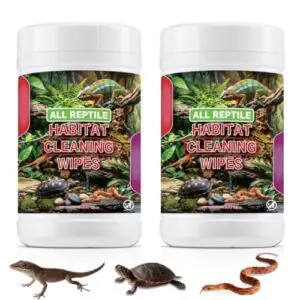
A neutral pH formula makes these wipes a gentle pick for ball python tanks, where skin and respiratory safety matter most. You get two sealed cans with 200 white wipes total, each can about 4.4 x 6 inches, so one can fits nicely on a shelf.
The thickened, lint-free fabric soaks up feces, food residue, and water stains from glass or acrylic. It cleans physically, so there’s no rinsing and no residue.
Pro tip: wipe hides and decorations daily. Just note the label lists no specific chemical ingredients, so it’s not a disinfectant!
| Best For | Reptile keepers who want a quick, no-rinse way to wipe up daily messes in glass or acrylic tanks housing snakes, lizards, geckos, or tortoises. |
|---|---|
| Product Type | Cleaning wipes |
| Price | N/A |
| Dimensions | 4.4 x 6 in per can |
| Weight | N/A |
| Rinse Required | No, no rinsing needed |
| Target Animals | Snakes, lizards, geckos, tortoises |
| Additional Features |
|
- Neutral pH formula is designed with reptile skin and respiratory safety in mind
- Thick, lint-free, high-absorbency fabric removes feces, food residue, and water stains without leaving residue
- Two cans with 200 wipes total give you plenty for daily cleaning of tanks, substrates, decorations, and shelters
- No specific chemical ingredients are listed, so it should not be treated as a disinfectant
- Each can is only about 4.4 x 6 inches, and measurements may be slightly off
- Color shown online may look a bit different in person because of screen settings
5. Mysora Reptile Tank Cleaner Kit
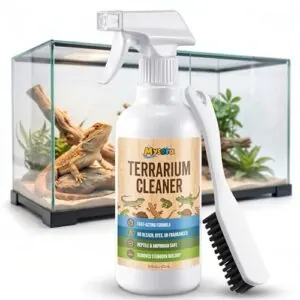
Enzymes do the heavy lifting in this 16 oz cleaner, loosening stuck waste and residue so you’re not scrubbing for ages. It’s made without bleach, artificial fragrances, dyes, or harsh fumes, which is a relief in a snake’s enclosed space.
The included 8-inch brush reaches corners, edges, and glass with ease. Use it on plastic and substrate too, and say goodbye to odor buildup rather than masking it.
Pro tip: skip the water. Diluting it weakens the cleaning power, so use it as is. Let everything air-dry fully before your snake goes home. Keep kids and pets away while you work!
| Best For | Reptile owners with bearded dragons, snakes, geckos, or turtles who want a fume-free, enzyme-based cleaner for scrubbing terrarium glass, plastic, and substrate. |
|---|---|
| Product Type | Enzyme cleaner |
| Price | N/A |
| Dimensions | 7.87 x 3.94 x 3.94 in |
| Weight | 1.41 lb |
| Rinse Required | N/A |
| Target Animals | Bearded dragons, snakes, geckos, turtles |
| Additional Features |
|
- Enzymes loosen stuck waste and residue, so there is less scrubbing
- Made without bleach, artificial fragrances, dyes, or harsh fumes
- Includes an 8-inch brush that reaches corners, edges, and glass
- Cannot be diluted with water, or it loses cleaning power
- The habitat must be fully air-dried before pets go back in
- Must be kept away from children and pets while in use
Household Cleaner Alternatives and Ingredients to Avoid
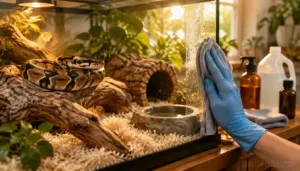
Imagine this: you’re out of reptile spray, so you grab the pine-scented cleaner under the sink. Stop right there! Pine oil lingers on surfaces, and your snake can absorb it through its belly.
Try this simple trio instead:
- Unscented Dawn dish soap lifts grease and waste, then rinses clean.
- White vinegar, mixed 1:1 with water, clears mineral spots, but it won’t kill harmful pathogens.
- 3% hydrogen peroxide disinfects without rinsing and evaporates completely.
Skip anything with phenols, ammonia, citrus extracts, or quats. Glass cleaners often hide ammonia. Never mix unscented household bleach with vinegar or ammonia, because toxic gas follows.
Pro tip: if you can still smell it, your snake can too. Choose non-toxic basics, and diluted bleach only when needed!
Safe Disinfectant Application During Habitat Deep Cleaning
A deep clean only works when you follow the right steps in the right order, and that’s what we’re covering next! Below, you’ll find three steps that take you from moving your snake to a spotless, safe enclosure. Follow them closely and you’ll keep your ball python healthy while you disinfect with confidence.
Relocating Your Snake and Removing Debris
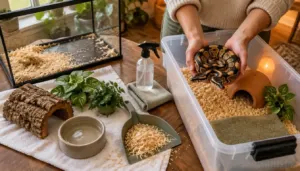
Start with clean, dry hands, then check that your snake hasn’t eaten in the last 24 to 28 hours. Skip handling if its eyes look blue or cloudy. Support its body with two hands, then settle it into a latched tub with a hide, somewhere quiet and warm.
Next, remove all loose substrate, feces, urates, uneaten food and shed skin. Pull out hides, bowls and décor too.
Following Label Dilutions and Contact Times
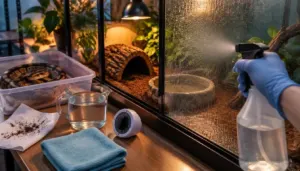
Ever wondered why your disinfectant didn’t seem to work? Usually it’s the math, not the bottle!
Always measure your proper dilution from the label. F10SC needs 20 minutes at 1:125 for tough viruses. Keep surfaces visibly wet the whole contact time, and reapply if they dry early. Clean off waste first, since organic matter weakens most products. Mix fresh, too!
Rinsing, Drying, and Restoring Safe Conditions
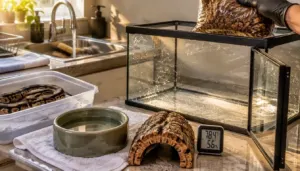
Here’s the step that protects your snake most: don’t rush it! Rinse thoroughly with clean water until no soap or chemical residue remains, since leftovers can irritate your ball python’s lungs.
Patience is your snake’s best protection, so rinse every trace of cleaner away before its lungs ever meet it
Then air dry everything completely. Sniff for any bleach smell, and wait until it’s gone. Finally, add substrate, check your temperature and humidity, and watch for mold over the next two days.
Sanitizing Substrates, Hides, and Porous Décor

Once the main enclosure is clean, it’s time to tackle the stuff that soaks things up. Porous materials like cork bark and wood hold onto whatever touches them, so liquid sanitizers and soap are off the table. Trapped fumes and residue can leach back out and bother your snake.
Heat is your friend here! Bake hides and bark in a home oven at 200°F (93°C) for one hour, then let them cool completely. High-pressure steam works too.
Scrub deep crevices first with a stiff nylon brush, since mites and mold love those ridges. Rinsing under the tap won’t cut it.
Pro tip: if a crevice-heavy piece can’t get clean and mites showed up, toss it. Swap in fresh substrate, too.
Ball Python Habitat Cleaning and Disinfection Frequency
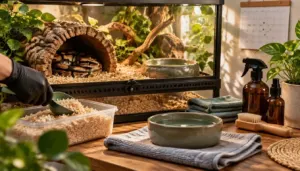
Now that your hides and décor are sparkling, let’s talk about how often you’ll repeat all this. Good news: it’s less than you’d think!
Spot clean daily. Scoop out feces, urates, and soiled substrate right away, and peek at your snake while you’re there. Swap the water every day, and disinfect the bowl weekly. Ball pythons love pooping in it, so refill sooner when needed.
Plan a full deep clean every month. Pull everything out, disinfect, and rinse thoroughly. Replace paper substrate weekly and loose substrate every one to three months.
Pro tip: never go longer than 90 days between complete teardowns. Bioactive setups need less overhaul, mostly upkeep. Consistency keeps your ball python tank healthy! Set calendar reminders, too.
Frequently Asked Questions (FAQs)
What should I do if my snake touches disinfectant?
Mild chemical burns usually heal within a month! Remove the ball python and rinse thoroughly with cool water for 15 to 20 minutes. Skip creams. Tell your vet the contact time; reptile toxicology matters most.
How do I safely disinfect a snakes water bowl?
A 10% bleach solution stays effective for only 24 hours, so mix fresh. Scrub your water bowl with dish soap, apply a reptile-appropriate disinfectant for 10 minutes, then rinse until no odor remains. Air dry.
Are UV lamps effective for sanitizing ball python enclosures?
Think UV lamps sound like an easy shortcut? Not quite! They only sanitize what they directly hit, miss shadowed spots, and can harm your snake’s eyes and skin. Use them only as a cleaning supplement.
How should cleaning supplies be stored around reptiles?
Picture a heat lamp glowing over a shelf of spray bottles, slowly cooking them. Store supplies in a cool, dark, ventilated spot away from enclosures, in sealed original containers. Mix dilutions fresh, and never leave open sprays near your snake!
Conclusion
Picture Mia grabbing a lemon-scented spray for a quick Saturday wipe-down, then watching her ball python rub against the glass all evening. One small swap would have changed everything. Choosing safe sanitizing products for ball python habitats takes a few extra minutes, and it protects your snake’s lungs and skin.
Stick to veterinary-grade disinfectants, follow the contact times, rinse well, and let everything dry. Do that, and your python gets a truly clean, calm home!