This site is supported by our readers. We may earn a commission, at no cost to you, if you purchase through links.
Your snake presses its nose against the glass at 9 p.m., holds it there, and stays put for the better part of an hour. It looks almost thoughtful, as though it’s waiting for the wall to give way.
Occasionally, that’s harmless curiosity. More often, snake head pressing against glass signals a gradient that’s too flat, a view that’s too exposed, or a tank that’s too tight to move through. A snake that fills most of its waking hours with the habit is telling you something about its enclosure, and the fixes tend to be cheaper and quicker than you’d expect.
First, learn to tell exploration from stress.
Table Of Contents
Key Takeaways
- A quick nose tap along the glass is normal exploration, but if your snake keeps pressing the same spot for hours without settling, it’s a stress response worth taking seriously.
- Most glass pressing traces back to the enclosure, so check for a thermal gradient of at least 10°F, species-appropriate humidity, and a tank with enough floor space rather than height.
- You can usually calm your snake by covering the glass sides, adding tight-fitting hides and floor clutter, and keeping foot traffic and vibration low.
- If the pressing continues after you’ve corrected the setup, or comes with snout injuries, tremors, stargazing, regurgitation, or refusing food, you’ll want a reptile vet to rule out pain, parasites, infection, or neurological disease.
Normal Exploration Versus Abnormal Head Pressing
Brief nose taps along the glass are part of a snake’s normal exploration instinct, and you’ll see them most often during feeding time, right after a rehousing, or when a shed is approaching. A snake that noses a corner, tastes the air, and then settles under a hide is simply gathering information.
That constant tongue-flicking is how snakes "taste" the air, and this guide on how snakes sense taste and smell explains why chemical cues guide so much of their exploring.
The picture changes when the pressing becomes repetitive and fixed. If your snake returns to the same corner or glass seam again and again without ever settling, you’re likely looking at stereotypic behavior. In Bredl’s pythons, it’s a coping response to confinement once it fills most of the hours the animal is awake and active.
Duration matters most. Short bouts after husbandry changes should fade within one to two weeks, and anything lasting longer is among the key snake stress indicators worth taking seriously. If the pressing continues even after you correct the enclosure, underlying medical issues such as pain, parasites, or infection may be involved and call for a veterinary exam.
Common Causes of Snake Glass Pressing
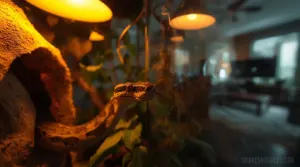
When your snake presses its nose against the glass, it’s almost always responding to something in its surroundings rather than acting out. Three causes account for most cases, and each one points to a different fix. Work through them in order, and you’ll likely spot the one that applies to your setup.
Unfamiliar Enclosures and External Stimuli
Newcomers to a glass enclosure often spend their first days probing every pane, and that’s usually a reaction to external stimuli rather than curiosity.
Tapping, waving, or hovering close reads as a threat, and a snake that’s unfamiliar with their glass enclosure can’t grasp the invisible barrier.
Keep foot traffic low, stay back, and your snake will settle.
Incorrect Temperatures and Humidity
If the enclosure is new and your snake still presses the glass, check the climate next. A gradient under 10°F between the warm and cool sides leaves nowhere to settle, so your snake paces and surfs the panes searching for a viable spot.
Measure at floor level, where your snake actually lives, with an infrared temperature gun. Match humidity to the species too: ball pythons need 60 to 80%, corn snakes 40 to 60%.
Limited Space and Inadequate Cover
If temperatures and humidity check out, look at the space itself. Snakes use floor area far more than height, so a tall, narrow tank leaves little room to roam, and your snake ends up pacing the perimeter.
A ball python enclosure size calculator can help you match floor dimensions to your snake’s length, so the footprint fits without going overboard.
- Choose a longer enclosure with more floor area.
- Place a hide directly in front of the pressed pane.
- Add a second hide.
- Cover that glass side.
- Scatter branches and clutter.
Enclosure Changes That Reduce Glass Pressing
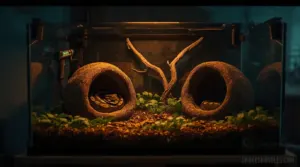
A few targeted changes usually calm a snake faster than any single piece of equipment, because most pressing comes from stress you can adjust. Start by reducing glass surfing through visual barriers: cover three sides and the back with construction paper, and add dense floor clutter so your snake can move without feeling exposed.
| Change | Why it helps |
|---|---|
| Opaque side panels | Cuts reflections of rivals |
| Tight-fitting hides | Coils touch walls and roof |
| Surface temperature checks | Confirms a real gradient |
| Stable, quiet stand | Removes vibration and traffic |
Good temperature regulation lets your snake choose security without sacrificing warmth. If inadequate enclosure size is part of the problem, branches and cork bark add environmental enrichment. Place a tight-fitting hide at each end.
3 Enclosure Accessories for Glass-Pressing Snakes
If your snake keeps pressing its nose against the glass, a few well-chosen tools can help you find the cause and ease the habit.
The three accessories below cover temperature monitoring, heat control, and a bit of climbing enrichment. You’ll find that each one targets a different reason your snake might be restless.
1. Etekcity Lasergrip 1080 Infrared Thermometer
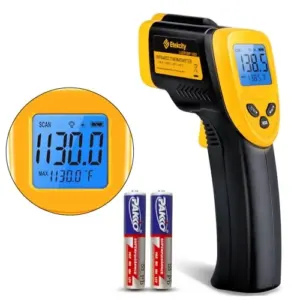
A snake that presses against the glass is often telling you something about its enclosure, and a handheld infrared thermometer is the quickest way to hear it. Point the laser point switch at a surface from 14.17 inches away, and within 0.5 seconds you’ll have a reading from -58°F to 1130°F, switchable to Celsius on the backlit screen.
Check the basking spot, the cool end, and the substrate. The MAX function records the highest value, and 15-second auto-off keeps sessions brief. Never aim it at skin.
| Best For | Reptile keepers and home cooks who want a quick, non-contact way to check surface temperatures in enclosures, ovens, and HVAC setups. |
|---|---|
| Primary Use | Non-contact temperature measurement |
| Pet Care Use | Suitable for pet care |
| Power Source | Two AAA batteries |
| Temperature Range | -58°F to 1130°F |
| Size | 6.1 x 3.1 x 1.57 inches |
| Main Limitation | 15-second auto-off timer |
| Additional Features |
|
- Non-contact readings from -58°F to 1130°F let you safely test hot or hard-to-reach surfaces.
- The 12:1 distance-to-spot ratio and 0.5 second response time give fast, precise readings with laser targeting.
- Adjustable emissivity (0.1–1.0) and a MAX function help you get accurate readings on different surfaces.
- The 15-second auto-off timer limits how long you can measure continuously.
- It is not intended for use on human skin.
- It needs two AAA batteries, so you will have to replace them when the low battery indicator appears.
2. BN-LINK Reptile Thermostat Temperature Controller
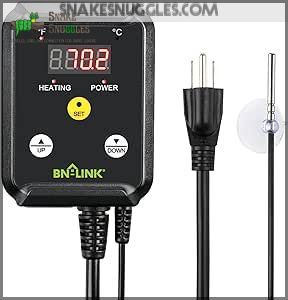
Picture a ball python that paces the glass every evening, nose pushed hard against the corner, while the warm side of the tank sits a few degrees too hot. Guessing won’t fix that, but controlling the heat will.
This thermostat has a digital display, three buttons for switching between Fahrenheit and Celsius, and a 4.92 ft probe you can place right at basking level. It regulates 40–108 ºF, takes up to 1000W, and isn’t meant for cooling or water immersion.
| Best For | Reptile keepers, seed starters, and home brewers who need steady, adjustable heat up to 1000W and want to place the probe exactly where the temperature matters. |
|---|---|
| Primary Use | Thermostat temperature control |
| Pet Care Use | Regulates reptile terrariums |
| Power Source | 120VAC power cord |
| Temperature Range | 40–108°F |
| Size | N/A |
| Main Limitation | Cannot cool or be submerged |
| Additional Features |
|
- Digital display with three buttons makes switching between Fahrenheit and Celsius easy, and the LED power and heating lights show status at a glance.
- The 4.92 ft probe and 3.94 ft power cord give you flexibility in placement, and the ETL listing adds safety assurance.
- Works for many uses, including reptile terrariums, incubators, brooders, seed germination, and fermentation.
- It only heats, so it cannot control cooling devices, and it should never be submerged in water.
- It may not reach the set point if the surrounding temperature is too low.
- The total connected load cannot exceed 1000W, and the control range stops at 40–108 ºF.
3. Koyal Natural Grapewood Vine Branch
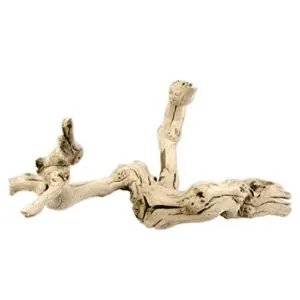
Picture a ball python that spends every evening nose against the glass, scanning for a way out because its enclosure offers no sheltered route upward or sideways. Giving it something to climb often redirects that restless energy.
This branch is sandblasted clean and dried, so it’s ready for immediate terrarium use. It’s about 6 inches long and weighs 5.8 ounces, light enough to position easily yet sturdy enough to bear a small reptile’s weight.
Keep expectations realistic, though. Each piece varies in width and length, and some buyers find it smaller than expected and more stick than vine.
| Best For | Owners of small reptiles or hamsters who want a lightweight, ready-to-use natural branch to add climbing space and rustic decor to a terrarium. |
|---|---|
| Primary Use | Terrarium climbing and decor |
| Pet Care Use | Climbing for hamsters and reptiles |
| Power Source | N/A |
| Temperature Range | N/A |
| Size | 6 inches long |
| Main Limitation | Smaller than expected |
| Additional Features |
|
- Sandblasted clean and dried, so it’s ready for immediate terrarium use
- Lightweight yet sturdy enough for climbing and decoration
- Versatile, working as a climbing structure, home decor, or a driftwood planter
- Each branch varies in width and length, so you can’t be sure of the exact shape
- Customers report it is smaller than expected, at only about 6 inches long
- Some buyers say it looks like a straight stick rather than a vine
When Head Pressing Needs a Reptile Vet
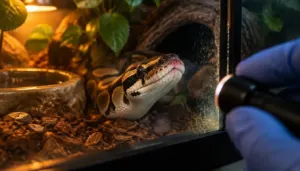
A snake that presses its nose against the glass for a few minutes and then moves on is exploring. One that keeps at it for hours, in the same spot and with the same rhythm, is telling you something else.
A brief brush against the glass is curiosity, but hours of the same rhythmic pressing is a snake’s way of asking for help
Call a reptile veterinarian if you see broken scales, exposed pink tissue, or bleeding on the snout, since raw tissue heals poorly and invites infection. Seizures, stargazing, corkscrewing, or trouble righting itself point to neurological trouble and need prompt attention. Repeated regurgitation, refusing food, swelling near the mouth, or discharge alongside the pressing suggest snake health issues that no enclosure tweak will fix.
The same goes for pressing that doesn’t ease after you’ve corrected temperatures, cover, and space. Persistent stereotypy calls for veterinary diagnosis, not more waiting.
Frequently Asked Questions (FAQs)
Can glass surfing cause permanent snout damage?
Picture a snout dragged against a cheese grater, over and over, in the same corner. Yes, it can leave lasting damage. Thin skin sits right over bone, so repeated pressing wears through scales, and infection may follow.
Can pre-shed snakes press against glass more?
It’s almost funny that a snake going blind and itchy suddenly wants to explore more. Yes, pre-shed snakes often press and rub against glass, because loosening skin and cloudy eyes make touch their guide.
Does glass surfing affect a snakes appetite?
It depends on how often it happens. Occasional glass surfing rarely affects appetite if your snake keeps eating and holding weight, but constant pacing can signal stress and environmental discomfort, which often leads to food refusal.
Can snake head pressing signal Inclusion Body Disease?
You might assume a snake pressing its nose to glass is simply restless, and usually it is. Still, it can point to inclusion body disease when paired with tremors, stargazing, regurgitation, or weight loss. Only PCR testing confirms it.
Conclusion
Watch the posture, check the temperatures, and measure the space. Those three habits turn a puzzling behavior into a solvable one. A snake head pressing against glass rarely means defiance; it usually means the enclosure is asking for a correction, whether that’s a steadier thermal gradient, a more sheltered hide, or a layout with room to roam.
Change one thing, then watch closely. If wheezing or refusing food joins the habit, call a reptile vet.
- https://theconversation.com/why-your-pet-reptile-surfs-the-glass-or-rubs-against-the-barriers-of-their-enclosure-281298
- https://smithsreptiles.co.uk/troubleshooting/why-does-my-reptile-keep-glass-surfing
- https://peqaboo.com/knowledge/en/guides/snake-restlessness-glass-nosing-and-burrowing-what-each-means