This site is supported by our readers. We may earn a commission, at no cost to you, if you purchase through links.
Your snake’s water bowl looks clean, but it isn’t. Within 24 hours, standing water turns bacterial, and a slick film called biofilm coats the bowl before you’ve noticed a thing.
That matters because your snake drinks from it, soaks in it, and sometimes soils it. Scratched plastic holds onto bacteria far longer than smooth stainless steel, so a quick rinse won’t protect your animal.
Cleaning snake water feeders properly takes a few minutes and the right order of steps; scrub first, disinfect second, rinse and dry last. Here’s exactly how to do each one safely.
Table Of Contents
Key Takeaways
- You must change your snake’s water every day and scrub the bowl with hot water and soap, because bacteria and a slimy biofilm form within 24 hours even when the water looks clear.
- You must follow the order of scrub first, disinfect second, then rinse and air dry, since disinfectant can’t reach germs hiding under biofilm and leftover chemicals can harm your snake.
- You must never mix cleaning products, wear nitrile gloves, and give your disinfectant its full contact time (10 minutes for chlorhexidine, 10 to 15 for 3% hydrogen peroxide) so the bowl is truly safe.
- You must replace scratched or chipped bowls and favor smooth stainless steel over plastic, because tiny scratches trap bacteria that no amount of cleaning can reach.
How Often Snake Water Feeders Need Cleaning
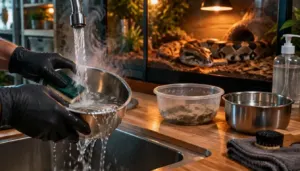
Always plan on changing your snake’s water every day; standing water turns bacterial within 24 hours, and a fresh bowl is your first line of defense.
For more ways to keep your snake’s bowl fresh between swaps, see this guide to snake tank water quality.
Your daily spot cleaning routine should include a scrub with hot water, because biofilm starts forming on bowl surfaces within a day, even when the water looks clear. If you feel a slippery film, rinsing won’t cut it; you must scrub. Bowl material also matters, since plastic bowls carry the highest biofilm risk because micro-scratches give bacteria more surface area, while smoother stainless steel is lower risk.
Refill twice a day if your snake soils the bowl. Pair the daily scrub with weekly disinfection to handle bacteria hiding in tiny scratches, since that’s the heart of water bowl sanitation.
Adjust your cleaning frequency for large boas, warm enclosures, and hard water; they speed up buildup and make biofilm removal harder.
3 Snake Water Feeder Cleaning Supplies
You don’t need a shelf full of products to keep your snake’s water clean; three simple supplies cover the whole routine. Each one has a clear job, and you must have them within reach before you pull the bowl out of the tank. Here’s what to gather so every step goes smoothly and safely.
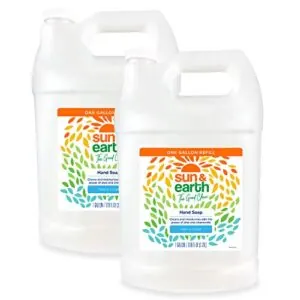
1. Sun & Earth Hand Soap Bulk Pack
 View On Amazon
Soap plays a bigger role in bowl care than most keepers expect; it’s what lifts the slick biofilm that water alone can’t remove. This bulk pack holds two 128 fl oz bottles, 256 fl oz in total, so you’ll rarely run short during daily scrubs.
The formula is hypoallergenic and free of dyes and perfumes, which means you won’t leave scented residue behind. You must still rinse the bowl completely; leftover soap can irritate your snake.
Not antibacterial, so it won’t replace disinfecting.
| Best For | Snake keepers and people with sensitive skin who want a fragrance-free, hypoallergenic soap in bulk for frequent hand washing and daily bowl scrubs. |
|---|---|
| Product Type | Hand soap |
| Size/Quantity | Two 128 fl oz bottles |
| Scent | Fragrance-free |
| Primary Use | Frequent hand washing |
| Target Users | People with sensitive skin |
| Key Limitation | Not antibacterial |
| Additional Features |
|
- Hypoallergenic and free of dyes and perfumes, so it leaves no scented residue behind.
- The bulk pack holds two 128 fl oz bottles (256 fl oz total), so you’ll rarely run short.
- Dermatologist-tested and made with aloe vera and moisturizers, so it’s gentle on hands even with frequent washing.
- It isn’t antibacterial, so it won’t replace disinfecting.
- You must rinse the bowl completely, since leftover soap can irritate your snake.
- The large bottles may be less convenient for small spaces.
2. 256 Pet Disinfectant Wintergreen Concentrate
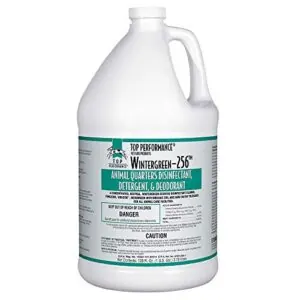
Since soap won’t disinfect, this concentrate takes care of the next job. It kills viruses, bacteria, and fungi, and it’s suitable for food and water bowls. You must dilute it first: mix 1 tablespoon per gallon of water.
For the full routine beyond the bowls, this guide to cleaning a snake tank walks through each step from start to finish.
One 128 fl oz jug makes 256 gallons, so a little goes a long way. The wintergreen scent masks kennel odors, but you must still rinse your bowl well afterward.
It’s made for professional facilities, not households, so check the label before you buy.
| Best For | Professional animal care facilities such as kennels, boarding facilities, veterinary clinics, grooming shops, dog daycares, breeders, and shelters that need an affordable, concentrated disinfectant for cages, runs, bowls, and crates. |
|---|---|
| Product Type | Concentrated disinfectant cleaner |
| Size/Quantity | 128 fl oz concentrate |
| Scent | Wintergreen |
| Primary Use | Disinfecting animal enclosures |
| Target Users | Kennels, vets, groomers, shelters |
| Key Limitation | Not for household use |
| Additional Features |
|
- Kills viruses, bacteria, and fungi while cleaning, disinfecting, and deodorizing in one step.
- One gallon of concentrate makes 256 gallons at just 1 tablespoon per gallon of water.
- Works on cages, runs, exam tables, bowls, transport crates, and synthetic turf, and the wintergreen scent helps mask tough kennel odors.
- Must be diluted with water before every use.
- Intended for professional facilities and not labeled for general household use.
- The one-gallon jug may be more than small or occasional users need.
3. MED PRIDE Blue Nitrile Exam Gloves
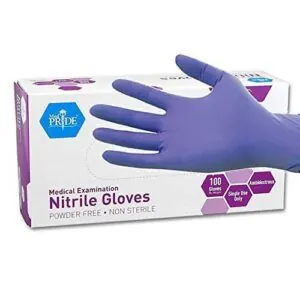
Once your disinfectant is ready, protect your hands before you touch it. You must wear gloves for every cleaning task, and you must toss them afterward; this keeps bacteria off your skin and chemicals off your hands.
Pairing good glove habits with a few other precautions is easy once you know the routine, and this guide to safe handling of frozen rodents walks through each step.
These nitrile gloves are powder-free, so they leave no residue behind. They’re 3.5 mil thick, with textured fingertips that help you grip a slippery, scrubbed bowl. A box holds 100 medium gloves, and they come in sizes Small through X-Large. Check your size first, since loose gloves slip.
| Best For | Home cleaners, caregivers, and professionals who need a powder-free, latex-free glove with a good grip for everyday cleaning, wound care, and similar tasks. |
|---|---|
| Product Type | Nitrile examination gloves |
| Size/Quantity | 100 gloves per box |
| Scent | N/A |
| Primary Use | Medical examinations and patient care |
| Target Users | Caregivers and medical professionals |
| Key Limitation | Single-use only |
| Additional Features |
|
- Powder-free and made without natural rubber latex, so there’s no residue on skin
- Textured fingertips help you grip slippery items like a scrubbed toilet bowl
- Comes in four sizes (Small through X-Large) with a beaded, ambidextrous cuff
- At 3.5 mil thick, they may feel less protective than heavier-duty gloves for harsh chemicals
- Non-sterile and single-use only, so you must throw them out after every task
- Loose gloves slip, so you need to check your size before buying
Scrub Snake Water Bowls to Remove Biofilm
Grab your dedicated scrub brush and scrub snake water bowls by hand; biofilm is a slimy film that rinsing alone can’t remove.
You must use hot water and a little hand soap, because heat loosens the film and soap breaks down the organic matter beneath it. Picture the process in three moves:
- Wet the bowl and work soapy bubbles across the rim and base, where slime collects first.
- Scrub the entire inner surface in small circles until it feels smooth, not slick.
- Rub a baking soda paste over any stubborn spots; it’s abrasive but safe.
Go gently on plastic and glass, since scratches and chips give biofilm new hiding places. You must remove biofilm daily, before it turns truly stubborn.
Disinfect Snake Water Feeders Without Mixing Chemicals
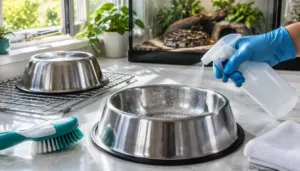
You must disinfect only after scrubbing; soap and brushing remove the slime, and disinfectant can’t reach germs hiding under it.
Scrub away the slime first, because disinfectant can never reach germs that are still sheltering beneath it
Pick one product and never mix it with another; combining chemicals can create harmful fumes. Disinfectant dilution safety matters too, so follow your label exactly. If you’d rather not measure dilutions yourself, a ready-to-use reptile enclosure disinfectant takes the guesswork out, as long as you follow its label.
| Option | Contact time |
|---|---|
| Chlorhexidine solution | 10 minutes |
| 3% hydrogen peroxide | 10-15 minutes |
Spray every surface of the bowl, or wipe it with a soaked cloth, then let it sit for the full time; shorter contact leaves germs behind. Check bowl material safety first, since porous or scratched plastic can hold residue. Soaking one of your lint-free microfiber cleaning cloths in the disinfectant helps you reach every curve of the bowl without leaving lint behind.
Wear nitrile gloves, keep the area ventilated, and use a dedicated scrub brush for cross-contamination control. Air drying bowls completely afterward also prevents recontamination.
Rinse, Dry, and Refill Snake Water Feeders
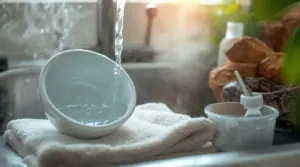
Rinse hot, dry fully, and refill fresh; that’s the order you must follow every time. Hot water carries away leftover disinfectant and loose debris, and it keeps biofilm from getting a foothold.
Once the bowl is clean, air dry it upside down on a clean surface. Damp plastic and ceramic invite bacteria, so don’t skip this or towel it off with a used cloth. A dedicated dish drying rack keeps the bowl tilted and elevated, so air reaches every surface and water drains instead of pooling.
Before you refill, run through this quick check:
- Rinse every surface until no chemical smell lingers.
- Tip the bowl to drain all trapped water.
- Dechlorinate the fill water before it goes in.
- Pour to the same level each time.
A consistent level lets your snake drink and soak without any drowning risk, and it makes daily care feel simple.
Frequently Asked Questions (FAQs)
How do I remove stubborn mineral deposits from bowls?
You must soak the bowl in white vinegar for 20 to 30 minutes; the acid dissolves the calcium carbonate buildup. Then lift softened residue with a soft brush, and rinse thoroughly so no acid remains.
When should I replace a scratched water bowl?
Replace it as soon as you spot a scratch, chip, or rough patch; microscopic scratches trap bacterial biofilm that cleaning can’t reach. Check weekly, and swap plastic more often than ceramic or stainless steel.
Is vinegar safe for cleaning snake water bowls?
You might worry vinegar is too harsh for your snake, but it’s safe when you rinse well. It clears mineral deposits and algae, yet it doesn’t disinfect. Never mix it with bleach.
Can I use tap water to rinse snake bowls?
Think of tap water as a final polish on a freshly scrubbed water bowl; it works, but only if you treat it first. You must use dechlorinated water for rinsing, so no disinfectant residue lingers.
What should I do if my snake soaks often?
First, check your enclosure. Soaking behavior often means temperatures run too high or humidity sits below 50%, so you must correct both. If it continues, look for mites; they drive snakes into water bowls, and a vet must treat them.
Conclusion
What’s the real price of skipping one step? Often, it’s a sick snake.
Cleaning snake water feeders properly means you must scrub first, disinfect second, and rinse and dry last; that order keeps biofilm from surviving and chemicals from lingering. Wear your nitrile gloves, never mix products, and replace badly scratched bowls. Do this and your snake’s water stays safe to drink. Now make clean water every day the habit your snake can count on.