This site is supported by our readers. We may earn a commission, at no cost to you, if you purchase through links.
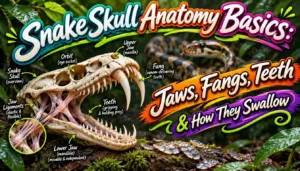
A snake can swallow a meal wider than its own head, and it doesn’t unhinge a single bone to do it. That’s one of the most persistent myths in reptile biology, and the truth is more impressive.
Snake skull anatomy basics start with a surprising fact: only the braincase stays fixed. Everything else, from the snout to the upper and lower jaws, hangs from stretchy ligaments and moves on its own. Each side of the mouth works independently, ratcheting prey backward one bite at a time.
Understanding this design explains how cranial kinesis works, why fang types differ, and how a snake senses the world through its skull.
Table Of Contents
Key Takeaways
- Your snake’s jaws never unhinge or dislocate; only the braincase stays fixed, while ligaments let the snout, upper jaws, and lower jaws move on their own.
- The two lower jaw halves aren’t fused at the chin, and a mobile quadrate bone swings the jaw outward, so each side can stretch wide and advance independently.
- Snakes swallow by "walking" their jaws, with one side gripping prey while the other slides forward, and backward-curved teeth keep the meal from slipping out.
- Fang type matters for safety: cobras have short fixed fangs, vipers have long hinged fangs that swing out as the mouth opens, and rear-fanged species carry grooved teeth deep in the jaw.
Snake Skull Layout and Braincase Protection
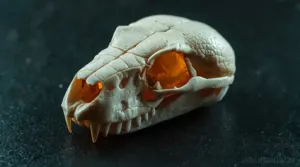
How does an animal that stretches its head around a whole rat keep its brain safe? The answer is that a snake skull isn’t one flexible structure. It’s four functional units: the braincase, the snout, the upper jaws, and the lower jaws. Only the braincase stays largely fixed.
While the braincase stays put, the other three units swing on separate joints, a process explained in more detail in this guide to how snake jaws dislocate and stretch.
Your snake’s braincase is a solidly ossified, compact box that wraps the brain. Its roof is often a single fused parietal bone, and frontal, prootic, and occipital bones close in the sides and rear. This rigid frame provides braincase protection, resisting deformation while everything around it shifts. In the Sahara horned viper, the supraoccipital bone develops at embryonic stage 34 from a central unpaired center flanked by paired epiotic centers.
Ligaments, not rigid sutures, hold the other units to it. That looseness makes cranial kinesis possible, and the braincase anchors the muscles that power it.
Upper Jaw and Palate Bones
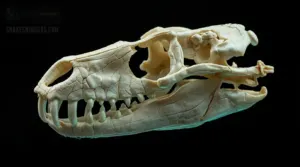
Hanging from the braincase by ligaments, each upper jaw is a chain of linked bones rather than a single plate. The premaxilla sits at the snout tip and is often toothless. Behind it, the chain runs like this:
- The maxillary bone forms the outer tooth row and pivots on the prefrontal bone.
- The palatine bone carries an inner tooth row along the palate.
- The pterygoid bone runs rearward toward the quadrate bone.
- The ectopterygoid links the pterygoid to the maxilla, passing muscle force forward.
- Left and right palate units move independently of each other.
Because the outer and inner rows move separately, your snake ratchets prey backward one side at a time. This palato-maxillary kinesis gives the upper jaw its reach.
The unfused lower jaw halves work the same way, as this guide to snake skeletal characteristics explains, letting each side advance on its own.
Lower Jaw Bones and Flexible Joints
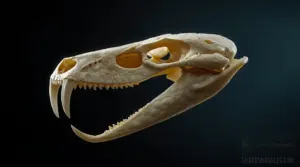
The upper jaw does half the work. Your snake’s lower jaw bones do the rest, and they’re built to bend. Each side has a tooth-bearing dentary at the front and a compound bone at the back, formed when the articular, surangular, and angular bones fused. A detailed snake skull anatomy model replica makes it easy to see how the compound bone sits behind the dentary.
At the chin, the two dentaries aren’t fused. Only a stretchy mandibular symphysis ligament joins them, so the halves can spread apart sideways and move on their own.
At the rear, the compound bone meets the mobile quadrate bone, which swings the whole lower jaw outward and downward. Some species add an intramandibular hinge between dentary and compound bone, letting the front bend down. Together, these joints give the jaw mechanics three-dimensional freedom of movement.
How Snake Skulls Enable Whole-Prey Swallowing
A snake can swallow prey wider than its own head, and its skull makes that possible. You’ll look at two key points below that explain how it works. Each one clears up a common misunderstanding about what your snake’s jaws can and can’t do.
Because those loosely connected jaw bones stretch so far, a swallowed meal then travels through a body built differently from ours, which how snake organs work explains in more detail.
Why Snake Jaws Don’t Unhinge
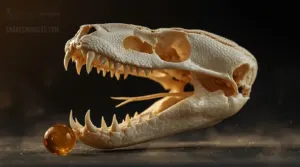
Do snakes dislocate their jaws to swallow big prey? No, that’s a myth. Your snake’s jaws stay attached throughout. Three features make the wide gape possible:
A snake never dislocates anything to swallow giant meals; its skull is simply built so loosely that the jaws stretch wide while staying connected
- A stretchy ligament joins the two lower jaw halves.
- A mobile quadrate bone swings the jaw outward.
- Loosely linked skull bones shift independently.
This cranial kinesis in squamates is flexible design, not broken anatomy.
Elapids like cobras keep short, fixed fangs instead, and this breakdown of snake teeth and fang types shows how designs differ.
Alternating Jaw Movements During Swallowing
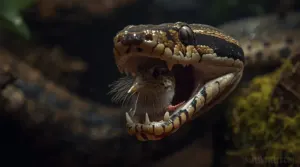
How does a snake move food without hands? It walks its jaws. One side of the lower jaw grips the prey while the other slides forward and bites down again. Then the sides trade roles.
Thanks to mandibular flexibility, each half moves independently, so you’ll see a slow, ratcheting pull drag the meal backward into the throat. Don’t expect speed.
Snake Teeth and Fang Arrangements
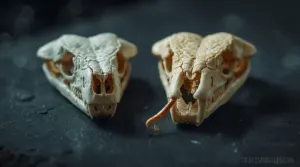
Every snake you’ll meet has teeth, but they aren’t all built or placed the same way.
Below, you’ll find the two tooth and fang arrangements that matter most, starting with the recurved teeth in common pet snakes.
After that, you’ll see how fixed, hinged, and rear-positioned fangs differ, which helps you stay safe around any species.
Recurved Teeth in Common Pet Snakes
Look inside a ball python’s mouth and you’ll find rows of needle-thin teeth, each curved backward like a tiny fish hook. These recurved teeth grip struggling prey and stop it from backing out during constriction. Keepers curious about quirks like these, and how they affect feeding, will find helpful explanations in a beginner-friendly ball python care book.
They don’t chew. Instead, the hooks guide food steadily toward the throat, while palato-maxillary kinesis, the jaws’ flexing motion, does the pulling.
Fixed, Hinged, and Rear-positioned Fangs
Picture a cobra and a gaboon viper, both mid-strike. The cobra’s short fangs stay put, visible even when its mouth is shut. The viper’s fangs, sometimes longer than half its skull, swing out only as the jaws open.
Fixed front fangs are hollow and straight. Hinged front fangs fold flat. Rear-fanged species carry grooved teeth deep in the jaw and must chew.
Sensory Connections Within The Snake Skull
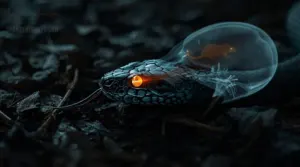
Picture a snake gliding through dark leaf litter, tongue flicking, skull pressed to the ground. Every part of that skull is gathering information.
Smell comes first. The forked tongue grabs odor particles and delivers them to Jacobson’s organ in the palate, which feeds the olfactory bulb. This vomeronasal chemoreception often matters more than eyesight for finding prey.
Pit vipers, boas and pythons add heat vision. Facial pits detect warmth from mammals and birds, and the optic tectum merges that signal with sight into one spatial map. Keepers can map the same warm and cool zones a pit viper senses by checking surfaces with an infrared thermometer gun inside the terrarium.
Hearing works differently. Without external ears, a snake seems deaf, but the stapes links to the quadrate bone, so ground vibrations travel up through the jaw to the inner ear. Airborne sound barely registers.
Frequently Asked Questions (FAQs)
Do snakes have ears or eardrums?
Snakes aren’t deaf, though you won’t find ears on them. They lack an eardrum and outer ear.
Instead, bone conduction carries ground-borne vibrations through the jaw to the inner ear, which they sense remarkably well.
Why do you bury the head of a snake?
A severed head can still snap like a trap with a rusted spring. Reflexes outlast the snake, so you bury it at least a foot deep, keeping fangs and venom away from hands and scavengers.
Why do snakes have lidless eyes?
Think of a snake’s eye as a window with the glass painted on permanently. Each eyelid fused during development into one clear scale, the spectacle, which shields the cornea and keeps a thin film of fluid moist.
How many vertebrae do snakes have?
Most snakes have roughly 130 to over 400 vertebrae, though the range stretches wider. Small colubrids sit around 200 to 300, while large pythons can reach about Your snake’s body length largely predicts its count.
Do boas and pythons have leg bones?
Yes, but only tiny remnants. Boas and pythons keep a vestigial pelvis and a small femur on each side of the cloaca. These bones float in muscle and support the external pelvic spurs you can see.
Do snakes have a sternum or breastbone?
Most snakes have several hundred vertebrae, and nearly every one carries a pair of ribs. Yet there’s no sternum.
Your snake’s ribs end freely along the belly, which lets its body widen around large prey.
Conclusion
Loose ligaments, independent jaws, and a locked braincase explain nearly everything a snake does with its head. Once you grasp snake skull anatomy basics, the myths fall away. Nothing unhinges, nothing dislocates, and nothing about a snake’s meal is accidental.
The next time you watch a snake feed, look for the alternating jaw ratchet, each side pulling prey steadily inward in turn. You’re seeing a skull built not to break rules, but to stretch them.