This site is supported by our readers. We may earn a commission, at no cost to you, if you purchase through links.

A ball python can hold more than 300 vertebrae, each one locked to its neighbors by five separate joints. Your own spine has 33 at most, and none of them can bend sideways the way a snake’s does without strain.
That difference explains how a limbless animal climbs, swims, constricts, and swallows prey wider than its head. Understanding how snake spines work means seeing the vertebrae (the stacked bones of the backbone), the ribs, and the muscles as one mechanical system. Each part solves a specific problem: bending without twisting, breathing while squeezing, and moving ahead in a straight line.
Start with the vertebrae and how many a snake carries.
Table Of Contents
Key Takeaways
- Your ball python’s 300-plus vertebrae each connect through five joints, and the interlocking zygosphene and zygantrum let its spine bend sideways while blocking the twisting that would otherwise corkscrew its body.
- Because snakes have no diaphragm, they breathe by moving their ribs with small muscles between them, so air keeps flowing even while the front of the body squeezes prey or stretches around a large meal.
- Muscles fire in sequence from head to tail, sending sideways curves down the body, while straight-line crawling relies on belly-skin muscles that pull skin forward and grip so the skeleton barely moves.
- Your spine trades range for support, but a snake’s spine spends everything on reach, which is how a limbless animal climbs, swims, constricts, and swallows prey wider than its head.
Snake Spine Anatomy and Vertebral Counts
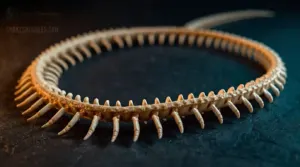
How does a limbless animal hold its body together? The answer lies in snake vertebral anatomy. Each vertebra (a single bone of the backbone) has a centrum (the main body), a neural arch (a bony roof protecting the spinal cord), and a neural spine.
Hundreds of these vertebrae link in a row to form the flexible spine behind the key characteristics of snakes.
Snakes have no sacrum (the fused hip bones) and no limbs, so the column runs unbroken from skull to tail tip. Depending on species, you’ll find 175 to over 400 vertebrae, and long-bodied snakes sit at the high end.
Precaudal vertebrae (those in front of the cloaca, the shared vent) carry ribs. Caudal vertebrae lack ribs and form the tail. Each has a procoelous structure (concave front, rounded rear), and spinal column length reflects trunk count.
How Snake Vertebral Joints Balance Flexibility
Those procoelous vertebrae (bones with a concave front and rounded rear) do more than stack up. Each one connects through five articulation points, and together they give you a spine that bends freely yet resists twisting.
Here’s how the five points work:
- The ball-and-socket joint: the condyle (rounded knob) fits the cotyle (cup) ahead of it, allowing bending in multiple planes.
- Pre-zygapophyses (forward-facing joint surfaces) guide the vertebra in front.
- Post-zygapophyses (rear-facing surfaces) guide the one behind.
- The zygosphene, a wedge-shaped process, projects forward.
- The zygantrum, a socket, receives it.
These interlocking accessory joints block roll (axial twisting), so your snake can bend sideways without corkscrewing. Remove the zygosphene and yaw (side-to-side bending) range increases, while pitch remains entirely unaffected. In cornsnake and boa vertebrae, roll became unconstrained only when the zygapophyses disarticulated at high yaw, which an intact zygosphene prevented.
Movable Ribs Support Breathing and Feeding
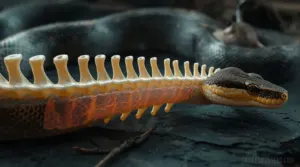
Those same vertebrae carry your snake’s ribs, and the ribs do far more than shield organs. Each rib attaches through a bicapitate joint (a two-headed connection to the vertebra), which stabilizes the body during bending while still letting the rib swing.
Because snakes lack a diaphragm (the muscle sheet mammals use to draw air in), they breathe with the levator costae, small muscles between the ribs. When these muscles move the ribs, the elongated lung acts like a bellows, pumping air in and out.
Feeding tests that system. During constriction, the anterior ribs squeeze prey, so the snake ventilates with ribs farther back. Swallowing large prey spreads the rib cage wide, and breathing continues in whichever body region stays free.
How Snake Spines Enable Different Movements

Once you understand the parts of a snake’s spine, you can start to see how they work together in motion. Two ideas explain much of what you’ll observe: coordinated bending and rectilinear (straight-line) travel. Let’s look at how each one works.
Because a snake’s backbone is made of hundreds of tiny joints, learning how snakes are vertebrates helps explain why each curve can spread out so smoothly along the body.
Coordinated Bending and Muscular Control
Picture a stadium wave rolling through a crowd: everyone’s standing up just after their neighbor. A snake’s spine works the same way. Through spinal segmentation (division into repeating vertebral units), muscles fire head to tail, and lateral bending (sideways curvature) travels down the body.
A snake’s spine ripples like a crowd’s wave, each muscle firing right after the last, sending sideways curves gliding from head to tail
- Feel quiet power in every ripple.
- Marvel at vertebrae moving as one.
- Trust each glide’s precision.
Rectilinear Movement Without Sideways Bending
A snake can crawl straight through a tight tunnel using rectilinear locomotion, a gait with no lateral curves. Costocutaneous muscles (sheets linking ribs to belly skin) pull sections of skin forward while your snake’s skeleton stays nearly still. Each patch then grips again and hauls the body ahead.
Ventral scales (broad belly plates) anchor patches, so smooth surfaces stall it.
5 Requested Accessories Unrelated to Snake Spines
You’ve just seen how a snake’s spine turns hundreds of small joints into smooth movement, so this section shifts gears. Below, you’ll find five requested accessories that have nothing to do with snake anatomy. Think of them as a practical side list, and take each one in turn.
1. Soundcore Q20i ANC Headphones White

Studying spinal mechanics takes focus, and focus is easy to lose to a noisy room. The Soundcore Q20i helps with that. Four built-in microphones drive hybrid active noise cancellation (ANC, which uses mics to detect ambient sound and generate opposing waves), so offices, commutes, and streets fade out.
You get up to 40 hours of playback with ANC on, and a 5-minute charge delivers 4 hours. Dual-device Bluetooth multipoint lets you switch between phone and laptop. Note that ANC doesn’t work in AUX mode, and fit comfort reviews are mixed.
| Best For | Students, office workers, and daily commuters who want affordable noise-cancelling headphones with long battery life and the ability to switch between a phone and a laptop. |
|---|---|
| Weight | N/A |
| Capacity | N/A |
| Material | N/A |
| Easy Cleaning | N/A |
| Portability | N/A |
| Battery Life | Up to 40 hours with ANC |
| Additional Features |
|
- Up to 40 hours of playback with ANC on, and a 5-minute charge gives 4 hours of listening
- Four built-in mics power hybrid noise cancellation that reduces noise in offices, commutes, and streets
- Dual-device Bluetooth multipoint, plus a customizable EQ and ANC modes in the soundcore app
- ANC is not available when using the AUX cable
- Customer feedback on over-ear fit comfort is mixed
- Software features require downloading the soundcore app
2. Owala FreeSip 24 oz Insulated Bottle
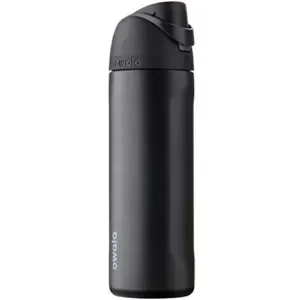
Like a well-fitted vertebra, the Owala FreeSip 24 oz bottle does one job cleanly: it keeps water steady. Its double-wall insulation (two stainless steel layers separated by a gap) holds drinks cold up to 24 hours, and the patented spout lets you sip or swig. The push-button lid locks, and a carry loop frees your hand.
At 13.6 ounces, it suits active days. Skip hot liquids, wash the bottle by hand, and check your cupholder, since it may not fit.
| Best For | Active people who want a leak-resistant, cold-keeping bottle they can sip from or swig from throughout the day. |
|---|---|
| Weight | 13.6 ounces |
| Capacity | 24 ounces |
| Material | Stainless steel |
| Easy Cleaning | Wide opening; lid dishwasher safe |
| Portability | Carry loop |
| Battery Life | N/A |
| Additional Features |
|
- Double-wall insulation keeps drinks cold for up to 24 hours.
- The FreeSip spout lets you sip or swig, and the push-button lid locks with a carry loop for easy carrying.
- The wide opening makes cleaning and adding ice easy.
- It is not meant for hot liquids.
- The bottle must be washed by hand, though the lid is dishwasher safe.
- It may not fit standard cupholders and could need an oversized or specialty holder.
3. Cosori Electric Kettle 1.7L Borosilicate Glass

Think of this kettle as a small, well-sealed boiler: water goes in, heat comes out, and nothing plastic gets in the way. Its borosilicate glass (a heat-resistant glass that tolerates sudden temperature swings) and BPA-free stainless steel keep your water clean.
You get 1.7 liters at 1500W, so 0.5L heats in under 3 minutes. Descale it with vinegar or lemon juice, and don’t tilt it backward or overfill it.
Be aware that some users report shut-off failures and durability problems after four months.
| Best For | Tea and coffee drinkers who want a plastic-free, easy-to-clean kettle for everyday hot water and are comfortable with some reports of durability concerns. |
|---|---|
| Weight | N/A |
| Capacity | 1.7 liters |
| Material | BPA-free stainless steel, borosilicate glass |
| Easy Cleaning | Wide opening |
| Portability | N/A |
| Battery Life | N/A |
| Additional Features |
|
- Water never touches plastic, thanks to the borosilicate glass and BPA-free stainless steel build
- Heats 0.5L of water in under 3 minutes with its 1500W power
- The wide opening makes cleaning easy, and vinegar or lemon juice can be used for descaling
- Some users report the auto shut-off does not always work properly
- There are reports of durability problems after about 4 months of use
- It must not be tilted backward or filled past the max level, or water can get into the steam mechanism
4. Amazon Basics 1/2 Inch Exercise Yoga Mat
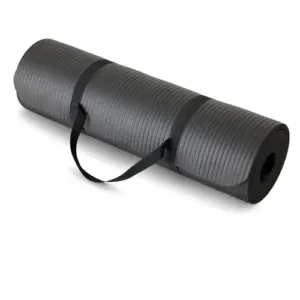
Ever try stretching out on a hard floor and wish something sat between you and the boards? This mat solves that. It’s built from 100% NBR foam (nitrile butadiene rubber, a dense, closed-cell material), which cushions your joints during yoga and floor exercises.
At 73.2" x 24.3" and just 0.5" thick, it weighs 1 kg (2.2 pounds), and the included elastic strap makes carrying it to the gym or park easy.
Know the tradeoffs: some buyers report a slippery surface, a noticeable new-mat odor, and tearing over time.
| Best For | Casual yoga and floor-exercise users who want a lightweight, cushioned, budget-friendly mat that’s easy to carry to the gym or park. |
|---|---|
| Weight | 1 kg (2.2 pounds) |
| Capacity | N/A |
| Material | 100% NBR foam |
| Easy Cleaning | Hand washable |
| Portability | Elastic carrying strap |
| Battery Life | N/A |
| Additional Features |
|
- Cushions joints during yoga and floor exercises thanks to its 0.5" thick NBR foam
- Lightweight at 1 kg (2.2 pounds), with an included elastic strap for easy carrying
- Hand washable, which makes it simple to keep clean
- Some users report the surface is slippery during use
- Customers notice a strong odor when the mat is new
- Durability feedback is mixed, including reports of tearing
5. Anker Soundcore 2 Portable Speaker
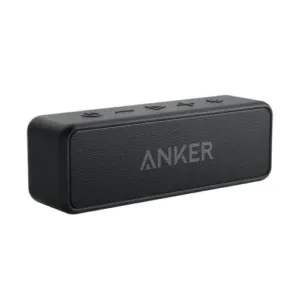
Not every gadget needs a spine, but this one earns a spot in your bag. The Soundcore 2 packs a 5,200mAh Li-ion battery (a rechargeable lithium-ion cell) that runs music for 24 hours, and its IPX7 rating (a standard for water resistance) means splashes won’t hurt it.
Two neodymium drivers (small, strong magnet-based speakers) deliver 12W stereo sound with BassUp, and Bluetooth 6 pairing lets you link two units. Expect mixed results on loudness, and bass-heavy genres may disappoint you.
| Best For | Campers, beachgoers, and travelers who want a compact, water-resistant speaker with a long battery life for casual listening. |
|---|---|
| Weight | N/A |
| Capacity | N/A |
| Material | N/A |
| Easy Cleaning | N/A |
| Portability | Compact portable design |
| Battery Life | 24 hours playback |
| Additional Features |
|
- IPX7 waterproof protection handles splashes and water vapor, so it’s fine for the beach, shower, or camping.
- The 5,200mAh battery plays music for up to 24 hours without stopping.
- Wireless stereo pairing lets you link two units for fuller sound.
- Some users find the volume not as loud as they expected.
- Bass performance may fall short for bass-heavy music genres.
- Exact dimensions and weight aren’t listed, so it’s hard to judge its size before buying.
Frequently Asked Questions (FAQs)
What happens if you break a snakes spine?
A snake’s spine is its lifeline, and a break cuts the thread. Your snake loses movement and sensation below the break, because the spinal cord (the nerve bundle inside the vertebrae) can’t relay signals onward.
How do baby snakes spines develop before hatching?
Your snake’s spine development starts with somites (paired blocks of embryonic tissue) forming every 100 minutes. This fast segmentation clock produces over 300 somites, and each one’s sclerotome (the bone-forming compartment) builds vertebrae and ribs.
How do snakes shed their skin along the spine?
Snakes don’t peel skin off the spine. During ecdysis (skin shedding), a new epidermis forms beneath the old one, and fluid separates them. The snake rubs its snout, then crawls out, inverting the shed skin like a sock.
Do snakes with longer spines live longer?
Does a longer backbone buy you more years? Not by any evidence on record. Spine length tracks body size and vertebral count, a product of body elongation evolution, so no proven link exists with longevity.
Conclusion
Picture a ball python flowing across a branch, three hundred vertebrae (the stacked bones of its backbone) rippling like a rope pulled through water. Nothing about that motion is accidental.
Once you grasp how snake spines work, you see a machine built from joints that resist twisting, ribs that swing free for breathing and feeding, and muscles that steer it all. Your spine trades that range for support. A snake’s spends it all on reach.