This site is supported by our readers. We may earn a commission, at no cost to you, if you purchase through links.
A heat rock can burn a ball python’s belly while the enclosure around it stays cold. Snakes press against whatever feels warm, and a rock with a hot spot gives them no warning before the damage starts.
Heat gear causes more preventable injuries in snake keeping than almost anything else. A bad probe placement, a loose heater, or a missing thermostat can turn a cozy enclosure into a hazard overnight. Knowing how to safely install a heater in a ball python enclosure protects your snake and your home.
Here’s the setup we’ll build, from picking the right heater to testing it before your snake moves in.
Table Of Contents
- Key Takeaways
- How Do You Install Ball Python Heating Safely?
- Position and Secure Your Ball Python Heater
- Connect The Thermostat and Position Its Probe
- Place Thermometers to Monitor The Temperature Gradient
- Test Enclosure Heating Before Introducing Your Snake
- Inspect and Maintain Your Heating Equipment
- Frequently Asked Questions (FAQs)
- Conclusion
Key Takeaways
- You’ll want a ceramic heat emitter on a thermostat as your main heat source, sized to your enclosure (50 to 75W for a 48"x24" setup), while skipping heat rocks entirely since they burn snakes without warning.
- Every heater needs its own thermostat, with the probe secured on the surface your snake actually uses, never buried in substrate or pressed against glass.
- You should aim for 88-92°F on the warm side and 76-80°F on the cool side, tracked with a thermometer at snake level on each side and confirmed with an infrared temperature gun.
- Run the full setup for 24 to 48 hours before your snake moves in, then keep checking probe placement daily, equipment weekly, and your thermostat against a second thermometer monthly, since heat failures rarely show warning signs.
How Do You Install Ball Python Heating Safely?

Getting your ball python’s heating right starts with two decisions you’ll make before you plug anything in. We’ll walk through choosing the right heat source first, then sizing its wattage to fit your enclosure. Get both right, and the rest of the setup falls into place.
If you’re weighing your options, this ball python heating and lighting guide breaks down how each heat source works so you can match it to your enclosure.
Choose an Appropriate Heat Source
Ceramic heat emitters are the best fit for most glass enclosures with screen tops. Mount one in a dome fixture overhead, and it warms the air and surfaces without sending out light, so your snake keeps a normal night cycle. Black, blue, or red bulbs are unnecessary at night, and disrupting circadian rhythms is a real risk when colored bulbs are used for heat.
Skip heat rocks entirely. Under-tank heaters alone won’t build a proper gradient, so treat them as a backup, and always pair any heat source with thermostatic control.
Match Wattage to Enclosure Conditions
Once you’ve picked a ceramic heat emitter, the next question is how strong it should be. Start with your enclosure’s footprint. A 48"x24" setup usually needs 50 to 75W overhead, and a cool room or screen top pushes you toward the higher end.
If you’re comparing wattages for different enclosure sizes, this roundup of the best ceramic heat emitters for boa constrictors is a handy place to start.
Mount the emitter 8 to 10 inches above the basking surface, then confirm surface temperatures with an infrared thermometer.
Position and Secure Your Ball Python Heater
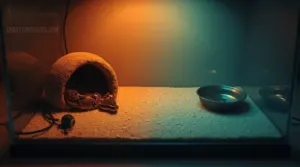
With your heat source chosen and sized, the next job is deciding exactly where it goes. For an under-tank heater, cover only one-third to one-half of the enclosure floor. That leaves a warm side and a cool side, so your snake can move between them and regulate itself.
Put the mat directly beneath the warm hide. If you’re using an overhead panel, mount it at one end so the temperature gradient runs lengthwise.
Attach everything firmly. Peel the adhesive backing and press the mat onto a clean, dry surface. Screw or bracket radiant panels tight so they can’t shift or fall. Keep every heating element away from walls, plants, and decor, and never rely on a heat rock.
If you’re still choosing a mat, this guide to snake heating pads for ball pythons explains which sizes and types suit your enclosure best.
Connect The Thermostat and Position Its Probe
Now we’ll wire it up. The thermostat is what keeps your heater from running unchecked, so every heat source needs its own.
Follow these steps in order:
- Plug the heater’s power cord into the thermostat’s outlet, then plug the thermostat into a surge protector.
- Set the probe where your snake actually spends time, such as the warm hide floor or basking surface.
- Fasten the probe cord with cable ties or silicone so it can’t be pulled loose.
Never bury the probe in substrate or press it against glass, since both insulate it and give false readings. If you’re using foil tape, leave a quarter to half inch of the tip exposed.
Once your probe is placed correctly, this corn snake enclosure setup guide shows how to build the rest of the habitat around those readings.
Then verify with a temperature gun at the surface.
Place Thermometers to Monitor The Temperature Gradient
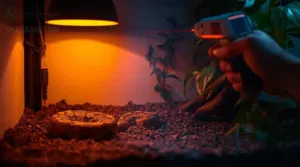
Mount one digital thermometer on each side of the enclosure, with the probe about an inch above the substrate. That’s the height where your snake actually rests, and ceiling readings run falsely warm. Skip the glass and walls too, since they only tell you the surface temperature of the material.
Put the first probe on the warm side, directly under the heat source, and the second in the cool zone, in the shade. Secure both with zip ties, hot glue, or a fixture so your snake can’t shift them.
Aim for 88–92°F on the warm side and 76–80°F on the cool side. Then point an infrared temperature gun at the substrate under the heater, where you want roughly 95°F.
Test Enclosure Heating Before Introducing Your Snake

Run your full heating setup for 24 to 48 hours before the snake goes anywhere near the enclosure. We’ll use this window to confirm that thermostatic control holds steady and that heat distribution matches what your snake needs.
Check the basking surface with an infrared thermometer. It should read 88 to 92°F. Then measure the cool side, which should stay between 74 and 80°F and never dip below 70°F overnight. Compare your thermostat’s reading with an independent thermometer at the probe location, and watch for any temperature spike as the element cycles on and off.
Track humidity and condensation. Confirm the hot spot fits a full coil and nothing lets your snake escape. If a number drifts, adjust and retest.
Inspect and Maintain Your Heating Equipment
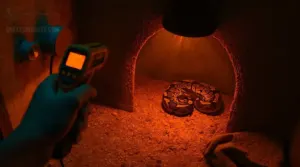
Imagine this: your thermostat reads 88°F, but an infrared gun shows 97°F on the hide floor. A drifting probe or a failing mat is the likely cause, and it’s the kind of quiet problem that becomes a temperature spike overnight.
A thermostat can read a safe temperature while the floor beneath your snake quietly runs far hotter, so trust a second thermometer
To inspect and maintain your heating equipment, build an inspection schedule you’ll actually follow. Check the probe position daily. Look over mats, panels, bulbs and sockets weekly for hot spots, discoloration or loose fittings. Once a month, compare your thermostat against a separate thermometer and replace anything that’s off by more than 3°F.
Don’t skip regular cleaning. Wipe dust off ceramic emitters with a dry cloth and clean your infrared thermometer’s lens with microfiber. Heat source malfunction rarely announces itself.
Frequently Asked Questions (FAQs)
What should I do if the power goes out?
A single candle flame in a dark room means someone planned ahead. Your power outage plan should start there: insulate the enclosure with towels, leave ventilation, skip feeding, and check temperatures with a battery thermometer.
How do I keep humidity up while heating?
Heat is a thief that steals moisture, so fight back. Use a damp coconut fiber substrate, a large water bowl over the heater, and partly covered ventilation. Keep the thermostat steady and humidity near 50-60%.
Is 70 degrees too cold for a ball python at night?
Not usually. Seventy degrees is the lowest safe point, and it’s fine for a night if your snake can still reach a warm hide at 80-85°F. Below that, add a ceramic heat emitter.
How do I heat a ball python enclosure in winter?
Picture a cold windowsill in January, and your snake’s tank sitting right beside it. Keep the warm hide at 86-90°F with a ceramic heat emitter, run through a thermostat, and let nights stay 70-78°F.
Can I use a heater with a glass lid?
Wondering if glass will hold up? Yes, with the right setup. Use an under-tank heat mat or an externally mounted ceramic emitter, cover most of the lid, keep gaps for airflow, and run everything through a thermostat.
Is it safe to leave a heater on overnight?
Leaving a heater on all night sounds safe until the one night it isn’t.
Yes, but only with a thermostat with probe, where it measures the heated surface. Check temperatures after setup and again overnight.
Conclusion
Picture a keeper who tests her setup for a full day, spots the probe sliding off its mount, and fixes it before her snake ever arrives. That small catch prevents a burn.
Now you know how to safely install a heater in a ball python enclosure: choose the right source, secure it, set the thermostat, and verify with thermometers. Safe heat isn’t a one-time job, it’s a habit, and your snake depends on it nightly.