This site is supported by our readers. We may earn a commission, at no cost to you, if you purchase through links.

Ball pythons come from the grasslands and scrublands of West Africa, where the ground absorbs heat from the sun and radiates it back up through the night. Their bodies evolved to draw warmth from below, not above. That one fact changes everything about how you heat their enclosure.
A lot of keepers assume an under tank heater is mandatory—others ditch it entirely and wonder why their snake won’t eat. The truth sits somewhere in the middle, and it depends heavily on your setup, your ambient room temperature, and the substrate depth you’re working with.
Get the thermal gradient right and your ball python thrives. Miss it, and you’ll see sluggish digestion, refusal to feed, and a snake that hides on the cool side around the clock. The numbers, the equipment choices, and the safety steps that actually make it work are all here.
Table Of Contents
- Key Takeaways
- Do Ball Pythons Need UTHs?
- Safe Under Tank Heater Setup
- Heating Alternatives and Night Heat
- Top 5 Ball Python Heating Items
- Frequently Asked Questions (FAQs)
- Is 70 degrees too cold for a ball python at night?
- What is the best heating setup for a ball python?
- How much heat does a ball python need?
- Do reptile heating pads go in or under the tank?
- How often should ball python thermometers be calibrated?
- What humidity levels do ball pythons need during shedding?
- What enclosure size does an adult ball python need?
- How long should lighting stay on each day?
- Can ball pythons be kept in glass tanks safely?
- Conclusion
Key Takeaways
- An UTH isn’t always required — what truly matters is hitting a warm side of 88°F–92°F, a cool side of 76°F–80°F, and never letting nighttime temps dip below 75°F.
- Always pair any heat source with a proportional thermostat, because an unregulated pad or emitter can burn your snake faster than you’d expect.
- Keep at least one inch of substrate over any under-tank heater, and limit it to covering 25%–33% of the floor so your ball python can move freely between hot and cool zones.
- Skip heat rocks entirely and avoid visible-light bulbs at night — ceramic emitters and radiant heat panels deliver safe, light‑free warmth that won’t disrupt your snake’s natural rhythm.
Do Ball Pythons Need UTHs?
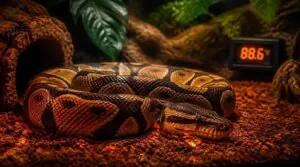
Under-tank heaters can be a solid tool for keeping your ball python warm, but they’re not the only option — and not always a must-have. What matters most is that your enclosure hits the right temperatures consistently. Here are the key numbers you need to know.
If you’re weighing your options, this breakdown of ball python heat source options covers the pros and cons of each method so you can choose what works best for your setup.
Helpful, Not Always Required
Since ball pythons regulate body heat through natural thermoregulation, a UTH isn’t always mandatory—your room’s baseline temperature decides that. Your heat source selection matters most. Aim for a steady temperature gradient across the tank. Before buying, weigh these basics:
- Room temperature
- Tank material
- Enclosure size
- Existing heat sources
Get those right, and your ball python thrives without extra gear.
Warm Side: 88°F–92°F
Your ball python’s warm side should always hit 88°F–92°F, measured right on the substrate. This range helps digestion and keeps shedding efficient by preventing dry skin.
If your snake still balls up or strikes despite good temps, patient handling techniques from this ball python taming guide can help build trust over time.
Surface temperature peaks can climb higher under a UTH, creating a true microclimate your snake can soak in. Place your thermocouple probe directly above the heater for accurate readings across the full temperature gradient.
Cool Side: 76°F–80°F
The warm side does the heavy lifting, but the cool side is where your ball python escapes the heat. Keep it at 76°F–80°F so your snake can self-regulate without stress.
Pairing a reliable thermostat with your cool side setup matters more than you’d think — explore the differences between thermostat types for snakes to find one that keeps temps steady without constant adjustment.
- Acts as a thermoregulation escape zone
- Prevents heat pooling across the enclosure floor
- Buffers against nighttime cold stress below 75°F
- Helps natural substrate heat exchange
Ambient Range: 80°F–85°F
The cool side keeps your snake comfortable, but ambient air temperature is what ties the whole enclosure together. Aim for 80°F–85°F throughout the tank.
This baseline promotes metabolic stability and prevents sharp temperature swings between the warm and cool zones. Your ball python relies on that steady middle ground to regulate digestion and activity across the day.
Night Minimum: 75°F
When the lights go out, your ball python still needs warmth. Don’t let nighttime temperatures drop below 75°F (24°C) — that threshold protects against metabolic slowdowns and respiratory infections that thrive in cold enclosures.
Seasonal dips are the sneakiest threat. A thermostat-controlled UTH or ceramic emitter keeps nighttime heating stable, even when your room cools unexpectedly.
Safe Under Tank Heater Setup
Setting up an under tank heater the right way makes all the difference between a safe, comfortable snake and a serious burn risk. There are a few key steps you’ll want to follow before you ever plug one in. Here’s what every safe UTH setup needs to include.
Exterior Underside Placement
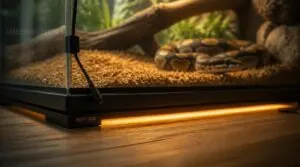
The safest place for your under tank heater is outside the enclosure, fixed to the bottom exterior surface. This keeps the heating element completely separated from your snake’s body.
Keep in mind that your substrate choice can affect how evenly heat travels upward, so reviewing a snake terrarium heating options comparison can help you fine-tune your setup for a stable thermal gradient.
- Mount on a stable, level surface
- Seal joints to prevent heat loss
- Place the thermostat probe directly above the heater on the warm-side substrate
Covers 25%–33% Floor
Your under tank heater should cover only 25%–33% of the floor. That one-third rule isn’t arbitrary — it creates the thermal gradient your ball python needs to self-regulate.
| Zone | Temperature Range |
|---|---|
| Basking (warm side) | 88°F–92°F |
| Cool side | 76°F–80°F |
| Ambient air | 80°F–85°F |
| Night minimum | 75°F |
| Winter conditioning | 70°F–75°F |
Leave the rest unheated. That open floor space is your burn risk buffer and your snake’s escape route when it gets too warm.
Always Use a Thermostat
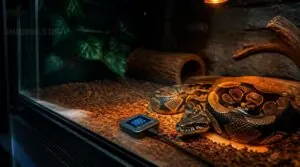
A thermostat isn’t optional — it’s the one thing standing between your UTH and a burned snake. Without it, a heat mat runs unchecked and can spike well beyond safe levels.
Proportional thermostats are the best choice. They fine‑tune power output gradually rather than cutting heat on and off, which means fewer temperature swings. Using energy saving programmable thermostats can further reduce heat mat usage and lower electricity costs.
At Least One-inch Substrate
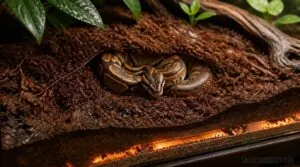
One inch of substrate between your ball python and the heat mat isn’t a suggestion — it’s a safety buffer. Without it, your snake can rest directly against a surface that runs hotter than it should, even with a thermostat in place.
Loose substrates like coconut husk or cypress mulch work best at this depth. They create thermal mass, which means the floor temperature stays stable rather than spiking and dropping. That consistency matters more than most keepers realize.
This depth also encourages natural behavior. Ball pythons burrow, and a one-inch layer gives them just enough room to regulate body temperature by nestling beneath the surface. Think of it as letting your snake do what it was built to do.
Four reasons to never skip this minimum:
- Belly burn prevention — a thin layer lets heat concentrate and contact skin directly
- Temperature buffering — substrate mass slows overnight cooling and reduces fluctuations
- Humidity retention — deeper substrate holds moisture better, supporting clean shed cycles
- Microclimate control — your python can self-regulate by choosing depth rather than side-to-side position
The insulation effect even buys you time during power outages, as the substrate holds warmth longer than bare glass would.
Monthly Pad Safety Checks
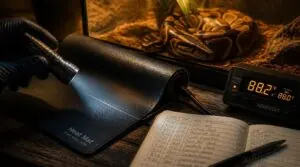
Your heat mat won’t warn you before it fails. That’s why a monthly pad safety check is non-negotiable.
Inspect electrical cords for fraying, check the thermostat accuracy, and document everything in a safety log. Look for cracks or peeling on the pad surface — these are early signs of a real heat mat fire hazard.
Heating Alternatives and Night Heat
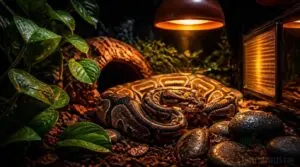
Under tank heaters aren’t your only option for keeping temperatures where they need to be. Several other heating tools work just as well — or even better — depending on your setup. Here’s a look at the most reliable alternatives and how to handle nighttime heat safely.
Ceramic Heat Emitters
A ceramic heat emitter is one of the smartest alternatives to an under tank heater. It converts electricity into infrared heat with zero visible light, so your ball python’s nighttime cycle stays intact.
Always pair it with a thermostat — unregulated heat can injure your snake fast. Keep it away from glass walls to prevent stress fractures.
Radiant Heat Panels
Radiant heat panels mount on the enclosure top and emit infrared energy downward, warming your ball python and the substrate directly — not just the air. That’s a meaningful difference. Your snake absorbs heat more naturally, and temperature gradient stays stable without the burn risk of a misplaced under tank heater.
- No visible light, so nighttime stays dark
- Surfaces stay cool to the touch
- Even heat distribution eliminates cold spots
- Pairs cleanly with a thermostat for precise control
- Low maintenance — just wipe occasionally and check mounting hardware
Panel installation is straightforward. Most units sit flush on the mesh top, keeping your setup clean and low-profile. Energy efficiency is a genuine advantage too: because infrared energy heats objects rather than air, less warmth escapes when you open the enclosure. For ball python reptile heating, that consistency matters.
Heat Cables Under Substrate
If radiant panels handle top-down warmth, heat cables work from the ground up.
Buried 25–50 mm deep in substrate, they create a vertical temperature gradient that your ball python can actually feel beneath its belly.
Moist substrate boosts thermal conductivity, spreading heat more evenly.
Always pair cables with a thermostat — unregulated cable heat causes burns just as fast as a UTH.
Avoid Dangerous Heat Rocks
One heating device you should never use is the heat rock.
These gadgets can’t be reliably regulated, which means surface temperatures spike unpredictably. Your ball python rests on it, absorbs that uncontrolled heat directly into its belly, and ends up with serious thermal burns — often before you notice anything is wrong. No thermostat fixes this. Just avoid them entirely.
Heat rocks spike unpredictably, burn your ball python from the belly up, and no thermostat can fix that
No Visible Night Bulbs
At night, your ball python doesn’t need light — it needs warmth without disturbance. Visible bulbs disrupt natural nocturnal rest cycles, creating unnecessary stress.
Keep nighttime heat delivered through:
- A UTH regulated by a thermostat
- A ceramic heat emitter
- A radiant heat panel
All three provide infrared heat, zero light — exactly what safe temperature regulation looks like after dark.
Top 5 Ball Python Heating Items
Once you understand how ball python heating works, picking the right gear becomes much easier. These five products cover the most reliable options — from heat pads and cables to thermostats and emitters. Here’s what’s worth having in your setup.
1. iPower 8×12 Reptile Heat Pad
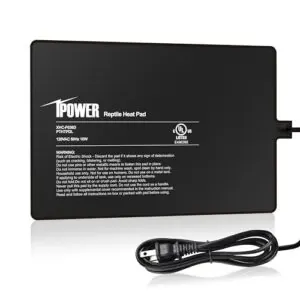
The iPower 8×12 Heat Pad is a solid starting point for warming a small or medium ball python enclosure. At 16 watts, it draws minimal power while maintaining a steady surface temperature around 86°F. Its PTC heating film spreads heat evenly, and the 3M adhesive keeps it firmly against the glass.
Keep in mind: this pad has no built-in thermostat, so you must pair it with an external controller — otherwise you risk burning your snake.
| Best For | Reptile, amphibian, small mammal, and plant terrarium owners running tanks up to 30–40 gallons who want an affordable, energy-efficient heating solution. |
|---|---|
| Wattage | 16 W |
| Thermostat Included | No |
| Heat Delivery | PTC conductive film |
| Primary Use | Under-tank or side heating |
| Enclosure Fit | Up to 40 gal |
| Safety Feature | Waterproof surface |
| Additional Features |
|
- PTC film distributes heat evenly across the surface, avoiding hot spots that could harm your pet
- 3M adhesive sticks firmly to glass and holds up through regular cleaning without peeling
- At just 16 watts, it keeps energy costs low compared to higher-wattage heating options
- No built-in thermostat means you must buy an external temperature controller separately to stay safe
- Bottom-mounting under a solid surface is a fire hazard — side or elevated placement only
- Not powerful enough for tanks larger than 40 gallons without adding supplemental heat sources
2. Inkbird Dual Relay Temperature Controller
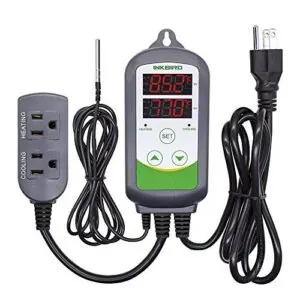
The Inkbird Dual Relay Temperature Controller is the missing piece if you’re already running an unregulated heat pad like the iPower. It controls both heating and cooling through two independent relays, so you can dial in your warm side set point without worrying about runaway temps.
The dual display shows your current reading and target side by side. Accuracy sits at ±1°C, well within safe range for ball pythons.
Pair it with your heat mat and your setup becomes genuinely reliable.
| Best For | Reptile keepers, homebrewers, and hobbyists who need reliable, automatic temperature control for enclosures, fermentation setups, or small refrigeration units. |
|---|---|
| Wattage | Controls up to 1,100 W |
| Thermostat Included | Yes |
| Heat Delivery | Electronic relay control |
| Primary Use | Temperature regulation |
| Enclosure Fit | Universal |
| Safety Feature | High/low temp alarm |
| Additional Features |
|
- Controls both heating and cooling independently through dual relays, giving you precise two-way temperature management in a single unit
- Dual display shows current temp and set point at the same time, so you’re never guessing where things stand
- Retains your settings after a power outage, so your setup picks back up without any manual reset
- Capped at 1100W, which rules out larger space heaters or high-draw appliances
- No built-in Wi-Fi or smart-home support — you’ll need extra hardware for remote monitoring
- Only one sensor included, so managing multiple zones means buying additional controllers
3. Zoo Med Reptile Heat Cable
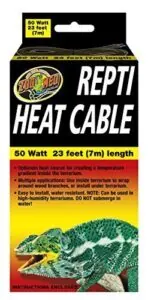
The Zoo Med Reptile Heat Cable gives you flexibility that a flat pad simply can’t match. Its 23-foot heating length lets you snake it under a breeder rack, coil it beneath the substrate, or wrap it around cage furniture for localized warmth exactly where your ball python rests.
At 50 watts, it runs efficiently without overwhelming a 30–40 gallon setup. Pair it with a thermostat — always — and check the cable monthly for fraying or damage.
| Best For | Reptile keepers who want flexible, targeted heat distribution across breeder racks or multiple enclosures in a 30–40 gallon range. |
|---|---|
| Wattage | 50 W |
| Thermostat Included | No |
| Heat Delivery | Flexible heating cable |
| Primary Use | Supplemental or rack heating |
| Enclosure Fit | 30–40 gal |
| Safety Feature | Water-resistant cable |
| Additional Features |
|
- At 23 feet long, it’s versatile enough to wrap around branches, run under substrate, or snake through a breeder rack for precise heat placement
- Low 50W output keeps temperatures manageable in smaller habitats without the risk of overheating
- Lightweight and water-resistant design makes it easy to reposition or clean around
- Requires a separate thermostat to operate safely — it’s an added cost and step that can’t be skipped
- 50W may fall short for larger or heavily insulated enclosures that need more consistent ambient heat
- The 6.5 ft cold lead limits where you can realistically position your power source relative to the enclosure
4. Fluker Ceramic Heat Emitter
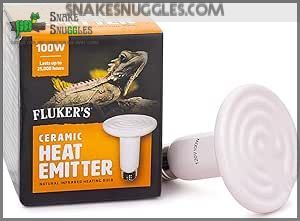
When your ball python needs warmth after dark, the Fluker Ceramic Heat Emitter earns its place. At 100 watts, it pumps out steady infrared heat without a single flicker of visible light — no disrupted sleep cycles, no stressed snake.
That large circular surface spreads heat evenly across the basking zone, targeting the 88°F–92°F range your python needs to digest properly. Pair it with a thermostat. Without one, you risk cooking your enclosure. Lifespan runs two to three years.
| Best For | Reptile and amphibian owners who need reliable, round-the-clock ambient heat without disturbing their pet’s natural light cycles. |
|---|---|
| Wattage | 100 W |
| Thermostat Included | No |
| Heat Delivery | Ceramic infrared emitter |
| Primary Use | Ambient night heating |
| Enclosure Fit | Any size |
| Safety Feature | No UV or visible light |
| Additional Features |
|
- Emits steady infrared heat with zero visible light, making it perfect for nocturnal species or overnight use
- Long lifespan of 2–3 years keeps replacement costs low
- Wide circular emitter spreads heat evenly across the basking area
- Provides no illumination, so you’ll need a separate bulb for daytime lighting
- Must be used with a thermostat — running it unregulated risks dangerously overheating the enclosure
- A failed emitter can melt or damage the lamp socket, so the fixture needs inspection when replacing
5. Zilla Reflector Dome 5.5 Inch
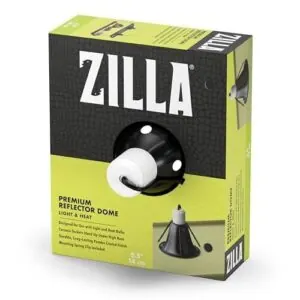
The Zilla Reflector Dome is the housing your heat bulb plugs into — not a heat source itself. That distinction matters. This 5.5-inch dome fits bulbs up to 60 watts and clips securely onto screen tops with its spring clip, so it won’t shift during feeding nights.
The reflective white interior pushes heat downward into the basking zone instead of letting it scatter. Just remember: it has no built-in thermostat, so pair it with one.
| Best For | Reptile owners who need a reliable, no-frills dome fixture for mounting a basking or heat bulb on a screen-top terrarium. |
|---|---|
| Wattage | Up to 60 W |
| Thermostat Included | No |
| Heat Delivery | Clamp lamp housing |
| Primary Use | Heat and light direction |
| Enclosure Fit | Small to medium tanks |
| Safety Feature | Inline on/off switch |
| Additional Features |
|
- The reflective white interior channels heat and light directly into the basking zone, making your bulb work more efficiently
- The spring clip keeps the dome firmly in place on screen lids — no wobbling or sliding during feeding time
- The inline on/off switch means you can cut power quickly without hunting for the outlet
- No thermostat built in, so you’ll need a separate temperature controller to avoid overheating your reptile
- Tops out at 60 watts, which may not be enough for larger enclosures or species that need intense heat
- The metal exterior gets hot during long sessions, so handle with care when adjusting
Frequently Asked Questions (FAQs)
Is 70 degrees too cold for a ball python at night?
Yes, 70°F is too cold for a ball python overnight. Aim for a nighttime minimum of 75°F. Dropping below that shrinks the thermal gradient your snake needs to regulate its body temperature.
What is the best heating setup for a ball python?
The best heating setup combines a thermostat-regulated UTH covering one-third of the floor, a ceramic emitter for nights, and digital thermometers on both sides to confirm your gradient stays accurate.
How much heat does a ball python need?
Your ball python needs a warm side of 88°F–92°F, a cool side of 76°F–80°F, and ambient air around 80°F–85°F. At night, don’t let temps drop below 75°F.
Pairing these temperature ranges with proper hatchling care practices—like waiting for that first shed before feeding—is covered in detail in this complete guide to breeding ball pythons.
Placing your heat source on just one end of the enclosure creates that essential gradient, letting your snake move freely between warmth and cool — for more setup tips, check out this guide to optimal snake habitat temperatures.
Do reptile heating pads go in or under the tank?
Heating pads go under the tank, not inside it. Attach the pad to the exterior underside of the enclosure. This keeps your snake from direct contact with the heat source.
How often should ball python thermometers be calibrated?
Check your thermometers every month. If you use probes daily, a quick accuracy check every 2–4 weeks catches drift before it becomes a problem for your snake.
What humidity levels do ball pythons need during shedding?
During shedding, raise humidity to 70%–80%. Once the eyes turn blue, target closer to 80%. After the shed completes, drop back down to a normal 55%–65% range.
What enclosure size does an adult ball python need?
An adult ball python needs a minimum enclosure of 36 × 18 × 12 inches, but most keepers prefer 48 × 24 × 24 inches. That extra space lets your snake move, thermoregulate, and feel secure.
How long should lighting stay on each day?
Keep lighting on for 12 hours a day. Aim for lights on at 6:00 AM and off at 6:00 PM. A simple timer controls this automatically, keeping your snake’s rhythm steady.
Can ball pythons be kept in glass tanks safely?
Yes, glass tanks work fine for ball pythons. They offer clear visibility, but heat escapes faster than PVC. Pair your setup with a reliable thermostat and monitor both sides of the gradient closely.
Conclusion
Picture a ball python wedged under a warm rock at dusk, belly pressed against heat‑soaked earth—that’s the blueprint your enclosure needs to copy. Whether ball pythons need an under‑tank heater depends on your room temps, your substrate depth, and your heating stack.
Nail the gradient. Run a thermostat. Check your pad monthly.
Get those numbers right, and your snake eats well, moves freely, and stays exactly where it should be.