This site is supported by our readers. We may earn a commission, at no cost to you, if you purchase through links.

A ball python coiled on a heat mat can sit at a perfect 88°F belly temperature while the air around it stays a chilly 74°F, and that gap trips up more new keepers than almost anything else in the hobby. Heat lamps and heat mats don’t just look different, they warm your snake through completely different physics: one radiates heat through open air, the other relies on direct surface contact. Pick the wrong one, or use it the wrong way, and you risk anything from sluggish digestion to serious burns.
Understanding the real difference between heat lamp and heat mat setups means knowing what each device does to your enclosure’s air, humidity, and thermal gradient, not just its price tag or wattage. Your snake’s species, its natural habitat, and even your enclosure’s ventilation all factor into which heat source actually keeps it healthy.
Table Of Contents
- Key Takeaways
- Heat Lamp Vs Heat Mat: Key Differences
- Heat Lamp Benefits and Drawbacks
- Heat Mat Benefits and Drawbacks
- Which Heat Source Suits Your Snake?
- Safe Heating Setup and Monitoring
- Frequently Asked Questions (FAQs)
- Do I need a heat lamp if I have a heat mat?
- Which is better for snakes, a heat lamp or a heat mat?
- Which is better, a heat lamp or a heat plate?
- Do heat mats use a lot of electricity?
- Can I use a heat mat and lamp together?
- How often should I replace a heat lamp bulb?
- What wattage heat lamp do I need for my tank?
- Are heat mats safe for glass enclosures?
- Do gravid or baby snakes need different heating?
- Conclusion
Key Takeaways
- Heat lamps warm through radiant heat that spreads across the air, while heat mats work through direct surface contact, so each device affects your enclosure’s temperature and humidity in totally different ways.
- Heat mats are far more energy-efficient and long-lasting than heat lamps, pulling just 4-25 watts and lasting up to 100,000 hours compared to a lamp’s 40-100 watts and much shorter lifespan.
- Your snake’s natural habitat should guide your choice, since arboreal species like green tree pythons need overhead heat lamps for basking, while burrowing species like sand boas do better with belly-level heat mats.
- No matter which heat source you choose, always pair it with a thermostat and properly placed temperature probe, since running either device unregulated risks burns, thermal runaway, or other serious harm to your snake.
Heat Lamp Vs Heat Mat: Key Differences
For keeping your snake warm and healthy, choosing between a heat lamp and a heat mat isn’t just about preference, it’s about understanding how each one actually works.
Heat mats warm from below to mimic ground heat, while lamps radiate warmth like natural sunlight, so this guide to the difference between heat pads and heat lamps for snakes can help you match the method to your setup.
These two heat sources handle warmth in genuinely different ways, from how they spread heat to how much power they pull from the wall.
Here’s what sets them apart, point by point.
Radiant Versus Conductive Heat
Since heat lamps and mats warm your snake through entirely different physics, understanding heat transfer methods matters before buying either.
| Heat Type | How It Works |
|---|---|
| Radiant | Energy travels through air, absorbed by skin |
| Conductive | Direct surface contact transfers warmth |
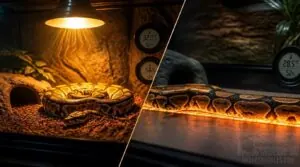
Radiant heat skips the air, targeting your snake directly. Conductive heat relies on thermal conductivity, warming only what touches the mat’s surface, creating an instant, localized hotspot. This distinction reflects the fundamentals of conduction, convection and radiation, which explain why each heating method behaves so differently in a snake’s enclosure.
Air Versus Surface Warming
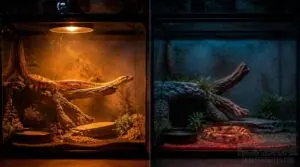
A lamp warms the whole enclosure through convective heat transfer, raising ambient air as warmed layers mix upward. A mat skips the air entirely, heating only what touches it, so vertical temperature mixing barely happens.
| Factor | Heat Lamp | Heat Mat |
|---|---|---|
| Air Impact | Raises ambient temps | Minimal |
| Humidity | Increases evaporation | Little change |
| Surface Albedo | Less relevant | Affects absorption |
Basking Gradient Versus Steady Warmth
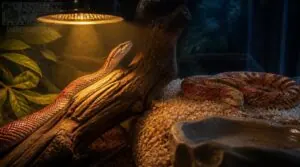
That air-versus-surface split sets up a bigger question: does your snake want options, or consistency? A heat lamp builds a true temperature gradient, letting your snake move toward or away from the basking spot for thermal regulation. A heat mat delivers warmth stability instead, steady belly heat with little room for positional adjustment or natural behavioral response.
| Setup | Best For |
|---|---|
| Heat Lamp | Active gradient-seekers |
| Heat Mat | Gravid females, neonates |
| Both Combined | Full thermal zoning |
Light and Humidity Effects
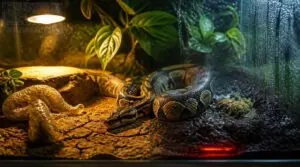
Beyond gradients, light and moisture shape your enclosure too. A heat lamp dries air fast, raising evaporation and stressing shedding below 40% humidity. Heat mats barely touch humidity levels, but poor ventilation near lamps invites mold on damp substrate.
| Source | Humidity Effect | Risk |
|---|---|---|
| Heat Lamp | Lowers humidity | Dry shed, mold if unvented |
| Heat Mat | Minimal change | Substrate mold near edges |
| Combined | Balanced | Requires monitoring |
Power Use and Lifespan
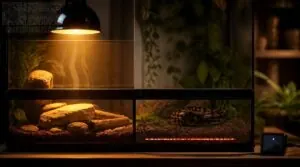
When your electric bill creeps up, the culprit’s often overhead. A heat lamp wattage rating runs 40-100 watts versus a heat mat‘s 4-25 watts, a real energy consumption comparison.
If you’re weighing long-term savings, this ceramic heat emitter vs heat lamp comparison breaks down wattage, durability, and true lifetime costs.
| Source | Wattage Range | Typical Lifespan |
|---|---|---|
| Heat Lamp | 40-100W | 2,000-10,000 hrs |
| Heat Mat | 4-25W | 50,000-100,000 hrs |
That heat mat lifespan advantage means fewer replacements and steadier power efficiency long-term.
Heat Lamp Benefits and Drawbacks
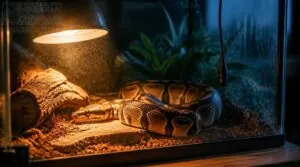
Heat lamps bring some real advantages to a snake enclosure, especially when you’re trying to mimic natural sunlight and give your snake room to self-regulate. That said, they come with trade-offs you’ll want to weigh before mounting one over your tank. Here’s what you can expect on both sides of the equation.
Strong Overhead Basking Heat
Nothing mimics the sun quite like a strong overhead heat lamp. It drives radiant flux straight onto your snake, pushing basking spot temperatures to 38-46°C depending on wattage and distance.
That intensity fuels fast heat recovery after cooling periods, real basking behavior support, and a sharper thermal gradient than any mat alone provides, especially for species craving that classic overhead heating experience.
Better Ambient Temperature Support
Since heat lamps warm the air itself, not just the basking spot, your snake gets real ambient air heating across the whole enclosure.
This reduces thermal stratification, helps steadier enclosure warmth, and shifts humidity patterns through better air movement.
Perks worth noting:
- Elevated air temperature enclosure-wide
- Smoother temperature gradient
- Reduced cold-corner pockets
- Easier thermostat control calibration
Natural Daytime Warming
Think of a heat lamp as a mini sunrise for your snake. It mimics natural basking by pairing light and warmth together, supporting day-night cycles your snake’s body clock depends on.
This sunlight simulation encourages normal thermoregulation behavior. Ball pythons and corn snakes both respond to that daytime brightness cue, settling into a basking spot when it clicks on, just like they would under real sun.
Higher Energy Consumption
That basking glow comes at a price. Basking bulbs usually pull 50 to 150 watts, while a heat mat runs just 4 to 24 watts for similar coverage, a wattage gap that adds up fast.
Running a lamp around the clock can raise your electrical draw enough to add $10 to $15 to monthly operating costs, since light production wastes energy your snake doesn’t actually need.
Burn and Fire Risks
A lamp placed too close can push surface temps past 120°F within minutes, scorching skin or bedding fast. Keep flammable material at least 12 inches away and always use a protective guard.
Check wiring often. Frayed cords near dry, flaking substrate invite ignition. Thermostat calibration and steady temperature monitoring aren’t optional, they’re your main burn prevention line of defense.
Heat Mat Benefits and Drawbacks
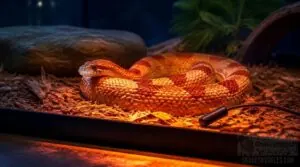
Heat mats work a little differently than lamps, and that changes what they’re good at. Where a lamp fills the whole enclosure with warmth, a mat focuses its energy right where your snake rests. Here’s what you can expect once you put one to use.
Efficient Surface-Level Warmth
When your snake needs belly heat instead of overhead warmth, a heat mat wins on efficiency. Surface contact heating sends energy straight into the animal’s body, with little wasted to ambient heat loss.
Paired with proportional temperature control, thermostat regulation efficiency stays high, drawing just 4 to 24 watts, far below a lamp’s power consumption.
Stable Contact Temperatures
Once your mat is dialed in, it holds there. A quality setup keeps contact temps within 28 to 32°C, with drift under 2°C across 24 hours.
That stability comes from:
- Built-in heat spreading layers
- Thermostat precision within 0.5°C
- Silicone or quilted material
- Non-slip contact surfaces
Reliable warmth, no guesswork, no midnight temperature checks needed for your snake’s thermoregulation.
Minimal Humidity Impact
Beyond stable temperatures, moisture control is where a heat mat quietly earns its keep. Since heat transfers through contact rather than open air, humidity levels barely shift, and substrate dryness stays consistent. Sensor accuracy confirms this: readings hold steady across ambient conditions.
Pair this with proper ventilation, and you get real humidity stability, something a heat lamp can’t offer nearly as reliably.
Limited Ambient Air Heating
Ask yourself this: does the enclosure feel warmer overall with a mat running? Not really. Low air warming effect is the tradeoff, since conductive heat stays surface-focused with minimal convection heating and reduced ambient temperature rise beyond the contact zone.
- A tank that stays cool to the touch except right above the mat
- Air near the glass barely shifting from room temperature
- A snake pressed flat against warmth, unbothered by cooler air above
Overheating Without Thermostat Control
Skip the thermostat and you’re gambling with thermal runaway risk, since a mat can climb well past safe belly heat and hold there for hours. Think of it like an engine running without a thermostat: coolant system failure and rising heat cause engine damage progression, from oil viscosity breakdown to metal deformation.
Your snake can’t escape a hot glass floor the way it dodges a lamp’s overheating glare.
A snake can’t escape a hot glass floor the way it would simply move away from an overheating lamp
Which Heat Source Suits Your Snake?

Choosing between a heat lamp and a heat mat isn’t a one-size-fits-all decision, since the right pick depends heavily on your snake’s species and how it naturally lives.
A ball python that burrows through leaf litter has very different heating needs than a green tree python that spends its life among branches.
Here’s what to think about before you decide what goes into your setup.
Natural Habitat and Behavior
In the wild, snakes are ectothermic, meaning every basking session or burrow retreat is really about survival, not comfort. They shift between sun patches and shaded burrows to hit their ideal body temperature.
Mimicking this rhythm through natural habitat simulation matters. Seasonal shifts and prey-driven activity also shape when they need warmth most, so your enclosure setup should mirror that natural gradient.
Arboreal Versus Burrowing Species
A green tree python and a Kenyan sand boa live worlds apart. Climbing preferences drive the divide: arboreal species need overhead heat lamps warming branches, while burrowing species crave belly-level heat mats mimicking warm soil.
- Prehensile tails aid branch gripping
- Curved scutes boost bark traction
- Lightweight bodies reduce branch load
- Ground contact fuels burrowers’ substrate interaction
Vertical movement favors lamps; ground-dwellers want mats.
Enclosure Size and Ventilation
Your enclosure size shapes which heat source actually works.
Snakes need 2 to 3 times their body length for movement, with vents placed on opposite sides for cross breeze.
Cramped tanks favor heat mats, easier to fit under small enclosures, while roomier setups with proper ventilation, 8 to 12 percent of floor area, support a heat lamp’s temperature gradient.
When Snakes Need Both
Some snakes just won’t settle for one heat source. Dual heat sources, a basking lamp plus a heat mat, create combined thermoregulation: overhead warmth for quick warmups, steady belly heat for digesting a meal. This pairing balances surface and air warmth, keeping a real temperature gradient across your reptile enclosure. Run both through a thermostat, and you’ve got thermal gradient balance your snake can actually use.
Separate UVB Lighting Needs
Here’s something many keepers miss: neither a heat lamp nor a heat mat provides UVB. That’s a separate job entirely.
Pair your UVB lighting with proper heat setup, using a reflector for coverage, matching bulb output to your species’ basking habits, and replacing bulbs on schedule since UVB fades before visible light dims. Monitor intensity with a UV meter, and time exposure to your snake’s natural day-night rhythm.
Safe Heating Setup and Monitoring
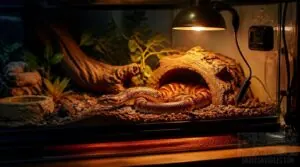
Picking the right heat source is only half the job, since even the best lamp or mat can turn dangerous without proper setup.
Snakes can’t tell you when something’s off, so safety comes down to the equipment and habits you build around them.
Here’s exactly what a secure, well-monitored heating system needs to keep your snake safe and comfortable.
Always Use a Thermostat
Running a heat lamp or heat mat without a thermostat is asking for trouble. A thermostat prevents extreme temperatures by cycling power automatically, cutting energy waste too.
For safe placement and monitoring, see ball python heat mat safety guidelines before setting up your enclosure.
Check compatibility with heaters before buying, since load ratings vary. Watch for fault detection methods like auto shutoff, and confirm the unit fits your setup before your snake ever moves in.
Position Probes at Hotspots
A thermostat only works as well as the probe feeding it data. Place it directly over the hottest spot, whether under a heat lamp or heat mat, using heat-resistant tape.
- Map the hotspot within a 15x15cm grid
- Avoid hides or substrate that skew readings
- Confirm with an infrared thermometer
Choose reptile-rated probes, they handle daily cycling without degrading.
Create a Safe Temperature Gradient
Once your probe sits right, build the whole picture around it. A safe temperature gradient spans roughly 10 to 30°C between zones, hotspot to cool refuge, whether you’re running a heat lamp, heat mat, or both. Place the cool zone opposite the heat source, then check multiple points regularly.
Watch behavior, too. If your snake avoids one zone, reassess it.
Secure Lamps With Guards
A well-placed gradient means nothing if your snake can touch the bulb. Guarded lamps use steel, ceramic, or polycarbonate housing to block direct contact while still passing heat through.
Look for adjustable clamps and gap spacing too narrow for a head to slip through, screws or clips for quick removal, and easy wiping to prevent dust buildup near your reptile enclosure.
Monitor Temperature and Snake Behavior
Numbers only tell half the story, so watch your snake too. Slithering toward the lamp signals a preferred basking zone, while gaping or restless pacing near cool spots often means overheating warning signs.
Track three things daily:
- Time spent per zone
- Feeding response
- Shedding cycle changes
These thermal preference indicators reveal whether your thermal gradient setup truly helps natural thermoregulation.
Frequently Asked Questions (FAQs)
Do I need a heat lamp if I have a heat mat?
Often, yes. A mat alone rarely warms enclosure air enough, especially for arboreal or diurnal snakes. Pairing it with an overhead lamp balances belly heat and ambient warmth, creating a true temperature gradient, always run both through a thermostat for safety.
Which is better for snakes, a heat lamp or a heat mat?
Like choosing between a campfire and a warm rock, it depends on your snake. Arboreal species thrive under a heat lamp for basking, while burrowers prefer substrate heating from a mat with steady, thermostat-controlled warmth.
Which is better, a heat lamp or a heat plate?
Heat plates function like mats, offering steady conductive warmth and better heat plate efficiency than lamps. For gradual, hands-on thermal management with strong temperature gradient control, heat lamps still win when you need broad basking heat and simulated daylight.
Do heat mats use a lot of electricity?
Your wallet can breathe easy here. A 12-watt mat running all day costs just 2-3 cents daily, and pairing it with a thermostat keeps energy consumption modest, making this heating solution genuinely budget-friendly for snake keepers.
Can I use a heat mat and lamp together?
Yes, pairing them works well. Use dual thermostat control for the mat and lamp separately, place the mat on the side for belly warmth, mount the lamp overhead for basking, and monitor humidity and gradient placement safety closely.
How often should I replace a heat lamp bulb?
Plan on swapping bulbs every 6 months with daily 8-hour use, since most last 5,000-7,000 hours. Watch for dimming or flickering, check wattage, and pair with a reliable thermostat for steady, safe temperature regulation.
What wattage heat lamp do I need for my tank?
Think of wattage as sunlight in a bottle: too little leaves your snake shivering, too much scorches it. For a 10-gallon tank, use 25-40 watts; 20-gallon, 50-75 watts; always pair with a thermostat for safety.
Are heat mats safe for glass enclosures?
Mostly, but with caveats. Direct glass contact risks thermal stress and cracking, so add insulation, avoid the base floor, and always pair the mat with a thermostat for reliable temperature control and hotspot prevention.
Do gravid or baby snakes need different heating?
It’s not one-size-fits-all: gravid females need steady, elevated warm-side temps for gestation warmth, while neonates need gentler, stable heat, minimal humidity impact, and precise thermostat control across defined temperature zones for neonate heat stability.
Conclusion
Your snake’s enclosure is a stage, and heat is the lighting that decides whether the whole scene works. The difference between heat lamp and heat mat comes down to matching physics to biology: radiant warmth for baskers, conductive warmth for bellies. Get the gradient right, add a reliable thermostat, and you’ll watch sluggish, stressed behavior disappear. Master this one variable, and every other part of snake care gets noticeably easier, letting your snake finally thrive.
- https://farmerboyag.com/blog/heat-lamp-vs-heat-mats-choosing-the-right-warmth-for-your-swine
- https://www.greenbuildingadvisor.com/question/bathroom-electrical-radiant-floor-vs-heat-lamp
- https://www.thebiodude.com/blogs/reptile-and-amphibian-lighting-faqs-and-help/here-s-why-you-shouldn-t-be-using-a-heat-mat-for-your-reptile