This site is supported by our readers. We may earn a commission, at no cost to you, if you purchase through links.
Most snake deaths in captivity trace back to one thing: inadequate thermal management. Not disease. Not diet. Temperature failure—slow, invisible, and easy to prevent if you know what you’re doing.
Snakes can’t generate their own body heat. Every biological process—digestion, immune response, even basic movement—depends on the temperatures you set. Get it wrong, and your snake doesn’t just feel uncomfortable. Its organs start shutting down.
If you’re unsure whether your setup is hitting the right temps, a guide to digital thermometers and hygrometers for boa constrictors can help you measure accurately.
Snake heating lamp requirements aren’t complicated once you understand the variables: wattage, gradients, thermostats, and safety protocols. What follows breaks each one down so you can build a setup that actually works.
Table Of Contents
Key Takeaways
- Temperature gradients — not disease or diet — are the leading cause of captive snake death, making precise thermal management your most critical keeper responsibility.
- Your enclosure needs both a warm basking zone (85–95°F) and a cool refuge (75–82°F) so your snake can self-regulate its metabolism and digestion on its own terms.
- A thermostat isn’t optional — unchecked heat sources can collapse the cool-side refuge and trigger fatal heatstroke within days, so dimming or pulse-proportional models are essential.
- Weekly equipment checks — calibrating probes, inspecting cords, and verifying basking temperatures — are the difference between a safe setup and a silent, preventable failure.
What Heat Lamp Does a Snake Need?
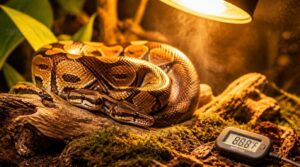
Not every heat lamp works for every snake, and choosing the wrong one can do more harm than good. Your snake’s species, enclosure type, and daily light cycle all play a role in what heating setup actually makes sense. Here’s what you need to know before picking a heat source.
For species like boas that rely on belly heat for digestion, it’s worth understanding why boa constrictors need belly heat to properly process their meals before deciding on overhead lamps alone.
Nighttime heating especially requires careful thought, since snakes often don’t need heat lamps after dark — but species and ambient temps can change that calculus entirely.
Heat Lamp Purpose
Snakes can’t generate their own body heat. That’s the main problem every keeper has to solve. A heat lamp delivers targeted radiant warmth directly to a basking zone, elevating surface temperatures fast without heating the whole room.
Using ceramic heat lamps can provide focused heat without emitting any visible light.
That warm zone does real work — it drives digestion support, activity, and thermal regulation. Without it, your snake’s metabolism stalls.
Daytime Versus Nighttime Heat
Daytime heat drives diurnal activity rhythms and metabolic digestion. At night, your snake needs nocturnal thermal stability — not darkness and cold.
Manage both phases:
- Run basking lamps only during the daily photoperiod
- Allow a controlled 5–10°F drop at night
- Never cut heat completely after lights out
- Prevent thermal shock with gradual transitions
- Support circadian rhythm with consistent day/night lighting cycles
Safe Heat Source Options
Once you’ve nailed the day/night cycle, the next decision is which heat source does the actual work.
Ceramic heat emitters (CHEs) convert electricity into infrared radiation — steady, wide-dispersion heat with zero light output. Electric infrared heaters warm surfaces directly without heating excess air volume, making them efficient for smaller enclosures. Never use combustion-based heaters indoors without carbon monoxide detectors and proper ventilation. A backup power supply keeps temperatures stable during outages.
Heat Lamps Versus Heat Mats
Both tools solve different problems. Heat lamps deliver radiant basking spots overhead — ideal for diurnal species that need a defined hotspot between 90–95°F. Heat mats warm the substrate from below, providing belly heat that aids digestion.
Lamps run 25W–150W; mats usually draw 4W–25W. Neither affects the other’s job. Most setups need both.
Heat Rocks to Avoid
Heat rocks are a dangerous heat source — skip them entirely. They create localized burn risks because snakes can’t detect damaging surface temperatures until tissue damage occurs. Uneven heat distribution produces hidden hotspots.
Heat rocks burn snakes silently — by the time damage registers, the tissue is already gone
Rocks crack under thermal stress, leak mineral leaching concerns into the habitat, and trap bacteria in crevices. No thermostat fixes these problems. Avoid them.
Required Snake Temperature Gradients
Getting the temperature gradient right is one of the most important things you can do for your snake’s health. A proper gradient gives your snake full control over its own body temperature — warm when it needs to digest, cool when it needs to rest. Here’s what each zone in your enclosure needs to look like.
Different snakes have surprisingly different needs, so it’s worth consulting a guide to snake habitat temperature requirements by species before you start setting up your zones.
Warm Side Temperatures
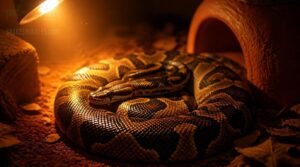
The warm side of your enclosure needs to reach 26–30°C (79–86°F) across the main zone, with a basking spot hitting 30–34°C for most species. Desert snakes push toward that upper limit; tropical species stay comfortable closer to 28°C.
Keep the basking area small — roughly 5–15% of the floor — so your snake can choose exactly how much heat it absorbs.
Cool Side Temperatures
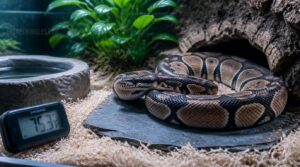
The cool side runs 75–82°F (24–28°C) — not an afterthought, but a critical part of your snake’s thermal regulation. Without it, your snake can’t self-regulate metabolism or digest prey properly.
A proper cool side also pairs beautifully with a bioactive setup, and our corn snake bioactive enclosure guide shows you how to build the whole gradient into a living habitat.
Don’t let it drop below 70°F. That slows digestion and stresses the animal. Your ambient room temperature does most of the work here — no extra heat source needed on this side.
Basking Spot Requirements
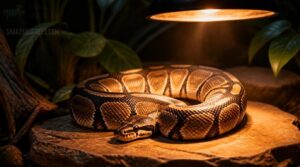
The basking spot is your snake’s thermostat dial. Aim for 85–92°F at the surface — measured with an infrared temperature gun, not guesswork. The lamp should deliver focused radiant heat to a defined patch, not flood the whole enclosure.
That patch must sit on a stable, non-slip surface. Slick substrate shifts under heat. Your snake won’t bask on unstable ground — and won’t thermoregulate properly without it.
Nighttime Temperature Drops
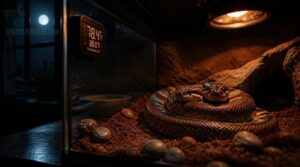
At night, your snake doesn’t need total darkness — it needs a thermal refuge. Ambient temperature can drop, but never below 70°F for most species. Desert snakes tolerate a dip to 60°F; tropical species won’t.
Substrate thermal mass slows surface cooling, buying time. If room temperatures fall below safe thresholds seasonally, a ceramic heat emitter keeps the warm side stable without disrupting darkness.
Species-Specific Heat Needs

Every species runs on its own thermal settings — get them right:
- Desert species: 90–100°F basking, 60–70°F nights
- Tropical species: 86–92°F basking, 75–82°F nights
- Ball pythons: 90–92°F warm side, 78–80°F cool side
- Corn snakes: 12-hour light cycle, 75–100 watt bulbs
- Arboreal snakes: higher ambient tolerance than terrestrial species
Match your setup exactly to the species. Wrong thermal gradients stress thermoregulation fast.
Choosing Safe Heat Lamp Wattage
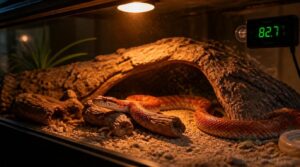
Wattage isn’t a one-size-fits-all decision — the right bulb for one setup can overheat or underwhelm another. Several factors determine what your enclosure actually needs to hit safe, stable temperatures. Here’s what to evaluate before you choose.
Enclosure Size
Enclosure size directly determines how much wattage you’ll need. A 5-foot ball python in a 4×2×2 enclosure demands more heating power than a juvenile corn snake in a 20-gallon tank, as larger air volumes lose heat faster.
The enclosure must provide 1.5× the snake’s body length, with 40–60% of floor space split between warm and cool zones to maintain a proper thermal gradient.
Tank Material
What worked for a 20-gallon glass tank won’t work the same way in a wood vivarium. Glass distributes heat evenly but loses it quickly, so you’ll need slightly higher wattage to compensate. Wood retains warmth better — lower wattage works.
Plastic enclosures demand low-wattage mats only; standard bulbs risk overheating or warping the shell entirely.
Room Temperature
Your room’s baseline matters more than you’d think. A cold room — say, 68°F — forces your heat source to work harder, meaning you’ll need higher wattage to hit target gradients.
Key ambient factors that shift your wattage needs:
- Winter HVAC dropping ambient air below 70°F
- Summer cooling pushing humidity past 60%
- Drafts destabilizing temperature regulation near the enclosure
- Seasonal thermostat adjustments affecting room baseline
- Dry air accelerating heat loss through glass
Ventilation Levels
Airflow pulls heat out faster than most keepers expect. High ventilation rates — especially in mesh-top enclosures — force your heat source to compensate, demanding more wattage to hold target gradients.
Stagnant air pockets trap humidity and skew your thermometer readings. Cross ventilation helps, but angle vents away from the basking zone. Direct drafts destabilize temperature control fast.
Overheating Risks
Too much wattage doesn’t just waste electricity — it kills snakes. Thermal gradient failure happens fast when your heat source runs unchecked, collapsing the cool-side refuge your snake depends on for temperature control.
- Restlessness or glass-surfing
- Open-mouth breathing
- Lethargy following basking
- Refusing water
- Heatstroke-level muscle tremors
A thermostat malfunction turns any setup dangerous overnight. Monitor basking temperature daily.
Thermostats and Temperature Monitoring
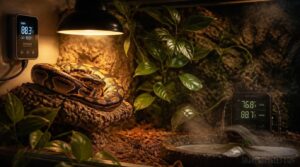
Getting the heat right isn’t just about picking a wattage and hoping for the best. You need the right tools to measure, regulate, and verify what’s actually happening inside the enclosure. Here’s what you’ll need to keep temperatures accurate and your snake safe.
Pairing the right thermometer and thermostat with ball python heat lamps that suit your setup gives you far more control over maintaining safe, consistent temperatures.
A reliable digital thermometer built for reptile enclosures gives you fast, precise readings so you can catch hot spots or cold zones before they become a problem.
Dimming Thermostats
A dimming thermostat doesn’t cut power on or off — it varies voltage continuously, holding your heat source at a precise target. Small adjustments, often 1–5% increments, keep the basking zone stable without thermal swings. That steady regulation also extends bulb lifespan by eliminating abrupt cycling.
Many units include automated day-night schedules, shifting temperatures automatically without manual intervention.
Pulse-Proportional Thermostats
Where a dimming thermostat adjusts voltage, a pulse-proportional model fires short power bursts to your heat source — cutting temperature fluctuations without constant cycling.
Most units handle up to 600 watts and support dual probes: one near the heater, one reading ambient air. Many include overheat protection that cuts power automatically. Calibrate the probes monthly to keep readings accurate.
Probe Placement
Place your thermostat probe 2–5 cm from the heat source — close enough to regulate accurately, far enough to avoid surface spikes. On the warm side, position it 1–2 inches from the basking spot for surface contact accuracy.
Use a second probe on the cool side for gradient validation. Keep both probes away from water bowls and drafts — microclimate interference skews readings fast.
Digital Thermometers
A digital thermometer is non-negotiable for any enclosure. These devices use a thermistor to convert temperature into a readable signal, delivering accuracy within ±0.1–0.2°C — tight enough to catch dangerous fluctuations early.
Place thermometers 6–8 inches above substrate to monitor air temperature accurately. The memory function lets you track trends without constant watching.
Keep batteries fresh. Low power silently degrades accuracy.
Infrared Temperature Guns
A digital thermometer tells you air temperature. An infrared temperature gun tells you what your snake is actually touching.
Point it at the basking surface and pull the trigger — you get an instant reading, no contact needed. Look for a 12:1 distance-to-spot ratio minimum. That keeps measurements precise rather than averaging a wide, useless zone.
Emissivity matters. Rocks and logs read differently than glass.
Heat Lamp Safety Requirements
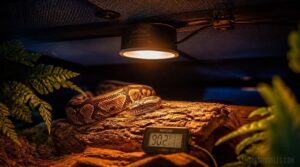
Getting the heat right is only half the job — keeping the setup safe is the other half. A single oversight, like an overloaded fixture or a dangling cord, can put your snake at serious risk. Here’s what to check and maintain to run a safe heating system.
Fixture Wattage Ratings
Every heat lamp fixture carries a maximum wattage rating — printed near the socket. Never exceed it.
Most standard fixtures cap at:
- 60 watts for enclosed dome lamps
- 75–100 watts for open-style fixtures
- Combined totals when running multiple bulbs
- Lower limits after any socket modification
Check the manufacturer spec sheet if the label fades. LED wattage efficiency means you can often meet temperature control needs at half the wattage, reducing overloading electrical circuits risks entirely.
Lamp Guards
Once your fixture wattage is confirmed, the next weak point is physical contact. A snake pressing against a hot bulb can burn in seconds.
Stainless steel mesh guards mount directly to dome fixtures via screws or clamps, maintaining airflow while blocking direct contact. Look for guards rated to 500°F with corrosion-resistant coatings — humid enclosures degrade uncoated metal fast.
Secure Cord Placement
Guards stop burns. Cords cause fires.
Route all heat lamp cords along the enclosure’s back edge, using cable management clips to keep them tight and out of reach. Slide protective cord sleeves over any run near a heat source. Moisture exposure risks are real — keep cords at least 15 cm from water dishes. Label every cord so inspections stay fast.
Water Bowl Distance
Cords are managed. Now keep the water safe too.
Place your snake’s bowl 6–12 inches from the basking area. Too close and water overheats — hitting 86–90°F promotes bacterial growth fast. Too far and your snake may avoid it, risking dehydration.
Never position the bowl directly under the heat lamp. That accelerates evaporation, spikes substrate moisture, and compromises temperature control inside the enclosure.
Weekly Equipment Checks
Weekly checks catch failures before your snake pays for them. Run through this every seven days:
- Inspect electrical cords for cracked insulation or exposed conductors.
- Calibrate temperature sensors against a known reference — deviation beyond ±0.5°C triggers action.
- Test safety guards and thermostat response times.
- Log temperature drift and update your maintenance record each week.
Miss a week. Miss a warning.
Frequently Asked Questions (FAQs)
What heat lamp does a snake need?
Snakes don’t need heat lamps — until they do. Without a precise heat source, temperature regulation fails entirely. A halogen basking bulb or ceramic heat emitter covers most species’ basic needs.
How often should snake heating lamps be replaced?
Replace heat lamps every 6–12 months. Output fades before bulbs fail visibly. Ceramic heat emitters last longer but still need annual performance checks to confirm basking temperatures stay within species-specific ranges.
Can UVB bulbs penetrate glass or plastic enclosures?
Ancient glassmakers never imagined their craft would trap UVB — but it does. Glass blocks UVB by over 90%. Plastic attenuation follows suit. Mount bulbs inside or above a mesh lid for direct line exposure.
What lighting schedule supports a snakes circadian rhythm?
A 12-hour light, 12-hour dark cycle is the reliable default. Consistency matters more than exact timing. Use a timer — manual switching disrupts your snake’s internal clock and throws off feeding and shedding cycles.
How should light fixture lenses be properly cleaned?
A dirty lens can slash UVB intensity by up to 30%. Monthly, unplug the fixture, wipe the glass lens with a microfiber cloth dampened in white vinegar and water. Never use abrasive pads.
Conclusion
A keeper once lost a ball python to a faulty thermostat — not negligence, just an unmonitored heat spike over three days. That single failure cost an animal its life.
Getting snake heating lamp requirements right isn’t about being perfect; it’s about systems. A calibrated thermostat, verified gradients, weekly equipment checks — these aren’t optional extras. They’re the baseline.
Your snake can’t tell you when something’s wrong. Your setup has to speak for it.