This site is supported by our readers. We may earn a commission, at no cost to you, if you purchase through links.
One thermometer near the basking spot won’t tell you what’s happening on the other side of the tank. That gap in data causes more heat-related deaths than most keepers realize. Reptiles regulate their body temperature by moving between warm and cool zones, so guessing at cool-side numbers puts your animal at real risk.
So how many thermometers does a terrarium need? For most snake and lizard setups, two is the baseline: one for the warm side, one for the cool side. Larger enclosures with multiple hides or heating elements often call for a third.
Get the placement right, and those readings become your best tool for building a gradient your reptile can actually use to thrive.
Table Of Contents
- Key Takeaways
- Most Snake Terrariums Need Two Thermometers
- When One Thermometer May Be Enough
- When Three or More Thermometers Help
- Place One Thermometer on Warm Side
- Place One Thermometer on Cool Side
- Measure Basking Surfaces Separately
- Choose The Right Thermometer Types
- Add Humidity Monitoring When Needed
- Check Thermometer Accuracy Regularly
- Use Readings to Adjust Temperatures
- Frequently Asked Questions (FAQs)
- Where to put a thermometer in a terrarium?
- How hot is too hot for a terrarium?
- Should a terrarium be warm or cold?
- How to control temperature in a terrarium?
- How often should terrarium thermometers be calibrated?
- Can smartphone apps replace physical thermometers accurately?
- Whats the average cost of a reliable thermometer?
- How quickly should readings update after adjustments?
- Conclusion
Key Takeaways
- Most snake and lizard terrariums need at least two thermometers, one for the warm side and one for the cool side, so your reptile can actually thermoregulate between zones.
- A single average temperature reading can hide huge swings across the enclosure, so relying on just one thermometer risks missing dangerous hot or cold spots.
- Larger enclosures, multiple heat sources, several hides, or tall vertical setups all call for three or more thermometers to track every microclimate accurately.
- Regularly checking placement, comparing devices, calibrating against a trusted reference, and watching min/max readings keeps your temperature data accurate and your reptile safe.
Most Snake Terrariums Need Two Thermometers
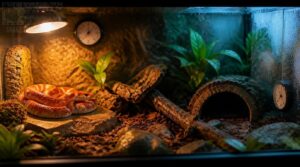
Most snakes can’t just handle one temperature all day. They need a warm side and a cool side to move between as their body demands. Here’s what two thermometers help you track, and why each spot matters.
Getting those temperatures right also protects your snake’s skin, since improper heat and humidity often lead to preventing stuck shed issues down the line.
Warm-side Temperature Monitoring
Two spots on the warm side matter most: the basking spot and the ambient air nearby.
- Verify basking surface temps with an infrared gun
- Check heat mat efficiency near hides
- Sample ambient air away from direct heat
Keep sensors off the lamp itself. For more precise setups, choosing the right temperature sensor types can improve reading accuracy across both zones. Accurate temperature gradient data starts with honest warm-side readings, not guesswork.
Cool-side Temperature Monitoring
Once the warm side reads true, shift focus to the coolest spot in the enclosure. This zone confirms thermal gradient stability and offers your snake a true retreat.
| Factor | Cool Side Target | Why It Matters |
|---|---|---|
| Placement | Away from heat/water | Probe placement accuracy |
| Range | Species-safe minimum | Prevents stress |
| Humidity | Monitored closely | Humidity impact cool zones |
Tracking The Thermal Gradient
With both readings in hand, you can now see the full picture. The thermal gradient is simply the gap between your warm and cool zones, and it’s what lets your snake self-regulate.
Track it daily using both thermometers together. Watch for:
- Stable basking temperature
- A cool zone that stays put
- Consistent gradient spread day to day
Species-specific Temperature Needs
Every species has its own preferred optimum temperature range, so your gradient targets shouldn’t be generic. Ball pythons want an 88-92°F warm retreat, corn snakes need 82-84°F for proper digestion, and desert lizards tolerate highs near 110°F. Even leopard geckos rely on a tight gradient (88-92°F warm, 75-80°F cool). Know your species before setting up thermometers.
When One Thermometer May Be Enough
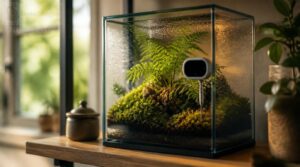
Not every setup needs a two-thermometer system. Some enclosures are simple enough that one device does the job just fine. Here’s when a single thermometer actually makes sense.
Small Uniform Enclosures
Small tanks under 20 gallons often heat evenly, so thermal uniformity makes single-point monitoring valid. Zone differences usually stay below 2°F.
Place one ThermometerHygrometer at mid-height to track ambient temperature and humidity together. For quarantine bins or juvenile reptile setups, this works well, though basking spots still need separate infrared surface readings for accuracy.
Central Thermometer Placement
A single sensor still needs the right spot to earn its keep. Skip the corners near heat lamps and vents. Aim for:
- Central location, away from direct heat sources
- Two-thirds up from the base for representative air sampling
- Snake level height, not glass level
Calibrate it monthly against a trusted device for accuracy.
Limitations of Average Readings
Here’s the catch: one number can’t describe a whole enclosure. Studies show gradient averages near 9.9°C while actual temps span 0.1°C to 38.7°C. That’s thermal gradient bias in action, averaging hides temperatures your snake actually feels.
One average temperature can hide a gradient spanning nearly 39 degrees, masking what your snake truly feels
A central probe misses hot basking spots and cool retreats alike, a real single point limitation worth respecting.
Temporary Quarantine Setups
Quarantining a new snake? Two thermometers, not one, since these setups are temporary but still need gradient stability monitoring.
Track warm and cool zones daily, verify snake level placement accuracy, and confirm your temporary heat source setup holds steady.
Run a quick thermometer verification routine each quarantine duration check.
It’s a short-term setup, but accuracy still matters for species specific climate needs.
When Three or More Thermometers Help
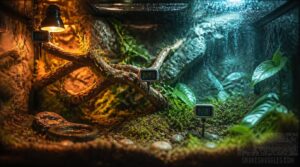
Sometimes two thermometers just don’t cut it. Bigger or more complex setups create extra variables that a simple gradient reading can’t capture. Here’s when it’s worth adding a third device, or even more.
Large Snake Enclosures
Big snakes need big real estate. Enclosures stretching 6 to 12 feet demand thermal gradient mapping, not guesswork.
With floor space near 3 square feet per meter of length, one thermometer just can’t capture warm-to-cool shifts across that much territory. That’s why serious keepers place three or more sensors, ensuring every corner of the reptile habitat stays accurately tracked.
Multiple Heating Elements
Two heat lamps working together? That calls for heat distribution mapping, not guesswork.
Place a thermometer near each element to check element cooperation assessment and confirm thermal balance optimization across the whole terrarium.
- Track each heat source separately
- Watch for overlapping hot zones
- Verify redundant heating verification during equipment checks
Mismatched elements create uneven gradients, so multiple sensors keep your setup honest.
Vertical Temperature Differences
Heat rises, so top and bottom readings rarely match. This thermal layering effect means air near the canopy can run several degrees warmer than substrate level.
Place sensors at multiple heights to capture this heat rise pattern through proper vertical air sampling. Convection impact varies by ventilation, so height-based monitoring keeps your thermal gradient setup honest from floor to basking branch.
Several Hides and Microclimates
Height isn’t the only wrinkle. Each hide box builds its own microclimate, with temperatures swinging 6 to 10°F from the rest of the enclosure.
- Snug hides run 2-4°F cooler than the basking zone
- Plant cover shifts humidity by 5-15%
- Dark hides trap nighttime moisture better
That’s why every hide deserves its own thermometer check.
Complex Enclosure Layouts
Once hides multiply, so do the variables. A layout with ramps, shelves, and split-level zones needs a real plan: map substrate layer depth, heater and vent alignment, and each vertical thermal zone before placing sensors.
Shallow substrate warms faster than deep layers, shifting nearby readings. Place thermometers where ramps meet shelves and near separated hides, so every microclimate gets tracked, not guessed at.
Place One Thermometer on Warm Side
Your warm side needs its own thermometer, plain and simple. Getting an accurate reading here takes more than just tossing a device on that end. Here’s exactly where and how to place it right.
Measure Near The Warm Hide
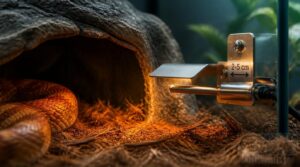
Your snake’s warm hide is where thermal regulation really happens, so thermometer placement matters most right here. Set the sensor 2 to 5 cm from the hide, at snake level, not floor level. Use a probe shield for radiant heat avoidance.
Track readings at the same height every time, this consistent height tracking keeps your temperature gradients reliable over weeks.
Avoid Direct Lamp Exposure
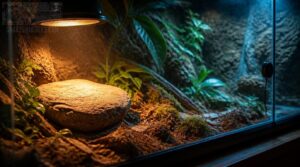
Since intense light can irritate a snake’s eyes and skin, keep your warm-side thermometer clear of the direct beam.
- Keep lamp housing placement 12+ inches away
- Use a diffusing shield for light diffusion
- Aim lamps at the rim, not the hide
- Prevent beam contact on your snake
- Build a gradual warmth gradient, not hotspots
Monitor Ambient Air Temperature
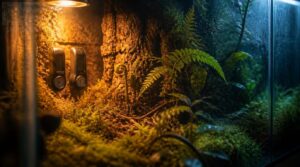
What does the air itself tell you? Your warm-side thermometer should track ambient air temperature, not just surface heat. Room temperature, airflow, and daily fluctuations all shift readings over time.
| Factor | Effect | Action |
|---|---|---|
| Airflow | Cools zone | Check vents |
| Season | Shifts baseline | Adjust heat |
| Drafts | Causes swings | Reposition |
| Room heat | Raises average | Recalibrate |
Position at Snake Level
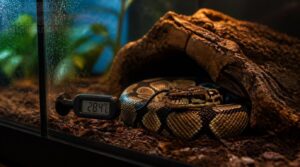
Two or three centimeters above the substrate, that’s where your snake actually lives and breathes, so that’s where your reptile thermometer belongs. This snake height placement avoids skewed floor or ceiling readings.
Keep the probe near warm hides for a real gradient verification. It confirms warm-side monitoring matches what your snake feels, not just what the glass shows.
Place One Thermometer on Cool Side
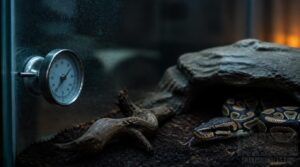
Your snake needs somewhere to cool off, too. That’s why the cool side of the tank deserves its own thermometer. Here’s what to keep in mind when you set it up.
Measure Near The Cool Hide
Where does your snake go when things heat up? Right to that cool hide. Cool hide placement matters, so keep your probe 2 to 5 centimeters from the opening, at snake level. Avoid airflow from vents nearby. Check readings at different times, since daily variation happens. Confirm your probe positioning isn’t touching substrate.
Avoid Water Bowl Interference
A water bowl sitting too close can quietly wreck your readings. Keep at least 5 inches of separation between the bowl and your probe, since evaporation cooling can drop temps 2 to 3 degrees nearby. Moisture also causes condensation, which throws off accuracy over time.
For humidity monitoring, place a combo thermo-hygrometer farther from standing water.
Detect Unsafe Temperature Drops
A sudden dip on the cool side isn’t just chilly, it’s a warning sign. Watch for a 1.5 C drop within 15 minutes, which often points to heater cycling issues or thermostat lag.
Overnight, don’t let temps fall more than 4 to 6 C. Anything sharper signals heater failure or a real gradient loss brewing.
Confirm Gradient Consistency
Once drops are ruled out, check the bigger picture. Sample both zones and confirm the difference stays within a 2 to 5 degree range, holding steady across day and night checks.
A healthy gradient shows warm readings near the basking hide and cooler ones by the cool hide, no odd spikes between. If it drifts, adjust heating or insulation to restore balance.
Measure Basking Surfaces Separately
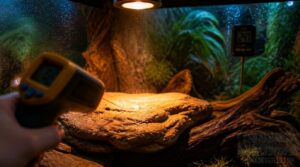
Air temperature only tells half the story. Basking spots and hide surfaces can run hotter than the air around them, so they need their own check. Here’s how to measure those surfaces the right way.
Use an Infrared Thermometer
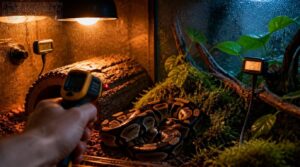
Why trust a probe alone when heat lamps create hot spots probes can’t reach? An infrared thermometer gives instant surface readings on basking sites.
- Feel confident your snake won’t get burned
- Catch dangerous hotspots before they cause harm
- Trust readings you’ve calibrated yourself
Set correct emissivity, keep a steady distance-to-spot ratio, clean the lens often, and calibrate against a trusted thermometer for accurate temperature verification.
Check Substrate Surface Temperatures
Air readings only tell half the story. Your snake presses its belly against the substrate, so substrate surface temperature matters most for hot spot detection.
Aim for 28-32°C baseline, with basking spots at 32-35°C. Check several points for consistent thermal gradient verification. Uneven readings mean your heating setup needs adjusting.
Measure Inside Heated Hides
Substrate readings cover open floor space, but what about inside the hide itself? Hide interior temperature needs its own check, since heated hides trap warmth differently.
- Use a probe reaching the interior without disturbing your snake
- Aim for 90-95°F, adjusting for species tolerance range
- Check near the opening for probe placement accuracy
- Compare against room readings for gradient verification
- Run monthly calibration checks to catch sensor drift
Prevent Belly Burns
Belly burns happen fast when heat sources sit too close to your snake’s skin. Keep a substrate heat barrier of 1-2 inches over heat mats, and check that surface temps stay under 95°F.
During feeding time, watch temperatures closely since digestion raises contact risk. Weekly checks on basking sites and heating elements catch hot spots before they cause harm.
Compare Surface and Air Readings
Since surface heat retention differs from air readings, you need both numbers. Air responds fast to vents or heaters, while surfaces hold warmth longer for accurate burn risk assessment.
Make sure the surface is clean and dry, then press thermometer firmly for a true reading. This dual approach helps with full thermal gradient mapping across your enclosure.
Choose The Right Thermometer Types
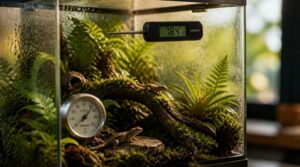
Not every thermometer works the same way, and that matters more than you’d think. Some give you a quick glance, while others track patterns over time. Here’s what to look for before you buy.
Digital Versus Analog Models
Picking a digital thermometer over an analog one comes down to accuracy and convenience. Digital units read within 0.5°C and often log data over time.
Analog dial gauges need manual calibration and give no history at all. For real temperature control, digital models with alarms and battery power beat old-style dials every time.
Remote Probe Thermometers
Want to check two zones without moving a sensor back and forth? A remote probe thermometer solves that. It keeps a display outside the enclosure while thin wires run to probes inside.
Place probes horizontally, away from lamps and water bowls, for accurate readings. Many models support multiple probes at once, so you can monitor warm and cool sides simultaneously from one unit.
Minimum and Maximum Memory
Your thermometer’s minmax memory quietly tracks the coldest and warmest points during logging, catching overnight dips or midday spikes you’d otherwise miss.
- Minimum memory guards essential readings from data loss
- Maximum memory sets your storage limits before overwriting
- Memory resolution affects how precisely gradients show up
- Data retention determines your backup frequency needs
- Circular buffers cycle old temperature logging automatically
Smart Sensors and Data Loggers
Basic thermometers only show you the moment. A data logger stores readings over time using onboard memory, so you can spot trends without watching constantly.
Wireless sensor networks add remote probes that send data to a central hub, cutting cable clutter. Good models improve battery life with sleep modes and offer software for graphing and CSV exports, so you catch patterns fast.
Reliable Alarm Features
A data logger tells you what happened. An alarm tells you right now, which matters more when temps spike fast.
Look for alert timing under 2 seconds and push notifications within 1.5 seconds. Audible alarms near 85 decibels cover 20 meters. Battery backup should run 12+ hours. Check MIN/MAX and reset buttons, plus sensor location details on each alert.
Add Humidity Monitoring When Needed

Temperature isn’t the only thing your snake needs you to track. Humidity plays a big role in shedding, breathing, and overall health, so it deserves its own attention. Here’s what to know about monitoring moisture levels the right way.
Combination Thermo-hygrometer Units
Since your snake needs both readings, a combination thermohygrometer saves space and hassle. These units track temperature and humidity together, with dual-unit display (C/F) for convenience.
Look for accuracy calibration options, remote sensor capability, and memory functions to log daily swings. An LCD readability feature makes checking your terrarium quick, even in dim lighting.
Warm-side Humidity Readings
Your combo unit earns its keep on the warm side. Aim for 60 to 80 percent humidity near the warm hide, since heat speeds up moisture loss. Check hygrometer placement at eye level, matching your snake’s breathing zone.
Don’t let readings creep past 90 percent, that invites mold and respiratory trouble while still supporting healthy shedding.
Cool-side Humidity Readings
Flip to the cool end, and humidity often climbs higher near the floor where damp air pools.
Keep hygrometer placement two to four inches above substrate, away from water bowls and vents. A reading above 60 percent signals good ground moisture, supporting substrate health without inviting mold or bacterial growth.
Humid Hide Monitoring
Your snake’s humid hide needs its own hygrometer, separate from your warm and cool side readings. Place the sensor at snake eye level, since that’s where moisture level tracking matters most for shedding humidity support.
Check substrate dampness by hand too. Damp, not soggy, substrate combined with proper hide ventilation needs prevents mold while keeping humidity steady inside the terrarium.
Species-specific Humidity Ranges
What humidity range does your snake actually need? It depends entirely on species.
- Desert snakes: 20-40%, brief peaks to 50%
- Arboreal species: 60-80% during active periods
- Tropical juveniles: 70-90% for proper development
- Hatchlings: higher moisture than adults for shedding
Match your terrarium setup to these ranges for healthy shedding and respiratory health.
Check Thermometer Accuracy Regularly
Even good thermometers drift out of accuracy over time. Since your snake’s safety depends on correct readings, you can’t just trust the numbers blindly. Here’s how to keep your devices honest.
Compare Readings Between Devices
Two thermometers rarely agree perfectly, and that’s normal. Expect a reading divergence of 2 to 3°F in most setups. Always check both at the same moment, since simultaneous measurement timing prevents false readings from temperature drift.
If your dual device comparison shows a gap beyond that range, it’s time for a sensor calibration check.
Test Against Trusted Equipment
How do you know your digital reptile thermometer is telling the truth? Calibrate against a reference thermometer with a known, certified accuracy first.
Verify probe response by timing how fast it settles, aiming for 30 seconds or less. Record multiple spots, then document calibration certificates for every device you trust.
Replace Unreliable Sensors
A drifting sensor is a silent threat, it can read fine for weeks, then quietly mislead you.
Replace any probe once readings stray past 0.5°C accuracy. Swap it out fast:
- Order a validated replacement
- Calibrate before install
- Confirm probe placement accuracy
- Test remote probe monitoring
- Log the swap date
Keep a spare digital reptile thermometer ready. Sensor drift prevention starts with never waiting.
Clean Probes Safely
A dirty probe can throw off readings without ever showing a warning sign.
Wipe away dust with a soft cloth first, then use a 70% isopropyl alcohol solution, never ammonia based cleaners.
Power off the unit, hold the base (not the tip), and let it air dry fully.
Recalibrate after cleaning, then store it in a protective case.
Inspect Batteries and Displays
A clean probe won’t help if the battery is failing. Check the case for corrosion, then confirm terminal contact is tight.
If readings still seem off after that, this guide to choosing a reliable home digital thermometer can help you spot other quirks before assuming the unit itself is broken.
Test voltage with a multimeter against the rated output for AG10 or LR1130 cells. Weak power skews the display and can wipe out memory function settings, so replace batteries and reset the unit right away.
Use Readings to Adjust Temperatures
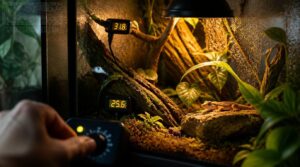
Numbers on a screen only matter if you act on them. Your thermometer readings should guide real changes to heating and equipment, not just sit there. Here’s how to turn those readings into a terrarium that stays right on target.
Adjust Heating Equipment Gradually
Never crank the heat all at once. Use incremental heat adjustments instead: raise the warm side 1-2°F every 24 hours, spacing changes 4-6 hours apart.
- Adjust heat lamps slowly
- Recheck thermometer placement after each change
- Watch for stress signs
This slow warm-up process protects your snake’s gradient, temperature stability, and humidity balance.
Monitor Daytime Temperature Changes
Once your heat lamps settle, watch daytime swings closely. Peak temps often hit mid-afternoon, so log readings every few hours to catch thermal stability shifts early. A slow sensor response time can mask real changes.
| Time | Warm Side (°C) |
|---|---|
| 9 AM | 29 |
| 12 PM | 32 |
| 3 PM | 34 |
| 6 PM | 30 |
Check Overnight Temperature Drops
Once lights go out, the real test begins. Your terrarium can lose 8 to 20°F within hours, with the steepest overnight temperature drop hitting in the first 2 to 4 hours.
Check MIN readings each morning. Since the warm side cools slower than the cool side, watch both to confirm your gradient still holds through the night.
Prevent Overheating and Underheating
Two dangers threaten your snake every single day: overheating and undercooling. Set up temperature fluctuation alerts so your controller flags swings before they become emergencies.
- Adjust heat mat regulation gradually, never in sudden jumps
- Run nighttime cooling checks alongside gradient stability monitoring
- Watch for thermal bias in placement near lamps or drafts
A steady sensor calibration routine keeps both temperature and humidity readings trustworthy.
Review Minimum and Maximum Readings
Your MINMAX button reveals the full daily temperature range in seconds. Check it each morning for the 24-hour extremes on both sides.
Compare results against species safety limits to catch abnormal spikes early. With dual thermometer placement and a remote sensor, minimum maximum temperature tracking becomes simple, consistent care documentation that actually protects your snake.
Frequently Asked Questions (FAQs)
Where to put a thermometer in a terrarium?
For single thermometer placement, set it centrally at snake level, away from drafts, water bowls, and direct heat. Keep it horizontal on the substrate. With dual setups, add one near the warm hide for gradient accuracy.
How hot is too hot for a terrarium?
Above 105°F (41°C), skin and mucous membranes risk thermal burns. Basking spots over 100°F for hours cause activity decline. Watch for heat stress signs like restlessness or refusal to eat near incandescent bulbs.
Should a terrarium be warm or cold?
Neither, really. Your snake needs both. A warm zone near 28 to 32°C and a cool zone around 22 to 26°C let it thermoregulate naturally, since that gradient mimics its preferred optimum temperature range in the wild.
How to control temperature in a terrarium?
Control comes down to a thermostat-regulated heat source, right wattage for your enclosure, and a proper heat gradient. Balance humidity through substrate and airflow, then confirm results with careful thermometer placement matching your species’ specific climate needs.
How often should terrarium thermometers be calibrated?
Calibrate terrarium thermometers on an annual calibration schedule using an ISO 17025 vendor. Track any correction factor, run a point-check verification, and remove faulty units to keep temperature and humidity readings trustworthy.
Can smartphone apps replace physical thermometers accurately?
It might seem convenient, but no. Phone sensors lack proper sensor calibration and suffer from environmental interference, so accuracy stays poor. Stick with physical thermometers built for enclosure conditions, not medical-use apps meant for skin readings.
Whats the average cost of a reliable thermometer?
Reliable digital thermometers for terrariums usually run $15 to $25, factoring in min/max memory and accuracy within ±1°C. Check sensor type, battery life, and warranty length. Cheaper models near $6 often sacrifice precision your reptile’s temperature and humidity needs.
How quickly should readings update after adjustments?
Patience pays off here. Warm side lag runs 1 to 3 minutes; cool side delay stretches 2 to Give the full gradient stabilization and verification window, about 10 minutes, before trusting any new reading.
Conclusion
Picture your terrarium as two rooms in one house, a sauna and a shaded porch, joined by a hallway your reptile walks daily. Without a thermometer in each room, you’re guessing which door to open.
So how many thermometers does a terrarium need? Enough to see both rooms clearly, sometimes three for larger homes.
Trust the numbers, not your hand. That habit turns guesswork into a gradient your reptile can trust.